



By Lianna Spurrier for CoinWeek …..
Josh Tatum and the 1883 Racketeer Nickel: Fact or Myth?
The 1883 Liberty Head Nickel created one of the most famous stories in American numismatics.
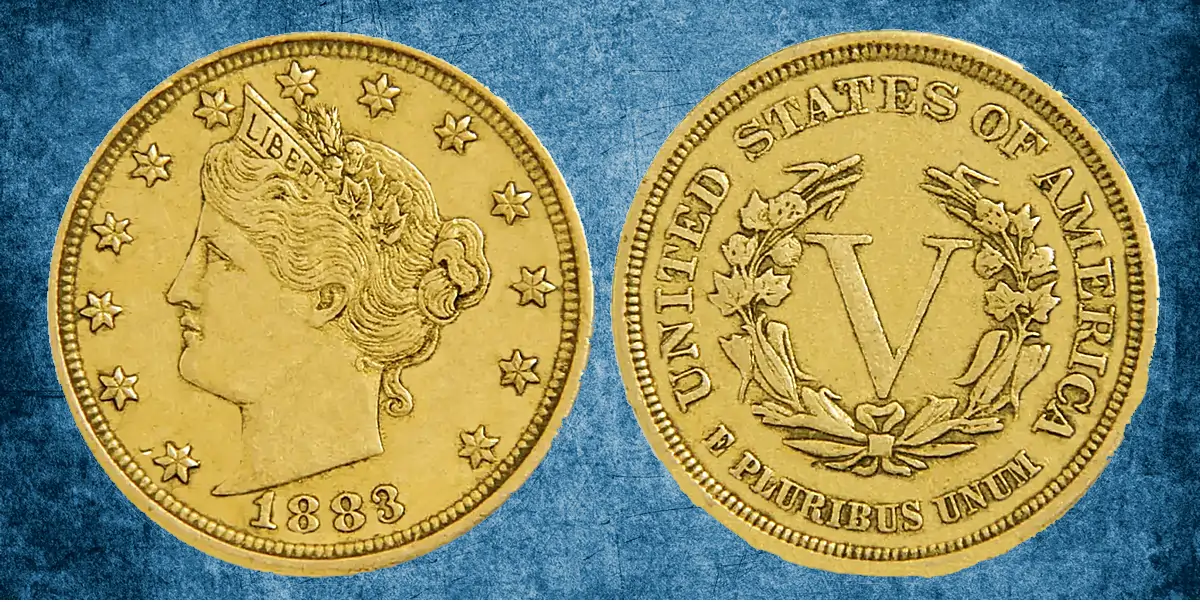
Collectors know the coin as the “V” Nickel. Its reverse carried a large Roman numeral V for five. However, the first design did not include the word “CENTS.” That small omission soon caused a large problem.
At the time, the United States also used three-cent pieces that showed only a Roman numeral III. Those coins did not spell out “cents” either. So, at first, the new nickel’s design followed an existing idea.
Still, the 1883 Liberty Head Nickel looked just enough like a $5 gold piece to invite fraud. That is where the Josh Tatum legend begins.
The Josh Tatum Story
According to the familiar story, Josh Tatum lived in Boston. The tale describes him as deaf and mute.
After the new nickel appeared on February 1, 1883, Tatum saw an opportunity. He allegedly asked a pawnbroker and second-hand jeweler to gold-plate 1,000 new nickels.
The plan was simple. The plated nickels looked enough like $5 gold pieces to fool busy shopkeepers. As a result, Tatum could pass a five-cent coin as gold.
The story says he visited small stores and bought a five-cent cigar. Then, he placed one gold-plated nickel on the counter. The clerk assumed the coin was a $5 gold piece and gave him $4.95 in change.
Soon, Tatum allegedly had more nickels plated. Then he moved from Boston toward New York. According to the legend, he made about $15,000 before authorities arrested him.
Did the Courts Convict Josh Tatum?
The legend gives Tatum an unusual legal escape.
Storeowners reportedly took him to court. Yet the court did not convict him. Why? According to the story, Tatum never asked for change. He also never said he had given anyone a $5 coin.
Therefore, the clerks made the assumption themselves.
The story also claims that a law soon followed to stop the defacement of U.S. coins, including gold-plating. Today, federal law does prohibit fraudulent alteration, defacement, mutilation, falsification, or passing of altered U.S. coins.
However, the Tatum courtroom story remains difficult to prove.
Why the “No Cents” Nickel Caused Trouble
The problem began almost immediately.
The original 1883 Liberty Head Nickel appeared without “CENTS” on the reverse. PCGS identifies the design as the first Liberty Nickel type and notes that early pieces lacked the words “Five Cents.”
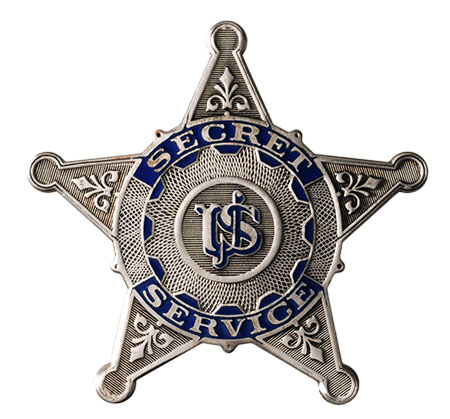
By February 11, 1883, newspapers had already warned readers. A Washington, D.C., dispatch quoted Secret Service Chief Brooks, who considered the new nickels dangerous. He warned that a thin layer of gold could help fraudsters pass them as new gold coins.
Then, on February 12, reports said gold-washed nickels had already appeared in Washington, D.C. Those coins could deceive people who did not know the new design.
So, the issue was not theoretical. It had already reached circulation.
Reports Spread Across the Country
The trouble did not stop in Washington.
More reports appeared in newspapers. In response, editors advised citizens to inspect their change. Some newspapers also described the differences between the nickel and the $5 gold piece.
By February 15, the Treasury Department had discussed whether it needed to withdraw the new nickels. However, officials did not act immediately.
At first, several government officials resisted a change. Treasury Secretary Charles Folger did not see an immediate need to alter the design.
Meanwhile, the plating continued.
On February 23, the Statesville Landmark of North Carolina reported that people in the North had gilded the new coin and passed it as a $5 gold piece.
The Mint Adds “CENTS”
Eventually, Folger accepted the need for a design change.
Still, A. Loudon Snowden, Director of the Philadelphia Mint, opposed the revision. He went to Washington, D.C., and made his case.
Snowden pointed to the silver three-cent piece. That coin used a Roman numeral for its denomination. It did not say “cents.” Also, people had not plated it and passed it as a $2.50 gold coin.
The argument failed.
After several weeks of debate, work began on new reverse dies by March 11. The revised design added “CENTS” to the reverse.
PCGS also notes that Mint officials moved quickly to fix the “No Cents” problem, and Charles E. Barber revised the reverse to include the word “CENTS.”
Was Gold-Plating the Reason for the Change?
Yes.
The record strongly supports that conclusion. Gold-plated 1883 nickels caused the government to change the design.
By early April 1883, arrests had occurred across the country. Reports named places such as California, St. Louis, Louisiana, Nashville, and Boston.
Therefore, the fraud was not the work of one person in one city. Many people took advantage of the design.
Did Josh Tatum Really Exist?
That question remains open.
Very few names appeared in contemporary reports about the plated nickels. Newspapers named G.F. McCord, also called “Mack,” in Morgan City, Louisiana. They also named two St. Louis suspects as John Williamson and William Williams.
Another figure, William C. Woodward, received more attention. Reports described him as an alleged accomplice of the St. Louis pair. He also ran from police when officers first found him.
So far, no known 1883 record names Josh Tatum.
That matters. The first gold-plated nickels that drew government attention appeared in Washington, D.C. Yet the Tatum legend places him in Boston. Therefore, even if Tatum existed, the evidence does not support him as the original mastermind.
When Did the Josh Tatum Story First Appear?
For years, many writers traced the first printed Josh Tatum story to Lynn Glaser’s 1968 book Counterfeiting in America. Others pointed to a 1965 article in the Independent Press-Telegram of Long Beach, California.
The original CoinWeek research found an earlier reference. On December 14, 1958, The Southwest Times of Pulaski, Virginia, published “Miss Long Tells Story for Group.” The article said Miss Willie Long told the Josh Tatum story at a Southwest Numismatic Society meeting at the YMCA.
That 1958 version already included many familiar details. It said Tatum was deaf and mute. It also described how much he supposedly made and how he spent the plated coins.
However, later research pushed the printed trail back even further. In 2022, The E-Sylum reported earlier Tatum references from 1955, including a May 1, 1955 article in The Wichita Eagle and a May 22, 1955 article in the Dayton Daily News. Even so, that research still did not identify an original 1883 source for Tatum.
The Verdict on Josh Tatum and the Racketeer Nickel
So, what can collectors say with confidence?
First, 1883 “No Cents” Liberty Head Nickels were gold-plated. Fraudsters did pass some as $5 gold pieces. The evidence supports that fact.
Second, the fraud pushed the government to change the design. Officials resisted at first. Then the problem grew too large to ignore.
Third, Josh Tatum remains unproven. The story may preserve a real event, a real person, or a mix of several swindlers. However, no known 1883 record ties Tatum to the plated nickels.
That uncertainty does not weaken the story of the 1883 Racketeer Nickel. Instead, it makes the coin more fascinating.
The “No Cents” Liberty Head Nickel stands at the crossroads of design, public trust, and American folklore. It reminds collectors that even a small missing word can change numismatic history.




i am a fairly adept genealogist. I researched the 1880 census. I found NO Josh, nor any other Tatum living in Massachusetts in 1880. I have always enjoyed the story, but never thought to verify it. I know this is not conclusive, but interesting none the less.
I always believed that the stories were exaggerated due to the press penchant for embellishing the news. Where are all the first hand accounts?
I recall reading somewhere that Josh Tatum’s antics provided us with the idiom, “you wouldn’t be joshing me now, would you”?
Weren’t the edges also reeded to aid in passing them as gold pieces?
I have always wondered if Tatum was up in up.
Very interesting
Really interesting story indeed.
Always found this story fascinating
Interesting to know that several individuals across the country all had the same idea.
Like DB Cooper – he up and disappeared
That’s quite a tale! I would imagine finding an actual racketeer nickel and having it graded and slabbed would be a goldmine in valuation for yourself. Bad pun, I’ll see myself out. :-P
Doesn’t seem likely that the US Mint resisted the adding of “Cents” to the coin when it was so easy to pass off as the $5 gold.
So much info.
I didn’t know the story behind the 1883. I have 4 of them, 2 of each type. Very interesting story!!!
fascinating
Interesting article.
Story makes for interesting reading, but I believe is fiction at best. No doubt some fraudsters did gold plate a few of the nickles and pass them off as $5 gold pieces, I doubt it was rampant at best.
A great article by Lianna Spurrier! I have always found racketeer nickels interesting and have sought to add an authentic one to my collection. One complicating factor is that some people have plated V nickels to pass them as authentic racketeer nickels, which is ironic.
What a fascinating story! Even if not true, it sure makes for good reading!
Interesting story. I wish I knew more about the history of coins.
Very interesting. The article doesn’t mention if any of the gold plated ones still exist or if so how many.
Josh Tatum is, to me, an old story. However as the article shows there doesn’t seem to be any contemporary account. Additionally I would think Boston court records would have info on this even that far back.
I once had a gold-plated V Nickel. I don’t know if it was an original “racketeer” nickel or if it was a later “forgery” of the original forgery. Still, it’s an interesting footnote in the history of coinage in this nation.
Very interesting article.
i enjoy this kind of stuff.
I never know this happen nice to learn something new. nice article.
thank you
Things that people think of and will do to cheat the system.
Did Tatum, or anyone, ever make these counterfeits with a reeded edge?