The Colosseo Collection
Ancient Greek Coins – By Russell A. Augustin, AU Capital Management, LLC
Opus stood as a small, infertile territory on the coast of mainland Greece. Larger and more powerful states surrounded it. Even so, its people, the Lokrians, produced a beautiful and extensive series of ancient Greek coins. Although the Lokrians made only a modest impact on history, their coinage tells a much richer story.
A Small State with a Striking Coinage
Mercenaries returned home after the Peace of Antalkidas in 387 BCE. They brought considerable amounts of silver with them. Those Syracusian coins formed their pay. As a result, they gave their home city both the bullion and the artistic models for new coinage.
At the same time, Lokris likely needed fresh coin production for another reason. The region faced continual conflict with neighboring Phokis during the Third Sacred War. Therefore, Lokris may have struck new coins to meet military expenses.
The Obverse Portrait: Demeter or Another Figure?
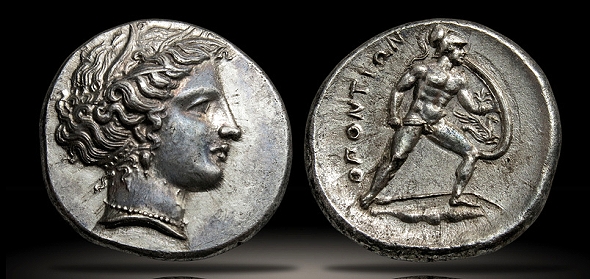
Scholars continue to debate the identity of the figure on the obverse. However, one point remains clear. The design draws direct inspiration from the Syracusan Arethusa heads of Euainetos.
For this particular variety, most specialists identify the portrait as Demeter. In Greek mythology, Demeter stands as the mother of Persephone. That attribution fits the style and the broader artistic tradition behind the type.
The Reverse: Ajax the Lesser in Action
The reverse depicts the hero Ajax the Lesser, the commander of the Lokrians in the Trojan War. This design gives the coin much of its historical and mythological force.
Most notably, Ajax carries a shield with decoration on the inside. That feature stands out immediately. A few sculptural parallels exist, yet ancient Greek coins rarely show this attribute. For that reason, the reverse remains especially remarkable.
Ajax the Lesser in Homer’s Iliad
Ajax the Lesser plays an essential role in Homer’s Iliad. He often fought beside his namesake, Ajax the Great. In addition, he led a strong Lokrian contingent of 40 ships to Troy.
Homer describes him as small and nimble. He also excelled as a javelin thrower. Because of these qualities, the Greeks counted him among their heroes.
However, Ajax also showed arrogance and conceit. That flaw shaped his fate. In the end, the gods themselves brought about his death.
Cassandra, Athena, and the Punishment of Ajax
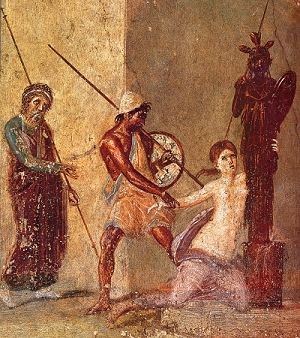
After the Greeks captured Troy, Cassandra, the daughter of the king, fled to the Temple of Athena. She sought the goddess’s protection there.
Ajax the Lesser found her. Then he committed an act that violated one of the core principles of ancient religion. He dragged Cassandra from the temple. In the process, he also toppled the statue.
That outrage brought divine punishment. During the Greek return voyage, Athena sent a great storm against the fleet. The storm scattered the ships. Athena then struck Ajax’s own ship with a thunderbolt and sank it.
Even then, Ajax survived. He clung to a rock and escaped immediate death. Yet he then boasted that he had withstood the wrath of the gods. Poseidon heard that proud claim. In response, he split the rock with his trident. Ajax fell into the sea and drowned.
The rest of the Opuntians made it home with difficulty. Still, they arrived largely unscathed.
The Lokrians’ Enduring Faith in Their Hero
Despite Ajax’s arrogance, the Lokrians kept deep faith in their national hero. Whenever their army prepared for battle, they left one place open for Ajax. They believed his spirit would stand and fight beside them.
Moreover, they honored his memory every year. They launched a ship fitted with black sails and loaded it with gifts. Then they set the vessel alight.
That ritual reveals how powerfully Ajax remained tied to Lokrian identity. Even after myth cast him as a cautionary figure, his people still revered him as their champion.
The Coin Itself
Lokris, Lokri Opuntii. Silver Stater (12.0 g), ca. 350-340 BCE.
Head of Demeter right, wearing wreath of grain ears, single-pendant earring, and necklace.
Reverse: Ajax advancing right, holding sword and shield; on inside of shield, palmette and griffin springing right; on ground below, broken spear.
References: BCD Lokris-Phokis 457.4 (this coin); Nanteuil 885 (same obv. die).
The coin shows lustrous surfaces and a strong strike in high relief. It also preserves excellent detail. As a result, it ranks as Superb Extremely Fine and stands among the finest known examples.
Provenance: Ex BCD Collection (NAC, 8 October 2010), 457.4.