Discover why the 1870-CC double eagle became a major rarity
This feature expands on CoinWeek’s 1870-CC Liberty Head Double Eagle collector’s guide. The original article remains available as a companion reference.
The 1870-CC double eagle began with a mint short of ready money. In 1870, Carson City lacked a fund to pay bullion depositors promptly. Consequently, business suffered before the branch had completed its first year.
From those difficult beginnings came a celebrated American gold rarity. The mint produced just 3,789 double eagles, and no accepted Mint State example is known today. In November 2021, a circulated specimen brought $1.62 million. More recently, another sold for $341,600 in September 2026.
A Gold Mint Without Ready Money
The Comstock Lode helped make the case for a federal mint in Nevada. Congress authorized the branch in 1863. Abraham “Abe” Curry promoted Carson City, supervised construction, and became its first superintendent. On January 8, 1870, the branch opened to receive bullion.
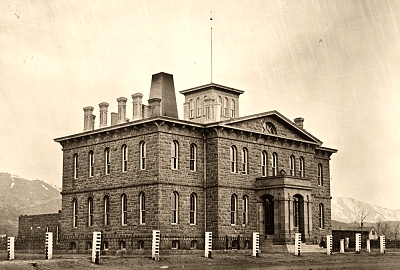
Yet proximity to rich mines did not guarantee a steady stream of deposits. The government had not supplied a bullion fund. Such a fund would let the mint pay depositors after determining their metal’s value. Without it, customers could face a wait while the mint processed their bullion.
The Mint’s 1870 annual report described the consequences. Payment delays discouraged business. Small batches also increased the work of remelting and reassaying metal. The branch therefore faced both limited deposits and inefficient processing.
Heritage’s historical accounts explain that some miners continued sending bullion to San Francisco, where prompt payment offered an advantage. That practical problem helps explain the small output of Carson City’s first twenties. The mint needed working funds as well as precious metal.
Five Production Months Yielded 3789 Coins
The 1870-CC double eagle followed the silver dollar, eagle, and half eagle into Carson City production. Specialist accounts place the first delivery of twenties on March 10, 1870.
Rusty Goe’s figures, reproduced in recent auction catalogs, record deliveries in five months. The totals are March, 1,332 coins; April, 398; May, 1,137; June, 462; and August, 460. Together, they total 3,789.
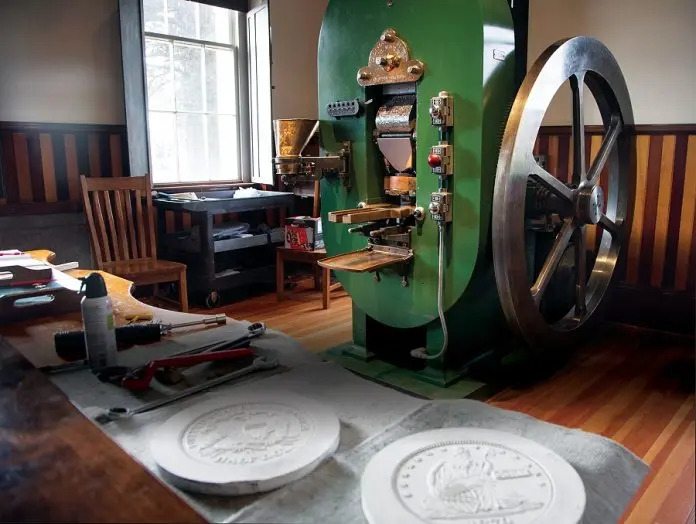
The original Mint report supplies a useful cross-check. It records 3,329 double eagles through June 30, worth $66,580. Those figures agree with the first four monthly totals. Adding August’s 460 coins yields the accepted annual mintage.
This was the smallest annual output of double eagles at Carson City. More than a century later, the 1870-CC remains the rarest circulation issue of the Type 2 Liberty Head double eagle. That type spans 1866 through 1876.
Why No Mint State Example Is Known
Low mintage explains only part of the rarity. These coins entered commerce when few collectors pursued complete sets of branch-mint double eagles. Setting aside a long run of $20 gold pieces also required substantial money. Consequently, circulation and attrition reduced an already small issue.
However, estimates of 1870-CC double eagle survival still vary. PCGS CoinFacts lists 41 examples. Rusty Goe’s estimate, quoted by Stack’s Bowers, runs from 55 to 65 in all conditions. Neither figure represents a complete, individually verified census.
Certification totals require similar care. For example, the same coin can return for grading or move between services. As a result, the number of certification records can exceed the number of individual coins. Heritage explicitly notes that problem in its 2025 census discussion.
Nevertheless, the sources agree on a central point: no accepted Mint State 1870-CC double eagle is known. Even well-preserved survivors show wear. Therefore, an attractive Extremely Fine coin can rank as a major collection prize.

Two Die Pairings and a Request for More Dies
Current specialist catalogs identify two die marriages for the 1870-CC double eagle: Winter 1-A and Winter 2-B. Their date and mintmark positions differ. On 1-A, the date sits higher and the CC lies farther right than on 2-B.
Jeff Ambio’s description places the first C of 1-A above the right edge of the N in TWENTY. The second C sits above the left flag of the following T. Ambio also identifies 1-A as the more frequently encountered pairing, although other catalogs describe their availability differently.
Heritage also reproduces a revealing request from Curry to Mint Director James Pollock. On May 4, 1870, Curry asked for two additional obverse dies for double eagles. The request documents his wish for more dies. It does not establish why he wanted them.
Many survivors show weak obverse stars and uneven detail. However, weak striking and circulation wear are different conditions. Likewise, numerous marks on one specimen cannot establish the appearance of every surviving coin.
A Treasure Tale That Needs a Label
The 1870-CC double eagle also carries an elaborate lost-gold story. In November 2000, PCGS published an essay by Michelle Elizabeth Frazer. It won third place in the company’s essay contest. Frazer linked the tale to a distant family connection.
Her account describes 3,600 deficient double eagles, a concealed cache, and a theft scheme involving Curry’s successor, Henry F. Rice. False-bottom trunks and unreliable accomplices add to the adventure. However, the essay does not provide verifiable evidence that establishes the alleged theft as historical fact.
Charles Morgan and Hubert Walker examined that claim in CoinWeek’s original guide. They reported that researcher Roger Burdette regarded Frazer’s account as fiction.
Rice did succeed Curry and had worked as a Wells Fargo agent. His actual service at the mint does not validate the treasure story. Therefore, the recorded mintage remains 3,789; an unsupported narrative cannot expand it.
The Theft That Heritage Actually Reported
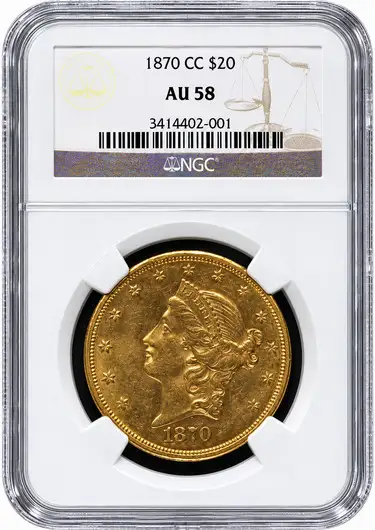
A much later disappearance has contemporary documentation. Heritage reported that an 1870-CC double eagle vanished from a Brink’s shipment sent from PCGS on October 17, 2011. The coin carried an NGC AU58 grade and certification number 3414402-001. Heritage described it as a recent discovery and the finest known example.
Initially, the firm had planned to offer it in its January 2012 FUN auction. Instead, the archived January 4 listing for lot 3000 records “Not Sold” and identifies the coin as stolen. The page continues to display a $100,000 reward for its safe return.
Later specialist catalogs continue to describe the coin’s whereabouts as unknown. Its disappearance also leaves an important gap in the issue’s ownership record.
The AU58 designation also needs context. It describes an About Uncirculated coin with wear. Even the missing specimen would not fill the issue’s conspicuous gap in Mint State.
Important Auction Appearances in the Past Year
Two significant, verified sales fall within November 1, 2025, through November 1, 2026. The amounts below include the buyer’s premium.
November 11, 2025 — Stack’s Bowers, November Showcase Auction, lot 3172 — PCGS XF45, certification 21874047 — $408,000. The catalog identified the consignor as a Texas Gentleman.
September 2, 2026 — Heritage, ANA U.S. Coins Signature Auction, lot 3744 — NGC XF40, Winter 1-A — $341,600. The coin came from the Reno-Carson City Collection.
The 2026 coin offers a useful reminder about surface quality. For example, Heritage described light, even wear and orange-gold surfaces, with no large distracting abrasions. The example shows why each survivor needs an individual assessment.
One additional sale provides recent context, although it falls outside that twelve-month window. On August 27, 2025, Stack’s Bowers sold the Great Pacific Collection’s PCGS AU50, CMQ example for $720,000. It appeared as lot 3386.
These are different coins. Their prices document individual transactions; they do not, by themselves, establish a rising or falling market.
The 1870 CC Double Eagle Auction Record
The 1870-CC double eagle auction record belongs to the Prestwick specimen, graded PCGS AU53. Heritage sold it on November 11, 2021, as lot 3699 for $1,620,000. Earlier appearances brought $368,000 in January 2004 and $411,250 in March 2014.
By comparison, the Carter–Richards PCGS AU55 sold for $1,440,000 at Stack’s Bowers on November 19, 2024. Although its numerical grade was higher, its auction total was lower. A grade alone cannot explain the outcome of two separate auctions.
The Fairmont–Hendricks coin makes the point another way. Stack’s Bowers sold that PCGS XF45 with CAC approval for $810,000 in April 2022. Meanwhile, the Mississippi Collection’s NGC AU53 realized $588,000 at Heritage in February 2025.
As a result, collectors need to examine strike, surfaces, appearance, and provenance alongside the holder’s grade. Auction timing and competition also vary. The record price belongs to a particular coin on a particular day; it is not a standing offer for every 1870-CC.
Donald E. Bently owned two examples that Heritage sold in 2014. One later became the Prestwick record setter. The other, a PCGS AU50, brought $305,500 that April. Even within a single collection, these survivors followed different paths.
The Families Behind Two Survivors
Some auction histories preserve more than ownership names. For example, Heritage’s January 2010 catalog describes a specimen from a family in Germany’s Rheinland-Pfalz region. According to that account, a grandfather visiting America wanted an Old West coin among the double eagles he brought home.
The coin remained in furniture for nearly a century before his grandson brought it to the auction firm. Heritage sold it as PCGS XF45 for $230,000.
Another coin traveled through five generations. Heritage’s October 2021 catalog traced it to Hirum Murdock in the 1870s. Later owners included Lois Murdock Whiting, Raymond Arthur Whiting, Biloine Whiting Young, and Scott Thomas Young. A family history accompanied the offering. That PCGS XF40 sold for $360,000.
Longacre Design and the Small CC Mintmark

James Barton Longacre designed both sides. Liberty faces left, with curled hair and a beaded coronet bearing LIBERTY. Thirteen six-pointed stars surround the portrait, while the date sits below. NGC’s series history identifies the ancient Crouching Venus sculpture as the model for Longacre’s portrait.
On the reverse, a shield covers the eagle’s breast. Its wings spread outward. The right talon holds an olive branch; the left holds three arrows. The bird faces its own right and grasps an extension of the viewer’s left scroll in its beak.
The two elaborate scrolls carry E PLURIBUS at the viewer’s left and UNUM at the right. Some numismatic references interpret the paired scrolls as a reference to the double-eagle denomination.
Above the eagle, thirteen stars form an oval around IN GOD WE TRUST. Seven upper stars overlap the rays; six lower stars occupy the clear field. UNITED STATES OF AMERICA follows the upper border, and TWENTY D. identifies the denomination below. The CC mintmark sits beneath the eagle. Denticles frame both designs.
Thus, the motto and abbreviated denomination identify the Type 2 design. In 1877, the reverse changed to spell out TWENTY DOLLARS. That later form belongs to Type 3.
Specifications

- Date: 1870
- Denomination: $20 Double Eagle
- Mint: Carson City Mint
- Mintmark: CC
- Mintage: 3,789
- Strike: circulation strike.
- Composition: 90% gold and 10% copper.
- Standard weight: 516 grains, approximately 33.44 grams.
- Diameter: 34 millimeters.
- Edge: reeded.
- Gold content: approximately 0.9675 troy ounce.
- Designer: James Barton Longacre.
A Rarity Built From Ordinary Use
Jeff Garrett and Ron Guth ranked the 1870-CC double eagle number 75 in 100 Greatest U.S. Coins. That ranking appears in the fifth edition, published in 2019. Its place in the hobby rests on Carson City’s first year, a tiny output, and exceptionally limited survival.
Yet the government created these coins to move money through commerce. The worn portraits, individual marks, and documented ownership trails connect that original purpose to today’s collections. The mint’s cash problem helps explain how few emerged. The surviving coins show what happened after they left.
Auction and Pedigree Register
This register carries forward the original guide’s specimen entries, consolidates the duplicated Bellini pedigree, and adds recent offerings. Prices are published auction totals, including premiums where reported. Certificate numbers identify historical holders and do not establish a coin’s present holder or owner. A repeated appearance does not add another survivor to the census.
The Upper Grades
Missing AU58 — NGC 3414402-001. Heritage planned the coin for January 4, 2012, lot 3000. The archive records it as stolen and not sold. The documented shipment date is October 17, 2011.
Carter–Richards AU55 — PCGS 49670059, Gold Shield holder, CMQ. Stack’s offered it in the James Walter and Margaret Woolfolk Carter collections in January 1986, lot 453. Stack’s Bowers sold it in the Bernard Richards Collection on November 19, 2024, lot 3198, for $1,440,000.
Southerly AU55 — NGC. Heritage’s published census records a March 2009 Bowers and Merena sale, lot 3909, at $414,000.
Mississippi AU53 — NGC 8242853-002. Heritage, February 27, 2025, lot 3441: $588,000. The catalog names the Mississippi Collection of Double Eagles, Part II, and describes an old collection source with recent certification.
Chicago AU53 — NGC. Its published pedigree includes Heritage, September 2003, lot 8296; Goldberg, May 2010, lot 1712; and Stack’s Bowers, August 18, 2011, lot 7762. The last appearance did not produce a sale.
The Prestwick and Battle Born Coins
Nevada–Bently–Prestwick AU53 — PCGS 60110622. Published pedigrees associate it with Doug Winter, the Nevada Collection, Universal Coin and Bullion, and the Isaac Edmunds Collection. Heritage’s 2025 census records a private transaction through Universal Coin and Bullion in 1999. Bowers and Merena offered the Edmunds collection in June 2002, lot 2371. Heritage’s verified sales are January 7, 2004, lot 3129, $368,000; March 20, 2014, lot 30435, $411,250; and November 11, 2021, lot 3699, $1,620,000. The last two appearances identify Bently and Prestwick, respectively.
Wyoming–Battle Born — NGC 1826809-001. Heritage sold it as AU50 on August 14, 2006, lot 5645, for $359,375. It later appeared as AU53 in Stack’s Bowers’ Battle Born sale on August 9, 2012, lot 11039. Greg Reynolds’s contemporary CoinWeek report gives $345,000. Later rosters sometimes give $352,500; that conflicting figure should not replace the contemporary result without explanation. A series of short, roughly parallel contact marks crosses Liberty’s cheek.
About Uncirculated Survivors
Joseph Bellini–Old West AU50 — PCGS 06565379, later 47428487. Stack’s, January 1985, lot 1118; Heritage, December 4, 2014, lot 3858, $305,500; Stack’s Bowers, March 26, 2024, lot 4365, $840,000. These certificate numbers identify successive holders for the same coin.
Olivia AU50 — NGC 957276-001. Heritage, October 6, 2022, lot 3312: $630,000. Heritage catalogs it as Variety 2-B. The first four stars show little central detail. Obverse identifiers include marks at star 2 and on the chin, a curved neck mark, and a diagonal mark beside the date’s final digit. Reverse marks appear above the W in TWENTY, below the eagle’s right wing as viewed, and near AMERICA’s final A. [34]
NGC AU50 4883069-001 — Heritage, August 4, 2020, lot 4042: $312,000. The catalog identifies Variety 1-A and notes an arcing scratch through the lower left obverse stars.
Kardatzke AU50 — NGC 3264938-008. Heritage, April 23, 2015, lot 5442: $270,250. The catalog traces an earlier appearance to Dr. Jon Kardatzke’s collection, Goldberg, June 2000, lot 1756. A shallow scrape lies above Liberty’s forehead, below stars 5 and 6. Other identifiers include two small chin marks, a diagonal mark left of the ear, and reverse marks between IN and GOD. Star detail is strongest across the upper obverse. Heritage also reported a reverse die rotation of about 20 degrees and a sharper reverse strike.
Haldan–Bently AU50 — PCGS 06576255. Published pedigrees include James E. Haldan, Sotheby’s, June 1996, lot 146, and Universal Coin and Bullion. Heritage sold it from Bently’s collection on April 24, 2014, lot 5821, for $305,500. Two diagonal, roughly parallel scratches lie left of Liberty’s nose. The hair and stars 10 through 13 show weak detail. Upper-hair marks include a nearly vertical scratch beside the final letters of LIBERTY.
Allen Rowe AU50 — NGC 3531774-001. CoinWeek’s Cool Coins Episode 5 featured this coin at the 2012 Central States convention. CoinWeek’s original guide reports that Rowe acquired it with a complete set of Carson City gold. That acquisition detail remains an attributed report. This entry documents a video appearance, not an auction result.
Extremely Fine Coins at XF45
NGC XF45 3829666-001 — Heritage, December 12, 2024, lot 3145: $312,000.
Rocklin XF45 — PCGS 46870981. GreatCollections, May 14, 2023, item 1353208: $433,125. The offering belonged to the Rocklin Complete Collection of Carson City Double Eagles.
Fairmont–Hendricks XF45 — PCGS, CAC approved. Stack’s Bowers, April 6, 2022, lot 5413: $810,000. The original guide associates historical certificate 44882777 with this coin.
Cameron XF45 — NGC 3088726-004. Heritage appearances include March 2009, lot 3270; April 2014, lot 5820; and April 24, 2021, lot 5174, $384,000.
Gator Man XF45 — PCGS 34485683. Heritage, January 4, 2018, lot 5119: $300,000. The catalog identifies the Gator Man Collection and records an earlier Goldberg appearance in September 2008, lot 1292.
German family XF45 — PCGS 60199970. Heritage, January 7, 2010, lot 2251: $230,000. The catalog supplies the Rheinland-Pfalz family account discussed above. A dark mark lies left of Liberty’s mouth, with a small spot between stars 7 and 8. Roughly parallel marks cross the face. The stars, peripheral reverse legend, and parts of the scroll inscriptions show weak detail. A mark lies beside the left scroll. The CC sits above the N and adjacent gap toward T in TWENTY.
Extremely Fine Coins at XF40
Husky–Bender XF40 — PCGS 06996656, CAC approved at the later offerings. Stack’s sold it in June 2008, lot 2108, for $299,000, then in an NGC XF40 holder. Heritage sold it in The Bender Family Collection, Part I, on August 24, 2022, lot 3630, for $456,000. It returned on February 9, 2023, lot 3861, at $480,000.
Murdock–Whiting–Young XF40 — PCGS 43495179. Heritage, October 7, 2021, lot 3605: $360,000. The published family chain runs from Hirum Murdock to Lois Murdock Whiting, Raymond Arthur Whiting, Biloine Whiting Young, and Scott Thomas Young.
Selman XF40 — NGC 654780-007. Heritage, April 24, 2021, lot 5173: $360,000. The catalog names the Selman Family Collection and records an earlier Heritage appearance in January 2010, lot 2250.
Recent Additions to the Register
Great Pacific AU50 — PCGS 21728942, CMQ. Stack’s Bowers, August 27, 2025, lot 3386: $720,000. Its earlier pedigree includes the Richmond Collection, David Lawrence, July 2004, lot 2288. A depression below ST in TRUST is an as-made planchet feature, according to the catalog.
Texas Gentleman XF45 — PCGS 21874047. Stack’s Bowers, November 11, 2025, lot 3172: $408,000. The catalog notes a reverse dig at the first S in STATES.
Reno–Carson City XF40 — NGC. Heritage, September 2, 2026, lot 3744: $341,600. The auction photographs show an older NGC holder. Heritage’s certification link identifies historical number 182484-001.