


The Black Eagle Dollar That Carried Silver,and Survived the Titanic
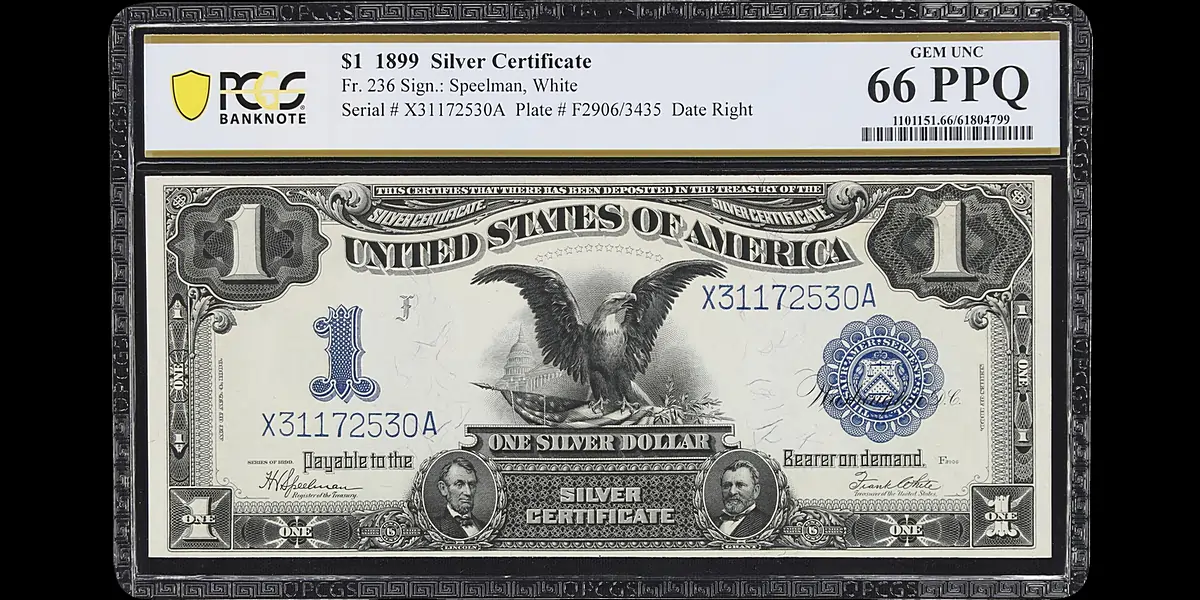
Stack’s Bowers Galleries will offer a high-grade example of one of America’s most famous banknotes on July 1, 2026. The note, listed as Lot 96070 in the firm’s Collectors Choice Online Auction of U.S. Currency, is a Fr. 236 1899 $1 Silver Certificate graded PCGS Banknote Gem Uncirculated 66 PPQ.
Collectors know this type by a better name: the Black Eagle.
That nickname fits. A huge bald eagle dominates the face of the note. Its wings stretch across an American flag. Behind it, the U.S. Capitol rises in the distance. Below the eagle, portraits of Abraham Lincoln and Ulysses S. Grant anchor the design.
Few American notes make a first impression like this one. Even fewer combine beauty, history, and collector demand so neatly.
A “Horseblanket” With Real Presence
The 1899 $1 Silver Certificate belongs to the large-size era of U.S. paper money. These notes measured about 7.375 by 3.125 inches. By comparison, modern U.S. notes measure about 6.14 by 2.61 inches.
That difference matters. A large-size note offers about 44% more surface area than a modern bill. Therefore, engravers had more room to create drama.
Collectors often call these large notes “horseblankets.” The term sounds informal, yet it captures the appeal. A Black Eagle feels substantial in hand. It looks like money from another age.
Also, the larger format gives the eagle room to dominate the composition. The result still feels bold more than 125 years later.
The Silver Question Behind the Note
The Black Eagle did not appear in a vacuum. It came from a period when Americans argued fiercely over silver, gold, and paper money.
Congress authorized silver certificates after legislation increased the purchase and coinage of silver. These certificates gave the public a more convenient way to use silver-backed money. Instead of carrying heavy silver dollars, Americans could carry paper certificates tied to silver held by the Treasury.
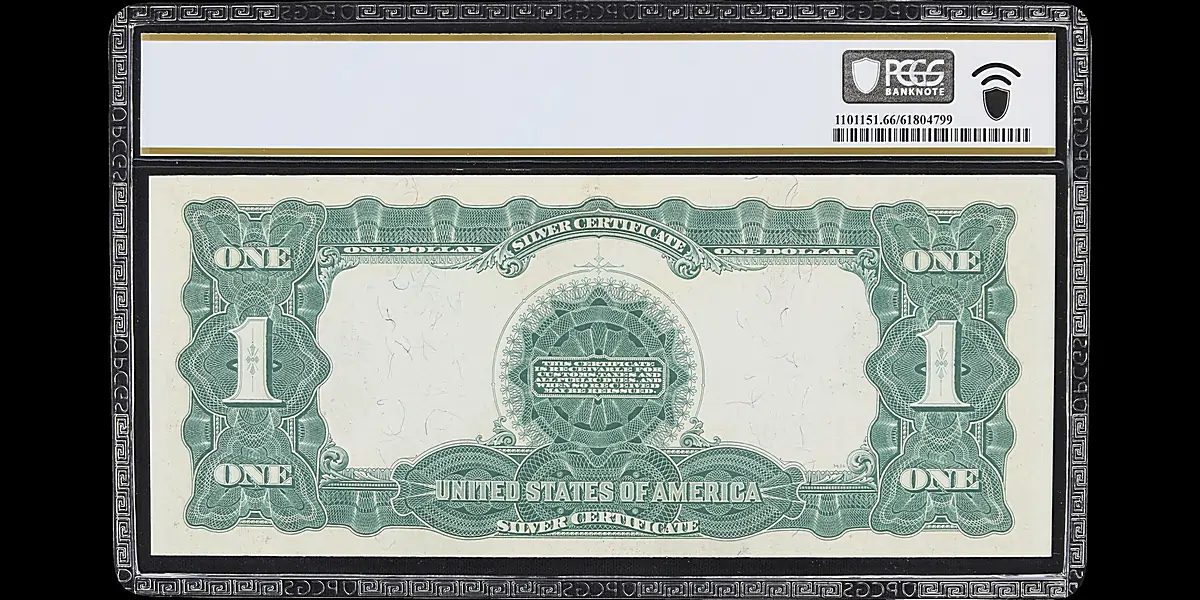
The 1899 $1 Silver Certificate states that the Treasury held “one silver dollar” payable to the bearer on demand. That promise gave the note its purpose. It also placed the Black Eagle at the center of America’s long debate over hard money and paper credit.
So, the note tells a larger story. It belongs to the era of Morgan dollars, silver politics, and a growing national economy that needed more flexible currency.
Why the Black Eagle Design Still Works
The 1899 Black Eagle replaced the earlier 1896 Educational Series $1 Silver Certificate. The Educational Series earned praise for artistry. However, the Black Eagle took a different path.
It did not rely on allegory. Instead, it used national symbols.
The eagle, flag, Capitol, Lincoln, and Grant create a powerful visual statement. The note looks patriotic, direct, and unmistakably American. It also does something rare in U.S. federal currency. It places two different presidents on the face of the same note.
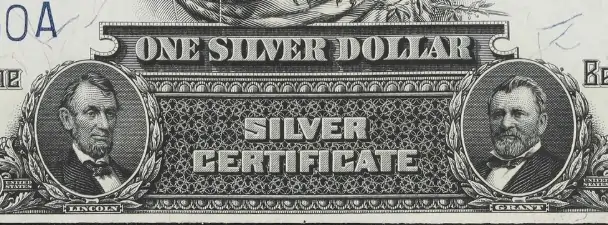
George Frederick Cumming Smillie’s engraving work gave the type its sharp detail and depth. The eagle commands the center. Lincoln appears at lower left. Grant appears at lower right. Together, the two Civil War figures frame the note’s message of Union and national authority.
That composition helped turn a common circulating note into a classic collectible.
What Fr. 236 Means
The Friedberg number identifies the exact variety. In this case, Fr. 236 refers to the Speelman-White signature combination.
Harley V. Speelman served as Register of the Treasury. Frank White served as Treasurer of the United States. Their facsimile signatures appear on Fr. 236 notes. This combination represents the final Black Eagle signature pairing in the Friedberg numbering sequence.
That matters to specialists. Signature combinations, seal style, plate details, and condition all help define value in large-size U.S. currency.
However, this Stack’s Bowers note has an even clearer selling point: preservation.
Gem Uncirculated 66 PPQ
PCGS Banknote graded this Fr. 236 as Gem Uncirculated 66 PPQ.
That grade places the note well above the typical collector example. Many Black Eagles survive, but most show folds, handling, edge wear, or paper problems. These notes entered commerce and did their job. People spent them, counted them, folded them, and carried them.
A 66 PPQ example tells a different story.
The Gem Uncirculated grade signals exceptional preservation. The PPQ designation also matters. PCGS uses PPQ for notes with premium paper quality and enough originality for the grade. In the Gem range, that originality becomes essential.
As a result, this lot does not depend on simple type demand. It offers type demand plus premium condition.
Common Type, Uncommon Quality
The Black Eagle ranks among the most collected large-size U.S. notes. It also survives in large numbers compared with many rare currency types.
That availability helps explain its broad appeal. A circulated Black Eagle can introduce a new collector to large-size currency without requiring a six-figure budget. Yet the market changes quickly at the Gem level.
High-grade notes attract type collectors, registry set builders, and specialists who want the design at its best. Strong centering, clean paper, vivid inks, and original embossing can turn a familiar type into a standout piece.
Therefore, the Stack’s Bowers Fr. 236 offers more than a famous design. It offers the Black Eagle in a grade that shows why collectors still chase this note.
The Titanic Story That Gave the Type a Second Legend
The Black Eagle also carries one of the most memorable side stories in American paper money.
An 1899 $1 Silver Certificate survived the sinking of RMS Titanic in 1912. The note belonged to August H. Weikman, a Titanic survivor. After the rescue, Weikman inscribed the back of the note and recorded that it had been in his pocket when the S.S. Carpathia pulled him from the sea.
That single note became a relic of maritime history. It also proved how far a common circulating Black Eagle could travel. One example moved from Treasury vaults, to everyday commerce, to the cold Atlantic, and then into numismatic legend.
The Stack’s Bowers Fr. 236 does not need that provenance to matter. Still, the story adds depth to the type. It reminds collectors that paper money records more than commerce. Sometimes, it records survival.
A Note Built for Collector Interest
This Black Eagle has several traits that make it stand out beyond the currency market.
First, the design grabs attention immediately. Second, the Lincoln-and-Grant pairing gives the note a Civil War connection. Third, the silver certificate format ties the piece to America’s bimetallic money debate. Finally, the Titanic survival story gives the type a human backstory that readers remember.
Final Thoughts
The Fr. 236 1899 $1 Black Eagle Silver Certificate in PCGS Banknote Gem Uncirculated 66 PPQ brings together design, history, and condition.
It comes from a time when the United States still treated silver as a central part of the money system. The note shows an eagle large enough to dominate a “horseblanket” note. It pairs Lincoln and Grant on the face. Also, it belongs to a type with one of the great survival stories in American currency collecting.
Collectors can find Black Eagles. However, they cannot always find them with this level of preservation.
That makes Lot 96070 a strong candidate for attention when Stack’s Bowers opens its July 1, 2026 U.S. Currency sale.




beautiful
Very informative article.
Absolutely beautiful, why can’t we have beautiful currency anymore?
These are very impressive notes.
I only have a few silver certificates but now y’all got me wanting to start collecting different notes
The 1899 $1 Black Eagle was the very first bank note I got when I started collecting 45 year’s ago. It was given to me by my grandma who kept it in a book to keep it in perfect condition.
I have always liked silver certificates
I love the color and design of the old saddle blanket bills. I wish the one I had was even close to the condition of this one.
First impression WOW! This banknote is a piece of Artwork! Very informative article.
I love this note, unfortunately it’s always pretty expensive in any condition. These large bills are so much more beautiful than our current currency. Can we please make more beautiful currency. And, let’s keep the new liberty dime and move on from the Roosevelt dime.
The 1899 black eagle was my first big victory in auction as a collector. So I know enough about them but the Titanic thing that just made it so much more amazing to me. It made me stop and think. I wonder what those amazing American notes have been through in over a hundred years
This may be the coolest note I’ve ever seen.
Are these certificates worth any money?