

The 1934-D Peace Dollar: The Depression-Era Variety Hiding in Plain Sight
The 1934-D Peace Dollar has a story that feels larger than its mintage.
On paper, the Denver Mint struck 1,569,500 pieces. That total does not make it the rarest Peace dollar. In fact, the 1934-S carries the strongest claim as the key business-strike date of the series.
Even so, the 1934-D holds a special place. It ranks as a scarcer Denver issue. It becomes elusive in high Mint State. Then, it becomes far more exciting when collectors find the famous Doubled Die Obverse.
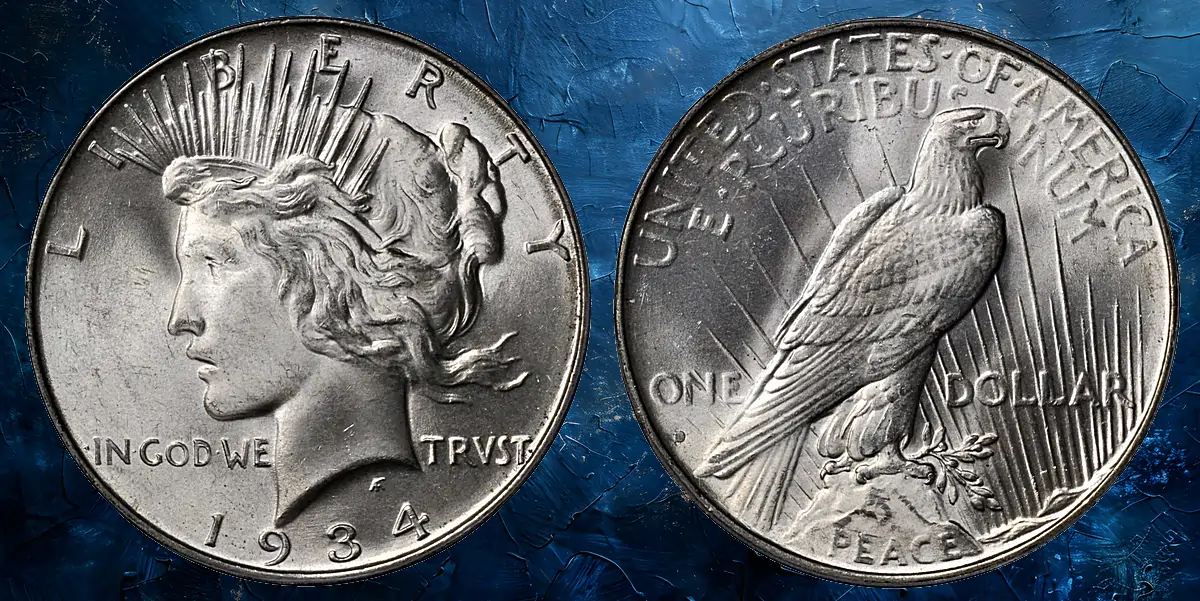
That variety, cataloged as VAM-3 with the Medium D mintmark, turns an already desirable Peace dollar into one of the most important variety coins in the series.
A Silver Dollar Born From Hard Times
The Peace dollar began in 1921. Anthony de Francisci designed it to mark peace after World War I. The coin carried a modern Liberty on the obverse and a resting eagle on the reverse. It also carried the word PEACE below the eagle.
However, the series went quiet after 1928.
By then, the United States had satisfied earlier silver dollar requirements tied to the Pittman Act. Also, commerce did not need more heavy silver dollars. The Great Depression soon made that lack of demand even clearer.
Then politics changed the coinage picture.
Western silver interests pushed for federal support. Farmers and miners faced brutal economic pressure. Silver prices had fallen sharply. Therefore, Congress and the Roosevelt administration moved to support silver through new monetary policy.
The Silver Purchase Act of June 18, 1934, helped drive renewed silver acquisition by the Treasury. As a result, the Mint resumed Peace dollar production in 1934.
That revival produced silver dollars at Philadelphia, Denver, and San Francisco. Denver struck the largest 1934 output, with 1,569,500 coins.
Yet the story did not end at the coining press.
Why the 1934-D Still Puzzles Collectors
Many Peace dollars sat in Treasury storage for years. Later, bags entered the market through releases, hoards, and Western channels. However, researchers have long noted a strange gap with the 1934-D.
The issue does not appear to have surfaced in large, original bag quantities.
That matters. Bag releases often explain why some dates survive in large numbers in Mint State. Without such a release, many 1934-D dollars likely reached collectors as rolls, single coins, or circulation finds.
This helps explain the date’s market personality. Circulated examples remain available. Yet attractive Mint State coins draw stronger attention. In Gem, the date becomes much tougher.
That scarcity grows even sharper with the VAM-3 Doubled Die Obverse attribution.
The Famous 1934-D Doubled Die Obverse
The 1934-D VAM-3 ranks among the most dramatic Peace dollar varieties.
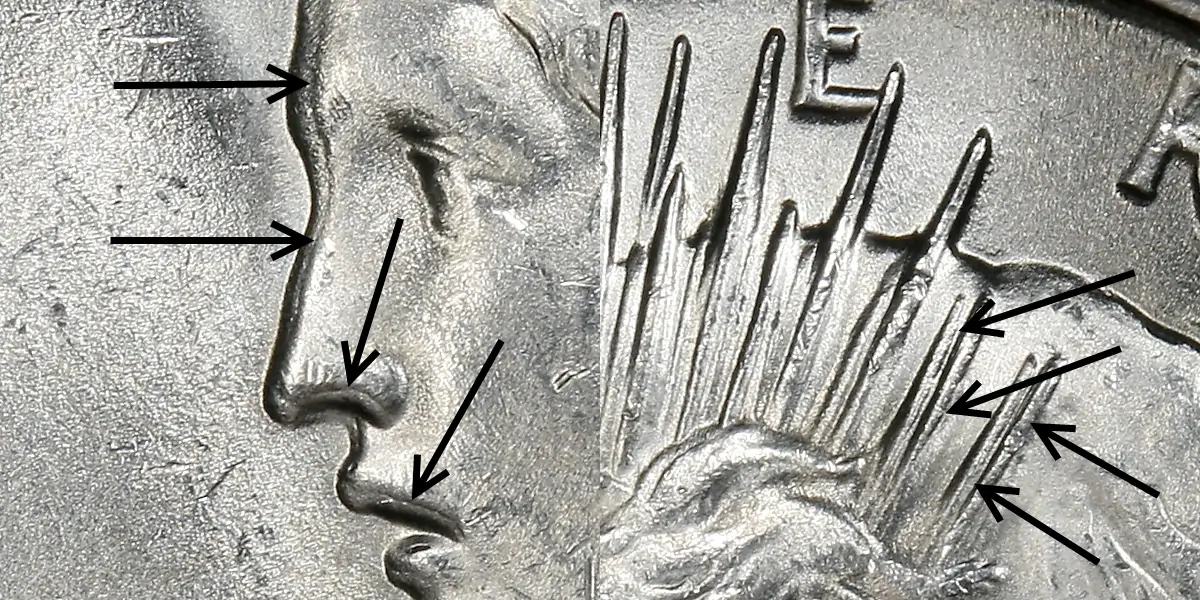
Collectors prize it because the doubling appears in major design areas. This is not a tiny minting curiosity hidden deep in the fields. Instead, the strongest diagnostics appear on Liberty’s profile and nearby devices.
Look first at Liberty’s face. Strong examples show doubling along the forehead, nose, eyelids, lips, and chin. Then look at the tiara rays. The shorter lower rays show clear separation. The motto also shows doubling, especially around IN GOD WE.
In addition, specialists examine the date digits and surrounding design details.
This kind of hub doubling gives the VAM-3 its power. It also explains why the variety appears on the Top 50 Peace dollar VAM list. Heritage has also noted that the variety has appeared in the Guide Book with a significant premium.
VAM-3 vs. VAM-4: Medium D and Micro D
The 1934-D Doubled Die Obverse exists in more than one important pairing.
VAM-3 carries the Medium D mintmark. Collectors often describe this as the standard or larger Denver mintmark for the issue. The D sits on the reverse below ONE in ONE DOLLAR.
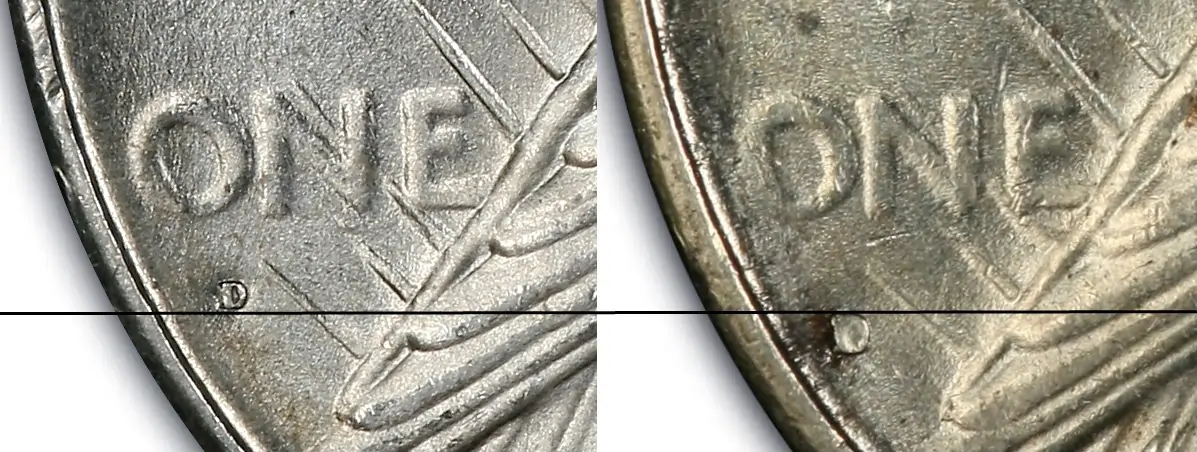
That small placement difference matters. It separates two famous varieties. It also gives collectors a clear reverse-side diagnostic after they spot the obverse doubling.
The Micro D is much tougher than the Medium D in the broader 1934-D variety family. Therefore, collectors should inspect both sides. A coin with bold obverse doubling deserves a second look at the mintmark.
The Blue Moon Collection Example
The Stack’s Bowers Galleries coin brings these themes together.
The coin carries the attribution:
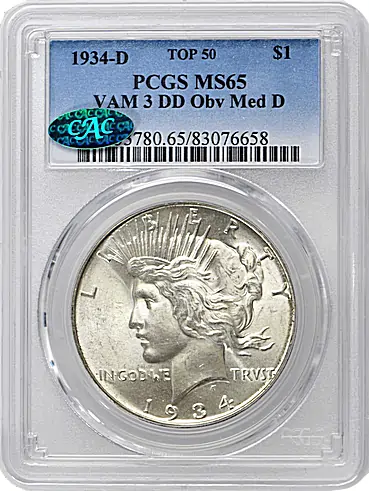
1934-D Peace Silver Dollar. VAM-3. Top 50 Variety. Doubled Die Obverse, Medium D. MS-65 (PCGS). CAC.
Stack’s Bowers describes it as fully struck and wonderfully original. The catalog description notes pale silver surfaces over intense satin luster. It also calls the coin very attractive.
Those details matter for this issue. Peace dollars often show bagmarks, especially on Liberty’s face and cheek. Therefore, a Gem 1934-D with strong luster, original surfaces, and CAC approval stands out.
The coin also comes from the Blue Moon Collection, Part I.
For VAM specialists, the population data adds another layer. Stack’s Bowers listed the PCGS population for the VAM-3 attribution at 12 coins in MS-65, with just three finer, all graded MS-66.
That places the coin in a narrow certified tier for the variety.
Market Context and Value
The 1934-D Peace Dollar trades across a wide range.
Circulated coins often appear in the low hundreds, depending on grade, surfaces, and eye appeal. Very Good to Fine examples can fall around the $85 to $130 range in retail settings. Extremely Fine coins often move higher, around $130 to $150 or more.
However, the market changes quickly in Mint State.
MS-63 examples can start in the several-hundred-dollar range. Retail listings around $440 and higher appear for certified Uncirculated pieces. In MS-65, the issue becomes far more expensive, especially with CAC approval, attractive toning, or a major variety attribution.
The VAM-3 Doubled Die Obverse brings an added premium. Circulated examples often sell for more than common 1934-D pieces. In Mint State, the price depends heavily on grade, certification, CAC status, and the strength of the doubling.
The Heritage MS66+ PCGS CAC VAM-3 shows the upper end of the market. That coin sold in August 2013 for $12,350.43. Heritage described it as the finest certified example at either leading service at that time.
That result still gives collectors a useful signal. The best 1934-D VAM-3 coins do not trade like ordinary Peace dollars.
Specifications
- Coin: 1934-D Peace Dollar
- Mint: Denver
- Mintage: 1,569,500
- Designer: Anthony de Francisci
- Composition: 90% silver, 10% copper
- Weight: 26.73 grams
- Diameter: 38.10 mm
- Edge: Reeded
- Actual Silver Weight: 0.7734 troy ounce
- Mintmark Location: Reverse, below ONE in ONE DOLLAR
Why Collectors Should Care
The 1934-D Peace dollar sits at the crossroads of history, scarcity, and variety collecting.
It came back to life because Depression-era silver policy pushed the Mint to strike silver dollars again. It left Denver in modest numbers. Then it disappeared into circulation, storage, rolls, and individual channels without the kind of famous bag release that shaped many other silver dollar dates.
Finally, one doubled obverse die gave collectors a dramatic variety.
A collector can hold a 1934-D VAM-3 and see several stories at once. The coin reflects the end of the classic Peace dollar era. It reflects Roosevelt-era silver policy. It reflects Denver Mint production at a time of economic strain. And, most visibly, it reflects one hubbing mistake that turned Liberty’s profile into a doubled image collectors still chase today.
For Peace dollar specialists, the 1934-D VAM-3 is not just another variety.
It is one of the defining coins of the series.
Thank you for a very interesting & informative article, I did not know about the double die obverse variety.
The Peace Dollar series is a series I am interested in and hope to complete a full collection of all the years because it is a smaller series compared to the Morgan Dollar series. Great information about 1934 D VAMS that I was no informed about.
Another interesting article from CW. Thanks.
The depression era getting the silver coin back again is substantial in our history.
It’s a beautiful remembrance of a difficult time for many.
My late father left me a few Peace Dollars but unfortunately the 1934-D is not one of them.
Thanks for the history lesson…
With my weak eyes I can’t see the difference between a double die and a normal strike, at least not without an enlarged picture with arrows pointing to the affected areas. Can someone please recommend the right magnifying device i can get ( at a reasonable price for a retired school teacher) ?
The go-to loupe is typically the 10x H.E. Harris model 1018 for $15-17. 5x magnification is the minimum and 10x it about as much as you need. I find 16x to be too much for coins. Jewelry is a different story.
I love Peace Dollars-such a beautiful design.
great information
How may one get one?
Great read. I learn something new every day!
Very nice article.
And of course, now I’m rechecking my Peace albums…
Beauty!! I’ve been collecting 5oz. Silver Rounds lately CoinWeek Giant 1999 Penny, Gpant Bffalo nickel, Big-azz Walking liberty, etc… They are fun to display :)
There are so many interesting stories in numismatics that I will never get bored.
Very interesting article.
very good !
Interesting article. I had quite a few Peace dollars as a kid, but I don’t remember ever seeing a 1934. Mostly 1920’s.
nice looking coin
Always learning
I think I need to go through my collection and see if I have any of these. My father may possibly have left me one. Thanks for this great article!
Although not a collector of VAM’s, I can appreciate the allure. Personally, I find the Peace dollar a beautiful under appreciated series
I am a fan of the Peace dollar can’t believe they sit in storage for years.
A beautiful coin and love the additional information!!
I had no idea there was a double die for this coin. This was a great article.
I didn’t know about this variety. Interesting lesson.
I like the eagle with wings folded – just a preference for me….looks better
The eagle is quite striking; wish it was still in use on at least some of our coins.
TY
Good Peace coin info.
@ Jodie Griffin, the go-to loupe is typically the 10x H.E. Harris model 1018 for $15-17. 5x magnification is the minimum and 10x it about as much as you need. I find 16x to be too much for coins. Jewelry is a different story.
I am on the search for a decent MS62 1934-D Peace Dollar. The price in this article is closer to redbook/retail. It is accurate in stating that the price does increase at the MS63 and above. Most likely due to population. I would be fine with a problem free MS62. Or hey, a problem free AU58 that pops is also very acceptable.
I wouldn’t mind having one.
It was stated that 1934-D bags were not released as were P & S bags. Why was that. Seems funny. With the mintage amount & not out in circulation, there should have been a number of hags in storage.
Another great article.
Very interesting article
Very interesting read about the 1934 Peace Dollar.
I didn’t know about these varieties.
My best friend just found a 1927 peace dollar thar was left in her parents belongings when they passed. It looks really good still shiny and silver with very little marks. I hope that she can get a good price out of it.
Very informative article. Thank you!
Never heard of this one.
unique coin!!