


The 1935 Waitangi Crown tells a larger story than most rare coins can hold. It links New Zealand’s first major commemorative coinage issue with one of the most important political agreements in Pacific history: the Treaty of Waitangi.
That story begins nearly a century earlier.
By the mid-1830s, Aotearoa New Zealand had become a place of trade, conflict, ambition, and fear. The Māori name Aotearoa often carries the meaning “land of the long white cloud,” a reference tied to the cloud formations that helped early Polynesian navigators find the islands.
There is a set for sale in the Alexander Auction House sale in Moscow on May 14th.
Aotearoa Before the Treaty
New Zealand’s distance from imperial control attracted people who wanted a fresh start. Some came as traders. Some came as whalers. Others came as deserters, adventurers, and escaped convicts from Australia.
Britain had used New South Wales as a penal colony since 1788. Across the Tasman Sea, however, British law had little reach. Therefore, New Zealand drew men who wanted to escape the stigma of conviction or simply live outside formal authority.
Many gathered at Kororāreka, now Russell, in the Bay of Islands. By the 1830s, the port served British, American, and French whaling ships. It also drew merchants, deserters, and escaped convicts from Australia. NZ History describes Kororāreka as a rough frontier settlement where many nationalities and backgrounds mixed.
The town soon gained a dark reputation. Locals contrasted nearby Paihia, a Church Missionary Society mission station, with Kororāreka. Paihia became known to some as “Heaven,” while Kororāreka carried the nickname “Hell.”
Missionaries, Whalers, and a Fragile Order
The Church Missionary Society had worked in New Zealand since 1814, and it established Paihia as its third mission station in 1823. Missionaries such as Henry Williams learned te reo Māori and built close relationships with many rangatira, or chiefs.
Those relationships mattered. They later shaped the Treaty’s wording, its translation, and the way many Māori leaders understood British promises.
Still, missionaries could not control the frontier. Whalers, traders, and settlers operated in a legal gray zone. Land deals grew larger. Disorder increased. In addition, the French showed interest in New Zealand. These pressures pushed both Māori leaders and Britain toward formal action.
The Musket Wars Changed Everything
Māori society had long included warfare. Traditional conflict could involve land, resources, mana, and utu, or the restoration of balance. Te Ara notes that warfare could arise from practical causes and cultural obligations. It also records that cannibalism appeared in Māori traditions and after battle as a way to degrade defeated enemies.
However, muskets changed the scale of violence.
Between 1818 and the early 1830s, thousands of Māori died during the conflicts often called the Musket Wars. Many others became enslaved or fled their homes. As muskets spread, iwi sought firearms for defense and advantage. The wars reshaped territories and disrupted communities across New Zealand.
Therefore, the Treaty did not emerge from a peaceful frontier. It came from a world under pressure.
Māori Chiefs Turn to Britain
In 1831, 13 Ngāpuhi chiefs wrote to King William IV. They asked for an alliance and protection from other powers. That letter helped bring James Busby to New Zealand as British Resident.
The chiefs had practical reasons to look to Britain. British missionaries had lived among Māori for years. Māori leaders had trade relationships with British merchants and personal ties to missionaries and officials from New South Wales. By contrast, French ambitions appeared less familiar and more threatening.
Then, in 1839, Britain acted. The British government appointed Captain William Hobson as consul. It sent him to secure Māori agreement to British sovereignty over all or part of New Zealand. Te Papa states that Hobson arrived in the Bay of Islands on January 29, 1840, and began planning a treaty with James Busby.
The Translation Problem
Hobson faced a nearly impossible task. He had to connect two political worlds in a matter of days.
Language alone did not create the main problem. Missionaries knew te reo Māori well. Instead, the challenge came from ideas. British officials used concepts such as “sovereignty.” Māori political authority worked through rangatira, hapū, land, kinship, and mana. The two systems did not match neatly.
The Treaty took shape quickly. Missionary Henry Williams and his son Edward translated the English draft into Māori overnight on February 4, 1840. Māori then debated the document before the first signing on February 6.
In the English text, Māori ceded sovereignty to Britain. In the Māori text, the translators used kāwanatanga, often understood as governance or governorship. Meanwhile, the Māori text guaranteed tino rangatiratanga, or full chiefly authority, over taonga. NZ History notes that many Māori believed they granted government over the land while keeping authority over their own affairs.
That difference mattered. It created a lasting source of conflict, debate, and legal interpretation.
February 6, 1840: The Treaty of Waitangi
On February 6, 1840, the first chiefs signed Te Tiriti o Waitangi at Waitangi in the Bay of Islands. The Waitangi Tribunal gives the first-day signatory count as between 43 and 46 Māori rangatira.
Tāmati Wāka Nene played a crucial role. He supported the Treaty during the debate at Waitangi and became one of its most influential Māori advocates.
The first signing took place in a large tent or marquee on the lawn in front of James Busby’s house. Contemporary retellings describe the structure as a tent made from ships’ sails. From there, copies of the Treaty traveled around the country. By the end of 1840, more than 500 Māori had signed.
[IMAGE SPACE: Treaty signing artwork or Waitangi Treaty Grounds. Suggested alt text: “Reconstruction of the signing of the Treaty of Waitangi in 1840.”]
New Zealand Marks the Treaty in Silver
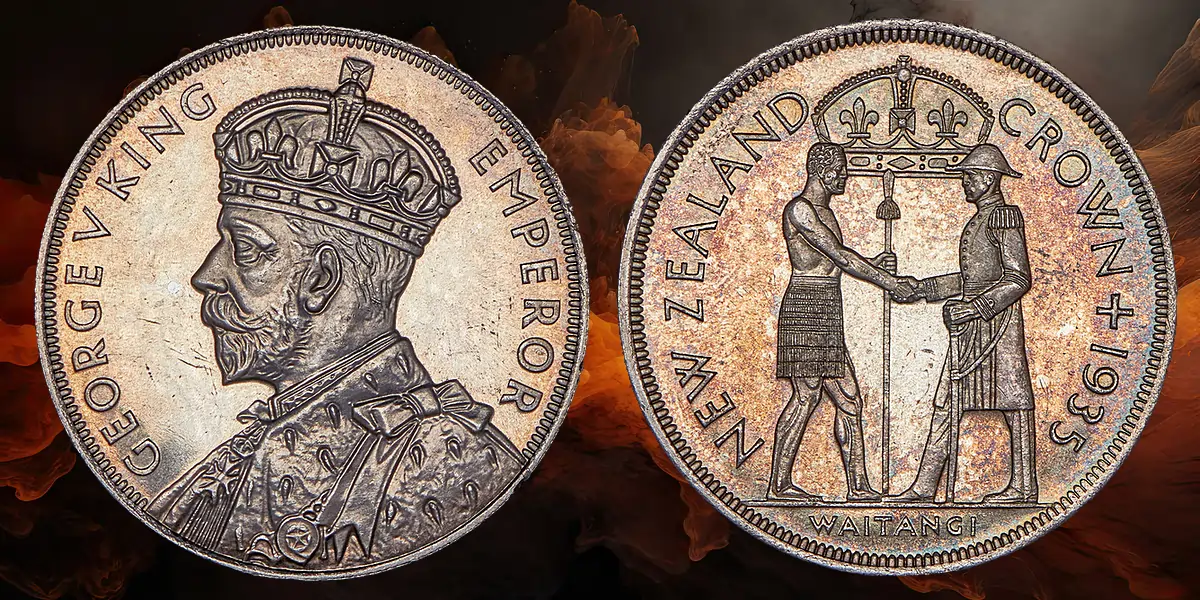
Almost a century later, New Zealand marked the Treaty with one of its most famous coins: the 1935 Waitangi Crown.
The Royal Mint in London struck the silver crown for New Zealand in 1935. Museums Victoria describes it as New Zealand’s most famous coin and states that it commemorated the 1840 signing of the Treaty of Waitangi. The total mintage reached only 1,128 coins.
The crown had a face value of five shillings. It also became the key coin of New Zealand numismatics.
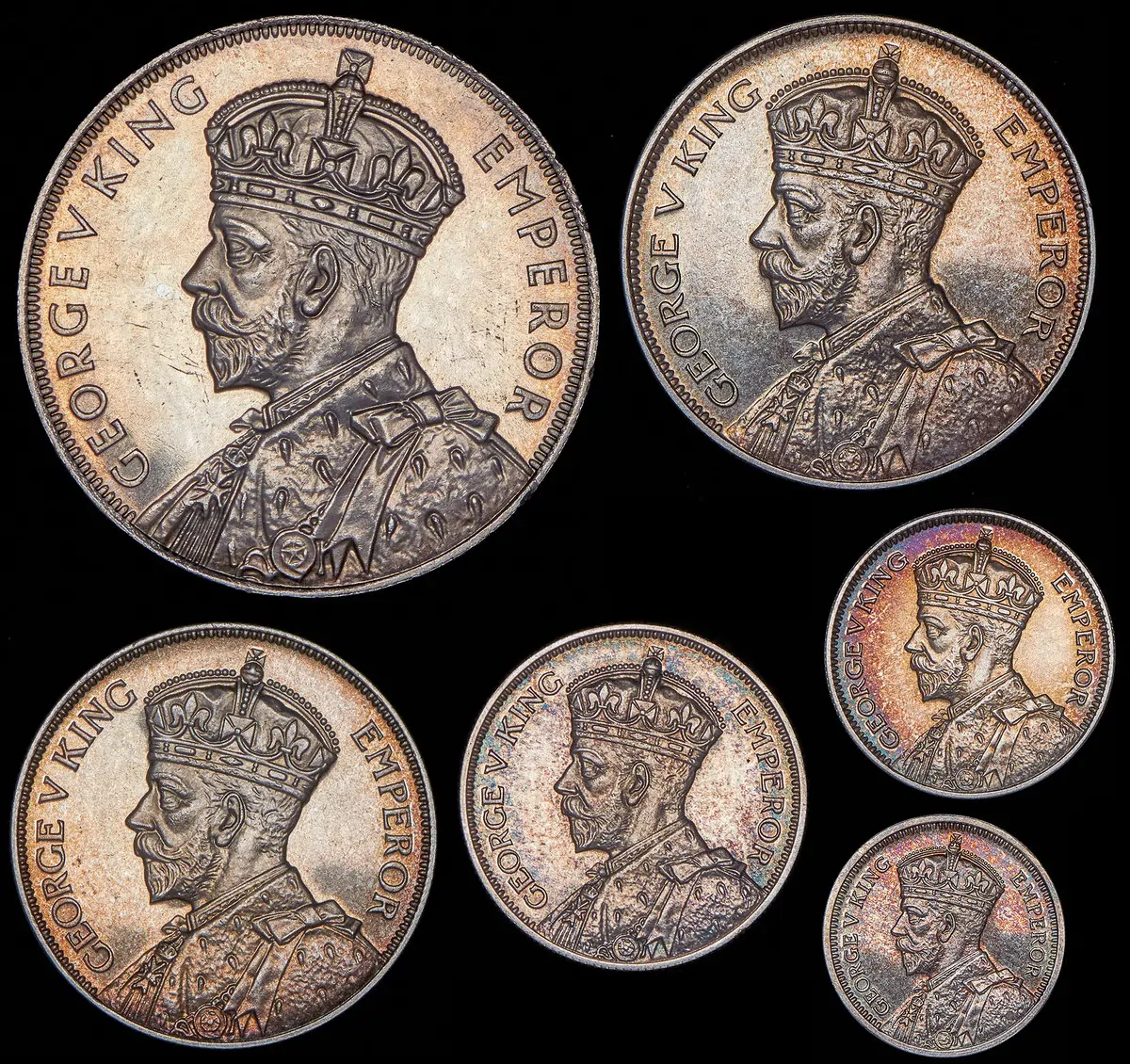
The coin’s reverse shows Captain William Hobson and Chief Tāmati Wāka Nene shaking hands beneath a large crown. The design presents the Treaty as an alliance under the British Crown. The obverse shows the crowned bust of King George V.
The 1935 Waitangi Proof Set
Collectors value the crown on its own. However, the full 1935 proof set offers a much broader numismatic story.
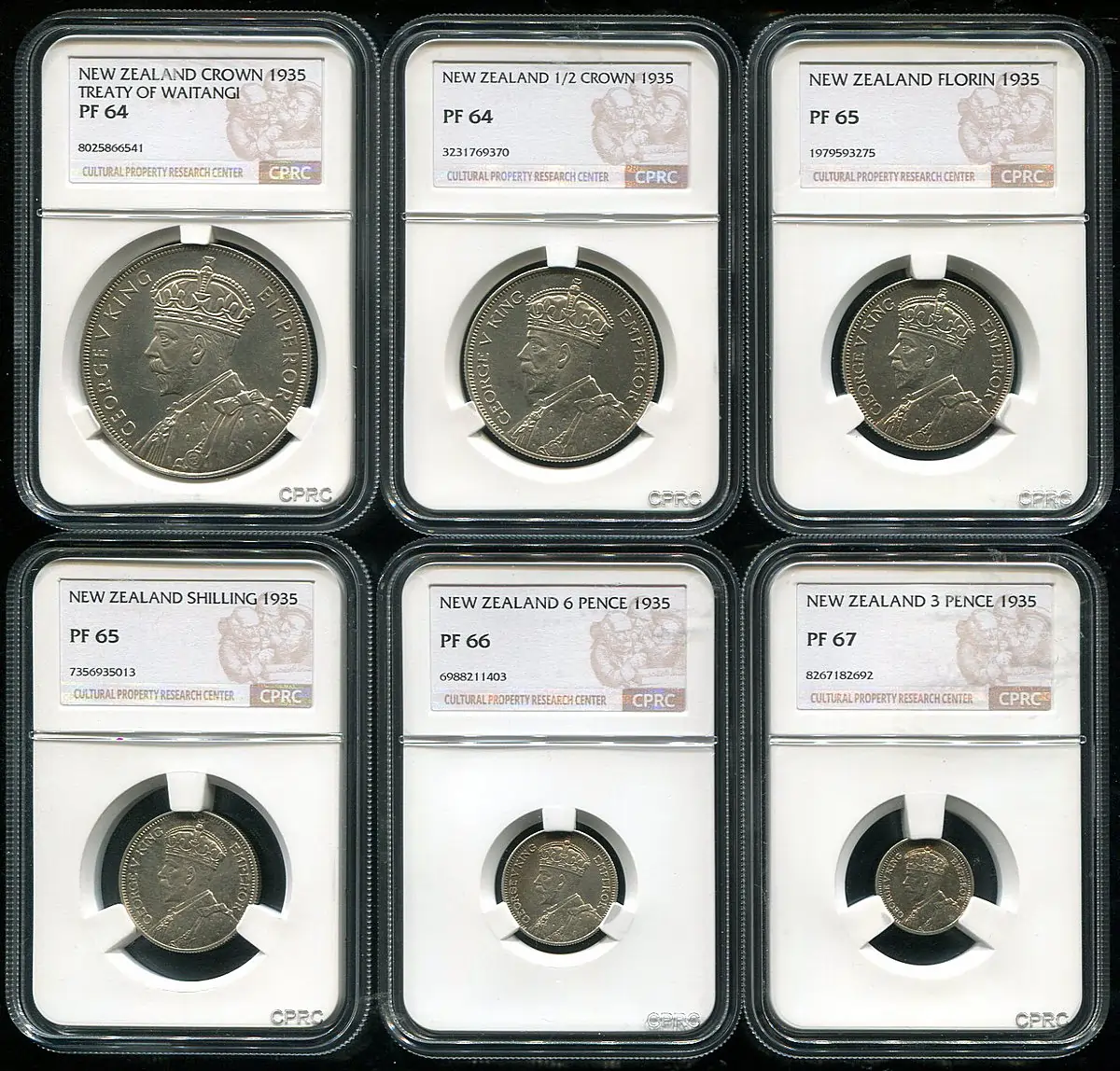
The six-piece silver set includes:
- Threepence
- Sixpence
- Shilling
- Florin
- Half-crown
- Crown
Museums Victoria lists each denomination as a 1935 proof issue struck by the Royal Mint in London. Its collection pages also confirm the designs and artists for the silver denominations.
The Royal Mint struck 660 circulation-quality Waitangi crowns and 468 proof crowns. Of those 468 proofs, 364 went into 1935 proof sets, while 104 were issued loose.
That small distribution explains why complete sets remain so desirable.
Symbolism on the Six Coins
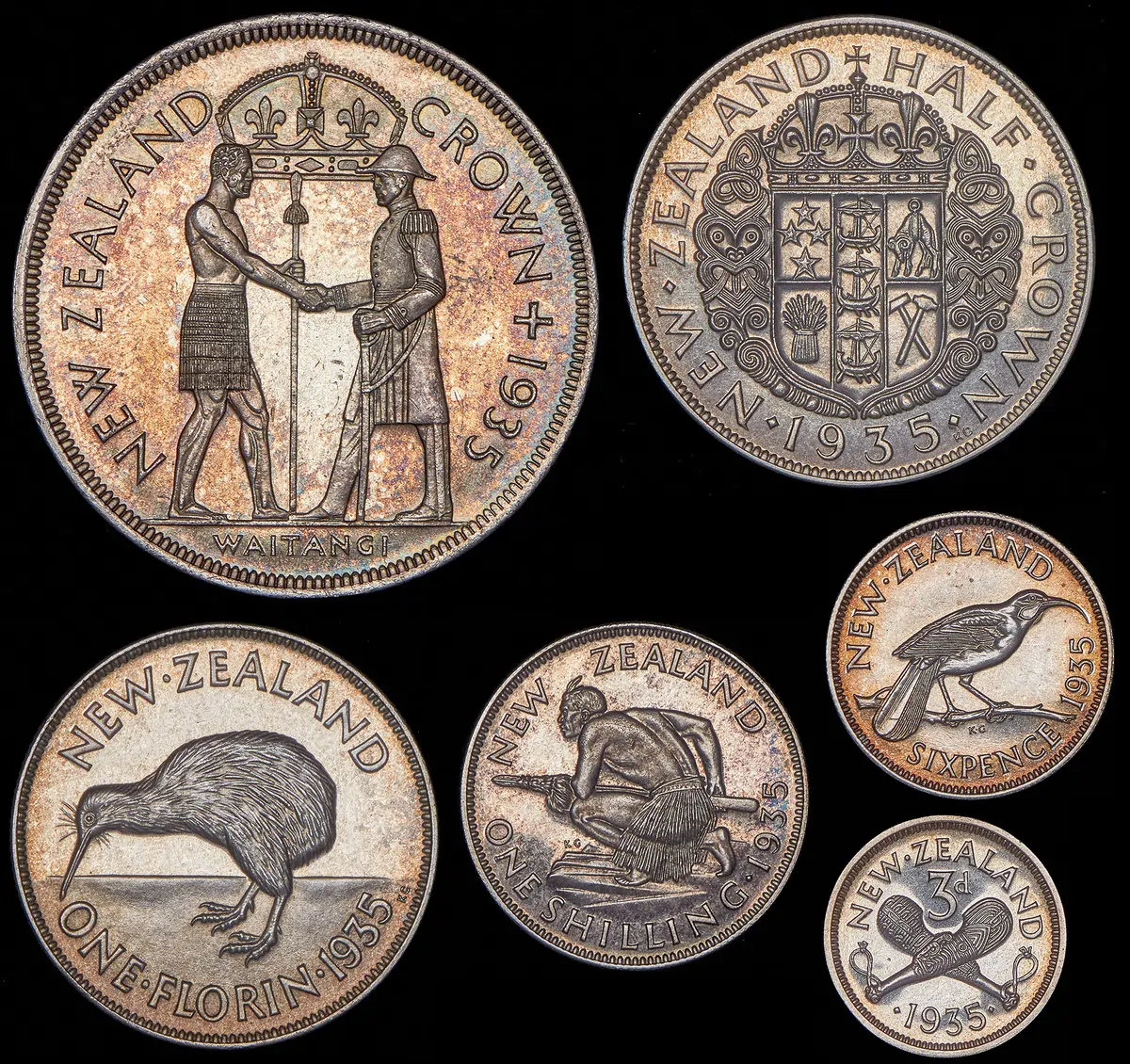
Percy Metcalfe and George Kruger Gray shaped the designs of the 1935 silver coins. Metcalfe designed the crowned bust of George V and the final Waitangi crown dies. Kruger Gray designed many of the smaller-denomination reverses. Museums Victoria identifies both artists across the 1935 proof coin records.
Each coin carries a New Zealand theme.
- The crown shows Hobson and Tāmati Wāka Nene shaking hands beneath the royal crown.
- The half-crown displays the Dominion of New Zealand coat of arms, crowned and surrounded by ornament inspired by Māori carving.
- The florin shows a kiwi standing left.
- The shilling depicts a Māori warrior crouching with a taiaha.
- The sixpence shows a huia bird perched on a branch. The huia later became extinct, which adds poignancy to the design.
- The threepence features two carved patu crossed with lanyards attached.
Together, the coins present New Zealand through history, culture, wildlife, and imperial authority.
Why This Set Matters
This particular six-piece set carries exceptional collector value. The reported grades range from PF64 to PF67, which places the coins in high-grade proof condition.
That matters greatly. Proof silver coins from 1935 often show handling, hairlines, haze, or storage problems. A set that survives nearly a century with grades from PF64 to PF67 stands well above ordinary examples.
The crown drives the set’s importance. It represents New Zealand’s only George V crown and the first crown denomination struck for the New Zealand pound. With only 1,128 total pieces and 468 proofs, the Waitangi crown remains the key to the classic New Zealand series.
More importantly, the coin captures a complicated historical moment. It compresses frontier disorder, Māori diplomacy, British ambition, missionary translation, and Treaty symbolism into one Art Deco silver design.
That combination gives the 1935 Waitangi Crown its power. It does not merely commemorate a treaty. It asks collectors to confront the history behind it.





Fascinating look at how countries decide what to put on their coins.