


The Wartime Jefferson Nickel Variety Hiding in Plain Sight
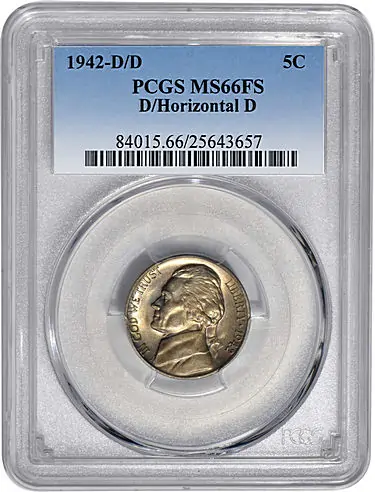
A dramatic Jefferson nickel variety crossed the block in Stack’s Bowers Galleries’ November 2025 Showcase Auction and brought $5,280 on November 14, 2025. The coin, from the Alan Harlan Collection, was a 1942-D/D Jefferson Nickel, FS-501, D/Horizontal D, graded MS-65 FS by PCGS.
At first glance, it looks like a bright, high-grade wartime-era nickel. However, the mintmark tells a much bigger story. A Denver Mint employee punched the “D” mintmark into the working die in a horizontal position. Then the Mint corrected the mistake with a normal upright “D.” The first punch did not disappear. Instead, it remained visible under the corrected mintmark.
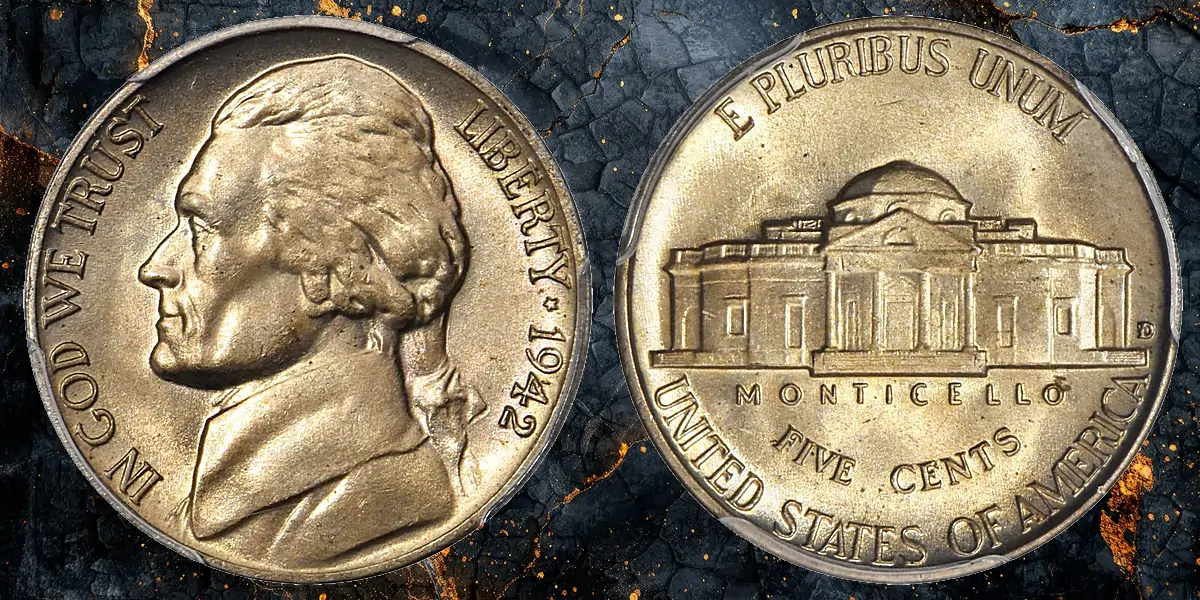
As a result, one of the most famous Jefferson nickel varieties entered circulation.
A Nickel From a Turning Point in American Coinage
The 1942-D/D Jefferson Nickel is one of the most interesting in the series. In early 1942, the United States still struck five-cent pieces in the standard 75% copper and 25% nickel alloy. The Denver Mint produced 13,938,000 nickels that year.
Then World War II changed everything.
Nickel had become a strategic metal. The war effort needed it for armor, aircraft, ships, and other military uses. Therefore, Congress authorized a temporary alloy change in 1942. The Mint replaced the standard copper-nickel composition with a 56% copper, 35% silver, and 9% manganese alloy. These silver “War Nickels” carried a large mintmark above Monticello.
However, Denver did not strike the silver-alloy nickel in 1942. That detail gives the 1942-D a special place in the series. It stands at the end of Denver’s prewar copper-nickel production and just before the full wartime change took hold.
How the D/Horizontal D Happened
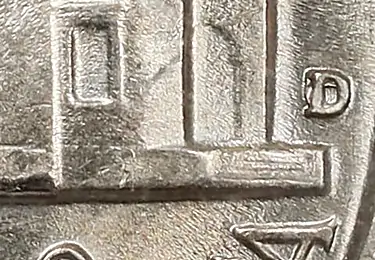
Today, mintmarks appear on the master hub or master die. That system prevents classic repunched mintmarks from forming in the old way.
But before the late 1980s, the Mint handled mintmarks differently. A Mint employee punched the mintmark into each working die by hand. That process required precision, a steady hand, and repeated force. Therefore, small shifts could create doubled or repunched mintmarks.
The 1942-D/D FS-501 shows a far more dramatic error. The first “D” entered the die horizontally. Then a properly oriented “D” corrected it. The correction did not erase the mistake. On sharp examples, the horizontal remnant remains easy to see.
That is why this variety appeals beyond Jefferson nickel specialists. It does not require imagination. It shows the human side of die preparation in plain metal.
Why Full Steps Matter
The Stack’s Bowers coin carried the PCGS Full Steps designation. That matters.
On Jefferson nickels, Full Steps refers to the horizontal steps at the base of Monticello on the reverse. PCGS awards the FS designation to Mint State coins with at least five complete steps. The steps must remain clear and uninterrupted.
Many Jefferson nickels show softness in this area. Others carry marks across the steps. Therefore, specialists pay strong premiums for coins that combine high grade, strong luster, and full step detail.
This example offered that combination. Stack’s Bowers described the coin as satiny, highly lustrous, untoned, and remarkably bold for the issue. The firm also noted that the overmintmark was especially visible on this sharp specimen.
A Scarce Variety in Gem Full Steps
The 1942-D/D D/Horizontal D ranks among the key die varieties in the Jefferson nickel series. Specialists also know it as FS-501 and RPM-001.
The variety reportedly first surfaced in the late 1970s. By then, most examples had already spent decades in circulation. That timing helps explain why high-grade pieces remain difficult to locate.
In ordinary circulated grades, collectors can still find examples with patience. Yet Gem Full Steps coins sit in a different category. PCGS estimates only about 100 examples survive in MS-65 or better with the Full Steps designation. That estimate includes raw and certified coins, not just PCGS-certified examples.
Consequently, a PCGS MS-65 FS coin with a clear mintmark error gives advanced collectors three things at once: a famous variety, a Gem grade, and premium strike detail.
The Collector Market Has Changed
For many years, Jefferson nickels did not command the same attention as Lincoln cents, Buffalo nickels, Mercury dimes, or Morgan dollars. Collectors pulled them from circulation. Dealers sold Mint State pieces cheaply. Even sharp coins often sat unnoticed in stock boxes.
However, the market has matured. Registry collecting, better variety attribution, and sharper photography have changed how collectors view the series. Today, the best Jefferson nickels often bring strong prices, especially when they combine Full Steps with a major variety.
The 1942-D/D fits that modern market perfectly. It remains visually dramatic. It also connects to a major historical moment. More importantly, it rewards collectors who study small details.
What to Look For
Collectors should examine the mintmark to the right of Monticello. The correct coin is a 1942-D copper-nickel issue, not a silver War Nickel with the large mintmark above Monticello.
On genuine examples, the horizontal “D” shows beneath the normal Denver mintmark. The strongest pieces reveal the error quickly under magnification. Still, collectors should rely on certified examples or expert attribution for higher-value coins. Minor die chips, damage, or ordinary doubling can confuse newer collectors.
Coin Specifications
- Coin: 1942-D/D Jefferson Nickel
- Variety: FS-501, D/Horizontal D
- Mint: Denver
- Designer: Felix Schlag
- Mintage: 13,938,000
- Composition: 75% copper, 25% nickel
- Weight: 5.00 grams
- Diameter: 21.20 mm
- Edge: Plain
- Grade: PCGS MS-65 FS
- Provenance: Alan Harlan Collection
- Auction Result: $5,280, Stack’s Bowers November 2025 Showcase Auction, November 14, 2025
Final Thoughts
The 1942-D/D Jefferson Nickel shows why mid-20th-century coinage deserves serious attention. It is not rare because of precious metal. It is not famous because of a low mintage. Instead, it matters because a clear Mint mistake survived at the exact moment American coinage changed for war.
A sideways punch, a corrected mintmark, a wartime metal shortage, and a Gem Full Steps strike all meet on one five-cent piece. For Jefferson nickel specialists, that combination is hard to ignore.




I have a 1942 nickel. Its for sell. Any body was to buy it please contact me at 870-494-6803
@Lynda Howard Hardaway A lot more information is needed. 1942 nickels were made at 3 different mints and in 2 different compositions. You need to know the mint mark (if any), where the mint mark is located, and how worn the coin is. Values for those found in circulation can range from face for an ordinary Cu/Ni coin up to 5 or 6 dollars for a part-silver wartime version.
There are sources like the Whitman and Krause guides as well as numismatic websites that can help you determine what you have. Please don’t rely on general auction sites though because they can have as much bad info as good.
I love collectiing error coins. What a wonderful example of this RPM.
I will have to go back and check my rolls of old Jefferson Nickles now
Searching boxes of coins & rolls to find those illusive errors is truly like finding a needle in a haystack when you land one. Most amazing feeling. Have been very blessed to find many errors!
I surely will be looking over my 42 nickels tonight. Good info.
I need this
Error coins who would of thought they would be worth anything.
I have the coin 1942 D so I have collection of Lincoln penis 1930 to 1958 I have 31 weet penis a need to money for this good condition
What a beautiful minting varietie.
I have 1941 nickel
I have a1942 s and 1942 p 1943 d
That’s beautiful.