


By Charles Morgan and Hubert Walker for CoinWeek Notes ….
While large silver dollar coins saw little practical circulation in the more populated regions of the United States, the coins did see use in the American West, where the durability of metal over paper gave coins a clear advantage. And nowhere did silver dollars flow more freely than in the gambling cities of Reno and Las Vegas, where they were the currency of choice for casino slot machines.
But as demand for silver dollars increased, Treasury Department stockpiles of the coins dwindled, which left the gaming industry in a dilemma. With the March 1969 death of Dwight D. Eisenhower, however, Congress was open to reintroducing a circulating dollar coin to honor the former president.
United States Mint Director Mary Brooks initially lobbied for the coin to be struck in silver to continue with tradition. Unfortunately, Congress had no interest in continuing to produce circulating coins in silver. The Coinage Act of 1965 called for the removal of silver from America’s dimes and quarters and reduced the silver content of half dollars from .900 fine to a 40% silver-clad composition. Over the next five years, silver coins all but disappeared from circulation and the silver-clad Kennedy Half Dollar saw limited use.
Signed into law by President Richard M. Nixon on December 31, 1970, the Bank Holding Company Act Amendments of 1970 authorized the production of the Cu-Ni clad Eisenhower Dollar for circulation. The Act also allowed for numismatic versions struck from 40% silver to be sold at a significant premium over face value. These coins would be produced in San Francisco and sold directly by the Mint. Another important provision of the Act authorized the General Services Administration (GSA) to sell 2.8 million Carson City Morgan Dollars from Treasury vaults.
The 1971-D Eisenhower Dollar Was Struck First
The Denver Mint was the first facility to strike Eisenhower Dollars in 1971, beating the Philadelphia Mint by a few weeks. In total, Denver produced 68,587,424 1971-D Eisenhower Dollars, while Philadelphia struck 47,799,000. These were significant numbers when compared to the later Morgan and Peace Dollar mintages.
Creating a Cu-Ni Eisenhower Dollar–a large, silver-dollar or “crown” format coin–proved to be quite a technical challenge. Even though the Denver Mint’s presses were older than those at the newly finished Philadelphia facility, Denver typically produced better dollar coins.
Coins struck at Denver typically have a sharper, cleaner look. Many are fully lustrous, and some were struck on highly polished planchets. By contrast, most Philadelphia issues appear dull, lack luster, and have residual annealing chatter marks on the high points of the relief (typically on Eisenhower’s chin and hair).
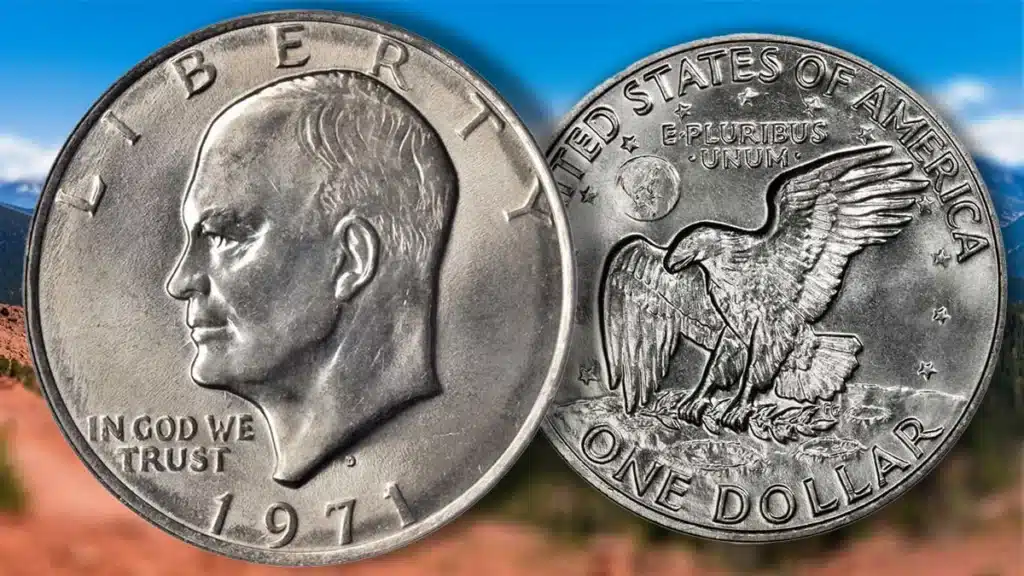
Despite this cleaner look, the 1971-D Eisenhower Dollar tends to show significant amounts of die sink along the bottom periphery. On the coin illustrated above, you can see this along the bottom of the design through the date and flattening the first few letters of the motto IN GOD WE TRUST.
How Much Are 1971-D Eisenhower Dollars Worth?
For coins struck after World War II, Mint Sets are the primary source for high-quality uncirculated coins of any given date. Initially, these sets included two examples of each coin–one mounted face up and another face down in cardboard holders–to allow collectors to admire both sides without removing them from the packaging.
In 1959, the Mint replaced the cardboard-mounted Double Mint Set with a set housing one coin of each denomination from each mint in a cellophane holder. Curiously, the Mint did not redesign this packaging to include Eisenhower Dollars until 1973. The implication of this is that the 2,193,396 Uncirculated Sets sold in 1971 do not feature uncirculated examples of the Eisenhower Dollar, meaning there are far fewer uncirculated 1971 and 1971-D Eisenhower Dollars in the market than there are for coins issued from 1973 to 1978.
It is common for the American public to save the first and last issues of a series. The first coin is saved out of enthusiasm for a new design; the last to preserve a moment in time. By our estimation, more 1971 Eisenhower Dollars were saved in Mint State than 1972 dollars.
So what are 1971-D Eisenhower dollars worth? The answer is surprising. At a minimum, a 1971-D Eisenhower Dollar has a face value of $1, which means that it can be used to buy $1 worth of goods, even today. Coin collectors are willing to pay between $3 and $10 for 1971-D Eisenhower Dollars in About Uncirculated (AU) or Uncirculated/Mint State (MS) condition.
The value increases dramatically in high uncirculated grades of MS65 and above. One caveat: when modern coins are graded MS65 or MS66, collectors expect that they have been professionally graded and encapsulated in CAC, NGC, or PCGS holders.
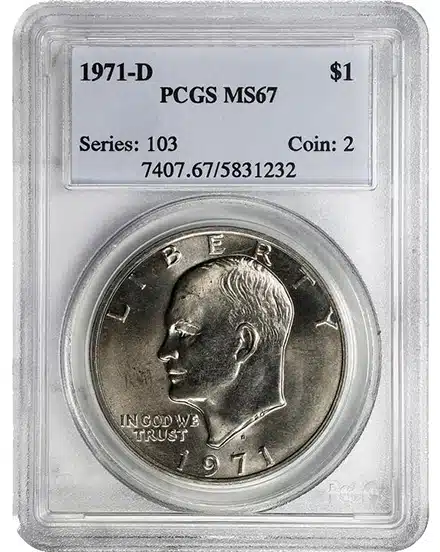
In Mint State 65, the 1971-D carries a price of about $15 according to our current market analytics. It is a first-year-of-issue type coin that carries a significant numismatic premium in ultra-high grades (or if it is a Gem-quality “Friendly Eagle Variety” – more on that below).
In Mint State 67, auction records indicate that the value of this issue at this level has fallen dramatically from where it was four or five years ago when a typical example might bring $1,500. These prices dropped to about $600 in 2020 and have since risen to about $900 today. The firm Stack’s Bowers sold a mid-range example graded PCGS MS67 for $840 in April 2023.
The three finest examples that we’ve ever seen are the two MS67s from the Richland Ikes Collection assembled by Ike Group founder Andy Oskam and another MS67 from Troy Weaver’s amazing registry set (now owned by Del Loy Hansen). Weaver’s example was a Peg Leg (die polished “R”) variety with a talon clash mark on Ike’s forehead.
But perhaps best of all was the modestly-toned NGC MS68 that brought an eye-popping $8,225 at a March 2020 Legend Rare Coin Auction.
* * *
1971-D Eisenhower Dollar Market Data and Noteworthy Specimens
Top Population: PCGS MS67+ (12, 4/2025), NGC MS68 (2, 4/2025), and CAC MS67 (18:1 stickered:graded, 4/2025).
- NGC MS68 #4932271-004: Legend Rare Coin Auctions, March 26, 2020, Lot 373 – $8,225.
- NGC MS67+ #6788805-002: Heritage, May 12, 2024, Lot 7400 – $1,200.
- PCGS MS67+ #48092224: Heritage, May 10, 2024, Lot 4913 – $3,600. Gold shield holder.
- PCGS MS67+ #47556533: Heritage, September 15, 2023, Lot 3454 – $6,000. Gold shield holder.
- PCGS MS67+ #47556533: Heritage, September 15, 2023, Lot 3454 – $6,000. Gold shield holder.
- PCGS MS67+CAC #83805161: Heritage, January 12, 2023, Lot 3559 – $10,200. Annular rainbow and rust-colored toning around rim. CAC-approved. Gold shield holder
The 1971-D (RDV-006) “Friendly Eagle” Variety (FS-901)
Discovered in 1999 by variety specialist Dr. James Wiles and popularized in the subsequent decade by the Ike Group, the 1971-D “Friendly Eagle” is a naked-eye-visible variety that is not as easy to cherrypick as it once was (you can blame CoinWeek Editor Charles Morgan for lobbying for the coin to get into the Cherrypicker’s Guide’s fifth edition as well as the Red Book).
The Friendly Eagle variety (FEV) features a rounded Earth (the regular issue is not as perfectly round at the upper left area of the globe). On the Earth, you can see a rounded and distinct Gulf of Mexico and a chain of islands in the Caribbean. The eagle’s brow is softer (one might say “friendlier”) than the standard issue. There is no heavy separation apparent in the relief between the eagle’s top two tail feathers on this variety. Also, the lines leading up to the impact ejecta “lines” of the crater are longer, more distinct, and bracket the second “L” in DOLLAR. In Very Early Die State, some FEVs show a contrail-shaped die scratch bordering the upper left portion of the globe; this feature was discovered by Ike Group member Brian Vaile.
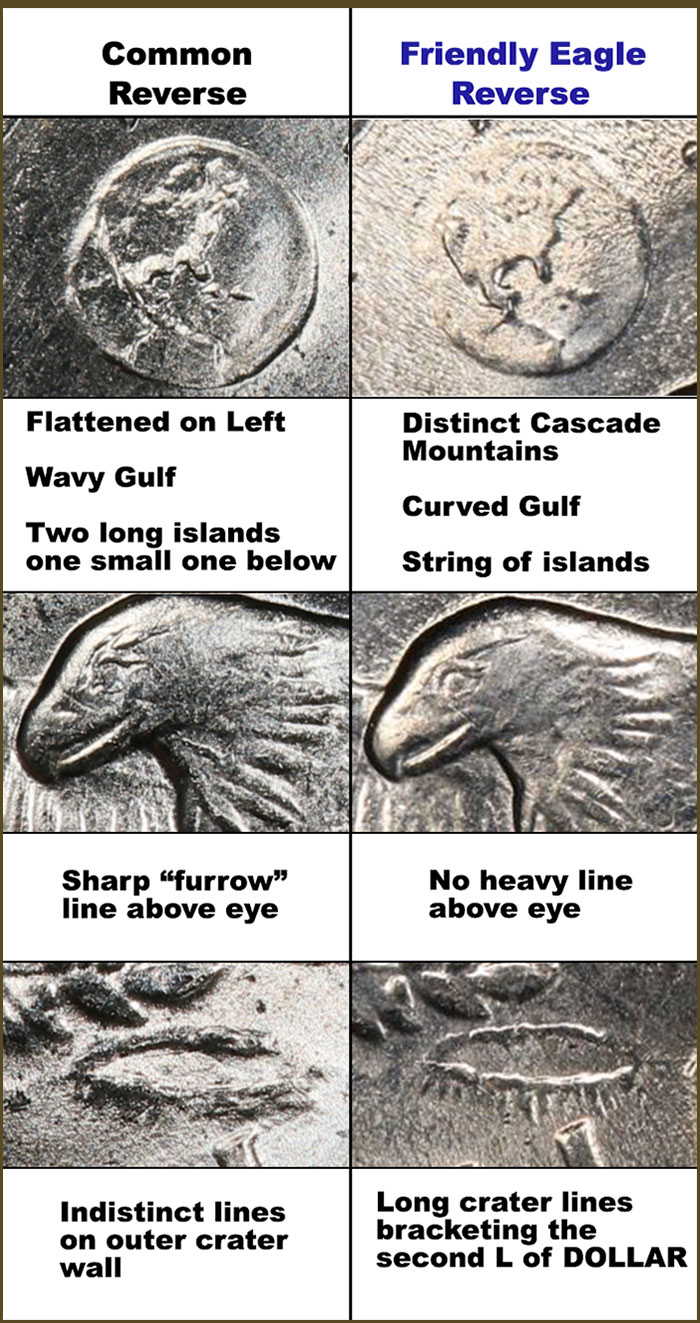
As for scarcity, the Friendly Eagle is not rare but probably represents no more than one million to 1.5 million of the issue’s 68,587,424 struck. Ike dollar specialists consider this a major variety and a semi-key to the series, the key being the 1972 “Type 2” variety.
In MS65, the FEV sells for $140 to $180. As of September 2024, PCGS reports 66 examples in MS66 with three in MS66+. No MS66+ has sold at public auction. MS66 examples have sold for over $500. One example, sold on July 21, 2022, by Heritage Auctions, slipped through the cracks after the firm misrepresented its population data and offered collectors no information about the variety in the lot description. In that instance, the lucky buyer acquired a $400-$500 coin for $204.
NGC has certified five coins finer at MS67 and one example at MS66+. Both services charge a fee to attribute this variety.
Top Population: PCGS MS67+ (1, 4/2025), NGC MS67 (5, 4/2025), and CAC MS67 (1:0 stickered:graded, 4/2025).
- PCGS MS66 #40147813: Heritage Auctions, July 21, 2022, Lot 25508 – $204.
- NGC MS66 #4199888-001: Heritage Auctions, November 17, 2021, Lot 25496 – $240.
- PCGS MS66 #83206393: Stack’s Bowers, October 27, 2021, Lot 92817 – $432.
- PCGS MS66 #26294672: “Sonoran Monsoon Collection,” Heritage Auctions, January 9, 2018, Lot 24919 – $504. Sonoran Monsoon on insert.
* * *
Design
Obverse:
Chief Engraver Frank Gasparro’s portrait of Dwight D. Eisenhower (as president); Eisenhower facing to the left. Gasparro’s initials FG appear raised in the bust truncation. Beneath Eisenhower’s chin, to the left, is the motto IN GOD WE TRUST. The word LIBERTY wraps around the top of the coin in the space between the rim and the top of Eisenhower’s head. The date 1971 wraps around the bottom of the design, between the rim and the bottom of Eisenhower’s bust. While Philadelphia-struck pieces bear no mintmark, coins struck at Denver and San Francisco bear the respective mintmarks of D and S above the space between the last two digits of the date. On Eisenhower Dollars, mintmarks were hand-punched and may vary in exact location and orientation.
Reverse:
The reverse is based on astronaut Michael Collins’ Apollo 11 Mission Patch design.
In the center, a bald eagle in descent. In its talons, an olive branch. Its left wing is raised. The lunar surface lies below. Above the eagle’s head is a depiction of the Earth. North America is prominently visible. Wrapping around the top of the coin adjacent to the rim is the legend UNITED STATES OF AMERICA. Thirteen small five-pointed stars circle around the eagle. Below the ring of stars but above the eagle is the motto E PLURIBUS UNUM. Wrapping around the bottom of the design is the denomination ONE DOLLAR.
Edge:
The edge of the 1971-D Eisenhower Dollar is reeded.
Designer
Frank Gasparro was an American medalist and coin designer. He joined the Mint’s Engraving Department in 1942 under John R. Sinnock and worked under Gilroy Roberts as Assistant Engraver. Gasparro succeeded Roberts as Chief Engraver of the U.S. Mint on February 23, 1965, and served until January 16, 1981. He died on September 29, 2001 (View Designer’s Profile).
Coin Specifications
| Country: | United States of America |
| Year of Issue: | 1971 |
| Denomination: | One Dollar (USD) |
| Mintmark: | D (Denver) |
| Mintage: | 68,587,424 |
| Alloy: | Copper-Nickel (Cu-Ni) |
| Weight: | 22.68 g |
| Diameter: | 38.10 mm |
| OBV Designer: | Frank Gasparro |
| REV Designer: | Frank Gasparro | Michael Collins |
| Quality: | Uncirculated |
* * *




Nice coin content described.thanks
I have also 2 of the same 1971, since i born in that year thats why i keep it..
Epic
Woooo … I noticed the Friendly Eagle reverse long before 1999 but had no success when presenting my coins for inspection at various shows. Win some, lose some I guess.
I have a 1971-D Eisenhower dollar in mint condition. Where “In God we Trust” is stamped on the coins mine says “N God we Trust” looking for a value of this coin. Compared to the Friendly Eagle everything looks good.
“N” God we Trust or “n” God we Trust?
I have a 1971 D UNCIRCULATED IN plastic with a blue plastic coin also, 40 % silver. In a thick blue envelope THE DEPARTMENT OF THE TREASURY 1789 WITH A LETTER FROM THEM.
THE TREASURY CANNOT GUARANTEED THAT THE UNCIRCULATED COIN WILL BE FREE FROM BLEMISHES.
I will pay $15 for all ten
John I will give you above it value just to put in my coll4tinnd. It’s only forty percent silver meañing it’s worth $2 in silver weight . I’ll pay $10.00 with free shipping??
Could you check that mint mark again? According to PCGS, 1971-date 40% silver Ikes were only struck by the San Francisco Mint. All Denver issues were cupronickel clad.
Please help i have one and i don’t know where to sell who to contact
I have ten 1971 Eisenhower pieces how can I cash them in and where for how much
I will pay $15 for all ten
It’s worth a premium of2$ if it nice I will give you $5
Hey there I have a 1971 one dollar coin and the back of my coin the eagle is upside is it worth something please let me know thanks.
@Mary Please compare the orientation of your coin’s sides with other denominations in your change. ALL modern US coins are struck with the reverse side pointing 180º versus the obverse (front). Your coin would only be a valuable error if both sides were oriented the same direction.
I have a 1971 dollar coin with eagle on back above the moon. I been keeping this coin for a very long time. Heavy dollar coin.
I have one of those coins
@Mary: Please look at the other coins in your pocket change. ALL current US coins are struck with what’s called “coin rotation”; i.e. the reverse side is oriented 180º opposite to the obverse.
A good rule of thumb when you find something apparently unusual on a coin is to compare it with others. If they all show the same thing (e.g. the Latin orthography TRVST on Peace dollars), it means what you’ve found is almost certainly _not_ an error but rather a characteristic of that particular design.
What if you have a 1971-D unfriendly certified by historic society but can’t find a FG anywhere around Ike or any other designer initials?