


, By CoinWeek Notes …..
The $1 Coin America Never Got to Spend
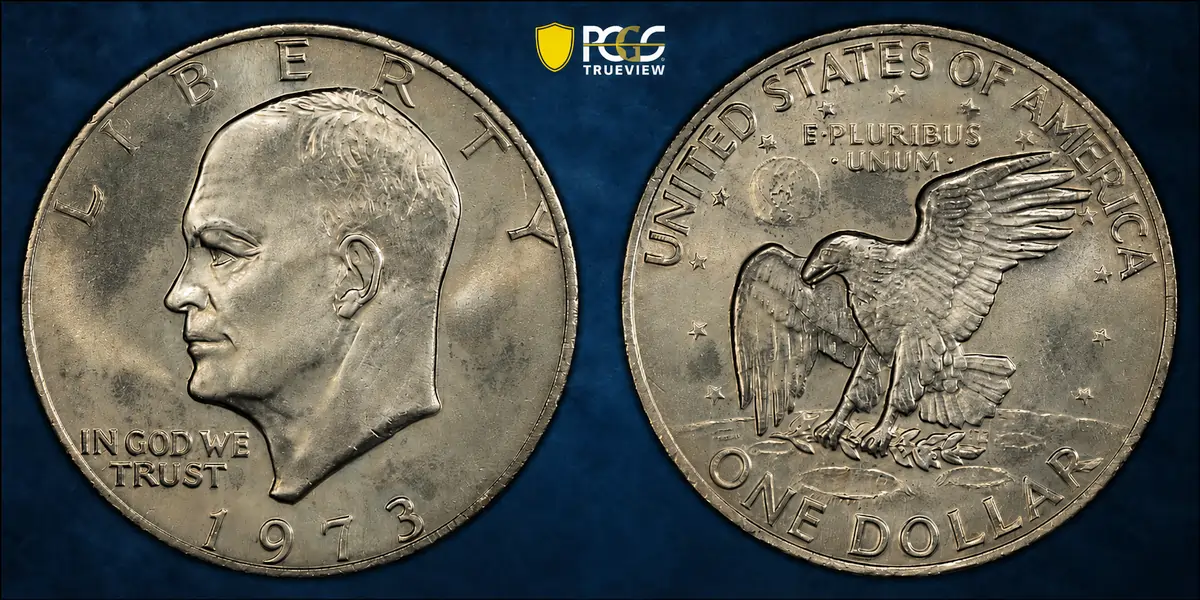
The 1973 Eisenhower Dollar looks ordinary at first glance. It is large, clad and carries no mintmark. And millions survive in Mint State.
However, this coin tells one of the strangest stories in the Eisenhower Dollar series.
The United States Mint struck the 1973 Philadelphia Eisenhower Dollar as legal tender. Yet the Mint did not release it for everyday commerce. Instead, collectors had to buy the coin in the annual Uncirculated Coin Set.
That decision turned the 1973 Eisenhower Dollar into a collector-only clad dollar. It also created a date that looks like a key issue by mintage, but behaves very differently in the market.
The Ike Dollar Had Already Failed in Circulation
Collector enthusiasm surrounded the Eisenhower Dollar when the series began in 1971. The coin honored President Dwight D. Eisenhower. It also celebrated the Apollo 11 Moon landing on its reverse.
Still, the public had little practical need for a heavy copper-nickel dollar coin.
The Mint produced huge numbers in the first two years. Philadelphia and Denver struck a combined 116,386,424 circulation-strike Eisenhower Dollars in 1971. Then they struck another 168,438,511 in 1972.
Even so, Americans mostly kept using paper dollars. The large clad dollar found some use in Nevada casinos. However, it never became a normal pocket-change coin.
Therefore, by 1973, the Mint changed course.
The 1973 Eisenhower Dollar Became a Mint Set Coin
For 1973, the Mint did not strike Eisenhower Dollars for general circulation. Instead, it made the Philadelphia and Denver business strikes for the annual Uncirculated Coin Set.
The Philadelphia Mint struck 2,000,056 1973 Eisenhower Dollars. Denver struck 2,000,000 1973-D Eisenhower Dollars.
However, the Mint sold only 1,769,258 Uncirculated Coin Sets. As a result, it did not need the full production run. Published accounts state that the Mint melted the remaining coins.
Because Denver produced exactly 2,000,000 coins, its unsold balance came to 230,742 pieces. Philadelphia’s reported production figure leaves a slightly larger arithmetic balance because of the 56 extra coins recorded for that facility.
That small accounting wrinkle matters. It also explains why older references sometimes round the Philadelphia mintage to 2,000,000.
Did Any 1973 Ike Dollars Escape?
One story still interests Ike Dollar specialists.
Ike Group member Brian Vaile reported an unconfirmed sighting of an open Mint bag of 1973 Eisenhower Dollars at a Florida coin shop several years ago. If that report proves accurate, then a small number of unpackaged 1973 Philadelphia dollars may have left the Mint system.
However, CoinWeek treats that report as unconfirmed.
Also, collectors rarely encounter the 1973 Eisenhower Dollar in circulated grades. That fact points to a very small release, if any release occurred at all. Therefore, any accidental emission likely involved only a tiny number of coins.
Is the 1973 Eisenhower Dollar a Key Date?
At first, the 1973 Eisenhower Dollar looks like a key date. Its mintage sits far below the 1971 and 1972 circulation-strike totals.
Yet mintage tells only part of the story.
The 1973 and 1973-D Eisenhower Dollars entered collector hands through Mint Sets. As a result, millions avoided the rough handling that damaged many 1971 and 1972 coins.
Therefore, the 1973 issue does not rank as the true business-strike key of the series in Mint State.
The tougher Philadelphia issues remain the 1971 and 1972 Eisenhower Dollars. The 1972 Type 2 reverse stands above them as the most important regular-issue business-strike key.
Better Dies Made Better Coins
The 1973 Eisenhower Dollar also benefited from a major technical improvement.
Early Eisenhower Dollars created problems for the Mint. The large copper-nickel clad planchets challenged the dies. As a result, many 1971 and 1972 coins show weak details and heavy planchet chatter.
By 1973, the Mint had improved die preparation. It moved away from the W-1 die steel used at the start of Ike Dollar production and adopted hardened 52100 die steel.
That change helped the Mint produce sharper coins. It also reduced a common die-sinking issue on the left side of the obverse.
Consequently, early and middle die-state 1973 Eisenhower Dollars often show better definition than many earlier Philadelphia strikes.
Varieties and Mint Errors
The 1973 Eisenhower Dollar does not offer many major varieties or mint errors.
That makes sense. The Mint struck the issue in limited numbers and distributed it only through Mint Sets.
Still, variety collectors should watch for “Peg Leg” examples. On a Peg Leg Ike, the left leg of the “R” in LIBERTY lacks its normal serif.
For the 1973 issue, collectors sometimes discuss the “OK” Peg Leg. “OK” means “Off at the Knees.” On that variety, die polishing removes about half of the base of the “R” in LIBERTY.
This is a specialist variety. However, it adds another layer to a date that many collectors overlook.
[IMAGE PLACEHOLDER: Close-up of LIBERTY showing normal R versus Peg Leg R]
What Is a 1973 Eisenhower Dollar Worth?
The 1973 Eisenhower Dollar carries a face value of one dollar. However, it never served that role in normal circulation.
That point makes the coin different from the 1971 and 1972 copper-nickel clad Ikes. Those earlier coins entered commerce, even if the public did not embrace them.
The 1973 coin came only through the Mint’s Uncirculated Coin Set. It also marked the first copper-nickel clad Eisenhower Dollar that collectors had to buy in a Mint Set rather than find in circulation.
The 1973 Uncirculated Mint Set also marked an important change for the annual set. It included two dollar coins, one from Philadelphia and one from Denver. Because of that added face value, the Mint raised the set price from $3.50 in 1972 to $6.00 in 1973.
Today, ordinary 1973 Mint Sets remain affordable. However, retail prices vary by packaging quality, dealer, and market conditions. Raw 1973 Eisenhower Dollars usually trade far below certified Gem examples.
The Real Challenge Starts at Gem
The typical 1973 Eisenhower Dollar comes from a Mint Set. Many examples grade in the Choice Uncirculated range.
However, true Gem coins create a much tougher challenge.
Mint Set quality varies dramatically. Some coins show attractive surfaces and strong strikes. Others show chatter, haze, unattractive toning, or handling marks from the Mint’s packaging process.
In MS65, the 1973 Eisenhower Dollar remains affordable. In MS66, the coin becomes much harder to locate. At that level, surfaces, strike, and eye appeal matter a great deal.
CAC-approved examples bring stronger prices. Coins with premium toning can bring much more.
In the modern market, top-end 1973 Eisenhower Dollars trade in several tiers:
MS65 examples remain within reach for many collectors.
MS66 coins move into a scarcer collector tier.
MS66+ coins attract advanced Ike specialists.
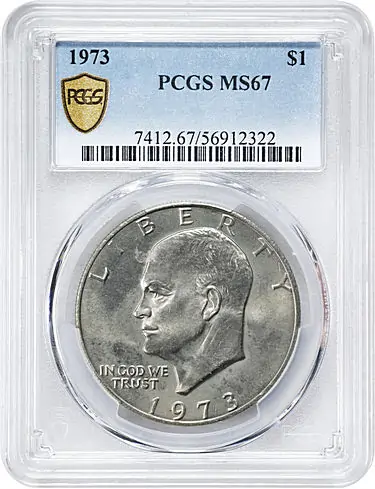
MS67 now defines the top certified PCGS level for the issue.
Therefore, the 1973 Eisenhower Dollar offers a classic modern-coin lesson. The date is not rare. However, the right coin in the right grade can become a major prize.
Market Update: The Grade Ceiling Moved
For years, MS66 represented the top practical grade for circulation-strike Eisenhower Dollars.
That changed during the 2010s. PCGS began certifying a slow stream of MS66+ examples. Some Ike collectors called the trend “gradeflation.”
However, the explanation may not rest only on looser grading. Advanced Ike Dollar researchers have long noted that planchet chatter can complicate grading. Rob Ezerman, one of the leading Ike Dollar specialists, argued that grading services sometimes treated pre-strike planchet marks as post-strike contact marks.
That distinction matters. A large copper-nickel clad dollar can show chatter before the dies strike it. If the strike does not fully erase those marks, graders must decide how to interpret them.
As more specialists submitted better coins, the MS66+ population grew.
Then the ceiling moved again. A 1973 Eisenhower Dollar reached PCGS MS67. PCGS CoinFacts now lists the coin in its condition census, with a prior MS66+ certification number and an August 30, 2025 Stack’s Bowers appearance.
That new top grade changes the conversation. It also confirms what Ike specialists have argued for years: the best Eisenhower Dollars deserve serious attention.
Noteworthy 1973 Eisenhower Dollar Specimens
The public auction record for a 1973 Eisenhower Dollar still belongs to a PCGS MS66+ example from the Sonoran Monsoon Collection. That coin sold for $7,637.50 in a Heritage Auctions sale on January 6, 2016.
Former Navajo Nation President Joe Shirley, Jr. built the Sonoran Monsoon Collection. His set included impressive United States dollar coins. However, later top-pop Ike Dollar collections raised the quality bar even higher.
Among advanced collectors, the names Wang, Weaver, and Oskam carry weight in the highest-end Ike Dollar market.
Other coins also stand out. Collectors have noted the James-Sego-Troy Weaver-Del Hansen rainbow toner. PCGS CoinFacts has also pictured an ice-blue specimen that appeals to many specialists.
Additional auction appearances include:
PCGS MS67: Stack’s Bowers, August 30, 2025, Lot 6172, $6,600. The coin traces from a PCGS MS66+ holder into its MS67 certification.
PCGS MS66+: Stack’s Bowers, June 25, 2025, Lot 2305, $4,320. This coin showed vivid peacock toning on both sides.
PCGS MS66+ CAC: Stack’s Bowers, March 23, 2023, Lot 6769, $5,520. The coin displayed blue-gray and antique-gold toning.
PCGS MS66+ CAC: Heritage Auctions, August 4, 2017, Lot 4619, $1,762.50. This was a brilliant example.
PCGS MS66+ CAC: Heritage Auctions, April 29, 2016, Lot 5463, $2,585.
These sales show how much eye appeal matters. A technically high-grade Ike Dollar can bring strong money. A beautifully toned high-grade Ike can bring a much stronger premium.
[IMAGE PLACEHOLDER: Certified Gem 1973 Eisenhower Dollar with attractive toning]
Design of the 1973 Eisenhower Dollar
Obverse
Chief Engraver Frank Gasparro designed the obverse. His portrait of President Dwight D. Eisenhower faces left.
Gasparro placed his initials, FG, at the truncation of Eisenhower’s bust. The motto IN GOD WE TRUST appears beneath Eisenhower’s chin. LIBERTY curves across the top of the coin. The date 1973 appears at the bottom.
Philadelphia-struck coins carry no mintmark.
Reverse
The reverse honors the Apollo 11 Moon landing. Gasparro based the design on the Apollo 11 mission patch created by astronaut Michael Collins.
A bald eagle descends toward the lunar surface. It holds an olive branch in its talons. The Earth appears above the eagle, with North America visible.
UNITED STATES OF AMERICA wraps around the upper rim. Thirteen stars circle the eagle. E PLURIBUS UNUM appears above the bird, and ONE DOLLAR curves along the bottom.
Edge
The edge of the 1973 Eisenhower Dollar is reeded.
Coin Specifications
- Year of Issue: 1973
- Denomination: One Dollar (USD)
- Mintmark: None
- Mint: Philadelphia
- Reported Mintage: 2,000,056
- Distributed in Mint Sets: 1,769,258
- Alloy: Copper-Nickel Clad
- Composition: 75% copper, 25% nickel outer layers over a pure copper core
- Weight: 22.68 g
- Diameter: 38.10 mm
- Edge: Reeded
- Designer: Frank Gasparro
- Quality: Uncirculated
Why the 1973 Eisenhower Dollar Matters
The 1973 Eisenhower Dollar is not a great rarity in ordinary Mint State. Yet it captures a key moment in modern U.S. coinage.
The Mint had already learned that Americans did not want a large clad dollar in daily commerce. Still, Congress and collectors wanted the Eisenhower Dollar program to continue.
So the Mint made a one-year pivot. It struck the 1973 Philadelphia and Denver dollars for collectors, not cash registers.
That decision left collectors with a coin that feels common in Mint Sets, scarce in superb grade, and fascinating in context.
In other words, the 1973 Eisenhower Dollar is not just another clad Ike. It is the dollar America never got to spend.



I have some of this stuff
me too
As the article notes, unless you have an uncirculated specimen the coins are worth face value only – $1.
True, however, please tell me ( us) where to find any, or one, for A dollar? PLEASE!
Check your local bank. They may have some on hand, probably not ’73’s but any of the other dates.
I have a Bicentennial 1776-1976 Eisenhower Dollar. what is it worth?
@Frederick Robertson. Without more information it’s not possible to say much about your coin. There were multiple varieties – Type 1 (thick, non-serif letters on the reverse), Type 2 (thinner letters with slight serifs), cupronickel circulation strikes, and both cupronickel and 40% silver proofs. Values vary greatly depending on which type you have.
However … the great majority of Bicentennial Ikes found by non-collectors are cupronickel circulation-strikes. Even half a century later these are common in average condition and will only bring a modest premium, if any.
I have a Eisenhower Dollar a 1973 how much is the value
What about brown box proofs s mint?
I have a 1977 elsenhower dollar miasing the letter LI in liberty with d mintmark how can i verify why its missing the letter and been keeping this for 30 years thank yoi
I have only a few Eisenhower’s. Not much of a fan vs. the Morgan or Peace
I usually get lucky finding these at local banks, but so rare to find a special one!
This is an interesting coin. My brother collects coins and would love to add this to his collection.
Ike dollars are what I started collecting in junior high school. I remember how exciting it was after I received my 73-s proof from the mint and the value shot up. It was my most valuable coin then. I think I can buy that coin now for half of what it was valued at in 1973-1974.
Liberty
Sounds like you have a “strike through” . Maybe had grease on the planchet when it was struck.
Love the Ikes!
These are handsome coins.
Got to check my mint sets.
Love Our days of looking for Coins for my Son Bad thing is got burn up in his house fire :(
I like IKE!!
i dont have one
My great grandmother used to give me one of these for Christmas. She was not a person who had money to spare so this was a big deal, so for me they are priceless. My father recently passed away at age 92, he had a small coin collection including Ike dollars. I continued his tradition of giving a silver dollar to each of his grandchildren and great grandchildren who were pallbearers.
Have to check my 73 S proof clad. May be double die.
Still have some Eisenhower dollars around somewhere. Will have to take a closer look at them.
I keep one the “IKE” Eisenhower Dollar 1776-1976 on my desk within reach to hold from time to time..just have the need to actually hold one…
I Like Ike!
I have seen many 73 mint sets that have been taken apart and the coins sold individually. There are probably some hidden gems out there still waiting to be rediscovered.
Neat coin
Every now and again I find one but they seem harder to come by.
I like Ikes
Interesting article. just not a fan of the coin in general.
Didn’t think of collecting the Ike’s. After reading this article, I’m rethinking !
Great coin, had one many times growing up, and the 76 set, love the size
And backside with eagle/moon showing don’t have one now wished I’d
Save one, or could get one? For a dollar too!!!!
I have a few of the 73 sets that have never been touched and are kept in great condition. alas i an biased so i will leave is at that. Great read. Thank You
Enjoyed this article,
Great article. Thanks for the info.
I have a few of the 73 sets….
Very interesting. I have a few of them. Funny thing – I tried to pay with an IKE dollar at a Taco Bell and the drive thru would not accept it because they did not know and never saw this coin before!!
I’ve always liked these, as my dad first got us some silver ones in 1971 when they were first released.
What’s it worth? As a dealer at a coin show said, “Today, a dollar. Next year, with inflation, 95 cents.”
I recently pulled a 1973 Ike dollar from circulation. Perhaps someone busted up a mint set. I was stunned to find it
I may have a few item’s in my collection.
I may have some of those in my collection.
What an amazing story and history!! I had no idea about this coin’s history. I really enjoyed this article and the time/effort the author used to gather all the information. I can tell by some of the comments that folks did not read the article….such a shame!
I have tried repeatedly to find them at banks with no success.
Interesting topic….guess I need to look through my Ike’s.
Today is D-Day Ike was supreme commander, We thank you.
Interesting story.
even at the banks in my area, the Ike dollars are hard to find.
I like Ike
I have three sets that never gave much attention to
I like Ike!
Always good to learn something new.
A useful guide!
Eisenhower always kinda reminds me of the dad in the ” 70’s Show “
This was a great read. I love the IKE dollars myself and have several in my collection. I tell my grand kids all the time,,,,Condition, condition, condition!!
I don’t collect Ikes but I like to use them for tips at the coffee shops. Always get a funny look from the barista.
Interesting
For a coin I generally dislike, I did like this article.
Glad I saved some!
This is an interesting coin.
always thought it was an ugly coin
Great story and so very informative Nice coin
I’ll have to go through my short stack of Ike’s again.
Interesting story. I’m going to have to pull out my small collection of Ike’s that I have not looked at in 30 years, to see what I have.