


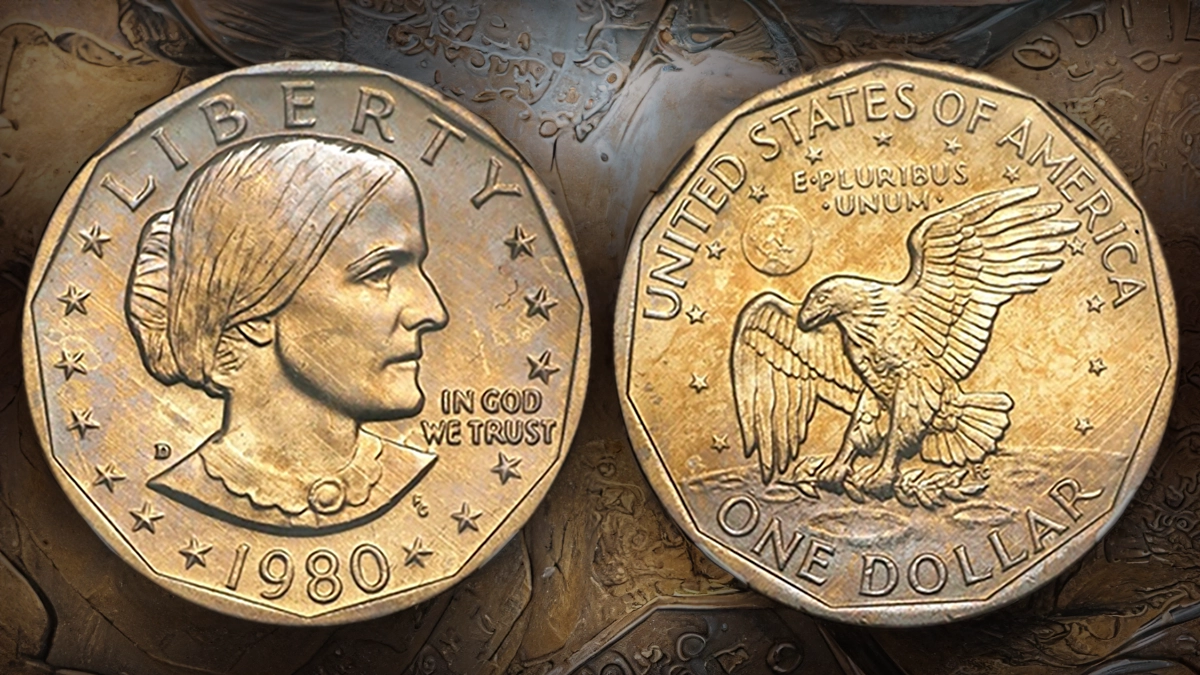
By Charles Morgan and Hubert Walker for CoinWeek Notes …..
In 1979, one year prior to the issue of the 1980-D Susan B. Anthony Dollar, the small clad dollar was released with a great amount of fanfare.
The new dollar coin depicted the eponymous American suffragette and was the first United States circulation strike coin to feature a historically real woman. In preparation for assumed massive demand, a combined total of 757,813,744 coins were struck for circulation that first year at the Philadelphia, Denver, and San Francisco facilities. Unfortunately, the coin was a total flop, and demand remained low in 1980 even though the total combined mintage was dropped to 89,660,708 pieces. The Denver Mint produced 41,628,708 Susan B. Anthony Dollars.
It was evident to everyone that the series was a complete failure. The United States Mint reported that while “there may have been other disasters like this in the history of our nation’s currency,” there had never been “anything this bad. Never rejection by the public that is this complete,” and “there is no way to overestimate how badly that coin was received” (Greene).
The American public didn’t like the new coin and preferred to continue using the $1 Federal Reserve Note. The Treasury Department had a sense that this would happen as their test market of Portland, Oregon spent the dollar coin only when there was an inadequate supply of $1 bills. During this same test, the Treasury demonstrated widespread public use for the $2 bill if distributed in quantity along with the $1 coin. However, the Treasury wasn’t willing to act on these findings at the national level, so by the end of the year, Congress was left to cast blame for the dollar coin debacle.
The 1980-D Susan B. Anthony Dollar was issued into circulation and coins were available to the public through circulation at local banks, as well as through the official 1980 Mint Set and special Souvenir Sets issued by each Mint facility. Despite these multiple collecting channels, it is estimated that up to 60% of the entire three-year (1979-81) mintage–520 million pieces–were still held in Treasury reserves for many years after they were struck.
The Mint began to think about how to dispose of the coins and recoup some of their sunk costs. One idea was to melt the coins, but the composite metal was worth only “about two cents” in 1980 (Reiter). Mint Director Donna Pope struck this idea down because the financial loss would be a serious problem.
How Much Is the 1980-D Susan B. Anthony Dollar Worth?
Due to the large mintage and the low rate of circulation, the 1980-D Susan B. Anthony Dollar is a common coin. It is easy to collect Mint State pieces, and population reports definitely do not account for the total extant number of coins. With a reported population of almost 300 in MS67, examples regularly auction for between $250 and $300. Interestingly, while the record for this type is $899 in a May 2022 eBay auction, at least two specimens sold recently for as little as $20, resulting in massive price fluctuations for the series’ top population.
In MS66, just one grade lower, 1980-D prices stabilize at between $20 to $30. MS65s hold half the value of MS66s and sell for between $10 to $20. The remaining Mint State grades (MS60 to MS64) sell for between $6 and $10.
Those not interested in ultra-high-end examples should know that 1980 U.S. Mint Uncirculated Sets routinely sell for under $15. These sets include Brilliant Uncirculated examples of each business strike coin produced by the United States Mint in a given year. In all likelihood, the coins in the set would grade between MS64 and MS66, with the occasional coin being a Superb Gem.
While there are comparatively large premiums for high Mint State Susan B. Anthony Dollars, premiums shrink to less than face value in lower grades. Examples graded and certified from AU50 up to Mint State are worth only a small premium over face value of between 10 and 50 cents, for a total of $1.10 to $1.50. For all grades below AU50, the 1980-D dollar generally is worth between face value and $1.05.
Since these lower grades are worth at most $1.50, there is a small recorded population in all grades below Mint State. In fact, PCGS records only one in XF40, two in AU55, and eight in AU58. NGC records one in AU55 and three in AU58. This is because it costs significantly more to grade the coin than the coin is worth.
Beware of eBay sellers offering uncertified artificially toned coins. These coins are numismatically worthless.
* * *
Market Data and Noteworthy Specimens
The PCGS top pop grade of MS67 has been stable for more than 10 years on the basis that the top pop grade is the terminal point for the issue. In other words, submitters can only profit from the sale of a coin after paying grading fees if the coin grades MS67.
Prices for PCGS MS67 coins run from the $203.50 reported sale on eBay to the total exceeding $1,400 that was paid for a superior example in a December 2021 GreatCollections offering. Our hunch is that the buyer saw the coin as a potential MS67+ or MS68 coin. If that’s the case, the coin has not yet worked out at PCGS.
NGC reports four 1980-D Susan B. Anthony Dollars at the MS68 grade. Three of the four have appeared at auction and photographs of the coins are available at the respective auction companies’ websites. The prices realized for the two most recently offered coins were significantly lower than the first reported sale.
We have studied the toned example that Stack’s Bowers sold in June 2023 and feel that it has a superior strike to the GreatCollections PCGS MS67. Conditionally, however, the two coins are on par; if the NGC coin is an MS68, then the PCGS coin should at some point upgrade. Both coins are far nicer than the other PCGS MS67 coins that have been photographed by GreatCollections and Heritage.
The PCGS MS67 population has increased from 138 to 143 since June 2023. The NGC MS68 population has remained unchanged over the course of that same period.
Top Population: PCGS MS67 (143, 5/2025) and NGC MS68 (4, 5/2025), and CAC MS64 (3, 5/2025).
- NGC MS68 #6343645-007: GreatCollections, June 16, 2024, Lot 1168499 – View.
- NGC MS68 #5704063-004: GreatCollections, August 27, 2023, Lot 737589 – View. Pale blue and yellow toning.
- NGC MS68 #6325862-001: Stack’s Bowers, June 16, 2023, Lot 6668 – $720. Gold and violet toning on both sides.
- PCGS MS67 #5767405: eBay (mjcte5), April 24, 2023 – $203.50.
- NGC MS67 #6590488-013: eBay (M. Barr Coins), April 10, 2023 – $76.
- PCGS MS67 #2749346: GreatCollections, December 12, 2021, Lot 1088339 – View.
- PCGS MS67 #03831461: Heritage Auctions, October 21, 2020, Lot 26491 – $360.
* * *
Design
Obverse:
The obverse of the 1980-D Susan B. Anthony Dollar displays a right-facing portrait of suffragette Susan B. Anthony in a high-necked blouse or shirtwaist, her hair pulled back into a bun. Designer Frank Gasparro’s initials FG appear just below Anthony’s left shoulder. The rim consists of smooth but angular line segments that frame an 11-sided polygon (an undecagon or hendecagon). The word LIBERTY is at the top and the national motto IN GOD WE TRUST in small letters is to the right of Anthony’s chin. Thirteen five-pointed stars circle the inside of the rim, seven to the left and six to the right; those on the right are split into two three-star groups by the motto. A small D mintmark is located just above Anthony’s right shoulder and the date 1980 is directly below her bust.
Reverse:
The reverse features yet another take on the Michael Collins-designed mission patch of Apollo 11 – a mission that included mankind’s first steps on the surface of another planetary body (the Moon). The 11-sided rim is repeated, framing a left-facing eagle with wings spread as if landing on the cratered surface of the Moon pictured on the bottom third of the coin. The eagle is clutching an olive branch. Planet Earth appears above and to the left of the eagle’s head, with the motto E PLURIBUS UNUM just to the right at top center. The legend UNITED STATES OF AMERICA encircles nearly the top half of the rim against the darkness of space, and ONE DOLLAR is at the bottom over the lunar landscape. Thirteen five-pointed stars form an arc around the eagle, below the top legend but above the earth and motto. United States Mint Chief Engraver Gasparro’s initials FG are also on the reverse, below the eagle’s tail feathers.
Edge:
The edge of the 1980-D Susan B. Anthony dollar coin is reeded, as are all other issues of the type.
Designer
One of the most prolific American coin designers of the 20th century, Frank Gasparro served as a junior assistant engraver under John R. Sinnock and later as the 10th Chief Engraver of the United States Mint. Besides the Susan B. Anthony Dollar, Gasparro’s most famous coin designs include the Memorial reverse of the Lincoln Cent and the reverse of the Kennedy Half Dollar, as well as both sides of the Eisenhower Dollar.
1980-D Susan B. Anthony Dollar Coin Specifications
| Country: | United States of America |
| Year of Issue: | 1980 |
| Denomination: | One Dollar (USD) |
| Mintmark: | D (Denver) |
| Mintage: | 41,628,708 |
| Alloy: | Outer layers of .750 copper, .250 nickel bonded to a pure copper core |
| Weight: | 8.1 g |
| Diameter: | 26.5 mm |
| Edge: | Reeded |
| OBV Designer: | Frank Gasparro |
| REV Designer: | Frank Gasparro | Michael Collins |
| Quality: | Business Strike |
* * *
Sources
Greene – https://www.chicagotribune.com/news/ct-xpm-1988-01-11-8803210571-story.html
Reiter – https://www.nytimes.com/1981/10/11/arts/numismatics-what-will-become-of-those-anthony-dollars.html
* * *




The Mint was being more than a bit disingenuous in claiming the hapless SBA coin was an unprecedented disaster. Numerous numismatic experts had forecast problems:
> The Mint ignored its own history with the ill-fated 20¢ piece of the 1870s. The “double dime” had multiple parallels, most notably that it was almost the same size as the quarter and used a nearly identical obverse design. Additionally, the denomination that it should logically have replaced (again the quarter) instead remained in full production giving people zero reason to change their behavior.
> Frank Gasparro, among others, strongly suggested that the new coin be struck on a multi-sided planchet and have a distinctive color. The Mint instead opted for a round, reeded-edge planchet and the same cupronickel sandwich as that used for the quarter. They even claimed that they couldn’t strike a multi-sided coin even though other countries had been doing so for decades, and the US had even used multi-sided blanks when striking foreign coins under contract.
> Reportedly they farmed out some of the initial design research to a private firm that among other things, compared proposed sizes and weights to many foreign coins – but not to US coins! By contrast, the British Royal Mint did hands-on usability testing of proposals for its then-new 20p coin: focus groups were given samples of different prototypes that were then used to “purchase” goods in simulated retail settings.
As lots of people have pointed out over the years, Canada looked at our train-wreck and did pretty much the exact opposite. The Loonie’s the same size as the US $1 coin but from Day One had a 12-sided planchet and gold color. Within a couple of years after its introduction the $1 bill was withdrawn – plus of course Canadians aren’t antipathetic to a $2 denomination. Result? Success almost from the beginning, and AFAIK no one ever confuses a Loonie with a quarter.
Great follow-up with the benefit of some finer detail and the added bonus of.some case study fodder for drawing comparison. That helped put things in perspective. They write how it was rejected by the greater public but aside from the common complaint of it being too close in size and weight to the U.S. quarter, never provide any explanation asto_why_ it was so universally panned.
Thank you. Most of my career was spent as a software designer and analyst which gave me a lot of training in how to run – or NOT to run – a development project. The SBA dollar is a perfect example of the latter.
It was almost like the Mint took a book on design and implementation best practices … and did the opposite.
They were called Carter quarters due to when he took office a 16oz tap beer was a quarter when he left that same glass of beer was $1 waitresses loved them because one would have to look close to distinguish th
em from a quarter and it w
As common to leave the change on the bar as a tip and when making change with them would in that day really boast their tip
I need help I have one with 2 mint marks one is Reg and puffy one is north west sideways about 1/8 away and indented .
There is a 1979 variety of this coin: a far date near date closeness to the rim, if that makes it any better
Please update. Thanks.