An Upside-Down Word, Two Proof Saints, and a Remarkable Collection of Rare U.S. Coins
A single upside-down word on a massive California Gold Rush coin tells a remarkable story. More than 175 years later, that mistake returns to the auction market alongside some of America’s most desirable collector coins.
On November 19, VCD Auctions will close VCD #15 — The Collector’s Cabinet. The focused sale features rare Capped Bust Half Dollars, a historic 1851 Augustus Humbert $50 gold piece, and two exceptional Proof Saint-Gaudens double eagles.
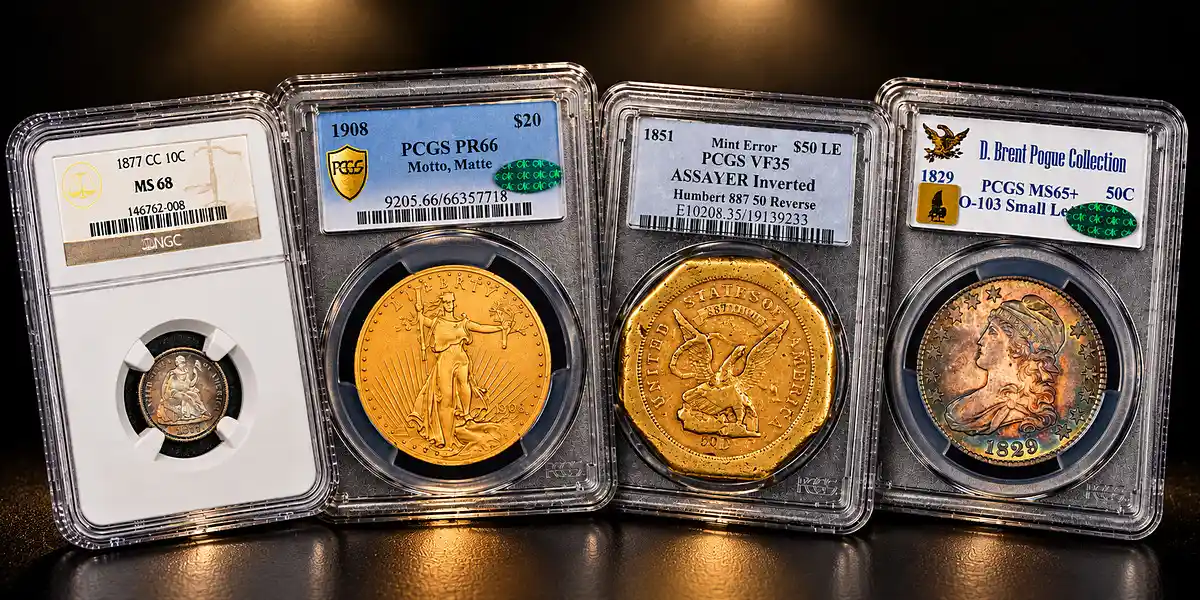
Moreover, several coins carry pedigrees that stretch back decades. Others once belonged to the celebrated D. Brent Pogue and Hamilton collections.
An 1851 Humbert $50 Gold Coin With a Remarkable Mistake
During the California Gold Rush, miners produced enormous quantities of gold. However, the region lacked enough reliable coinage to support its rapidly expanding economy.
The United States Assay Office of Gold in San Francisco helped address that problem. Under Augustus Humbert, the office produced massive octagonal $50 gold pieces that soon became known as slugs.
These early pieces required extraordinary amounts of handwork.
Workers punched the fineness and denomination into the gold. They also applied inscriptions separately to all eight edge panels. Consequently, every additional step created another opportunity for a mistake.
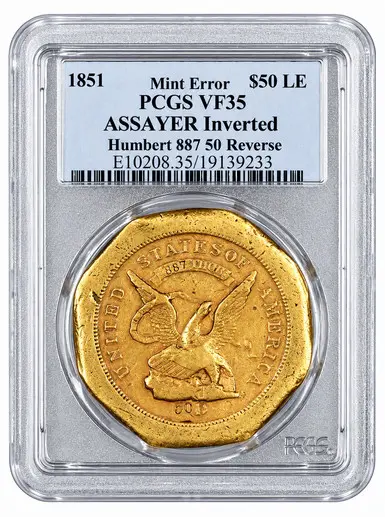
The 1851 Augustus Humbert $50 Gold Piece, Kagin-4, PCGS VF35, carries the famous ASSAYER INVERTED edge error.
The coin contains .887 fine gold and features a lettered edge. However, a worker punched the word ASSAYER upside down in relation to the other inscriptions.
The mistake survived more than a century and a half of collecting history. Today, it provides a direct glimpse into the labor-intensive manufacturing methods of Gold Rush California.
Equally important, this particular coin carries a remarkable pedigree.
Its documented auction history begins with Harmer Rooke in November 1969. Later appearances include Bowers in May 1973, the 1993 Baltimore ANA sale, and Heritage Auctions in 2003.
In August 2007, Heritage offered the coin as part of its Pacific Rim Collection. It realized $48,875.
For collectors of Pioneer gold, the attraction extends beyond the error itself. This coin combines California history, an unusual manufacturing mistake, and more than 50 years of documented auction appearances.
Pogue and Hamilton Half Dollars Bring Exceptional Pedigrees
The Capped Bust Half Dollar section offers another kind of numismatic history.
During the early 19th century, the Philadelphia Mint produced half dollars using numerous combinations of obverse and reverse dies. Today, specialists study those die marriages through the Overton attribution system.
As a result, two half dollars carrying the same date can represent very different collecting opportunities.
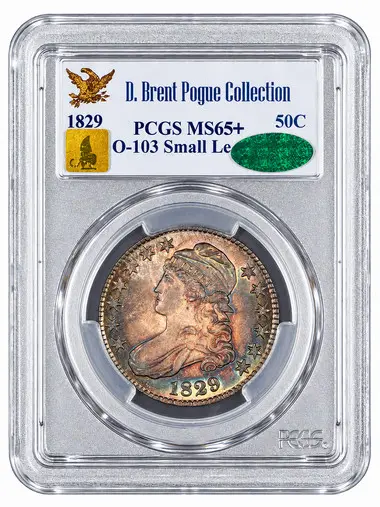
VCD’s offering includes several pieces with distinguished ownership histories.
Among the highlights is an 1829 O-103 Small Letters Capped Bust Half Dollar, graded PCGS MS65+ with CAC approval and Gold CMQ recognition.
The coin appeared in the landmark D. Brent Pogue Collection sale in February 2016. Earlier, it passed through R.M. Smythe & Company in May 2001.
The Hamilton Collection contributes additional material.
One highlight is an 1835 O-103 Half Dollar graded PCGS MS62. It remains in an Old Green Holder and carries CAC and CMQ approval.
Another is an 1837 GR-6 Reeded Edge Half Dollar graded PCGS AU55. Its Old Green Holder and Gold CAC sticker add further collector interest.
Meanwhile, an 1811 O-111 Early Die State Small 8 Half Dollar, graded NGC MS64 CAC, offers specialists an appealing early die-state example.
Other Hamilton pieces include an 1823 O-106a NGC MS62 Gold CAC and an 1834 O-107 Large Date, Small Letters NGC AU58 CAC CMQ.
For advanced collectors, these coins offer more than attractive grades. Their die varieties, earlier ownership, and documented histories help distinguish them from ordinary type examples.
Two Rare Proof Saint-Gaudens Double Eagles Take Center Stage
Few American gold coins combine artistry and rarity as effectively as the Proof Saint-Gaudens double eagles.
Augustus Saint-Gaudens created one of America’s most celebrated coin designs. Yet the Mint produced remarkably few Proof examples for collectors.
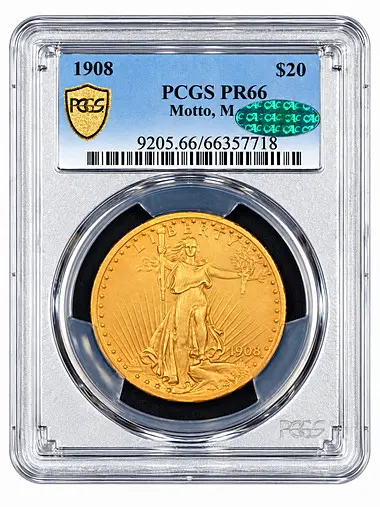
VCD will offer two important dates in consecutive lots.
Lot 34 features a 1908 Saint-Gaudens $20 Motto Matte Proof, PCGS PR66 CAC.
The Philadelphia Mint recorded a Proof mintage of just 101 pieces that year. Unlike the brilliant Proofs collectors knew from earlier decades, the new issue displayed a finely textured, sandblasted surface.
Many contemporary collectors disliked the unfamiliar finish. Nevertheless, those same surfaces now help define the character of the earliest regular Proof Saint-Gaudens double eagles.
PCGS CoinFacts estimates approximately 71 survivors across all grades. Furthermore, it places only about 35 examples at PR65 or finer.
The VCD specimen has spent more than 20 years in a private collection.
Immediately afterward, Lot 35 offers a 1909 Saint-Gaudens $20 Proof graded PCGS PR66.
The Mint changed direction in 1909, favoring a smoother satin or Roman-style finish. However, it struck just 67 Proof double eagles.
PCGS CoinFacts estimates approximately 43 surviving examples, including about 17 at PR65 or finer.
According to the auction catalog, PCGS has certified only six examples at PR66, with four finer.
Together, the two coins offer collectors an unusual opportunity to compare successive years of early Saint-Gaudens Proof production.
They also illustrate how quickly the Mint experimented with finishes on its prestigious gold coinage.
More Condition Rarities Round Out the Sale
Beyond the leading attractions, VCD has assembled a diverse selection of United States coins.
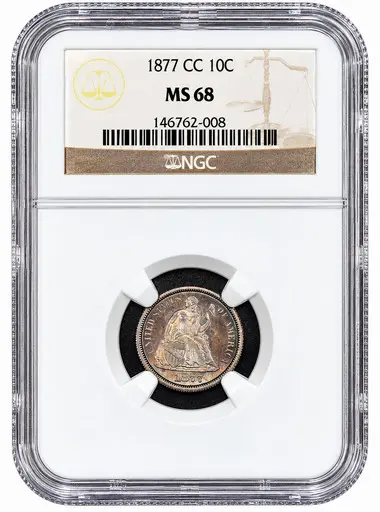
An 1877-CC Liberty Seated Dime graded NGC MS68 stands out for its exceptional certified grade. Likewise, an 1885-S Morgan Dollar graded NGC MS65 Prooflike CAC offers a desirable combination of preservation and reflective fields.
Gold collectors will also find an 1877 Liberty Head Double Eagle graded PCGS MS63.
Meanwhile, a 1935 original bank-wrapped roll of Lincoln cents from Mellon National Bank in Pittsburgh offers an entirely different collecting angle. A 5.52-troy-ounce San Francisco Mint silver ingot also adds historical interest to the catalog.
Rather than assemble a sprawling sale, VCD has concentrated on a smaller group of coins with distinctive qualities.
Charles Jonath, chief numismatist of VCD Auctions, emphasized the importance of provenance in discussing the offering.
“You are not just looking at grades on holders,” Jonath said.
Indeed, the strongest coins in this auction tell stories that began long before modern grading services existed.
VCD Auction Closes November 19
VCD #15 — The Collector’s Cabinet opened for bidding October 19, 2026. The current online catalog contains 37 lots.
The first lot closes Thursday, November 19, at 5 p.m. Pacific / 8 p.m. Eastern.
VCD Auctions charges a 10% buyer’s premium.
Collectors can view the complete catalog, examine photographs, review lot descriptions, and submit bids through the VCD Auctions online catalog.
For additional information, contact VCD Auctions at 702-949-7515 or [email protected].