


PlusThe cent is gone from circulation, so why is there a brand-new 2026-S Proof cent?
The United States Mint will release a Proof Set on October 6 that collectors may look back on very differently from a typical annual issue.
The 2026 United States Mint Proof Set captures one of the most unusual years in modern American coinage. It includes a Lincoln cent made after the Mint ended production of pennies for circulation. Plus it contains a dime with Liberty on the obverse for the first time since 1945. And it also replaces John F. Kennedy on the half dollar for a one-year anniversary design. Moreover, five different quarters tell an abbreviated story of the American experiment.
All of it comes during the nation’s 250th anniversary.
Sales open October 6, 2026, at noon Eastern Time. The Mint has priced the set at $107. Each set contains 10 Proof coins struck at the San Francisco Mint with the “S” mintmark. The Mint packages the coins in two clear protective lenses with a presentation package and certificate of authenticity. This 10-Coin Proof Set may define 2026 U.S. coinage.
For collectors, however, the real attraction lies inside.
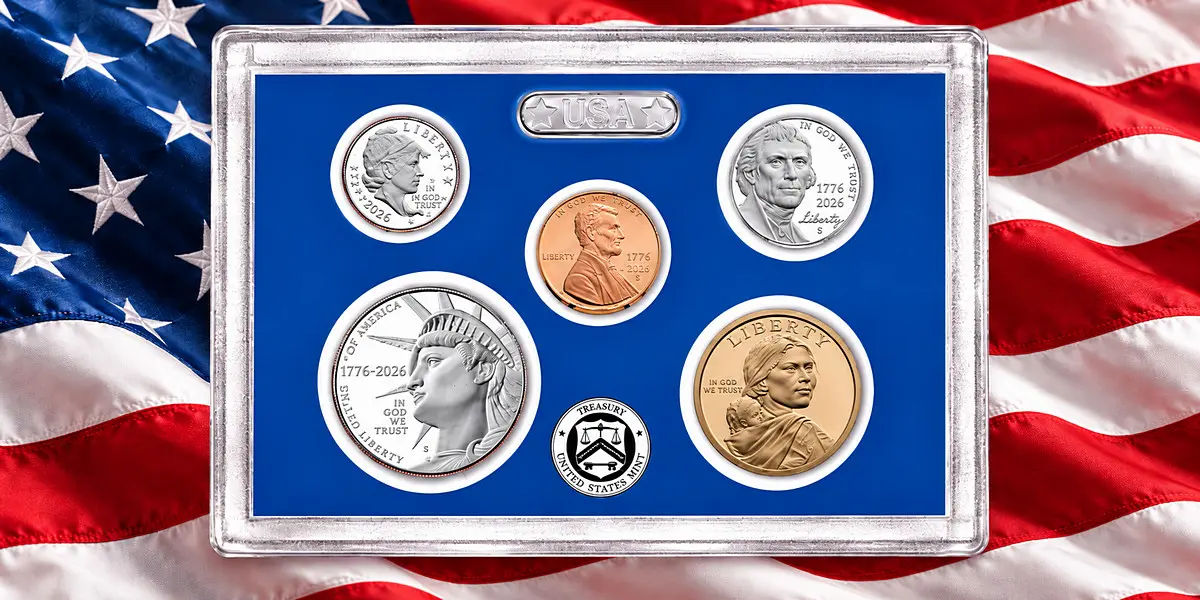
This Is More Than an Annual Proof Set
Most United States Proof Sets record a year of coinage. The 2026 set records a year in which the coinage itself changed.
Congress authorized special 2026 designs through the Circulating Collectible Coin Redesign Act of 2020. The law gave the Treasury authority to redesign circulating denominations for the one-year period beginning January 1, 2026, to celebrate the United States Semiquincentennial.
As a result, collectors receive 10 coins that function almost like a miniature metallic history of the United States.
Five are Semiquincentennial quarters. Their themes cover the Mayflower Compact, Revolutionary War, Declaration of Independence, U.S. Constitution, and Gettysburg Address.
Together, they move from self-government in colonial America through revolution, independence, constitutional government, Civil War, and Lincoln’s restatement of the nation’s ideals.
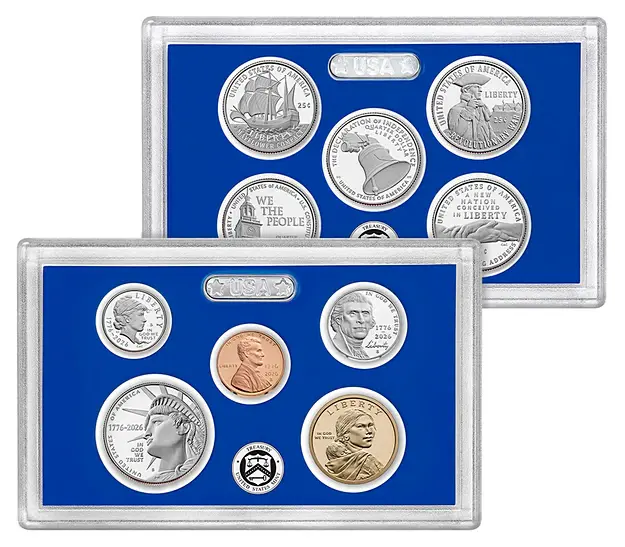
That alone separates the 2026 Proof Set from an ordinary annual issue.
Then come the dime and half dollar.
Liberty Returns to the Dime After 80 Years
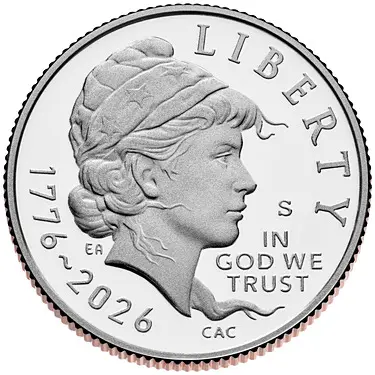
The 2026 Emerging Liberty dime breaks an 80-year run of the familiar Roosevelt design on the obverse.
For 2026 only, the obverse features a personification of Liberty. The design shows a determined Liberty facing forward as the winds of revolution move through her hair. Her cap carries stars and stripes while also recalling Liberty caps seen on early American coins.
The change carries real numismatic significance.
Before the Roosevelt dime arrived in 1946, nearly every American dime featured some form of Liberty.
Therefore, the 2026 coin does more than commemorate an anniversary. It reconnects the denomination with a design tradition that stretches back to the earliest federal coinage.
The Roosevelt design gives way for this single anniversary year.
The Kennedy Half Dollar Steps Aside for the Statue of Liberty
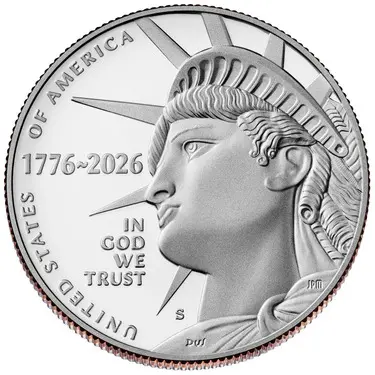
The half dollar delivers another dramatic break with modern tradition.
For 2026, the Enduring Liberty Half Dollar replaces the familiar portrait of President John F. Kennedy and the Presidential Coat of Arms.
Instead, the obverse presents a close view of the Statue of Liberty, looking outward toward the future.
The reverse carries the theme further. Liberty passes her torch to a new generation. The coin also carries the words, “KNOWLEDGE IS THE ONLY GUARDIAN OF TRUE LIBERTY.”
It marks the first major departure from the Kennedy half dollar format that collectors have known for more than six decades.
Yet perhaps the smallest coin in the set tells the biggest story.
The 2026 Lincoln Cent Exists After the Circulating Penny Ended
In November 2025, the United States Mint struck its final one-cent coin for general circulation.
That ceremonial strike in Philadelphia closed a 232-year chapter in American commerce. The Mint had produced one-cent coins for everyday use since the earliest years of federal coinage.
However, the cent itself did not disappear.
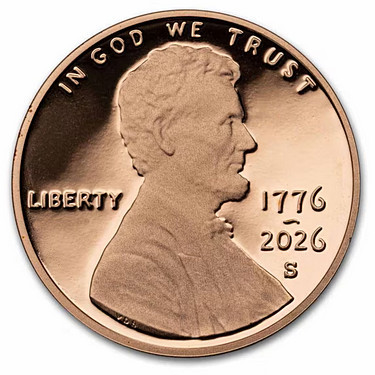
The Mint decided to continue making Lincoln cents specifically for collectors. Therefore, the 2026-S Proof Lincoln cent in this set belongs to a new era. It is a genuine United States one-cent coin, but the Mint never intended it for circulation.
That makes this small copper-plated zinc coin historically fascinating.
Lincoln first appeared on the cent in 1909, on the 100th anniversary of his birth. His appearance also made him the first U.S. president portrayed on a regularly issued American coin.
The 2026 Proof cent retains Victor David Brenner’s familiar Lincoln portrait and the Union Shield reverse introduced in 2010. However, its obverse carries the special anniversary date: 1776 ~ 2026
So the coin connects three different chapters of American history: the nation’s founding, Lincoln’s preservation of the Union, and the end of the cent as an everyday circulating coin.
For cent collectors, that alone gives the 2026 Proof Set a compelling reason to exist.
Jefferson Also Gets the 250th Anniversary Treatment
The 2026-S Jefferson nickel keeps its familiar Jefferson and Monticello designs. However, the obverse also carries the special “1776 ~ 2026” dual date.
The current forward-facing Jefferson portrait dates to 2006 and draws inspiration from an 1800 painting by Rembrandt Peale. The word LIBERTY appears in Jefferson’s own handwriting. On the reverse, Felix Schlag’s classic Monticello design continues.
Again, the dual date makes the 2026 issue immediately identifiable even to someone who does not normally collect coins.
Polly Cooper and an Overlooked Revolutionary War Story
The set’s 2026 Native American $1 Coin adds another powerful historical connection.
Its obverse retains Glenna Goodacre’s portrait of Sacagawea carrying her infant son Jean-Baptiste.
However, the reverse honors Polly Cooper and the Oneida Indian Nation.
During the Revolutionary War, the Oneida supported the American cause. At Washington’s invitation, Oneida representatives traveled hundreds of miles to Valley Forge with badly needed supplies, including dried white corn.
Oneida oral tradition credits Polly Cooper with helping the starving Continental soldiers prepare the corn properly. She remained at Valley Forge after others returned home and continued assisting the army.
The coin shows Cooper holding a basket and sharing the Oneidas’ gift of corn with General George Washington. Washington holds his hat in a gesture of gratitude and respect.
It brings a lesser-known story of the Revolution into millions of potential collections.
The Five Quarters Tell America’s Story
The five 2026 Semiquincentennial quarters form the historical backbone of the Proof Set.
They honor:
- Mayflower Compact
- Revolutionary War
- Declaration of Independence
- U.S. Constitution
- Gettysburg Address
These are not simply five variations of a standard reverse.
The program uses different historical subjects to trace the evolution of the American idea. For example, the Mayflower Compact coin recalls government based on the consent of the governed. The Declaration quarter pairs Thomas Jefferson with the Liberty Bell. Meanwhile, the Constitution quarter features James Madison and Independence Hall.
Therefore, a single Proof Set provides a compact visual history lesson spanning more than two centuries.
2026 Proof Set Specifications
- Lincoln Cent: 2.5% copper, balance zinc; 2.50 grams; 19.05 mm; plain edge.
- Jefferson Nickel: 25% nickel, balance copper; 5.00 grams; 21.21 mm; plain edge.
- Emerging Liberty Dime: 8.33% nickel, balance copper; 2.268 grams; 17.91 mm; reeded edge.
- Semiquincentennial Quarters: 8.33% nickel, balance copper; 5.67 grams each; 24.26 mm; reeded edge.
- Enduring Liberty Half Dollar: 8.33% nickel, balance copper; 11.34 grams; 30.61 mm; reeded edge.
- Native American $1 Coin: 6% zinc, 3.5% manganese, 2% nickel, balance copper; 8.10 grams; 26.49 mm; lettered edge.
- Mint: San Francisco
- Mintmark: S
- Finish: Proof
- Number of Coins: 10
- Issue Price: $107
- Product Limit: 480,000 sets
Proof coins differ sharply from ordinary pocket change. The Mint manually feeds specially prepared blanks into presses fitted with specially polished dies. Each coin receives at least two strikes. The process creates sharply defined designs, frosted devices, and deeply reflective fields.
How Many 2026 Proof Sets Will the Mint Make?
The United States Mint lists a product limit of 480,000 sets.
Importantly, that figure is not the same thing as a final mintage.
The Mint currently lists no mintage limit for the coins in the 2026 Proof Set. Some Proof versions also appear in other annual products. Therefore, collectors should not describe the individual coins as having a 480,000 mintage.
The final number of 2026 Proof Sets distributed will depend on actual sales, returns, and Mint production within the announced product limit. The Mint currently lists no household order limit.
Why the 2026 Proof Set Matters Beyond Coin Collecting
Collectors often talk about rarity, grade, and mintage. However, the best coins also document moments when American history changes direction.
The 2026 United States Mint Proof Set does that unusually well.
It marks America’s 250th anniversary, yet preserves several designs created only for this historic year. It records Liberty’s dramatic return to the dime and half dollar, but also tells five chapters of American history through the quarter. And Finally it honors an Oneida woman who helped Washington’s starving army.
And tucked inside sits a Lincoln cent struck after Americans stopped receiving newly minted pennies in everyday commerce.
For longtime collectors, the set fills an obvious place in a modern U.S. collection.
For families, new collectors, and people who normally pay little attention to coins, it offers something more accessible: a time capsule of America at 250.
That may ultimately make the 2026 Proof Set one of the most memorable annual sets of the modern era.
The 2026 United States Mint Proof Set goes on sale Tuesday, October 6, at 12 noon Eastern Time for $107.




This is quite a collection of coins!
I would love to purchase both these proof sets. Beautiful coins with lots of United States history.
This is an informative article. I never really collected mint sets. Some were gift to me when I was younger, but I was interested in filling the coin books.
I think that the coinage for 2026 is beautiful and it’s my intention to aquire the proof set.
Definitely looking forward to receiving my sets from the mint.
I love the Liberty dime design, I wish it had been used on a larger coin denomination.
one of a kind set waiting for mine delivery
I’d like to have this for the penny alone. :D
It’s a beautiful set.
I received my proof set from the mint last week with a signed coa by Paul Hollis #7 of 41 nobody knows about this its a treasure hunt set for the other 40 sets hand signed so let the hunt begin for all of you!!! Good luck!!!