


Only Five Exist: One of America’s Rarest Gold Coins Returns
One of America’s great experimental gold coins returns to the market as Heritage prepares an ANA auction packed with Stellas, Carson City rarities, early gold, Proof Lincoln cents, and a newly discovered 1795 large cent overstrike.
Some auction headliners need little introduction. Others require an explanation of why collectors consider them important.
The 1879 Liberty Head Quintuple Stella needs neither.
Only five examples of this extraordinary $20 experimental gold coin have been traced. Moreover, the Smithsonian Institution holds one permanently in the National Numismatic Collection. That leaves only four examples available to private collectors.
Now, the finest-certified example will return to the auction block.
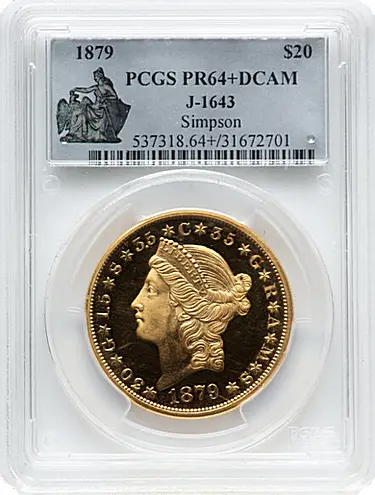
Heritage Auctions will offer the 1879 Liberty Head Quintuple Stella, Judd-1643, Pollock-1843, Low R.7, graded PR64+ Deep Cameo by PCGS, during its ANA U.S. Coins Signature Auction, scheduled for August 31 through September 5, 2026. The coin comes from the celebrated Bob R. Simpson Collection, Part XIII.
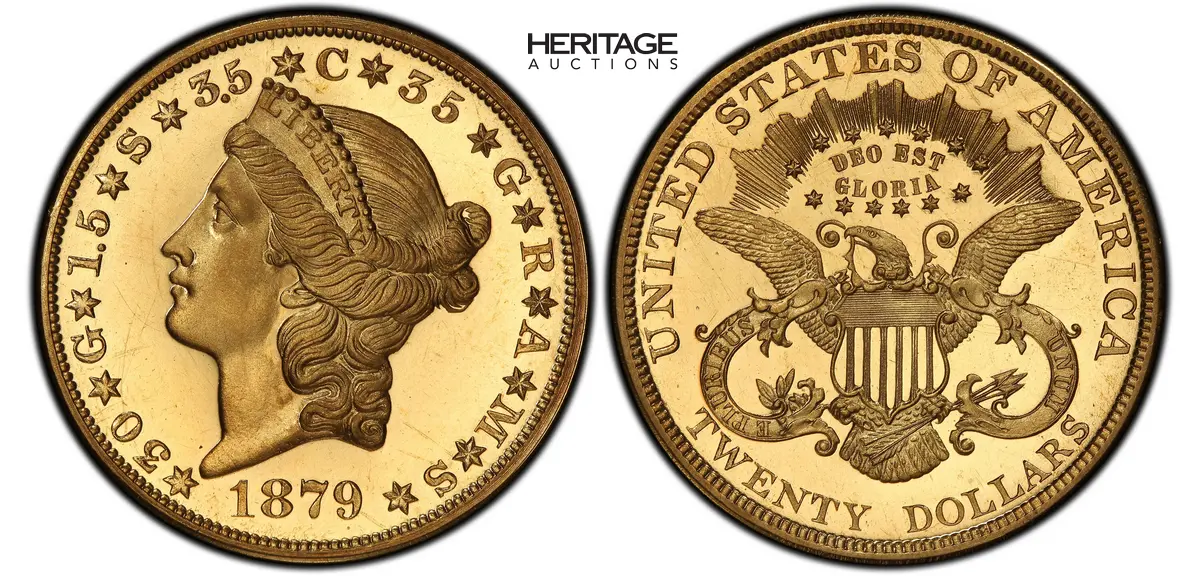
Todd Imhof, Executive Vice President at Heritage Auctions, calls the issue extraordinarily rare and points to the Simpson coin as the finest-certified example.
That description barely hints at the story behind it.
The $20 Coin Born From America’s Stella Experiment
The Quintuple Stella grew from a late-1870s attempt to create an American coin that could compete more conveniently with European gold denominations.
Former congressman and U.S. Minister to Austria John A. Kasson advocated a coin that could exchange readily with the Austrian eight-florin piece, then worth about $3.88. However, later research by numismatist Roger W. Burdette points to Dr. William Wheeler Hubbell as a driving force behind the actual Stella proposal.
Hubbell promoted both the metric system and his patented goloid alloy of gold, silver, and copper. He proposed the familiar $4 Stella at seven grams. The Quintuple Stella multiplied that concept by five and produced a 35-gram, $20 metric double eagle.
The Philadelphia Mint struck only five gold examples.
A June 4, 1880 letter from Acting Mint Director Robert Preston confirmed that total and stated that officials had destroyed the dies. Today, Heritage has traced all five coins. One resides at the Smithsonian, while four remain privately held.
The Simpson specimen stands at the top.
PCGS grades it PR64+ Deep Cameo, with none finer. Heritage also notes that the coin has remained off the market for 18 years. Simpson acquired it when he purchased the Southern Collection in 2008.
The issue already carries a seven-figure auction pedigree. In August 2025, Heritage sold another Quintuple Stella, graded PR64 Deep Cameo PCGS, for $2.16 million. Simpson had previously owned that coin as well but retained the higher-graded specimen now coming to auction.
A Unique 1876 Double Eagle Pattern Joins the Simpson Offering
The Simpson Collection supplies another coin that collectors cannot simply wait to find again.
Heritage will offer the unique 1876 Liberty Double Eagle pattern, Judd-1490, Pollock-1643, PR64+ Cameo PCGS, CAC.
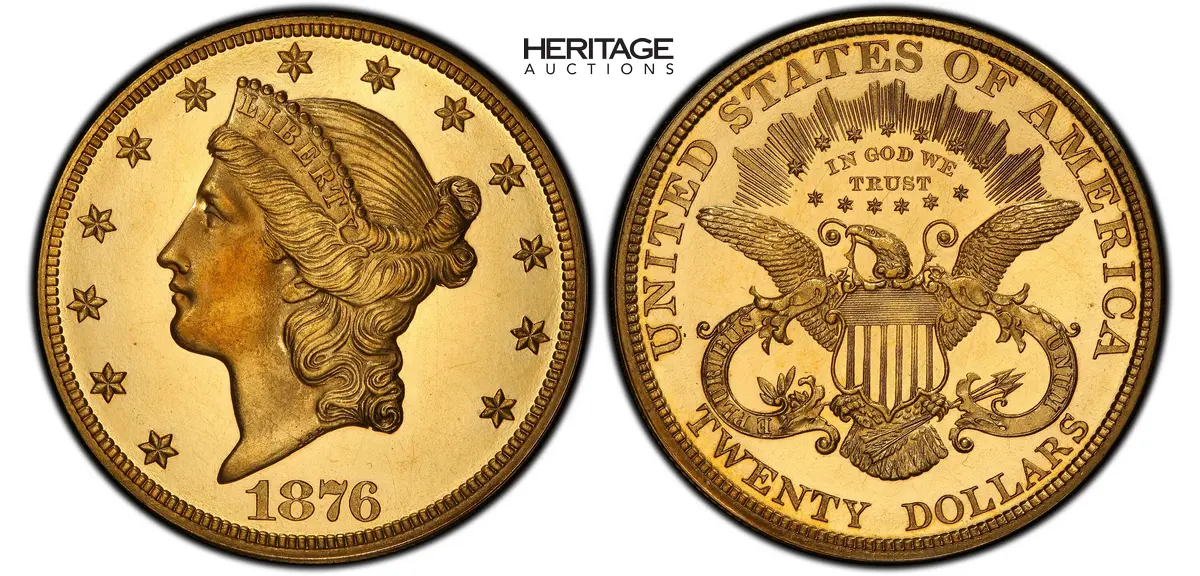
The Philadelphia Mint created the piece while it worked toward the Type Three Liberty Head Double Eagle design. The experimental coin spells out TWENTY DOLLARS on the reverse rather than using the earlier TWENTY D format. The Mint adopted major elements of this transition for regular coinage in 1877.
Yet collectors knew nothing about Judd-1490 during the 19th century.
No contemporary auction catalog offered one. Numismatic publications did not report it. The coin finally emerged publicly in the early 20th century, and The Numismatist discussed the unique pattern in 1909.
Its pedigree later included William H. Woodin, Waldo Newcomer, Colonel E.H.R. Green, King Farouk, Dr. John W. Wilkison, Ed Trompeter, and Bob Simpson. Heritage says the 2026 sale marks only its third auction appearance.
Costa Family Collection Brings Three Major Stellas
Stellas do not stop with the Simpson coins.
The 51-lot Costa Family Collection, Part III brings rare gold, high-end Colonial coins, type coins, Betts medals, and three major Stella rarities.
First comes the 1879 Coiled Hair Stella, Judd-1638, Pollock-1838, JD-1, R.6, PR67 Cameo NGC.
Heritage has traced only 14 examples. The auction coin ties for the finest certified. Although references traditionally classify the $4 Stella as a pattern, collectors routinely pursue it alongside regular-issue U.S. gold. The combination of extreme rarity, unusual denomination, and distinctive design has made the Stella one of the great trophies of American numismatics.
The Costa Collection also offers the 1880 Coiled Hair Stella, Judd-1660, Pollock-1860, JD-1, Low R.7, PR64 Cameo PCGS.
This variety ranks as the rarest of the four principal Stella issues. Heritage has identified 10 examples. In the past, researchers sometimes merged the pedigree of the present coin with that of the Kern specimen. As a result, earlier counts suggested only nine survivors. Heritage catalogers later examined both coins and confirmed them as separate pieces.
The third Costa Stella is an 1880 Flowing Hair Stella, Judd-1657, Pollock-1857, JD-1, R.6, PR66 NGC.
Heritage has confirmed 18 examples, although other estimates place the surviving population near 20 or slightly higher. Like the other Stellas, the 1880 Flowing Hair technically belongs to the pattern series. Nevertheless, major references regularly present it alongside federal gold coinage, including A Guide Book of United States Coins and 100 Greatest U.S. Coins.
Round Lake Collection Offers Major Early Gold Rarity
The Round Lake Collection, which contains more than 60 auction lots, turns the clock back to the early Philadelphia Mint.
Its centerpiece is a 1798/7 Capped Bust Right Eagle, 7×6 Stars, BD-2, Low R.6, graded MS62 by PCGS.
The variety ranks among the classic rarities of early American gold. Heritage has traced 18 specimens, while PCGS CoinFacts estimates roughly 20 to 30 survivors in all grades.
The auction coin ties for the third-finest known grade. Moreover, the finest example belongs to the Smithsonian and therefore remains unavailable to collectors. The present coin also carries a remarkable pedigree. It first surfaced in the collection of former Treasury Secretary and celebrated numismatist William H. Woodin, which Thomas Elder sold in March 1911.
Carson City Gold and a Key-Date Morgan
Meanwhile, the 43-lot Reno-Carson City Collection attacks another area where collectors rarely lack competition.
An 1870-CC Liberty Head Double Eagle, Winter 1-A, graded XF40 by NGC, leads the gold offerings.
The Carson City Mint struck only 3,789 double eagles in 1870, its inaugural year of operation. Heritage currently estimates that roughly 55 to 65 collectible examples survive, plus about a dozen Details-grade pieces. Consequently, the 1870-CC $20 has become one of the defining rarities of Carson City coinage.
Large-denomination U.S. gold attracted relatively few systematic collectors during the late 19th and early 20th centuries. However, that market changed dramatically during the 1930s. Collectors including Louis E. Eliasberg and Dr. Charles W. Green recognized rare U.S. gold coins as one of the lawful ways private citizens could retain significant gold holdings following federal restrictions on private monetary gold ownership.
The Reno-Carson City Collection also contains an 1889-CC Morgan Dollar, VAM-5, graded MS64 by NGC and approved by CAC.
The Carson City Mint produced only 350,000 Morgan Dollars in 1889. Many entered circulation soon after production. The Treasury released additional pieces beginning in the 1930s. Few full bags survived into the modern collecting era, which makes high-grade 1889-CC dollars especially elusive.
Current Heritage catalog data lists 44 NGC grading events at MS64, one at MS64★, and five numerically finer certifications.
Bolt Collection Assembles Elite Proof Lincoln Cents
Lincoln cent specialists will find another major attraction in the 26-lot Bolt Collection of Proof Lincoln Cents.
Heritage describes it as the all-time finest PCGS Registry Set of 1909-1958 Proof Lincoln cents. The collection also contains several coins from the famous Stewart Blay Collection.
Its star is a 1909 Lincoln Cent PR68 Red PCGS, CAC.
PCGS reports just one example at PR68 Red and none finer. CAC likewise records the coin as the sole example at that grade in Heritage’s April 2026 census data.
The year 1909 produced three different Proof cent types: the outgoing Indian Head Cent, the short-lived Lincoln VDB Proof, and the Lincoln non-VDB Proof.
After the Lincoln Cent debuted on August 2, Treasury Secretary Franklin MacVeagh ordered Victor David Brenner’s initials removed on August 12. The Mint also reduced the reverse rim relief. Proof production then continued with the revised design, while one obverse die from VDB production carried over to the later Proofs.
Heritage reports a mintage of 2,618 for the non-VDB 1909 Proof Lincoln Cent. Yet full Red survivors remain much scarcer today.
Other major Bolt Collection coins include the 1909 VDB Cent PR66 Red PCGS, CAC; 1914 Cent PR68+ Red PCGS, CAC; and 1955 Cent PR69 Red Deep Cameo PCGS.
The “Bearded Goddess” Leads the Van Cleve Collection
The 57-lot Van Cleve Family Collection provides two exceptional 1807 Capped Bust Half Dollars.
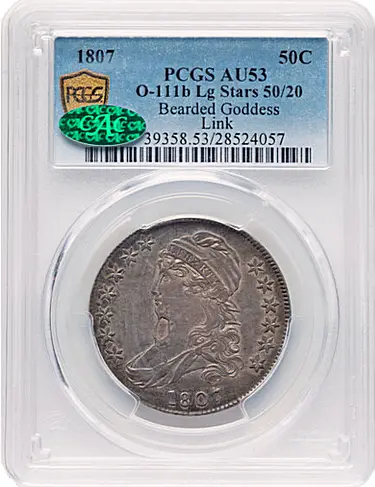
The first carries one of the most colorful nicknames in early federal coinage: the “Bearded Goddess.”
Heritage will offer an 1807 Capped Bust Half Dollar, O-111b, High R.4, AU53 PCGS, CAC. Leaman and Gunnet’s emission sequence places O-111 as the third die marriage in the Capped Bust Half Dollar series. A prominent die crack extending from Liberty’s chin toward the bust creates the “beard” that gives the late die state its nickname.
The collection also includes an 1807 Large Stars Half Dollar, O-114, R.3, MS65 PCGS, CAC.
Only four 1807-dated die varieties exist for the new Capped Bust type. In addition, Heritage reports only two O-114 examples with higher numeric grades than the auction coin.
A 1795 Large Cent Hid Its Secret Until 2026
One of the auction’s most intriguing discoveries did not come from an old-name collection.
Kentucky numismatist Jeff Garrett found a trio of large cents while attending the Berlin Coin Fair. One proved far more unusual than its initial appearance suggested.
The coin is a 1795 Lettered Edge Cent, S-76, B-4, struck over a 1794 S-71 Cent, R.8, graded AU58+ by PCGS.
Most importantly, collectors can see elements of the 1794 date underneath the 1795 strike.
Heritage knows of two other 1795 S-76 cents with evidence of 1794 large cent undertypes. Both grade lower. One offers no visible evidence of the underlying 1794 date. The other came from an approximately 80% off-center 1794 S-63 cent and displays the famous “Fallen 4.”
Garrett’s discovery stands apart because the undertype shows unusual clarity. Heritage identifies the host coin as an S-71 and notes visible 7, 9, and 4 digits between portions of the 1795 reverse design.
Until Garrett encountered it in Germany in January 2026, the current generation of early copper specialists did not know the coin existed.
More Major Rarities Fill the ANA Auction
The depth of Heritage Auction 1396 stretches well beyond its featured collections.
Additional highlights include:
A 1797 Small Eagle Half Eagle, 16 Stars, BD-4, High R.8, AU58+ PCGS, HBJ-209. Heritage identifies it as the unique known example of the BD-4 die marriage.
An 1860-O Half Dollar indented by a Half Dime planchet, MS63 PCGS, with the two pieces surviving together as a remarkable mated error pair.
The finest-known 1897-S Liberty Head Double Eagle, graded MS67 by PCGS and approved by CAC. The coin traces to the Clapp and Eliasberg collections.
An 1893-O Morgan Dollar MS65 PCGS, CAC, a major condition rarity for the New Orleans issue.
An 1827/3 Capped Bust Quarter Original, B-1, R.7, PR64 PCGS, one of only nine known Originals.
An 1849 Gold Dollar No L, JD-1, R.7, PR62 PCGS. Researchers recognize five confirmed Proofs and estimate no more than seven may exist.
Heritage will conduct its ANA U.S. Coins Signature Auction #1396 from August 31 through September 5, 2026. The auction catalog is now available, and Heritage will post prices realized as the sale concludes.
For collectors, however, the defining moment may come when the Simpson Quintuple Stella reaches the block.
Five examples exist. One belongs to the nation. Only four remain in private hands.
And the finest of those four is about to change hands.




Wonderful article and very informative.