Only 731 Made: Eliasberg’s Extraordinary 1897 Barber Half Dollar
A remarkable 129-year collecting history, exceptional Cameo surfaces, and one of America’s greatest numismatic pedigrees distinguish this Proof half dollar.
In November 1897, collector John M. Clapp purchased a Proof Barber half dollar directly from the Philadelphia Mint. He could hardly have known how many important collections the coin would eventually enter.
Nearly 129 years later, that same half dollar will cross the auction block during Stack’s Bowers Galleries’ November 17, 2026, Rarities Night sale. The coin, from the Mack C. Chase Collection, carries an NGC grade of Proof-68★ Cameo.
Only 731 Proof Barber half dollars left the Philadelphia Mint in 1897. Yet this particular survivor offers something beyond its low original mintage. Its documented ownership history connects three celebrated American collections: Clapp, Eliasberg, and Hugon.
For advanced collectors, that combination of quality and provenance makes Lot 2063 especially interesting.
Two Million Half Dollars for Commerce, Just 731 Proofs for Collectors
The Philadelphia Mint struck 2,480,000 regular-issue Barber half dollars in 1897. Those coins served an expanding American economy and eventually entered everyday commerce.
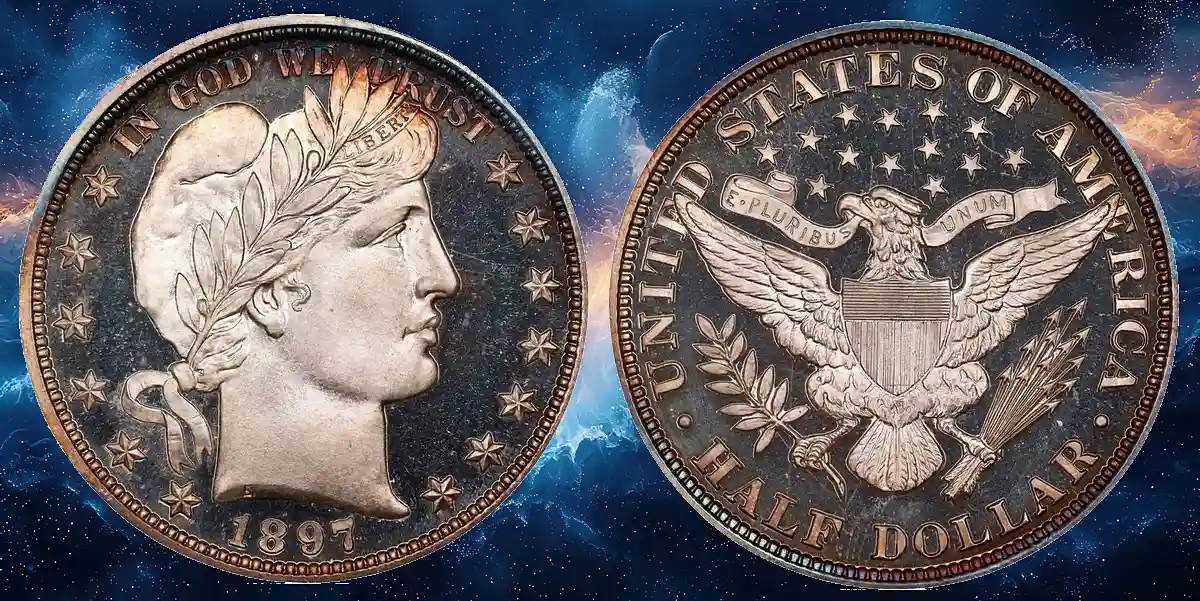
However, the Mint produced a separate group of just 731 Proof half dollars for collectors. Workers prepared these coins with specially finished dies and planchets to create reflective surfaces and exceptionally sharp details.
Unlike circulation strikes, these pieces entered the numismatic market rather than everyday commerce.
Proof production remained relatively consistent during the early Barber years. The Mint struck 1,245 Proof half dollars in 1892, the series’ inaugural year. Thereafter, annual production generally ranged from 500 to 900 pieces.
The entire Proof Barber half dollar series spans 24 dates, from 1892 through 1915.
Today, collectors can locate many dates in Choice Proof condition. However, exceptional preservation and strong Cameo contrast dramatically narrow the available population.
A Cameo Proof With Remarkable Preservation
The Eliasberg-Hugon specimen offers an impressive combination of surface quality, contrast, and color.
Both sides feature bright silver-white central areas surrounded by reddish-apricot peripheral toning. Meanwhile, heavily reflective fields contrast with the frosted design elements, creating the distinctive Cameo effect.
The coin also displays exceptionally sharp details throughout Liberty’s portrait and the reverse eagle. Furthermore, its surfaces show remarkably little evidence of handling or deterioration.
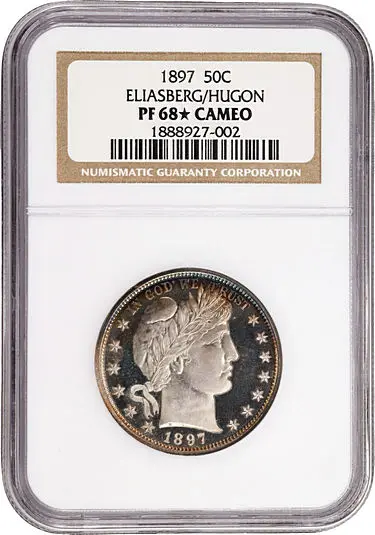
NGC assigned the coin Proof-68 Cameo and added its Star designation for exceptional eye appeal. That additional recognition distinguishes particularly attractive coins from others with the same numerical grade.
According to the Stack’s Bowers catalog, NGC reports seven examples at the Proof-68 Cameo level. Four carry the Star designation, and none grade higher within that Cameo category.
PCGS reports three examples at Proof-68 Cameo, with none finer in its corresponding category.
Although 1897 ranks among the more obtainable Barber half dollar dates with strong Deep or Ultra Cameo contrast, coins at the highest certified grade levels remain exceptionally scarce.
Consequently, collectors must distinguish between the availability of an 1897 Proof and the rarity of a specimen approaching the top of its grading category.
The Clapp-Eliasberg Connection: A Direct Link to the Philadelphia Mint
The coin’s ownership history offers perhaps its greatest distinction.
John M. Clapp began assembling an important collection of United States coins during the 1880s. Unlike collectors who relied exclusively on dealers and auctions, Clapp obtained numerous contemporary issues directly from their issuing mints.
His approach allowed him to acquire exceptional specimens during their original year of production.

In November 1897, Clapp obtained this Proof half dollar directly from Philadelphia. Following his death in 1906, his son John H. Clapp continued developing the family’s collection.
The collection remained intact until 1942, when Baltimore financier Louis E. Eliasberg, Sr. purchased the Clapp estate holdings through Stack’s.
The reported purchase price was $100,000 for the collection, not for this individual half dollar. The acquisition became one of the most consequential transactions in American numismatic history.
Eliasberg subsequently assembled what collectors regard as the only complete collection of regular-issue United States coins by all then-known dates and mintmarks. He achieved that milestone in 1950.
His cabinet included extraordinary rarities, but it also preserved beautiful examples of comparatively obtainable issues. The 1897 Proof Barber half dollar exemplifies that emphasis on quality.
The coin eventually entered Bowers and Merena’s April 1997 sale of the Louis E. Eliasberg, Sr. Collection as Lot 2079.
Later, it joined the Hugon Collection and appeared in Heritage Auctions’ January 2005 FUN Signature Sale as Lot 4277.
Now part of the Mack C. Chase Collection, the half dollar returns to the auction market with its distinguished provenance intact.
The Barber Half Dollar’s Little-Known Star Mystery
One of the most interesting features of Barber silver coinage involves something collectors can easily overlook.
The stars on the two sides do not have the same number of points.
Liberty’s portrait appears between 13 six-pointed stars. However, the 13 stars above the reverse eagle have five points each.
This difference was deliberate.
During the development of the Barber designs in 1891, Mint officials debated several artistic details. They considered the arrangement of the reverse eagle, its surrounding elements, and even the appearance of the stars.
Historical Mint correspondence provides an unusual glimpse into the decision.
In October 1891, Mint Director Edward O. Leech supported the use of six-pointed stars on the obverse.
He agreed with the engraver that the six-pointed star looked richer. Meanwhile, he authorized five-pointed stars for the reverse.
The surviving correspondence confirms that the different star styles resulted from a conscious design decision rather than an engraving mistake.
The episode also illustrates how closely Mint officials supervised America’s new silver coinage.
Charles E. Barber’s designs debuted in 1892, replacing the long-running Seated Liberty designs on the dime, quarter, and half dollar.
The 1897 Proof offered by Stack’s Bowers preserves those design details with exceptional clarity.
Why Early Barber Proofs Are Particularly Special
The earliest Proof Barber half dollars also represent an important period in American Mint craftsmanship.
During the 1890s, Proof dies frequently produced strong contrast between frosted devices and mirrorlike fields. Collectors today prize that visual effect, particularly when both sides show pronounced contrast.
However, Proof production methods changed during the early 1900s.
Around 1902, the Philadelphia Mint shifted toward a more brilliant Proof appearance. As a result, deeply contrasted Cameo examples became much less common among later Barber half dollars.
Stack’s Bowers notes that Deep and Ultra Cameo examples virtually disappear from the series after 1902.
That distinction gives the Proofs of the 1890s an additional appeal. They represent a period when the Mint produced some of the series’ most visually dramatic examples.
The 1897 issue stands out in this respect. PCGS identifies the date as particularly strong in overall Proof quality, with an unusually high number of survivors grading Proof-68.
Nevertheless, preservation remains critical. More than a century of storage, cleaning, handling, and environmental exposure has affected many surviving Proof coins.
The Eliasberg-Hugon example combines the desirable early Cameo appearance with a grade that places it among the finest certified pieces in its specific category.
1897 Barber Half Dollar Specifications
- Denomination: Half Dollar (50 cents)
- Date: 1897
- Mint: Philadelphia (no mintmark)
- Designer: Charles E. Barber
- Composition: 90% silver, 10% copper
- Weight: 12.50 grams
- Diameter: 30.6 mm
- Edge: Reeded
- Silver content: 0.3617 troy ounce
- Proof mintage: 731
- Die attribution: JD-1, Rarity-2
- Auction specimen: NGC Proof-68★ Cameo
The obverse depicts Liberty facing right, wearing a Phrygian cap and a laurel wreath. The motto IN GOD WE TRUST appears above her portrait.
The reverse features a heraldic eagle holding arrows and an olive branch. A ribbon carries E PLURIBUS UNUM, while UNITED STATES OF AMERICA and HALF DOLLAR complete the design.
A Historic Proof Returns to Rarities Night
Stack’s Bowers Galleries will offer the 1897 Barber half dollar as Lot 2063 during Session 2 of its November 2026 Showcase Auction.
The Rarities Night session begins Tuesday, November 17, at noon Pacific Time (3 p.m. Eastern).
The coin comes from the Mack C. Chase Collection, which also contributes an important group of Walking Liberty half dollars to a separate auction session.
For collectors of Proof Barber coinage, the Eliasberg-Hugon specimen combines technical quality, an attractive Cameo finish, and a documented history stretching back to its original sale by the Philadelphia Mint.
Its appeal extends beyond the series itself. The half dollar offers a tangible connection to John M. Clapp’s collecting methods, the formation of Eliasberg’s legendary cabinet, and the changing standards of American Proof coin production.
After nearly 129 years, the coin’s history remains as compelling as its appearance.
Auction details: Stack’s Bowers Galleries — November 2026 Rarities Night, Lot 2063