


A Gilded Age $20 Gold Rarity Could Steal Summer FUN
Heritage Auctions will bring one of the great Gilded Age proof gold rarities to market during its July 16-18, 2026 Summer FUN US Coins Signature Auction.
The Dallas-based firm announced the sale on June 30. The auction includes more than 1,400 lots. It spans the U.S. coin market from Colonials to proof Trade dollars, Morgan dollars, patterns, and gold.
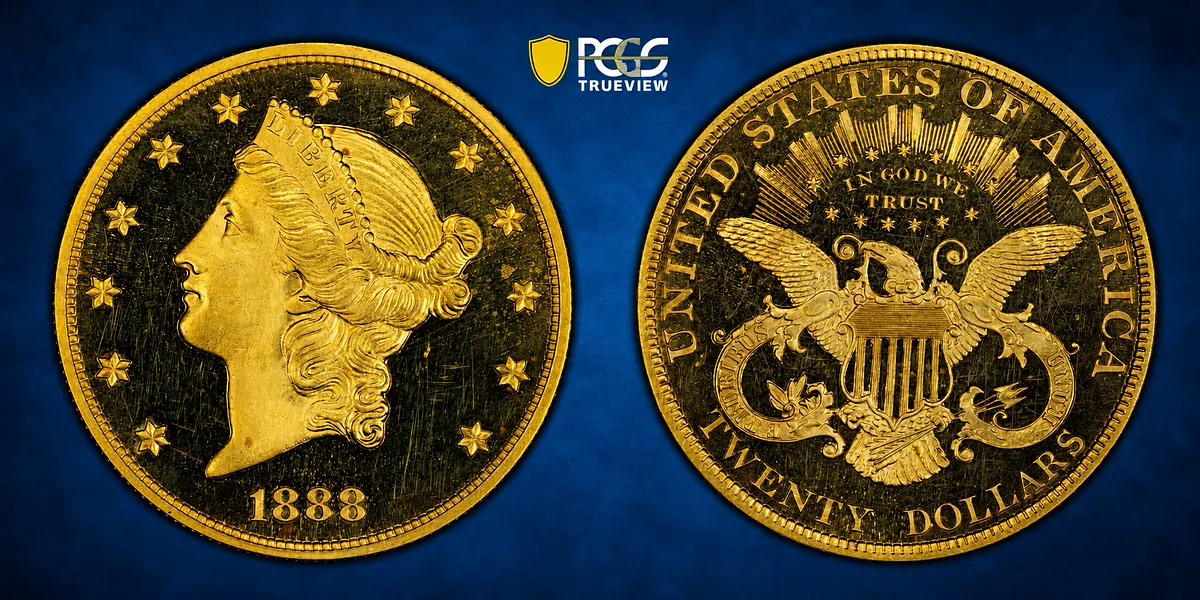
At the center stands an 1888 Liberty Head Double Eagle graded PR64 Deep Cameo by PCGS. For advanced collectors, that combination carries serious weight. The coin combines rarity, eye appeal, and one of the most desirable finishes in classic U.S. proof gold.
1888 Proof Double Eagle Carries Gilded Age Power
The 1888 $20 gold piece comes from a proof mintage listed as either 102 or 105 coins. Today, Heritage estimates that only 20 to 25 proofs survive in all grades.
That tiny survivor pool explains the excitement. Most examples now sit in advanced double eagle collections. As a result, fresh opportunities rarely appear.
Cameo examples range from PR61 to PR66, with 16 listed. Deep Cameo pieces occupy an even tighter range, from PR64 to PR66. The coin in this sale ranks as one of just four examples carrying the PR64 grade.
James B. Longacre designed the Liberty Head Double Eagle. Longacre served as Chief Engraver of the United States Mint. By the 1880s, proof gold coins had become high-status objects for serious collectors. They represented taste, money, and access.
Todd Imhof, Executive Vice President at Heritage Auctions, emphasized that point in Heritage’s announcement. He noted that proof gold from this era carried special prestige. He also pointed to the shrinking survivor population, since many examples disappeared through loss, melting, or impairment.
For type collectors, the Deep Cameo designation adds another layer. Frosted devices and mirrored fields show the design at its most dramatic. Therefore, this 1888 proof delivers more than rarity. It delivers presence.
A Newly Surfaced 1797 Small Eagle Half Dollar
The sale also features a 1797 Draped Bust Half Dollar, O-101a, Tompkins-1, graded VF20 by PCGS. The coin sits in an early PCGS “rattler” holder.
This is not a routine early half dollar. Heritage describes it as previously unknown to the firm. It also does not appear in the Amato reference. In addition, Heritage could not confirm any auction appearance for the piece during the last 25 years.
That matters because 1796 and 1797 Draped Bust, Small Eagle half dollars rank among the rarest silver type coins in American numismatics. Fewer than 4,000 examples were struck across both dates combined. Heritage places the surviving population at about 175 coins.
As a result, this newly surfaced example should command attention from early half dollar specialists. It also gives type collectors a rare chance at a coin many Registry-level sets lack.
Superb Proof 1831 Capped Bust Dime Adds Early Proof Drama
Early proof silver also brings heat to this sale. Heritage will offer an 1831 JR-2 Capped Bust Dime graded PR67 by NGC.
Proof Capped Bust dimes appear only rarely. That scarcity drives interest well beyond date-and-variety specialists.
David Akers once estimated that six to eight 1831 JR-2 proof dimes survive. More recently, Early United States Dimes cited at least three JR-2 proofs, plus an unspecified number of JR-4 proofs. PCGS estimates 15 to 20 proof dimes for 1831 across all varieties, although Heritage regards that figure as generous.
Heritage’s current roster lists eight proof 1831 dimes for all varieties combined. This PR67 NGC example ranks at the top of Heritage’s roster of high-grade JR-2 proof dimes.
The Capped Bust dime type is generally attributed to John Reich, the former assistant engraver at the U.S. Mint.
Confederate Cent Restrike Connects to a Civil War Mystery
Another historic highlight comes from the Confederate States of America series.
The auction includes an 1861-dated Confederate Cent, Haseltine’s Copper Restrike, graded PR63 Brown by PCGS and endorsed by CAC. The coin is listed as Breen-8008 and Bertram-B861-202.
Coin dealer John W. Haseltine’s copper restrike dates to about 1874. The piece likely came from dies made by Robert Lovett. Lovett reportedly produced those dies in New York in 1861.
That year carries obvious Civil War weight. In 1861, federal coinage and Confederate control overlapped at Southern mints such as New Orleans, Charlotte, and Dahlonega. However, actual Confederate coinage remained extremely limited.
For years, numismatic texts described the 1861-dated copper-nickel Confederate cent as an original. Then the first example appeared in 1873. Eleven more examples followed. Haseltine then marketed restrikes in bronze, silver, and gold.
This PR63 Brown PCGS CAC copper restrike belongs to that famous Haseltine chapter.
Sole Finest 1932-S Washington Quarter Certified
Condition rarity also plays a major role in the sale.
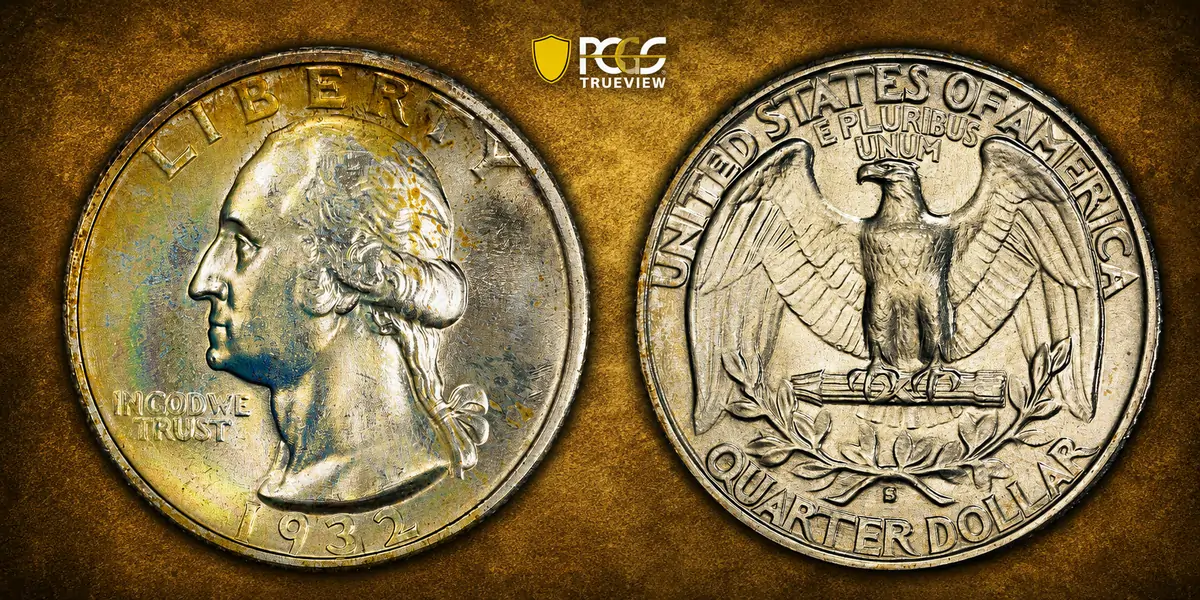
Heritage will offer a 1932-S Washington Quarter graded MS66+ by PCGS and endorsed by CAC. The 1932-S ranks with the 1932-D as one of the two key issues in the Washington quarter series.
The San Francisco issue appears more often in MS66 than the Denver issue. Even so, it remains conditionally rare at this level.
PCGS and NGC combined report only 20 grading events in MS66. Only three carry CAC approval. The auction coin is the only Plus-designated example. Therefore, Heritage describes it as the sole finest certified 1932-S quarter.
That status matters in Registry Set competition. Many high-ranking sets still use MS65 or MS65+ examples because MS66 coins appear so rarely.
The Fudd Collection Brings Serious Gold
The auction includes 101 lots from the collection of John Erickson. His University of Minnesota fraternity brothers gave him the nickname “Fudd.”
Erickson built several collections. His interests included pocket watches and hockey memorabilia. However, his numismatic focus centered on Liberty double eagles. He first assembled the largest date collection of Liberty double eagles. Then he upgraded the quality.
The Fudd Collection includes a 1930-S Indian Head Eagle graded MS64+ by PCGS and endorsed by CAC. The San Francisco Mint struck 96,000 examples. Yet as many as 95,000 were melted after 1933.
That destruction reshaped the series. Many branch mint eagles and double eagles struck after 1916 stayed in Treasury vaults. Then the government melted them in the late 1930s. As a result, the 1920-S and 1930-S Indian Head eagles remain exceedingly elusive.
Most 1930-S eagles never left the Mint. Heritage estimates that only 150 to 200 Mint State examples survive. The auction coin sits in the upper range of that surviving Mint State population.
The Fudd Collection also includes an 1884-S Double Eagle graded MS65+ by PCGS and approved by CAC. The coin once belonged to the D. Brent Pogue Collection. Heritage identifies it as the finest example at PCGS.
Most San Francisco double eagles from this era appear in VF through MS62. Finer coins prove much tougher. Gold circulated widely in the West. Also, double eagles served as a preferred American trade coin because one $20 gold piece moved more value than two eagles or four half eagles.
Because many examples traveled through trade and later returned from overseas, bagmarks often define the issue. Heritage describes this MS65+ coin as either a rare non-exported survivor or a coin that escaped the typical abuse of repatriated pieces.
Another key Fudd coin is a 1920-S Saint-Gaudens Double Eagle graded MS62 by PCGS. The San Francisco Mint struck 558,000 examples. Heritage estimates only 80 to 120 survive.
The 1920-S begins the final run of Saint-Gaudens double eagles after a four-year production break. Branch mint issues largely avoided export because they sat farther from New York, the nation’s financial center. Instead, many stayed as reserves at the Treasury Department in Washington, D.C., or at Federal Reserve banks.
When the government melted double eagles in the late 1930s, nearly the entire mintage of some branch mint issues disappeared. Heritage estimates the 1920-S survivor pool at 40 to 60 circulated coins and 40 to 60 Mint State coins.
Other Fudd Collection highlights include a 1927-S Saint-Gaudens Double Eagle MS62 PCGS CAC; an 1872-S Double Eagle MS64 PCGS, listed by Heritage as the finest PCGS-graded example; an 1861-S Double Eagle AU55 NGC; a 1920-S Indian Eagle MS61 NGC; and an 1855 Wass & Molitor Twenty Dollar, Small Head, S.S. Central America #2, AU55 PCGS.
Cole Carter Collection Offers Three Matched Proof Sets
The Cole Carter Collection adds 116 lots to the auction. The group includes key issues and varieties across multiple denominations.
Three well-matched proof sets stand out:
- An 1866 nine-piece proof set graded PR61 to PR65 by PCGS.
- An 1872 10-piece proof set graded PR62 to PR64 by NGC.
- An 1873 10-piece proof set graded PR63 to PR65 by PCGS.
Together, these sets offer a broad look at Reconstruction-era proof coinage.
Bellaire Collection Focuses on Silver and Copper Strength
The Bellaire Collection contributes 86 lots. It spans denominations from cents to silver dollars. Silver and copper issues dominate the group, with Buffalo nickels and Shield nickels also represented.
The collection also includes early dollars, Gobrecht dollars, Seated dollars, and Trade dollars. Several early dimes and Bust dimes add further depth.
Highlights include a 1794 V-4, LM-4 Half Dime graded VF30 by PCGS. Heritage describes it as an earlier die state of a frequently seen 1794 variety.
The Bellaire Collection also includes a 1915-S Panama-Pacific Quarter Eagle graded MS65 by NGC. Heritage notes its medium yellow-gold color.
Another key coin is an 1895 Proof Morgan Dollar, VAM-2, JD-1, certified by NCS as Proof AU Details. The Philadelphia Mint distributed only 880 proof Morgan dollars in 1895. The Mint also reported 12,000 circulation strikes. However, no 1895 circulation-strike Morgan dollars have appeared in numismatic channels. The reported figure likely reflects either an accounting error or a melting event.
The collection also features an 1873-CC Seated Dollar with XF40 Details from ANACS. The Carson City Mint struck only 2,300 examples. In addition, melting before the Trade dollar’s introduction further reduced the surviving population. Today, the 1873-CC Seated dollar remains rare in any grade.
A Broad Summer FUN Sale With Multiple Entry Points
Heritage’s July 16-18 Summer FUN US Coins Signature Auction offers more than one headline coin. The 1888 Proof Double Eagle gives the sale its Gilded Age centerpiece. Yet the 1797 Small Eagle half dollar, the Superb Gem proof 1831 dime, the Confederate cent restrike, and the finest certified 1932-S quarter add real depth.
Meanwhile, the Fudd, Cole Carter, and Bellaire collections give specialists several paths into the sale. Gold collectors will follow the Fudd Collection closely. Proof-set buyers will study Cole Carter. Early silver and type collectors will find plenty to examine in Bellaire.
Images and information for all lots appear on Heritage’s auction page.






I got all different kinds of coins I’ve collected definitely no gold coin like that. one day I’ll have one I hope
I will attend the FUN show, but I won’t be bidding.
That proof 1888 double eagle is a amazing story & coin!
IN for 2nd chance!
Beautiful coins. Good luck on the coin giveaway everybody!
I just really like the reverse of the 1888 eagle.