


The 1997 Sabi Sabi Proof Krugerrand Became a Modern Gold Trophy
The Krugerrand usually represents liquidity, recognition, and gold ownership. South Africa produced millions of the coins, and dealers around the world still trade them every day.
However, the 1997 Sabi Sabi Proof Krugerrand belongs to a very different market.
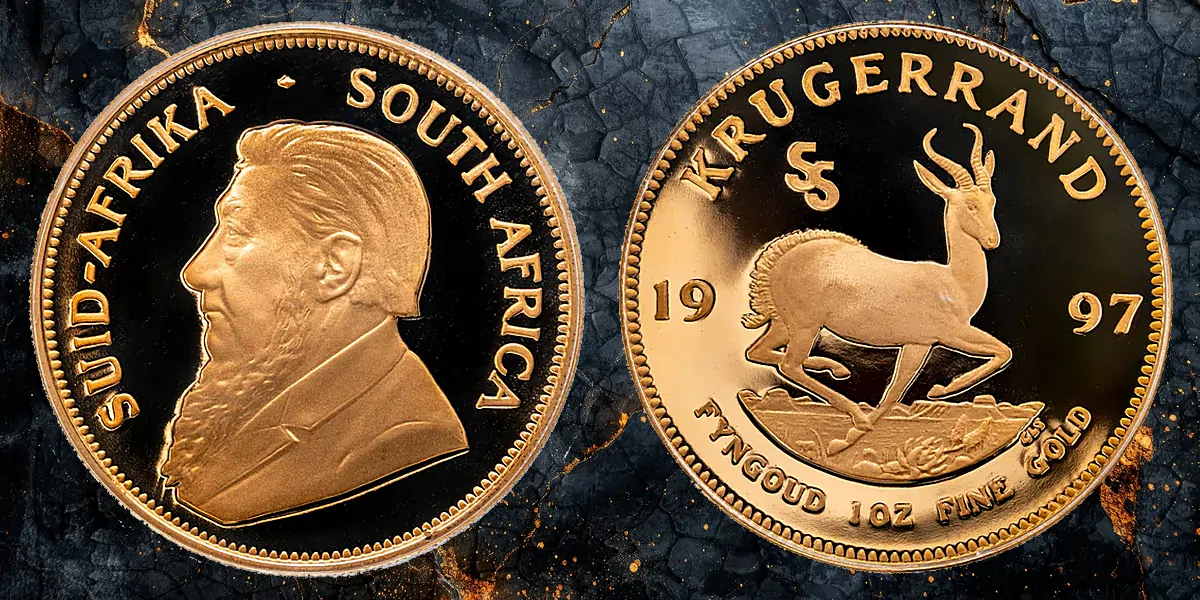
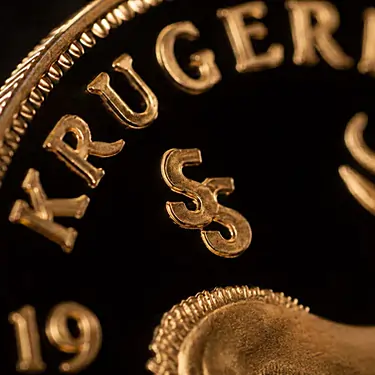
The South African Mint struck only 72 examples of this one-ounce Proof gold coin. Each carries a small “SS” privy mark above the springbok. That tiny addition transformed a familiar bullion design into one of the great modern rarities of South African numismatics.
Moreover, the coin arrived at a turning point in Krugerrand history. It marked the coin’s 30th anniversary. It also helped introduce a new era of special-edition Krugerrands created for advanced collectors rather than ordinary bullion buyers.
As a result, the Sabi Sabi Krugerrand now occupies the narrow space between bullion coin, commemorative issue, wildlife collectible, and trophy rarity.
The Krugerrand Changed How the World Bought Gold
South Africa introduced the Krugerrand in 1967. The coin gave private buyers a convenient way to own one troy ounce of gold in recognizable coin form. Rand Refinery and the South African Mint produced the new issue to promote South African gold internationally.
That concept seems ordinary today. It looked revolutionary in 1967.
Earlier gold coins generally carried fixed denominations and circulated according to their stated face values. In contrast, the Krugerrand carries no printed denomination. Its value follows the international gold market.
The coin also established the model that later bullion programs followed. Canada introduced the Gold Maple Leaf in 1979. China followed with the Gold Panda in 1982. The United States launched the American Gold Eagle in 1986.
However, the Krugerrand came first.
Its name combines “Kruger,” for former South African Republic President Paul Kruger, with “rand,” South Africa’s currency. Otto Schultz’s portrait of Kruger appears on the obverse. Coert Steynberg’s springbok design dominates the reverse.
The alloy also served a practical purpose. Each one-ounce Krugerrand contains 91.67% gold and 8.33% copper. Therefore, the coin contains one full troy ounce of fine gold but weighs about 33.93 grams overall. The copper strengthens the surface and gives the Krugerrand its familiar reddish-gold color.
From Global Success to International Boycotts
The Krugerrand quickly became the world’s dominant gold investment coin. By 1980, it reportedly controlled about 90% of the international gold-coin market.
Yet that success carried political baggage.
South Africa still enforced apartheid. Consequently, governments, organizations, and consumers increasingly targeted South African products. The United States prohibited new Krugerrand imports in 1985, while other countries imposed their own restrictions or boycotts.
Demand collapsed. Krugerrand production also fell sharply during the late 1980s and early 1990s.
South Africa ended apartheid and held its first fully democratic national election in 1994. The Krugerrand then entered a new period. It retained its established gold identity. However, the South African Mint also began exploring the coin’s potential as a modern numismatic collectible.
The 1997 anniversary program became an important part of that transition.
A New Kind of Krugerrand Arrived in 1997
The Krugerrand turned 30 in 1997. To mark that milestone, the South African Mint created special Proof editions that collectors could distinguish through privy marks.
A standard 1997 one-ounce Proof Krugerrand carried a reported mintage of 1,663. The Mint also produced a 30th-anniversary privy-mark issue with a much smaller mintage. However, the Sabi Sabi edition went in another direction. It connected the Krugerrand’s springbok imagery with one of South Africa’s best-known private wildlife reserves.
The result looked familiar at first glance.
Paul Kruger still appeared on the obverse. The springbok still crossed the reverse. Nevertheless, the Mint added a stylized “SS” monogram above the animal.
That small mark carried major significance.
It identified the coin with Sabi Sabi Private Game Reserve, which lies in the Sabie Game Reserve along the southwestern section of the Greater Kruger ecosystem. The reserve borders Kruger National Park and forms part of a large, interconnected wildlife region. Sabi Sabi states that fences came down in 1993, allowing animals to move more freely between the private reserve and Kruger National Park.
Therefore, the privy mark connected two instantly recognizable South African symbols: gold and wildlife.
Why Did the Mint Strike Only 72?
Published specialist accounts state that the program originally contemplated 300 Sabi Sabi Proof Krugerrands. However, production stopped after only 72 coins.
No widely available official record explains why the Mint ended production at that number. Therefore, collectors should treat any specific explanation as speculation unless new documentation emerges.
Still, the surviving certificates provide an intriguing clue.
The Mint apparently prepared certificates for a 300-coin program before production ended. As a result, certificate numbers do not always correspond with the final mintage of 72.
Heritage Auctions sold one example in January 2016 with Certificate of Authenticity number 74 of 300. That number exceeds the total number of coins reportedly struck. The certificate does not prove that at least 74 coins entered the market. Instead, it shows that the Mint numbered certificates according to the larger planned release.
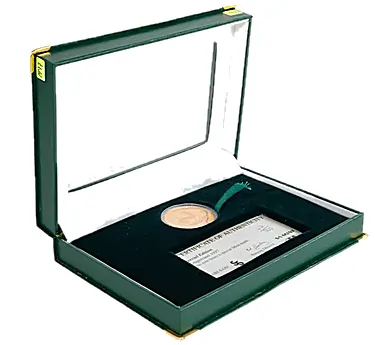
Another Heritage example carried certificate number 43. NGC graded that coin PR69 Ultra Cameo. Heritage sold it for $27,600 in January 2025.
Consequently, collectors should authenticate the coin itself rather than use the certificate number as a population guide.
The Proof Finish Changes the Familiar Design
Most buyers associate Krugerrands with bullion production. Those coins serve investors first. Their value largely follows their gold content.
Proof Krugerrands target collectors.
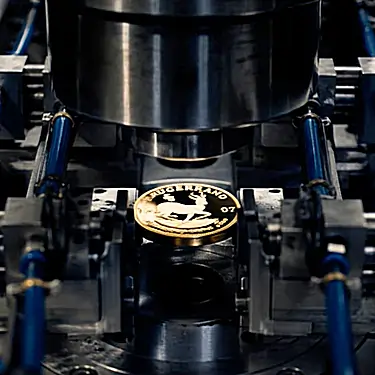
The Mint prepares their surfaces and dies to create deeply reflective fields, sharp details, and strong contrast between the design and background. On high-quality examples, the frosted portrait and springbok appear to float above the mirrored fields.
The Sabi Sabi coin combines that finish with the “SS” privy mark and the tiny 72-piece mintage. Therefore, it offers several layers of collector interest at once.
It represents:
- The 30th anniversary of the Krugerrand
- One of the earliest special privy-mark Krugerrands
- A one-ounce Proof gold issue
- A direct connection to South African wildlife heritage
- A mintage of only 72 pieces
Few modern gold coins combine all five elements.
Auction Results Show the Power of the Mintage
The Sabi Sabi Krugerrand rarely appears at major international auctions. However, its recorded sales reveal how strongly collectors respond when one reaches the market.
Heritage Auctions sold an example in 2013 for $18,212.50. The auction house referenced that result when it offered another coin in January 2016. That second example, accompanied by certificate 74 of 300, realized $8,812.50.
Then, in January 2025, Heritage sold the NGC PR69 Ultra Cameo example from the Gatsby Collection for $27,600. The coin retained its original presentation box and certificate number 43.
Those results also demonstrate the danger of assigning a fixed value to a coin with such limited market activity. Grade matters. Eye appeal matters. Original packaging matters. Timing also matters.
Most importantly, two motivated specialists can dramatically change the result.
Is It the Rarest Modern Krugerrand?
Dealers and auction houses long described the 1997 Sabi Sabi issue as the rarest modern Krugerrand. For many years, that description appeared justified.
However, CoinWeek cannot repeat that claim without qualification.
More recent reporting identifies a 2020 VE-Day one-ounce Krugerrand with an original target of 150 coins but a reported final production of only 25. COVID-19 disruptions reportedly curtailed that program. If the 25-piece figure proves complete and official, the VE-Day issue has a lower mintage than the Sabi Sabi coin.
Therefore, the safest description calls the Sabi Sabi coin one of the rarest and most important modern Krugerrands. It also remains the key rarity among the pioneering 1997 privy-mark issues.
That distinction does not diminish the coin. Instead, it places the Sabi Sabi Krugerrand within a developing and increasingly sophisticated modern series.
Why the Sabi Sabi Krugerrand Matters
The coin’s importance extends beyond its mintage.
First, it helped prove that collectors would treat Krugerrands as more than interchangeable ounces of gold. The “SS” mark created a distinct variety. The Proof finish elevated the presentation. Meanwhile, the tiny production total created true scarcity.
Second, the coin foreshadowed later Krugerrand privy-mark programs. The South African Mint subsequently used special marks to recognize anniversaries, historical events, institutions, and prominent figures.
Third, the coin broadened the Krugerrand’s visual identity. The standard reverse already features a springbok. However, the Sabi Sabi association deepened the connection between the coin and South Africa’s wildlife landscape.
Finally, the issue emerged during a period when South Africa sought to present a new national story to the world. The Mint did not formally describe the coin as a political statement. Nevertheless, collectors can reasonably view the 1997 issue within that larger historical setting.
The original Krugerrand promoted South Africa’s mineral wealth. The Sabi Sabi edition also emphasized wilderness, conservation, tourism, and national heritage.
1997 Sabi Sabi Proof Krugerrand Specifications
 Country: South Africa
- Year: 1997
- Coin: One-Ounce Proof Krugerrand
- Mint: South African Mint
- Composition: 91.67% gold and 8.33% copper
- Fine Gold Content: One troy ounce
- Gross Weight: 33.93 grams
- Diameter: 32.77 mm
- Finish: Proof
- Privy Mark: Stylized “SS” above the springbok
- Reported Mintage: 72
The South African Mint and specialist references confirm the weight, composition, diameter, finish, privy mark, and 72-piece mintage.
A Krugerrand That Left the Bullion Market Behind
“The Sabi Sabi Krugerrand is one of those pieces that changes the temperature of a conversation among serious collectors,” said Rael Demby, CEO of the South African Gold Coin Exchange and The Scoin Shop.
That assessment captures the coin’s unusual position.
Collectors can acquire most Krugerrands by date, size, or gold weight. However, money alone does not guarantee immediate access to a Sabi Sabi example. An owner must first decide to sell.
The Scoin Shop currently lists a 1997 Sabi Sabi Proof Krugerrand for private inquiry with its presentation box and certificate.
When another example will enter the public auction market remains unknown.
That uncertainty explains much of the coin’s appeal. The 1997 Sabi Sabi Proof Krugerrand contains one ounce of gold. Yet its market identity no longer depends primarily on metal value.
Its 72-piece mintage changed the equation.
So did the mysterious shortfall from the planned 300 coins. So did the “SS” privy mark. Moreover, its position at the beginning of the Krugerrand’s modern collector era secured its place in the series.
Many Krugerrands store gold.
The 1997 Sabi Sabi Krugerrand stores a story.
About the South African Gold Coin Exchange and The Scoin Shop
The South African Gold Coin Exchange began operations in 1972 and specializes in gold bullion, rare coins, medallions, and modern numismatic collectibles. The company later developed The Scoin Shop as its retail division and now operates stores across South Africa.




To rare to care
Quite rare with only 72 minted.
This coin is so rare…it’s barely there!