The Golden Dollar That Shouldn’t Exist: Finest PCGS Sacagawea Mule Heads to GreatCollections
One of America’s most extraordinary modern mint errors returns to the auction spotlight. This time, the coin carries the highest grade PCGS has assigned to the famous Washington quarter/Sacagawea dollar mule.
In 2000, the United States Mint introduced a golden dollar featuring Sacagawea instead of George Washington. Its advertising campaign even joked about Washington’s absence from the new coin.
Then something remarkable happened.
An Arkansas collector opened a bank roll of the new dollars and discovered Washington staring back at him. On the reverse, an eagle soared across the familiar Sacagawea dollar design.
The Philadelphia Mint had somehow combined two coin designs that never belonged together.
More than 26 years later, that mistake ranks among America’s most celebrated mint errors. Now, a spectacular 2000 Sacagawea dollar mule, graded PCGS MS-67, will headline a GreatCollections auction closing December 13, 2026.
GreatCollections identifies the specimen as the single finest example that PCGS has graded. With only about two dozen examples known across all grades, the auction offers collectors an uncommon opportunity to acquire this famous modern rarity.
The Golden Dollar That Put Washington Back in the Picture
The story begins with an ambitious effort to reinvent America’s dollar coin.
The Susan B. Anthony dollar had struggled to gain public acceptance after its 1979 debut. One major complaint involved its similarity to the Washington quarter. Both coins shared a silvery appearance, and their relatively close diameters created confusion.
Consequently, Congress authorized a new dollar with distinctive physical characteristics.
The Mint introduced the Sacagawea dollar in 2000. Glenna Goodacre created the obverse portrait of Sacagawea carrying her infant son, Jean Baptiste. Meanwhile, Mint sculptor Thomas D. Rogers Sr. designed the reverse, which features a soaring eagle surrounded by 17 stars.
The coin also introduced a golden-colored manganese-brass outer layer, a broad border, and a smooth edge. Together, these features helped distinguish the new dollar from the quarter.
Ironically, the Mint’s promotional campaign created an unexpected connection to the error coin.
Contemporary news reports described an advertisement featuring George Washington expressing his acceptance of the new dollar without his portrait.
Yet the Philadelphia Mint had accidentally produced precisely the combination that collectors would soon find so extraordinary: George Washington on a golden dollar.
The advertising irony only added to the story’s national appeal.
One Bank Roll in Arkansas Changes Everything
In May 2000, collector Frank Wallis of Arkansas obtained rolls of newly issued Sacagawea dollars from his local bank.
As he examined the coins, he encountered something that looked impossible.
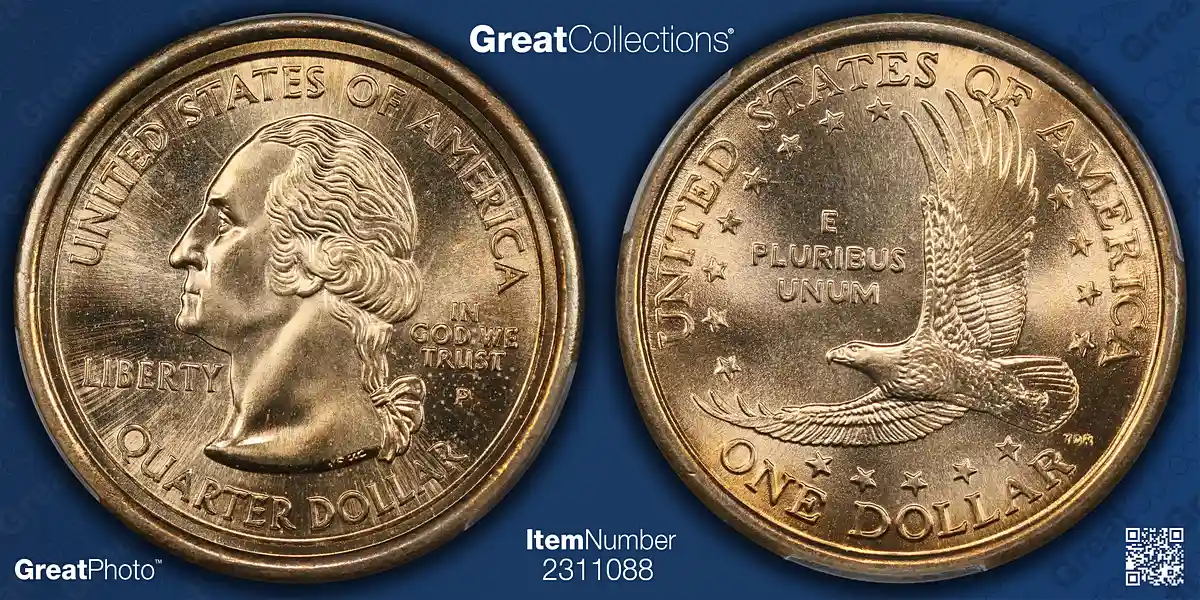
One golden dollar displayed the obverse of a Washington quarter rather than Sacagawea. However, the reverse carried the eagle design of the new dollar.
The discovery represented a dramatic mule error. In numismatic terminology, a mule results when a coin press combines dies that the Mint never intended to use together.
Moreover, this particular error combined designs from two different denominations.
The coin quickly attracted attention from error specialists, grading services, and the national media. News programs and newspapers introduced the remarkable discovery to audiences far beyond the coin hobby.
Questions initially surrounded its authenticity and legal status. However, the U.S. Mint acknowledged the error as genuine on June 19, 2000.
That August, Bowers and Merena sold the discovery specimen during the American Numismatic Association’s convention in Philadelphia.
The price: $29,900.
At the time, collectors had only begun to understand the significance of the new discovery. Its story was just getting started.
How Did a Quarter Die End Up in a Dollar Press?
The production of the Sacagawea dollar/Washington quarter mule remains one of the most intriguing mysteries in modern American coinage.
Under normal circumstances, Mint employees install matching obverse and reverse dies in a coin press. Quality-control procedures help prevent employees from combining dies for different denominations.
Nevertheless, someone at the Philadelphia Mint apparently introduced a Washington quarter obverse die into a press producing Sacagawea dollars.
The quarter measures 24.3 mm in diameter, while the golden dollar measures 26.5 mm. Although the coins differ in size, their relatively close dimensions may have contributed to the confusion.
Error specialists have offered explanations for the mistake.
One theory involves the protective plastic covers that concealed die designs before installation. A covered quarter die might not immediately reveal its identity.
Separately, longtime error-coin specialist Fred Weinberg has discussed changes in Mint employee assignments during the late 1990s. According to his account, employee rotation may have increased the chances of confusion in the die room.
However, these explanations remain specialist accounts rather than a fully documented reconstruction of the incident.
Reports from error specialists indicate that Mint workers eventually detected the problem and destroyed numerous affected coins. Even so, some examples had already escaped into circulation.
The exact number of coins the Mint struck or destroyed remains unknown.
Perhaps the biggest mystery involves the existence of three different die pairs. Their survival suggests a more complicated production history than a single incorrectly installed die.
Three Die Pairs and One Important Die Crack
Specialists have identified three distinct die combinations among the surviving Sacagawea dollar/Washington quarter mules.
The coin in the upcoming GreatCollections auction belongs to Die Pair 1, the most frequently encountered combination.
Collectors can identify this pairing through a small but important feature on the reverse.
A die crack crosses the letter F in the word OF within the inscription UNITED STATES OF AMERICA.
Additionally, examples from this pairing display radial die striations near the obverse border. These lines create a distinctive sunburst appearance and reflect stresses associated with the mismatched dies.
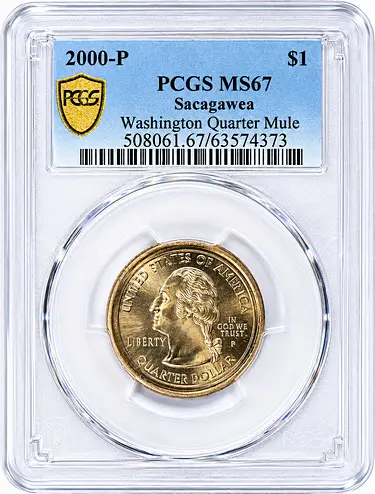
The GreatCollections specimen carries a PCGS grade of MS-67, placing it at the top of that grading service’s population for the error.
Its certification number is 63574373.
While other examples have earned MS-67 grades from NGC, GreatCollections identifies this coin as the sole PCGS-certified example at that level.
For specialists, the combination of a famous error, a recognizable die pairing, and an exceptional certified grade makes this an important offering.
Why Collectors Call It the $1.25 Coin
The Sacagawea dollar/Washington quarter mule carries another unusual distinction.
It displays two different denominations.
Washington’s side includes the inscription QUARTER DOLLAR. Meanwhile, the reverse identifies the coin as ONE DOLLAR.
Together, those inscriptions explain the popular nickname: the $1.25 coin.
However, the nickname does not establish its actual face value.
Because the Mint struck the mule on a Sacagawea dollar planchet, numismatists classify it as a one-dollar coin.
Even its missing date tells an interesting story.
The 50 State Quarters program placed the year on the reverse of each quarter. Conversely, the original Sacagawea dollar carried its date on the obverse.
By combining the quarter obverse with the dollar reverse, the Mint accidentally eliminated the date from both sides.
As a result, every surviving example lacks a visible year, even though collectors identify the issue as a 2000 Philadelphia Mint error.
The coin retains the P mint mark from the quarter obverse.
A Modern Rarity With an Extraordinary Ownership History
Unlike many modern mint errors, the Sacagawea dollar/Washington quarter mule has become a trophy coin among advanced collectors.
GreatCollections estimates that only about two dozen examples exist across all grades and die pairings.
Even more remarkably, one collector has acquired a substantial share of the surviving pieces.
New Mexico collector Tommy Bolack spent years pursuing these errors. His acquisitions concentrated many of the known examples in a single collection.
Consequently, collectors seeking an example face a challenge that goes beyond the coin’s limited population.
Only a small number of specimens remain available outside major collections, and public auction opportunities occur infrequently.
The coin’s importance extends beyond price and rarity.
In 2010, Whitman Publishing released 100 Greatest U.S. Error Coins, by Nicholas Brown, David Camire, and Fred Weinberg.
The authors placed the Sacagawea dollar/Washington quarter mule at number one. They also featured it on the book’s cover.
That distinction helped establish the coin’s reputation as a defining modern American mint error.
From $29,900 to a $194,062 Auction Record
The market has provided several striking demonstrations of collector demand.
The original discovery coin brought $29,900 in August 2000. As additional specimens appeared, collectors began competing for examples in higher Mint State grades.
In March 2018, Stack’s Bowers Galleries sold an NGC MS-67 example for $192,000.
Then, on January 21, 2024, GreatCollections established a new public auction record when a PCGS MS-66 specimen realized $194,062.50, including the buyer’s premium.
CoinWeek reported that result shortly after the sale. The auction demonstrated that exceptional rarity and sustained collector interest could outweigh even a one-point difference in certified grade.
More recently, a different public auction appearance added another important benchmark. During Stack’s Bowers Galleries’ Summer 2026 Global Showcase Auction, an NGC MS-67 example realized $158,600, including the buyer’s premium.
These results illustrate the substantial sums collectors have paid for the error. However, each specimen has its own grade, appearance, ownership history, and market circumstances.
Therefore, previous prices offer useful context rather than a guarantee of the outcome of the upcoming GreatCollections auction.
2000 Sacagawea Dollar/Washington Quarter Mule Specifications
- Country: United States
- Year of manufacture: 2000 (no date appears on the coin)
- Mint: Philadelphia (P)
- Denomination: One dollar; incorporates quarter-dollar and dollar designs
- Obverse: George Washington, from the 50 State Quarters program
- Reverse: Soaring eagle encircled by 17 stars, from the original Sacagawea dollar
- Designers: John Flanagan (Washington portrait, adapted for State Quarters by William Cousins); Thomas D. Rogers Sr. (Sacagawea dollar reverse)
- Composition: Manganese-brass clad over a pure copper core. The outer alloy contains 77% copper, 12% zinc, 7% manganese, and 4% nickel
- Overall metal composition: 88.5% copper, 6% zinc, 3.5% manganese, 2% nickel
- Weight: 8.10 grams
- Diameter: 26.50 mm
- Thickness: 2.00 mm
- Edge: Plain
- Strike: Business-strike mule error
- Known population: Approximately two dozen across all grades and die pairs
- Auction specimen: Die Pair 1, PCGS MS-67
- PCGS number: 508061
- PCGS certification: 63574373
The Mint has not published a separate official mintage figure for the mule. Its surviving population should not be confused with the much larger production total for ordinary 2000-P Sacagawea dollars.
GreatCollections Offers the Finest PCGS Example December 13
GreatCollections will offer the PCGS MS-67 Sacagawea dollar/Washington quarter mule in an online auction scheduled to close on Sunday, December 13, 2026, at approximately 6:30 p.m. Pacific Time.
The auction house identifies the coin as Item 2311088.
GreatCollections lists a standard buyer’s premium of 12.5%, with a reduced 10% premium for qualifying check, eCheck, or wire payments.
Collectors can examine photographs, review bidding details, and follow the auction directly through the GreatCollections listing.
More than a quarter-century after Frank Wallis opened an ordinary bank roll, the mule continues to attract extraordinary interest.
Its appeal rests on more than an unusual combination of designs. The coin captures a moment when the U.S. Mint attempted to reinvent the American dollar, only to produce one of the most celebrated mistakes in its history.
The Mint wanted a dollar that Americans would never confuse with a quarter.
Instead, it accidentally created a dollar that was both.
And that mistake has become numismatic history.