


A Radical Coin Born from a Monetary Crisis
In 1852, the U.S. Mint experimented with a radical idea, a ring-shaped gold half dollar. Only a handful were struck, and today fewer than a dozen examples survive.
Today, that proposal survives only as a handful of experimental coins known as the 1852 Pattern Annular Gold Half Dollar, cataloged as Judd-135. The design is unlike anything else produced by the Mint. Even more remarkably, fewer than a dozen examples are believed to exist.
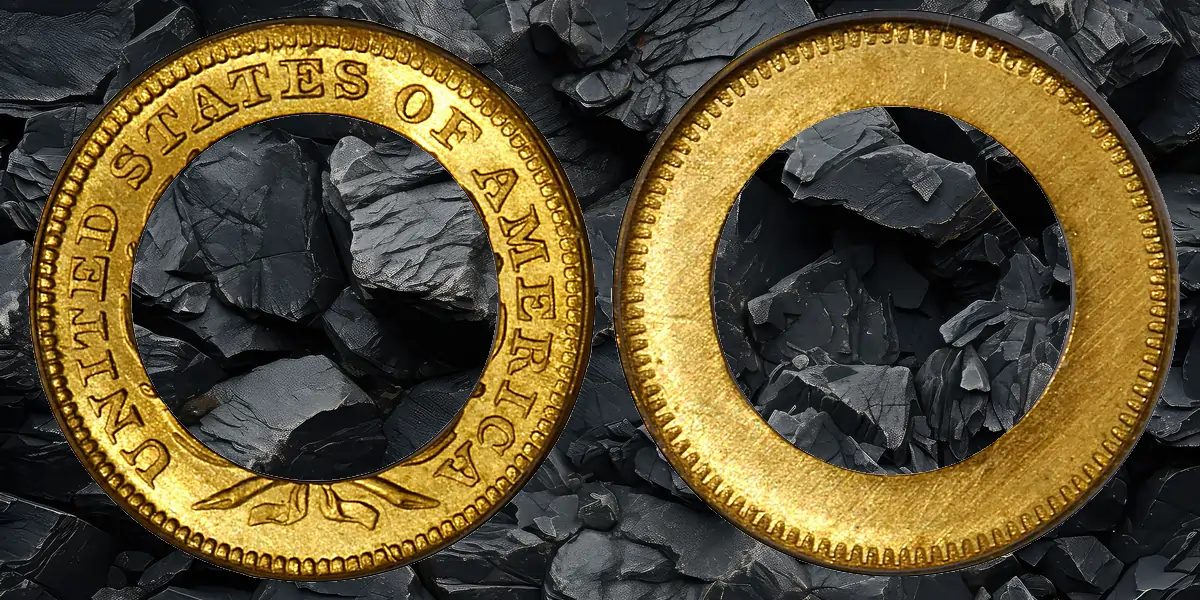
One surviving specimen, graded Proof-66 by the Professional Coin Grading Service and approved by the Certified Acceptance Corporation, ranks tied for the finest known. For collectors of U.S. pattern coinage, pieces like this represent the intersection of rarity, innovation, and American monetary history.
However, the story behind the coin is even more fascinating than its rarity.
The Gold Rush Changes America’s Money
The origin of the proposed gold half dollar lies in the economic upheaval that followed the California Gold Rush.
Beginning in 1848, vast quantities of newly mined gold entered the world market. As the supply of gold increased, the relative value of silver shifted. Consequently, silver coins began to disappear from circulation.
By the early 1850s, Americans faced a serious shortage of small change. Merchants struggled to conduct everyday transactions because fractional silver coins rarely appeared in commerce.
The United States Mint had already introduced the Gold Dollar (United States coin) in 1849, and the denomination quickly gained acceptance. Therefore, some officials believed a gold half dollar might provide another practical substitute for vanishing silver coinage.
By 1852, the problem had become severe enough that the Mint decided to test the idea.
An Unusual Solution: The Annular Coin
Mint officials experimented with a bold concept. Instead of striking a solid coin, they produced pieces on annular planchets, metal blanks with a hole in the center.
This design offered several potential advantages. First, the unusual shape made the denomination easy to recognize. Second, the larger diameter prevented the coin from becoming too small to handle.
To create the patterns quickly, the Mint reused existing dies. The obverse employs the reverse die of the Liberty Seated half dime with the laurel wreath motif. Because the planchet includes a large central perforation, only the outer legend UNITED STATES OF AMERICA and the lower portion of the wreath remain visible.
The reverse side is even more unusual. It carries no design at all, showing only denticles around the rim.
The finished piece resembles a delicate ring rather than a traditional coin. Even among experimental issues, the appearance is striking.
A Rushed Mint Experiment
The Mint produced these patterns under tight time constraints. Evidence for this appears in a letter written on January 27, 1852.
In that correspondence, Mint Director George N. Eckert responded to Senator Robert Mercer Taliaferro Hunter regarding the proposed coins.
Eckert explained that the Mint enclosed examples of perforated or annular gold dollars and half dollars. However, he also admitted that the designs were crude. Officials lacked both time and resources to prepare entirely new dies.
Instead, workers struck the patterns using existing dime and half dime dies. Eckert also noted that the planchets were larger than ideal and that the perforation appeared wider than desired.
These details reveal that the coins were rapid prototypes, produced simply to demonstrate the concept.
Why the Idea Failed
Despite the creativity of the design, the gold half dollar never entered circulation.
Several problems became clear. The coin would contain only a tiny amount of gold, which made it impractical for everyday commerce. Furthermore, the unusual shape could create confusion among the public.
More importantly, Congress soon addressed the silver shortage through legislation. The Coinage Act of 1853 reduced the weight of most silver denominations. That adjustment allowed silver coins to remain in domestic circulation.
Once that solution took effect, the proposed gold half dollar became unnecessary. The annular patterns therefore remained experimental pieces.
Among the Finest Known Examples
Today, the 1852 Pattern Gold Half Dollar (Judd-135) stands among the great rarities of American pattern coinage.
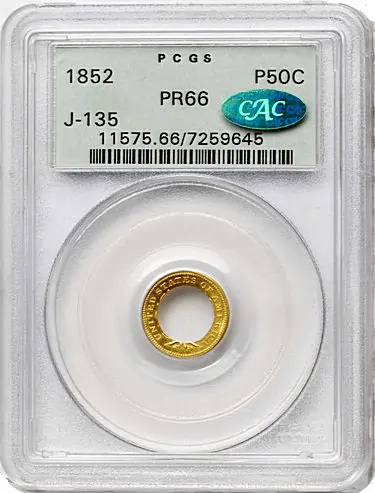
The finest surviving specimens display attractive gold color and strong proof surfaces. One example graded Proof-66 by PCGS shows medium gold coloration with lively satin to semi-reflective surfaces.
Population reports confirm the rarity:
- PCGS Population: 2 coins at Proof-66, none finer
- NGC Census: one example listed at the same grade, possibly representing the same specimen
As a result, the coin stands tied for the finest known at PCGS.
Even within the specialized world of pattern collecting, pieces of this quality rarely appear.
A Coin with a Distinguished Pedigree
This specimen also carries an impressive provenance.
The coin later entered the E. Horatio Morgan Collection, where it was acquired in January 1994. Earlier, it appeared in the Tower Hill Collection sale conducted by Bowers and Merena in September 1993.
That auction marked the last time the firm handled the coin for more than two decades. Because examples surface so rarely, collectors closely follow each appearance in the marketplace.
For advanced numismatists, the pedigree adds another layer of historical significance.
One of the Great Pattern Coin Rarities
Pattern coins reveal the ideas the United States Mint considered but never fully adopted. Few examples illustrate that creative experimentation better than the 1852 annular gold half dollar.
The coin emerged from a moment when the nation’s monetary system struggled to adapt to the sudden influx of gold from California. Mint officials searched for innovative solutions. For a brief time, a ring-shaped gold coin seemed like a practical answer.
Ultimately, the concept proved unnecessary. Yet the surviving patterns capture that fascinating moment of experimentation.
Today, with perhaps only seven examples available to collectors and two preserved in the National Numismatic Collection at the Smithsonian Institution, Judd-135 remains one of the most intriguing coins in American numismatics.
For collectors of patterns, it is more than a rarity. It is a tangible reminder of a bold idea that almost reshaped the nation’s coinage.




No mention of value. What did it fetch the most recent time one of the 66s changed hands?
We generally do not focus on Prices. They change all the time. And Value is subjective. Ultimately CoinWeek trys to give you the backstory about coins that few people know about, or popular coins that have a history. In any case, This coin pictured last sold in A Stacks Bowers auction in 2019 for $60,000
Talk about a unusual coin.
Interesting idea, but U can see why it didn’t catch on.
Fascinating. I had never heard of this pattern. Perhaps the modern US Mint could take note and try something original again. Instead, we keep seeing old patterns recycled into modern coins. Maybe I’ll feel less cynical once I hold some of the 2026 issues.
I have been collecting coins since 1992, when I was in 7th grade, and never have I ever heard of this. Very interesting! While this is a very different design, I’m kind of glad that it never was adopted. Can you imagine having to carry this in your pocket? Yeesh!
interesting
Interesting coin.
It would never even occur to me now that this was a coin.
Very interesting article.
Good info. Thanks!
Interesting! I know that Australia did something similar with their “Holey Dollar” and the smaller-denomination “Dump” minted from the material punched from the center of the Dollar, but this is the first I had heard of the US Mint considering the same idea.
Wow, very cool! Not practical which is why it didn’t survive, but I had never heard of this before. What an interesting article!
Had never seen that pattern.
interesting idea for a coin
I never knew this prototype even existed. Fascinating article.
How unusual!
Interesting info…
Great article. I didn’t know about this “coin.”
WOW…they say you learn something new every day and this was it for me! I never heard of these before today!!!!
I also have never seen or heard of this coin. The story behind it is very interesting though. Thanks.
LOVE THAT HISTORY…. Love it! For me the history that comes with each coin design, change, pattern, etc. THAT is one of the BIGGEST perks of you will, of coin collecting!
LOVE THAT HISTORY…. Love it! For me the history that comes with each coin design, change, pattern, etc. THAT is one of the BIGGEST perks if you will, of coin collecting!
Nice looking coin
The gold rush changed a lot
That’s a beautiful little coin. And interesting story. I sure would have made great fun for us now if they had struck a hundred thousand or so.
That just looks weird.
Imagine metal detecting and finding one of these on a beach somewhere in just pristine condition. A dream of a dream LO. L gorgeous L.
Cool! I have never heard of these.
I have never heard of this design before.
Unreal would liketo see in person.
I would call this a Halo Coin.
A novel solution to a problem of supply. Scarce silver and plentiful gold. The owner of these little gold rings could carry them on a cord or chain and strung like a necklace.
Cool design, I have seen similar designs from other mints but none this rare.
I would love to see some unique and innovative coins in our pocket change in the near future. Of course we have redesigned coins for the Semiquincentennial, but how about a ring-shaped coin? Or a bimetallic coin? Or even a $2 or $2.50 coin?
Another interesting tale of the history of coins. I’d never even heard of the US trying this concept.
Very nice. Didn’t know this one.
Never heard of this coin. Very cool.
First time I’ve heard of this. Fun info.
Wow! I never knew this existed. Thanks
Does anyone know about a quarter penny made of gold very very small from California around 1960 or 62 or maybe
I have a exsparemental gold ring dollar never seen before