A Canadian Quarter Struck in Gold? The 1969 Mint Mystery Gets Stranger
An extraordinary 1969 Canadian quarter struck over a British gold sovereign went to auction on October 25, 2026. But the discovery of similar coins raises an intriguing possibility: Someone may have known exactly what they were doing.
A British gold sovereign had no business entering a Canadian quarter-dollar press in 1969.
Yet a remarkable gold coin appeared at GreatCollections suggests that somehow, somewhere, that unlikely encounter took place.
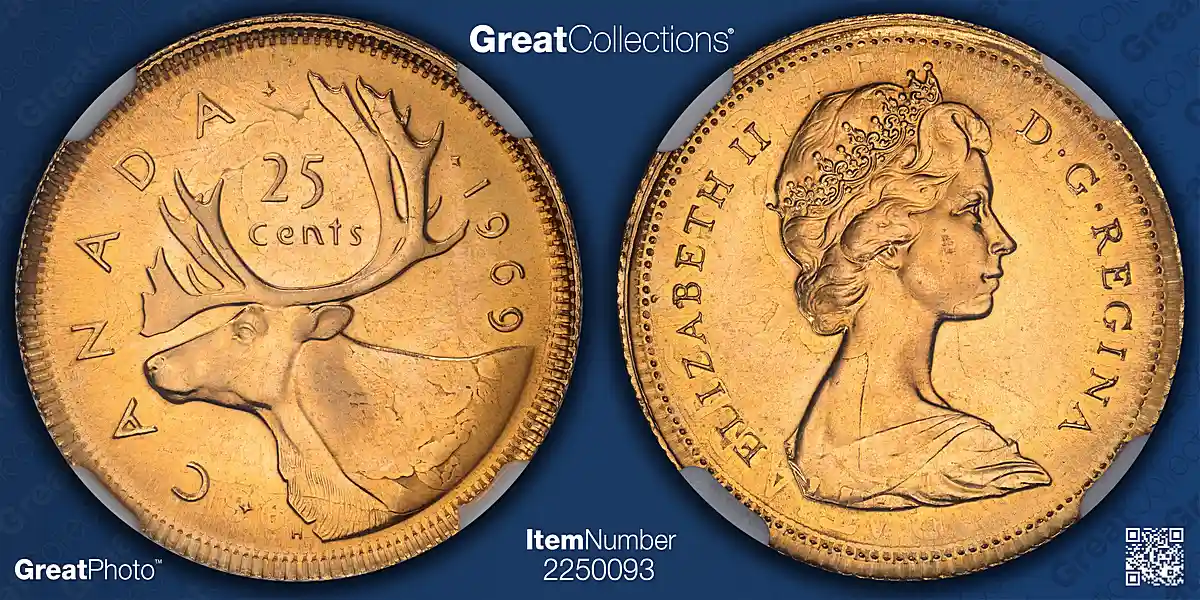
The 1969 Canadian gold quarter error began its life as a perfectly ordinary 1966 British gold sovereign. Three years later, a second set of dies transformed the gold coin into something entirely different: a Canadian 25-cent piece.
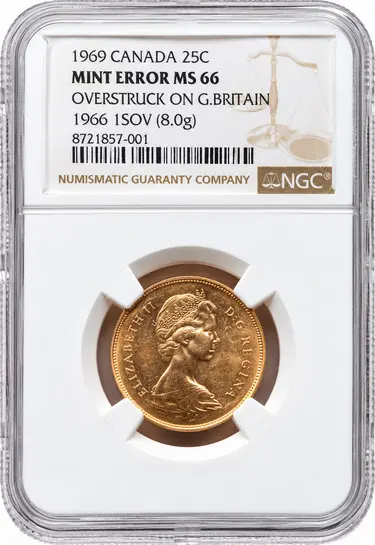
Even more remarkably, the second strike placed Queen Elizabeth II almost directly over her earlier portrait. The original 1966 date remains visible, creating a fascinating combination of two nations, two denominations, and two different coin designs.
NGC graded the unusual survivor MS-66.
However, the real mystery lies beyond its unusual appearance.
How did a valuable British gold coin enter a Canadian Mint press designed to strike nickel quarters? And was this truly an accident?
Two Countries, Two Coin Designs, One Queen
The story begins in Britain in 1966.
The Royal Mint produced gold sovereigns featuring Mary Gillick’s youthful portrait of Queen Elizabeth II. A laurel wreath adorns the Queen’s head, while Benedetto Pistrucci’s famous St. George and the dragon design occupies the reverse.
Each sovereign contains approximately 0.2354 troy ounce of pure gold.
Meanwhile, Canada’s circulating quarter was undergoing an important transformation.
Rising silver prices had pushed the Royal Canadian Mint toward less expensive coinage metals. By 1969, pure nickel had replaced silver in regular Canadian quarter production.
The quarter retained Emanuel Hahn’s familiar caribou reverse, which first appeared in 1937. Arnold Machin’s portrait of Elizabeth II appeared on the obverse.
Consequently, the two coins shared a monarch but little else.
One carried Britain’s long-standing gold coinage tradition. The other represented Canada’s modern, economical approach to circulating money.
Then, in an extraordinary encounter, the two designs came together.
When Queen Elizabeth Met Herself
The GreatCollections specimen provides a particularly striking example of an overstrike.
The Canadian dies impressed their designs onto an existing British sovereign. However, they did not completely erase the earlier coin.
The underlying 1966 date remains visible. Meanwhile, the Queen’s two portraits occupy nearly the same position, although the second strike shows a slight rotational difference.
That alignment creates an unusual visual effect. Two artists portrayed the same monarch at different stages of her reign, and both portraits now share a single gold surface.
The reverse presents another remarkable combination. Britain’s celebrated image of St. George and the dragon became the underlying design for Canada’s familiar caribou quarter.
For collectors, the result offers much more than an off-metal error.
It preserves two separate chapters of numismatic history on one piece of gold.
Could a Gold Sovereign Accidentally Enter a Quarter Press?
Here is where the story becomes especially interesting.
A normal 1969 Canadian quarter weighs approximately 5.05 grams and measures 23.88 millimeters in diameter. The British sovereign weighs approximately 7.99 grams and measures just 22.05 millimeters.
Therefore, the sovereign carried substantially more weight than the nickel blank the Canadian press normally required.
More importantly, the Royal Canadian Mint had no ordinary production reason to feed previously issued British gold coins into its quarter presses.
A routine wrong-planchet error might involve two denominations sharing a production facility. Workers or machinery could inadvertently mix similar blanks.
But this case presents an entirely different problem.
The host coin already carried British designs and a date three years earlier than the Canadian strike. Its gold composition also differed dramatically from the nickel blanks that Canadian quarter production required.
Someone would have needed to bring that sovereign into the minting process.
The question is whether that happened accidentally or deliberately.
The Clue That Changes Everything: This Happened Before
CoinWeek’s research uncovered something particularly important about the GreatCollections specimen.
Other 1969 Canadian quarters exist with impressions over foreign gold coins.
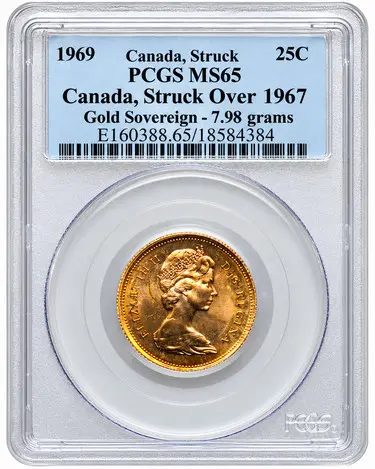
The First Example: As far as we know, the first known 1969 gold quarter error coin involved a 1967 British gold sovereign struck with 1969 Quarter dies, a Elizabeth II gold 25 Cents 1969 Mint Error, graded PCGS-65
Heritage Auctions sold that remarkable piece in January 2014 for $21,150, including the buyer’s premium.
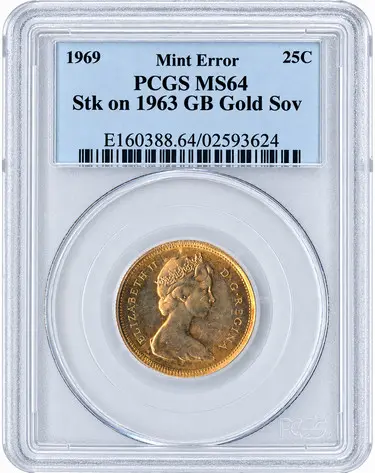
The Second Example: Mint-error specialist Mike Byers previously documented a 1969 Canadian quarter overstruck on a 1963 British gold sovereign. PCGS graded that piece MS-64 and it was presented in a 2017 article in MintErrorNews.
In May 2025, Geoffrey Bell Auctions of Canada sold that same coin, a 1963 sovereign overstrike from the Botany Collection for CAD $14,500, before the buyer’s premium.
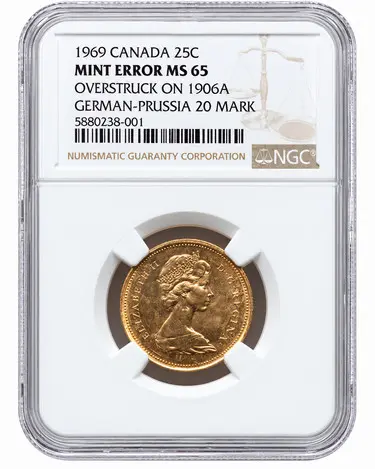
The Third Example: is an even stranger combination of coins. In January 2021, Heritage offered a 1969 Canadian quarter overstruck on a gold 20-mark coin from Prussia, dated 1906-A. That coin, graded NGC MS-65, brought a hammer price of $21,000.
The Prussian piece makes the circumstances especially difficult to dismiss as an ordinary production mix-up. Its original date preceded the Canadian quarter strike by 63 years.
The Fourth Example: Now the GreatCollections 1966 sovereign example joins this unusual group as the fourth appearance of a 1969 Quarter being overstruck on a foreign gold Coin in this case a 1966 Great Britain Gold Sovereign.
The GreatCollections Canadian Mint Error 1969 25 Cents Overstruck on 1966 Great Britain Gold Sovereign KM-62b/908 NGC MS-66 just sold last night, October 25, 2026 for $28,125 (that includes BP)
These documented specimens establish at least four distinct host-coin combinations involving the 1969 Canadian quarter dies.
Their existence does not prove deliberate manufacture. However, the repeated appearance of foreign gold coins beneath the same Canadian denomination makes the possibility difficult to ignore.
An Accidental Error or a Deliberate Mint Creation?
Numismatists recognize a category of unusual coins that sometimes involves human intervention inside a mint.
Collectors generally call these assisted errors. In some cases, a mint employee intentionally introduces an unusual planchet or an already struck coin into a press.
The resulting piece may carry genuine mint impressions, even though its creation did not follow the normal production process.
Canadian minting history includes several dramatic examples of such unusual combinations. Some involved circulating coins, while others used precious-metal pieces or commemorative issues.
Could the gold sovereign overstrikes represent an earlier example of that practice? Perhaps…….
One explanation would involve an unofficial experiment or special striking that never entered the Royal Canadian Mint’s formal product records. Possible, but unlikely.
Another possible explanation involves the accidental introduction of foreign coins into the production equipment in 1969. However, how could anyone explain how a 1906 gold 20-mark coin from Prussia was just sitting around the Canadian Mint and accidently fell into the press. Again possible but even more unlikely.
And the final possibility would suggest that a mint employee deliberately placed the foreign gold coins into a quarter press to create extraordinary numismatic curiosities. Here I would have to follow the Occam’s razor principle, that the simplest explanation, the one requiring the fewest assumptions, is usually the best choice.
However, no publicly established documentation reviewed by CoinWeek identifies anyone who produced these coin, how they were made, who supplied the gold coins, or why the second strike occurred.
Therefore, deliberate manufacture remains a theory rather than a proven fact.
The remarkable survival of several related gold overstrikes strengthens the question. It does not resolve it.
Canada’s Forgotten Connection to British Gold Sovereigns
SOLD in 2021
There is another historical twist that makes this gold quarter especially compelling.
Canada once produced British sovereigns itself.
In January 1908, the Royal Mint opened its Ottawa branch. The facility helped Canada transform domestically mined precious metals into coinage.
Between 1908 and 1919, Ottawa struck British gold sovereigns bearing a small C mintmark. Those issues remain important reminders of Canada’s early monetary relationship with Britain.
In 1931, the Ottawa facility became the Royal Canadian Mint under Canadian government control.
Then, on April 1, 1969, the Mint became a Crown corporation.
That transition occurred during the exact same year that all four of the above error coins were struck at the Canadian Mint
Of course, the 1966 sovereign beneath the Canadian design did not originate at Ottawa. Nevertheless, the combination creates an unexpected connection between Canada’s early gold coinage history and its modern circulating coins.
In effect, a British denomination that Ottawa had once produced returned decades later beneath the dies of an ordinary 1969 Canadian quarter.
Whether through chance or someone’s deliberate intervention, the result connects two distinct eras of Canadian minting.
A Remarkable Gold Error Sold by GreatCollections
The 1969 Canadian quarter overstruck on a 1966 British sovereign carried a NGC MS-66 grade and certification number 8721857-001.
GreatCollections offered the piece as lot 2250093, with bidding concluded Sunday, October 25, 2026. The Coin Sold for $28,125 that includes the Buyers Premium.
The coin’s stated actual gold weight is 0.2355 troy ounce. However, its numismatic appeal extends well beyond its precious-metal content.
Collectors rarely encounter an example that combines a foreign gold coin, two different dates, two national coinages, and such distinctive overlapping portraits.
Furthermore, the documented appearance of other 1969 Canadian gold overstrikes gives this specimen an intriguing historical context.
Perhaps a mint employee wanted to create an extraordinary souvenir. Perhaps an informal experiment took place inside the Ottawa facility. Or perhaps some forgotten circumstance explains how valuable gold coins reached a press intended for everyday change.
For now, the evidence leaves those questions open.
More than half a century later, the coin still holds its secret.
And that may be its most fascinating feature.
View the coin and auction details: GreatCollections Lot 2250093 – 1969 Canadian Quarter Overstruck on 1966 British Gold Sovereign
Coin Specifications for the 1969 Canada 25 Cents Overstruck on 1966 Great Britain Gold Sovereign
Sold October 26, 2026 by GreatCollections
- Country of second strike: Canada
- Original coin: Great Britain Gold Sovereign, 1966
- Second denomination: 25 cents, 1969
- Original composition: 22-karat gold (.9167 fine)
- Original sovereign weight: Approximately 7.988 grams
- Original sovereign diameter: 22.05 mm
- Stated actual gold weight: 0.2355 troy ounce
- Original obverse designer: Mary Gillick
- Original reverse designer: Benedetto Pistrucci
- Canadian obverse designer: Arnold Machin
- Canadian reverse designer: Emanuel Hahn
- Grade: NGC MS-66
- NGC Certification: 8721857-001
- Auction: GreatCollections, Lot 2250093
- Auction date: October 25, 2026
- Price Realized: $28,125 [including BP]