


When the United States introduced the Shield nickel in 1866, the nation was still finding its footing after the Civil War. Hard money had vanished from circulation, confidence in coinage needed rebuilding, and Congress sought practical solutions that could function in daily commerce. Out of that environment came the copper-nickel five-cent piece, an experiment that would endure for generations.

Yet within that experiment lies one of the most fascinating and elusive issues in American numismatics: the Proof 1867 Shield nickel with rays.
Although the “With Rays” design survived for barely more than a year, its legacy far outlasted its production. Today, Proof examples from 1867 represent a pivotal moment when artistic ambition, industrial limitation, and political influence collided at the Philadelphia Mint.
From Wartime Shortage to Postwar Coinage Reform
The roots of the Shield nickel can be traced directly to the economic upheaval of the early 1860s. As specie payments were suspended during the Civil War, gold coins disappeared by late 1861, followed by silver coins the next spring.
In everyday commerce, the silver half dime simply vanished. To fill the void, the government turned to five-cent fractional currency notes, paper substitutes that lingered well after the war ended in 1865.
Congress, however, wanted a durable metallic alternative. After authorizing a copper-nickel three-cent coin in 1865, lawmakers expanded the concept to a five-cent denomination the following year.
The Act of May 16, 1866, created the copper-nickel Shield nickel, composed of 75% copper and 25% nickel. From the outset, this alloy posed challenges, but it also aligned neatly with the interests of the domestic nickel industry.
Weight, Nickel, and Influence
Early discussions envisioned a coin weighing roughly 30 grains, modestly heavier than the old silver half dime. That proposal changed as debates continued. Industrial pressure, particularly from the nation’s dominant nickel producer, pushed Congress to approve a substantially heavier planchet of 77 grains. As a result, each coin consumed significantly more nickel, cementing the alloy’s place in federal coinage.
That decision had lasting consequences. The increased hardness of the planchets complicated striking, accelerated die wear, and directly influenced the short lifespan of the rays design that debuted in 1866.
Design Symbolism and the Rays Reverse
The Shield nickel’s design aimed to project national unity and resilience. The obverse features a bold shield at center, symbolizing strength and defense, with crossed arrows below and a wreath draped along the sides. A cross above the shield reinforces themes of faith and moral order, while the motto IN GOD WE TRUST appears prominently at the top.
On the reverse, the original design placed a large numeral 5 at center, encircled by 13 stars representing the original states. Between those stars radiated 13 stylized rays, visual echoes of unity and national glory. The inscriptions UNITED STATES OF AMERICA and CENTS completed the design.
Artistically, the rays added drama and balance. Technically, they proved disastrous.
Why the Rays Failed
The copper-nickel alloy was unforgiving. The rays, with their sharp angles and recessed fields, demanded strong striking pressure to render fully. As production continued, Mint officials encountered persistent problems: weakly struck details, rapidly cracking dies, and shortened die life that disrupted efficient coinage.
Complaints escalated quickly. By January 21, 1867, the Treasury Secretary ordered the immediate removal of the rays from the reverse. Coinage stopped while new dies were prepared, and by February 1, production resumed with the simplified “No Rays” design. In less than thirteen months, the rays had become a historical footnote, at least for circulation strikes.
Proof coinage, however, followed a different path.
Proofs, Delays, and Quiet Strikings
Proof Shield nickels with rays dated 1867 occupy a murky corner of Mint history. Research indicates that Proof production of the rays design did not begin immediately in January. Instead, the Chief Coiner appears to have delayed striking these coins for inclusion in annual Proof sets.
At the same time, evidence suggests that additional Proofs may have been struck outside official channels. During this period, it was not uncommon for specially made coins to be quietly distributed to favored collectors.
The existence of multiple distinct die pairings, identified by later numismatic research, strongly implies that Proof 1867 Shield nickels with rays were produced in more than one session, possibly even after the rays design had been officially discontinued.
While documentation remains elusive, the coins themselves tell a compelling story.
Rarity Defined by Survival
The exact number of Proof 1867 Shield nickels with rays struck has never been conclusively determined. Estimates generally cluster around 100 pieces, a figure supported by the survival rate seen today. Approximately 60 examples are believed to exist, a remarkably high percentage for a Proof issue of the era but still small enough to ensure intense competition whenever one appears at auction.
Condition rarity further enhances their appeal. Many surviving pieces display reflective fields, sharp devices, and vivid toning that accentuates the intricate rays. Others reveal light handling or faint hairlines, reminders of their age and early collecting history.
Collecting Significance and Market Standing
Within the Shield nickel series, the Proof 1867 With Rays stands as a cornerstone. It bridges the transition between the ambitious original design and the practical realities that forced its revision. More broadly, it represents one of the key Proof issues in all 19th-century copper-nickel coinage.
Advanced collectors prize the coin not only for its scarcity but also for its narrative power. Every example encapsulates a moment when artistry, metallurgy, and politics intersected, leaving behind a tangible artifact of that struggle.
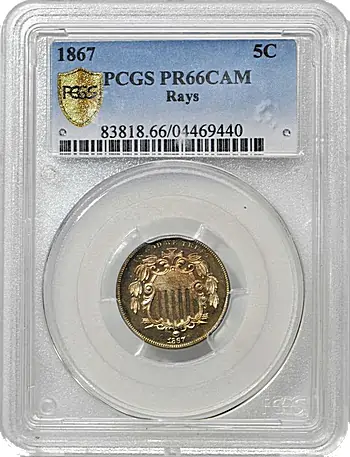
Key Specifications
- Denomination: Five Cents
- Composition: 75% copper, 25% nickel
- Weight: 77 grains (5.0 grams)
- Designer: James B. Longacre
- Mint: Philadelphia
- Design Type: Shield nickel, With Rays (Proof)
- Estimated Proof Mintage: Approximately 100
- Estimated Survivors: About 60 known
A Coin That Outlived Its Design
The Proof 1867 Shield nickel with rays was born from compromise and ended by necessity. Its design failed in mass production, yet succeeded spectacularly as a numismatic icon. Few coins illustrate so clearly how short-lived decisions can produce enduring legends.
More than a century and a half later, this elusive Proof issue continues to captivate collectors, historians, and researchers alike. It stands as a reminder that even failed designs can achieve greatness, especially when they survive against the odds.





Very intersting article.
What a gorgeous specimen!
I love these nickels.
Amazing story!
Not a bad nickel to have in the collection lol
I have never, ever seen this beautiful coin.
I never knew about this before! Thanks.
didn’t know all of this – thanks for sharing
gorgeous coin
Noice!
That detail is crazy amazing. Great addition to any collection.
Nice looking coin and cool backstory.
Never thought nickels could be interesting!haha
Great information!
Cool coin!
Nice coin and cool story! I’ll take one please!
Very interesting story!
Still one of the nicest designs from those post-civil war years!
Amazing the different coins that have been produced. Thanks.
Good Stuff
Wowwwwwwwwww great coin.
A great design that maybe they could do today?
Very interesting article and beautiful coin!!
Love the design. They need to bring this back.
Nice
I will have to buy one of these coins for my collection.
Very artistic coin. Love the history.
This is the next coin I would really like to buy to add to my collection I’ve had my eye on it for a while and love the design and style of the coin they just don’t make them like this anymore It’s a very beautiful coin and craftsmanship is amazing for its time I just got to have it…
Working on complete set
TY
Always liked Shield Nickels. This is a truly beautiful specimen. Thanks for the article!
interesting coin, I’ve never seen one before