


U.S. Mint Silver Plug Coins and the 1794 Planchet Problem
In the first years of the United States Mint, quality control did not look modern. It looked human. It showed up as file marks, uneven strikes, rejected coins, reused planchets, and, in a few extraordinary cases, a small silver plug placed into a planchet before striking.
Today, collectors often use the word “plugged” to describe a damaged coin with a filled hole. That is a different subject. PCGS describes those pieces as holed coins later filled with metal to hide the damage. They receive Details grades. Mint-made silver plug coins belong to another category entirely. They represent original U.S. Mint work, not later repair.
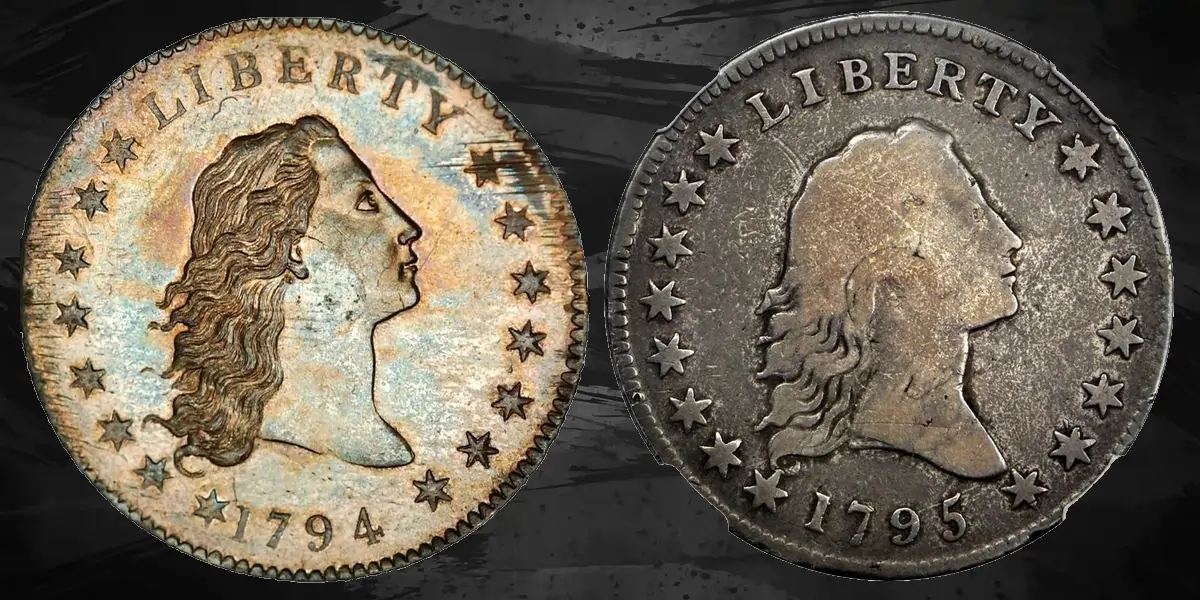
What Is a Mint-Made Silver Plug Coin?
A Mint-made silver plug coin began as an underweight planchet. Mint employees inserted a small silver plug into the center of the blank. Then they struck the coin. The pressure from the dies flattened the plug into the surrounding metal. As a result, the finished coin came closer to its required legal weight. PCGS defines this early American practice as a way to add weight or value before striking.
That distinction matters. A later “plugged” coin lost originality because someone repaired damage. A Mint-made silver plug coin gained its plug before it became a coin. Therefore, the plug forms part of the coin’s original manufacture.
Why Weight Mattered So Much
The Coinage Act of April 2, 1792, set exact standards for the new nation’s silver coins. A silver dollar had to contain 416 grains of standard silver. A half dollar had to contain 208 grains of standard silver. The law also defined the silver standard as 1,485 parts fine silver to 179 parts copper alloy.
Those numbers gave each coin its legal identity. They also created a hard production problem. The early Philadelphia Mint had to refine metal, roll strips, cut planchets, weigh blanks, and strike coins with equipment that still relied on hand labor and judgment.
The Planchet Problem at the First Mint
Early Mint employees did not start with perfect blanks. They made silver coins only when depositors requested specific denominations. Then the Mint refined the metal, rolled it into strips, and cut planchets. Stack’s Bowers notes that the Mint often made planchets slightly overweight so workers could trim them by filing. That approach reduced the risk of producing too many underweight blanks.
However, some planchets still weighed too little. In those cases, the Mint could melt the metal and start again. Yet that wasted time. Instead, workers sometimes added a silver plug. This practical fix brought the planchet closer to standard. It also reflected a technique known at other world mints.
Adjustment Marks: The Other Side of the Same Problem
Collectors know the opposite correction as adjustment marks. When a planchet weighed too much, Mint employees filed away excess silver before striking. Those file marks often remained visible after the coin left the press. On many Flowing Hair Dollars, they still cut across the design today.
Adjustment marks and silver plugs tell the same story from opposite directions. Heavy planchets needed silver removed. Underweight planchets needed silver added. In both cases, the Mint tried to meet the legal standard.
1794: America’s First Silver Dollar Meets Reality
The silver dollar carried enormous symbolic weight in 1794. It served as the unit of the American monetary system. It also had to compete with Spanish and Mexican dollars already familiar in commerce. CoinWeek notes that the 1794 Flowing Hair Dollar followed the Mint Act of 1792 and carried a legal weight of 416 grains with a fineness of .89243.
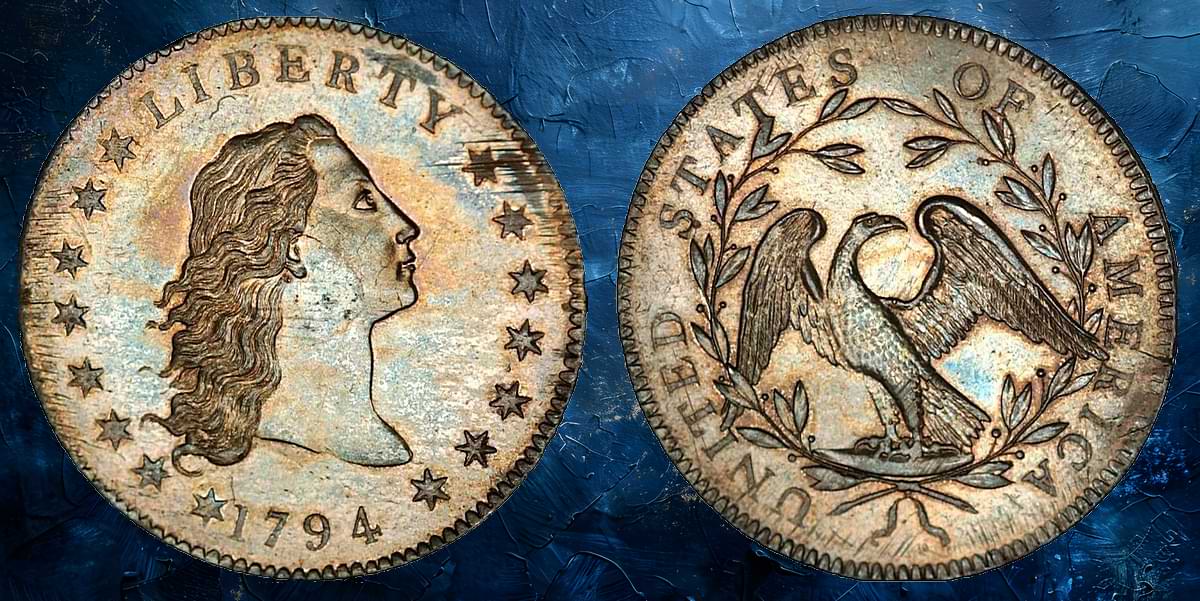
However, the Mint struggled to make the coin. CoinWeek reports that the Mint struck an estimated 2,000 1794 dollars, but delivered only 1,758 to Mint Director David Rittenhouse on October 15, 1794. Poor strike quality caused the Mint to hold back the remaining pieces. Those rejected coins later went back into production in 1795. At least one known 1795 dollar shows a visible 1794 undertype, which points to the reuse of rejected coins as planchets.
That detail gives the 1794 story its power. The first silver dollars did not emerge from a smooth industrial system. They came from a shop learning how to make national money in real time.
Why Many 1794 Dollars Look Weak
The Mint’s equipment also shaped the finished coins. CoinWeek notes that typical 1794 dollars show weakness on the lower left obverse and the corresponding reverse area. The Mint’s screw press had not been designed to strike coins larger than a half dollar. As a result, the first-year dollars often lacked full detail.
Therefore, planchet quality and striking pressure worked together. A correct-weight planchet still needed a strong strike. A strong design still needed proper metal flow. In 1794, the Mint fought both battles at once.
The Unique 1794 Silver Plug Dollar
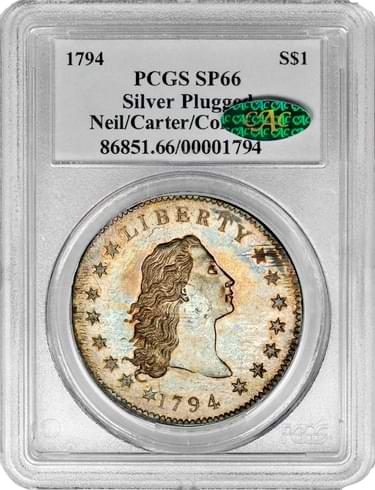
The most famous Mint-made silver plug coin remains the unique 1794 Flowing Hair Silver Dollar, B-1, BB-1, Silver Plug, Specimen-66 (PCGS), CAC. PCGS records the coin as Lot 13094 in Stack’s Bowers’ January 2013 Americana Sale, where it realized $10,016,875.
This coin carries even more importance because of its die state. PCGS describes it as the earliest die state known for a 1794 silver dollar. It matches the copper Judd-19 pattern dollar in the Smithsonian, which researchers believe tested the dies and press. PCGS also notes that this unique specimen may represent the first silver dollar struck by the United States. That remains an informed numismatic interpretation, not a settled historical fact.
Still, the backstory explains why collectors respond so strongly to silver plug coins. The plug does not reduce the coin’s importance. Instead, it helps explain why the coin exists.
1795: The Practice Becomes More Visible
Research first brought broad attention to silver plugs on 1795 Flowing Hair Silver Dollars. Stack’s Bowers credits research by Kenneth W. Bressett, Q. David Bowers, and Roger W. Burdette with publicizing the practice. Later study suggests that silver dollars became the main target for the technique. Most U.S. Mint silver plug coins are 1795 Flowing Hair Dollars, although the unique 1794 example points to an earlier attempt.
The Mint also used silver plugs on a few half dollars. However, these coins are far rarer than plugged dollars. Stack’s Bowers reports only four positively confirmed silver plug half dollars, all dated 1795.
The 1792 Silver Center Cent Is Related, But Different
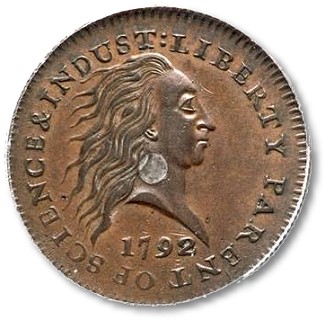
The 1792 Silver Center Cent also used a plug. However, it served a different purpose. Henry Voigt and David Rittenhouse produced the pattern as an experiment in copper coinage. Jefferson described the concept to President George Washington as a copper cent with a silver plug worth three-fourths of a cent. That design tried to solve the problem of intrinsic value in a smaller copper coin. It did not serve the same planchet-weight correction role as the 1794 and 1795 silver plug dollars and half dollars.
Why These Coins Still Matter
Mint-made silver plug coins capture the birth of American coinage in a way few other objects can. They show a Mint that had legal standards but limited equipment. They show workers who solved problems at the bench. They also show why early U.S. coins can carry both mechanical flaws and immense historical value.
Adjustment marks reveal silver removed from heavy planchets. Silver plugs reveal silver added to light ones. Reused planchets show the Mint refusing to waste rejected metal. Together, these features turn early Flowing Hair coinage into a record of the Mint’s first quality-control system.
For collectors, that is the “wow” factor. A silver plug is not merely a curiosity. It is a visible scar from the moment the United States learned how to make its own money.






What is the value of the 1794 flowing silver dollar
The article stated the 1794 SP66 sold in 2013 at auction for over $10 million, alot of factors will determine how much they are worth..condition, die state, graded or not graded.
It’s amazing what they did to coins back then. What are the odds of finding a coin like that