


The 1838-O half dollar occupies a rare place in American numismatics. It is not merely scarce. It is legendary.
This Capped Bust half dollar links the birth of the New Orleans Mint, the rise of branch mint coinage, and one of the most fascinating production mysteries in early United States silver. Experts believe the New Orleans Mint struck no more than 20 examples. Today, researchers confirm only nine survivors.
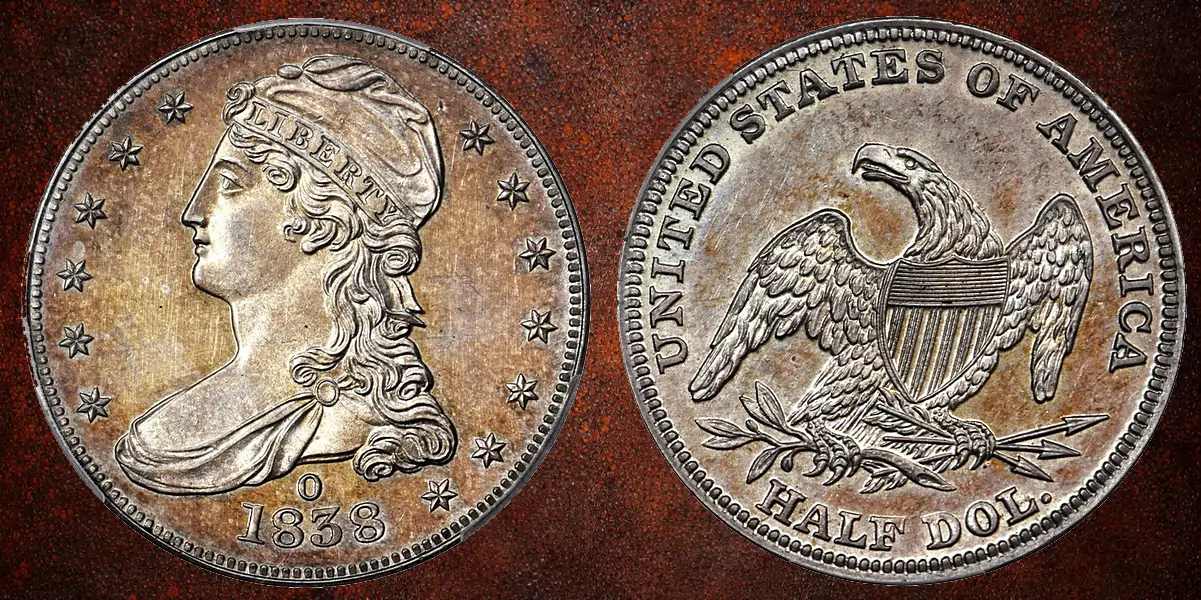
One of those survivors, the celebrated Cox-Robison specimen, sold on November 15, 2019, in the Stack’s Bowers Galleries Baltimore sale of The E. Horatio Morgan Collection of U.S. Half Dollars. The coin realized $504,000.
That result reflects more than rarity. It reflects the coin’s status as an American classic. Jeff Garrett and Ron Guth ranked the 1838-O half dollar as No. 19 in 100 Greatest U.S. Coins. Few coins deserve that type of attention more.
Congress Builds a Mint for the Gulf South
The story begins on March 3, 1835. On that date, Congress approved $200,000 to build a mint in New Orleans, Louisiana. The facility would coin both gold and silver.
The same act also authorized $50,000 each for new mints in Charlotte, North Carolina, and Dahlonega, Georgia. Those two mints would coin only gold.
Congress placed each branch mint under the authority of the Director of the Mint at Philadelphia. The law also required a clear way to identify coins from each mint while keeping national standards for weight, form, and fineness.
So the Mint adopted branch mint letters. New Orleans received the letter O.
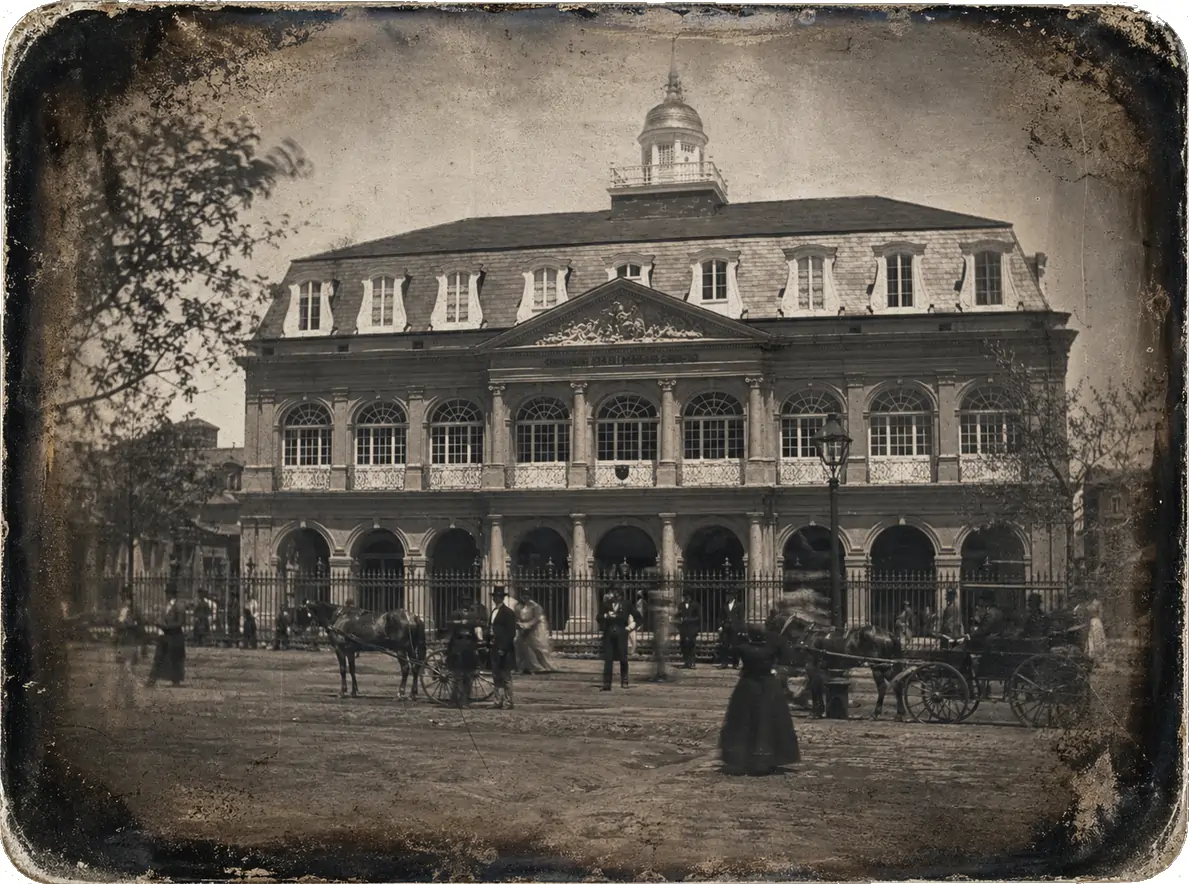
That decision gave American coinage a new visual language. Unlike France, which assigned mint letters in sequence from Paris outward, the United States chose letters that reflected each mint city. As a result, the “O” mintmark became one of the most famous symbols in American coin collecting.
Why New Orleans Needed Half Dollars
New Orleans played a major role in American commerce. Large amounts of foreign silver moved through the city, especially coins from Mexico and the West Indies.
Those coins did not always meet the needs of American banks, merchants, or everyday trade. The United States needed a practical way to convert that mixed foreign silver into reliable federal coinage.
Dimes helped with small change. However, half dollars mattered more.
At the time, the half dollar served as the largest and most important silver coin in common circulation. It moved efficiently through banks and commerce. Therefore, half dollar production became a major goal for the new branch mint.
The First O-Mint Coins Were Not Half Dollars
The first coins struck with an O mintmark were dimes. The New Orleans Mint produced them in May 1838.
Philadelphia had already supplied the technical tools. It shipped dies in separate packages on April 9 and April 11, 1838. New Orleans received 12 dies on May 3. The shipment included two pairs each for half dimes, dimes, and half dollars.
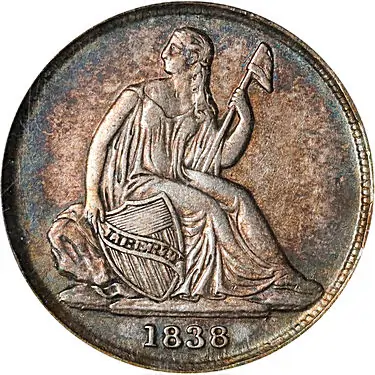
The mint began with dimes. On May 8, it struck a small group of 30 pieces. Officials treated many as presentation coins. One went to Philadelphia Mint Director Robert M. Patterson on May 12.
Then the problems began.
The small press used for dimes malfunctioned. Repairs followed, and production resumed for a short time. Then yellow fever hit New Orleans. The epidemic forced the Mint to close during August, September, and October 1838.
When the facility reopened in November, officials turned to half dimes. That work continued into the new year.
So 1838 ended with an odd result. The New Orleans Mint had dies for half dollars, but it had struck no regular half dollar coinage.
Patterson Pushes for Bigger Silver
Mint Director Patterson wanted the New Orleans Mint to move beyond small denominations.
On January 17, 1839, he wrote to Superintendent David Bradford and urged him to prepare for half dollar coinage. Patterson understood the problem. Dimes and half dimes did not raise the branch mint’s coinage totals quickly enough.
By February 25, 1839, New Orleans officials reported that they averaged more than 25,000 pieces per day in dimes and half dimes. Even so, that output could not replace the commercial value of half dollars.
The mint needed to strike larger silver. Yet it still had a mechanical problem.
Rufus Tyler’s Improvised Experiment
Coiner Rufus Tyler gave the 1838-O half dollar its remarkable origin story.
In a February 25, 1839 letter to Patterson, Tyler explained that the 1838 half dollar dies posed two problems. They were already out of date. Also, the bottom dies were too short for the press setup then available.
The dime press could not handle half dollars. The proper half dollar press was not yet ready. So Tyler used a medium-sized press intended for quarter eagles.
Then he improvised.
He attached an extension to the bottom of one die so the die could sit in the press. The solution worked, but only briefly. Tyler struck 10 excellent impressions. Then the added piece loosened, and he could strike no more without further repairs.
Those 10 coins likely represent the first 1838-O half dollars.
That moment gives the coin its “wow” factor. The 1838-O half dollar did not begin as a routine product of an orderly mint. It began as a mechanical test, created by a coiner who solved a problem with ingenuity and urgency.
Bradford Confirms the January Striking
Superintendent Bradford added more detail in a March 7, 1839 letter. He reported that Tyler struck a few half dollars around the middle of January 1839.
Bradford also explained that the half dollar dies had been made for Mr. Eckfeldt’s press, the proper half dollar press. They did not fit the other press well. Tyler’s added piece supplied the needed length, but it crushed after only a few strikes.
As Bradford’s letter traveled north, new dies moved south. On March 12, 1839, Patterson sent two pairs of 1839 half dollar dies to Treasury Secretary Levi Woodbury for forwarding to New Orleans.
However, the 1838 dies still had one more role to play.
The Second Striking Period
On March 29, 1839, Bradford wrote Patterson again. He confirmed that the 1839 half dollar dies had arrived. He also noted Patterson’s advice that New Orleans should not use the 1838 dies
Bradford suggested returning those dies to Philadelphia. Tyler disagreed.
Then Bradford reported important news. Tyler had placed the half dollar coining press in operation. He began striking on the evening of March 27, 1839, and the press worked well.
This sequence strongly suggests a second group of 1838-O half dollars came from the proper half dollar press. These coins would have followed Tyler’s January trial strikes.
Within days, the Mint began 1839-O half dollar production. Some researchers have also noted that at least one 1838-O half dollar, the Smithsonian specimen, may show a die state later than the earliest known 1839-O half dollars. That point matters because many 1839-O halves used a leftover 1838 reverse die.
The exact sequence still invites study. That uncertainty adds to the coin’s appeal.
“Not More Than Twenty”
The best-known mintage clue appeared decades later.
In 1894, dealer Ed. Frossard offered an 1838-O half dollar with an original note from Rufus Tyler. Frossard discussed the note in the July 1894 issue of The Numismatist.
Tyler’s note accompanied a coin presented to President Alexander Dallas Bache. In the note, Tyler stated that not more than 20 pieces had been struck with the 1838 half dollar dies
That wording remains important. Tyler did not claim that exactly 20 coins existed. He said the number did not exceed 20.
Tyler’s own correspondence confirms 10 pieces in January 1839. Bradford’s letters point to additional pieces in March. However, no document fixes the final total.
Therefore, the best statement remains careful and precise: no more than 20 1838-O half dollars were struck.
Why Most Did Not Survive
The coin’s survival story may prove as interesting as its production story.
Recent research by Kin Carmody suggests that the Bache presentation coin may be the only survivor from Tyler’s first trial striking on the medium press. Other researchers have argued that reverse strike doubling on both the Bache, or Anderson-Dupont, specimen, and the Empire specimen may link those pieces to Tyler’s spliced die setup. Either way, few January trial coins likely survived. Tyler made those pieces to test a press. They did not enter a mature collector market.
In 1839, the southern United States had little organized numismatic activity. Collectors also had not yet embraced mintmarks as a major field of study. Augustus Heaton’s famous work on mintmarks still lay more than 50 years in the future. As a result, people who saw an 1838-O half dollar in 1839 may not have understood its importance.
The March strikings may have fared better. Carmody argues that the later pieces struck on the proper half dollar press likely served presentation purposes. Some may have gone to Patterson, perhaps with assay coins in June 1839.
One 1838-O half dollar now resides in the National Numismatic Collection at the Smithsonian Institution. Other high-grade survivors may have passed through Mint or government hands before entering the collector market later in the 19th century.
From Breen’s Census to Nine Known Coins
Walter Breen listed 11 examples of the 1838-O half dollar in his 1988 Encyclopedia. Later researchers refined that census. They removed accidental duplications and reduced the accepted population to nine distinct specimens.
That number gives the 1838-O half dollar a special standing. It is rarer than many famous U.S. coins that receive far more public attention. It also offers a better story than many of them.
The coin combines a branch mint origin, a delayed production program, an improvised striking, a tiny estimated mintage, and a surviving population that collectors can almost count on two hands.
The Cox-Robison Specimen
The coin sold in 2019 is known as the Cox Specimen or Cox-Robison specimen. Before its appearance in the E. Horatio Morgan Collection sale, it had remained away from the market since the 1980s.
Its pedigree carries exceptional weight.
The coin once belonged to “Colonel” E.H.R. Green, one of the most remarkable collectors in American numismatic history. Green reportedly owned no fewer than six 1838-O half dollars. That fact still amazes specialists. One collector controlled most of the known population of one of America’s greatest silver rarities.
From Green, the coin passed through a long chain of major collectors and dealers. Its recorded provenance includes Burdette G. Johnson, Wayte Raymond, J.G. Macallister, and likely Charles M. Williams. It later appeared in Numismatic Gallery’s Adolphe Menjou Collection sale in June 1950 as lot 1073, and in Numismatic Gallery’s ANA Sale of August 1953 as lot 905, according to Carl Carlson.
Stack’s sold the coin in the R.E. Cox, Jr. Collection in April 1962 as lot 1873. It then passed through Empire Coin Co., operated by Q. David Bowers and James Ruddy, and later belonged to Hazen B. Hinman. Paramount offered it in the Century Collection sale in April 1965 as lot 1151.
After an unknown intermediary, the coin appeared with Bowers and Ruddy Galleries in Rare Coin Review numbers 17 and 18. Stack’s later sold it in the Ellis H. Robison Collection in February 1982 as lot 1605. It then passed to Marvin Browder and David W. Akers before entering the E. Horatio Morgan Collection.
That chain places the coin in the center of 20th-century American numismatics.
The Look of a Special Striking
The Cox-Robison 1838-O half dollar shows the character expected from a special striking. The surfaces carry strong reflectivity. The strike shows sharp detail. The rims stand high. Together, those traits support the coin’s Specimen status.
The obverse displays light golden-orange color near the borders, along with brief ice-blue highlights. The reverse shows light copper-rose and pale blue iridescence in the fields. The coin also carries useful provenance markers. A few fine marks appear in the obverse field. A tiny oval depression sits left of star 7 above Liberty’s cap. Since the obverse lacks other major marks, that feature helps identify the coin.
The reverse shows several die cracks. One runs through the letters ERIC and reaches the rim above the C. Another short crack extends from the bottom of the I into the field. A longer crack begins at the left wing tip, crosses the middle group of leaves, passes through the tip of the lower leaf, continues through HA in HALF, and ends at the base of the L.
A tiny speck sits below the left wing. Additional tiny specks appear around the arrowheads. These details help specialists track the coin across photographs, catalogs, and sales records.
PCGS Population
PCGS reports three examples at the Specimen-63 level. Four examples grade finer. All four grade Specimen-64, and one of those carries a Cameo designation.
For a coin with only nine confirmed survivors, population data can only tell part of the story. Provenance, surface quality, originality, and historical context matter just as much.
Specifications
- Coin: 1838-O Capped Bust Half Dollar
- Mint: New Orleans
- Mintmark: O
- Designer: John Reich
- Type: Capped Bust Half Dollar
- Edge: Reeded Edge
- Reverse Denomination: HALF DOL.
- Variety: GR-1
- Rarity: Rarity-7
- Certified Grade: Specimen-63, PCGS
- CAC Status: CAC Approved
- Estimated Mintage: No more than 20 struck
- Confirmed Survivors: Nine known
- Notable Provenance: Cox-Robison; E.H.R. Green; E. Horatio Morgan Collection
- 2019 Public Sale: Stack’s Bowers Baltimore, November 15, 2019
- Realized Price: $504,000
Why the 1838-O Half Dollar Still Matters

The 1838-O half dollar matters because it captures a turning point.
Before the branch mints, Philadelphia dominated federal coinage. New Orleans changed that. It connected federal coin production to the commercial needs of the Gulf South. It also gave American coinage one of its most recognizable mintmarks.
Yet the 1838-O half dollar shows that the transition did not happen smoothly. Dies arrived before the presses worked properly. Yellow fever stopped production. Small coins came first. Half dollars lagged behind. Then Rufus Tyler forced the issue with a mechanical workaround.
That is the deeper story. The 1838-O half dollar is not just rare because few pieces survive. It is rare because it emerged from a moment of pressure, improvisation, and institutional ambition.
The Mint wanted New Orleans to strike the silver coins that commerce demanded. Tyler wanted to prove that the branch mint could do the job. The result became one of the most famous half dollars ever made.
A Coin With a Backstory Equal to Its Rarity
Many great coins have low mintages. Fewer have origin stories this strong.
The 1838-O half dollar began with an act of Congress. It passed through a yellow fever shutdown, using dies that did not fit the available press. It required Rufus Tyler to improvise a fix, and then survived through presentation channels, government hands, and the cabinets of some of America’s most important collectors.
The Cox-Robison specimen adds another layer by carrying the legacy of E.H.R. Green, the Cox and Robison collections, and the E. Horatio Morgan Collection. Its 2019 realization of $504,000 confirmed the market’s respect for both the issue and the pedigree.
Still, price alone cannot define this coin.
The 1838-O half dollar stands out because it tells a complete American story. It speaks to commerce, disease, technology, ambition, and the birth of branch mint silver coinage. It also reminds collectors that some coins become legendary not through mintage figures alone, but through the human decisions that brought them into existence.



Such beauties in my opinion I dont really know how people eye peace dollars or silver eagles over older coins.
Incredible story. Shows why collecting is such fun, even when a given coin is unattainable to the vast majority of collectors.
What a coin. You have to love historical coins.
The New Orleans mint has a fascinating history with all the coins they did. I wish it would have survived longer or still existed today.
Very pretty coins!
That’s interesting .
I have a nice 1839-O. Great example of some of the first Orleans mintage.
Great coin history !
What an interesting story. I enjoy browsing the articles and growing my knowledge, as well as becoming interested in collecting a wider variation of coin types and denominations.
The coin sure got passed around a lot.
Would love to know the history of this coin
What a story! I love the history attached to a piece with tangibility!
What a great story on this coin.
This has always interested me. Thanks!
Very interesting background on this coin.
New Orleans Mint… Does this qualify as (Big)Easy money? [ducking]
“Col” E. H. R. Green, I would love to see a comprehensive review of his coin, currency, stamp and medals collection. It was vast. His mom, Hetty Green, the witch of Wall Street, gave him tens of millions when she died. He spent like she saved!
Amazing story!
I love the stories behind historical coins!
The history and stories of all these coins is so amazing. Thanks.
Very interesting coin and history
Beautiful coin. Wish I had one.
First that I have heard of this coin, or the Mint in New Orleans. Thanks for the backstory.
For a newer run from New Orleans, the Morgan dollars, are difficult to find in better than average condition. My understanding was that they sent the dollars to the casinos for their usage and not many went out for circulation. Still, a beautiful coin.
Thank you for sharing the history behind this amazing coin. I need to add more New Orleans mint coins to my collection.
What a story, I love the history that surrounds coin collecting!