


Only 8,000 Were Struck: The 1866 Dime That Survived Reconstruction
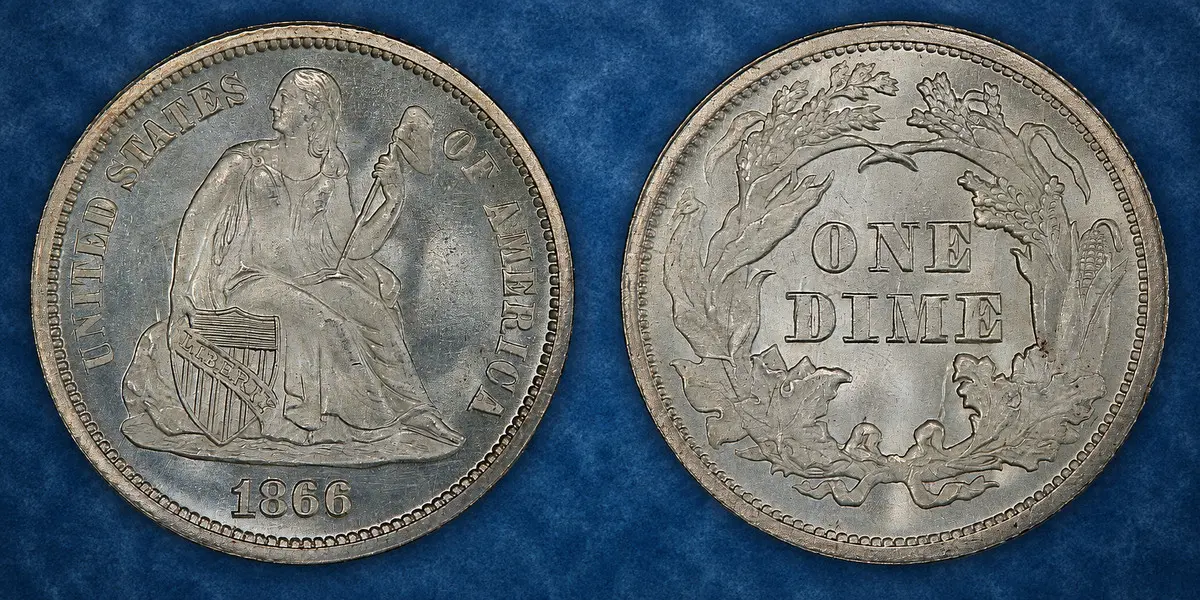
Only 8,000 business-strike 1866 Liberty Seated Dimes left the Philadelphia Mint. Even more remarkably, the Mint struck the entire business-strike production on a single day: January 31, 1866.
That tiny output alone makes the coin important. Yet the story behind it adds another dimension.
The United States produced the 1866 dime during one of the most difficult transitions in American history. The Civil War had shattered lives, wealth, infrastructure, and the monetary system. Precious-metal coins had disappeared from everyday commerce. Meanwhile, hundreds of millions of dollars in federal paper money circulated at a discount to specie.
Against that backdrop, Philadelphia devoted only token attention to the dime.
Today, the 1866 Liberty Seated Dime ranks among the key low-mintage Philadelphia issues of the series. High-grade survivors remain especially elusive. Moreover, an extraordinary group of toned condition-census coins gives the date added appeal for advanced collectors.
America Entered 1866 With Deep Scars
Robert E. Lee surrendered the Army of Northern Virginia to Ulysses S. Grant at Appomattox Court House on April 9, 1865. Other Confederate forces remained in the field, however, so Appomattox did not immediately end every military operation.
Then came another national shock.
John Wilkes Booth shot President Abraham Lincoln at Ford’s Theatre on April 14. Lincoln died the following morning. His death removed the leader who had already turned his attention toward national reconciliation and Reconstruction.
The human cost of the war also continues to attract scholarly study. Earlier demographic work by historian J. David Hacker placed the death toll near 750,000 and allowed a broad range of roughly 650,000 to 850,000. That research informed the higher estimate cited in earlier versions of this CoinWeek article.
However, newer research provides a more precise estimate.
A 2024 study published in the Proceedings of the National Academy of Sciences used full-count census records rather than the earlier one-percent sample. The authors calculated about 698,000 Civil War deaths, with an estimated interval of roughly 647,000 to 749,000. Therefore, current scholarship places the most likely total below the earlier 750,000 estimate.
The South also faced enormous economic devastation. Contemporary and later assessments show that roughly two-thirds of assessed Southern wealth disappeared during the war. However, physical destruction alone did not cause that decline. Emancipation also removed enslaved people from property valuations. Meanwhile, war damage devastated railroads, livestock, farm machinery, factories, and large sections of urban infrastructure.
Thus, the reunited nation entered 1866 with an enormous reconstruction bill and without Lincoln’s leadership.
Greenbacks Changed What the Philadelphia Mint Produced
The monetary problem proved equally difficult.
Congress had authorized federal Legal Tender Notes, better known as greenbacks, to help finance the Civil War. Unlike specie, these notes did not convert into gold or silver on demand. As a result, their market value fluctuated against coin.
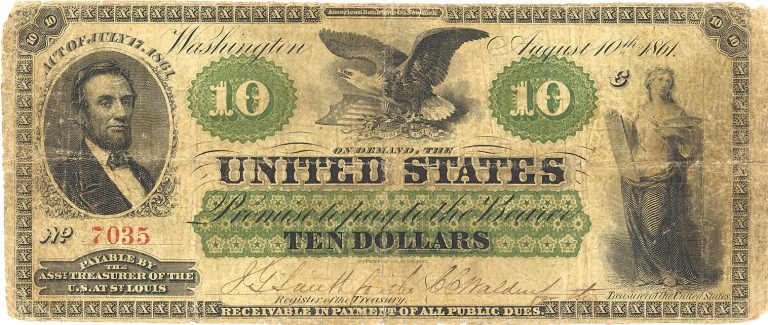
More than $400 million remained in circulation during 1866. A March 1866 financial report placed outstanding greenbacks at more than $423 million. Americans had already spent years treating gold and silver coin as more valuable than paper currency. Consequently, precious-metal coins largely disappeared from normal circulation.
Treasury Secretary Hugh McCulloch wanted to retire greenbacks and move the country back toward specie payments. Still, the transition could not happen overnight.
Therefore, Philadelphia’s coinage reflected two very different needs.
The Mint produced huge quantities of low-value base-metal coins for domestic transactions. At the other end of the spectrum, it struck 698,745 Liberty Head Double Eagles, worth $13,974,900 at face value. Banks, government institutions, international commerce, and overseas payments continued to demand gold.
The Mint also introduced the new copper-nickel Shield Nickel in 1866. Congress authorized the five-cent nickel on May 16. The new coin eventually replaced the smaller silver half dime, although the Mint continued making half dimes through 1873.
A Correction to the Original 1866 Philadelphia Mintage Count
Earlier versions of this article stated that Philadelphia produced 15 circulating coin types in 1866 and that eight had mintages below 25,000.
A closer accounting reveals 16 Philadelphia business-strike denominations, with nine below 25,000 pieces. The earlier count omitted the 1866 Three-Cent Silver, which had a business-strike mintage of 22,000.
The overall point still holds. Philadelphia devoted very little production capacity to many precious-metal denominations.
Among silver coins, the Mint struck 744,900 half dollars. That made the half dollar the only Philadelphia silver denomination of 1866 with a substantial business-strike mintage. In comparison, the dime received a microscopic production of only 8,000 pieces.
The 1866 Liberty Seated Dime: Just 8,000 Business Strikes
The Philadelphia Mint struck all 8,000 business-strike 1866 Liberty Seated Dimes on January 31.
It also produced 725 Proof dimes for collectors.
Some numismatists have suggested that postwar collector sentiment may have helped lift Proof sales in 1866. However, no firm documentary evidence establishes that connection. Moreover, Philadelphia had already produced 1,000 Proof dimes in 1860. That earlier total weakens any argument that the end of the Civil War alone explains the 1866 Proof mintage.
Meanwhile, the business-strike mintage continued a dramatic decline in Philadelphia dime production that began in 1863 and bottomed in 1867.
All five Philadelphia issues from 1863 through 1867 challenge collectors. However, the 1867 dime reached an even lower mintage of only 6,000 pieces.
The 1866 remains scarce across the grading spectrum. Yet high-end Mint State examples carry particular significance.
Nineteenth-century collectors often preferred Proofs when the Mint offered them. Consequently, relatively few collectors deliberately saved pristine business strikes. Many ordinary 1866 dimes instead faced commerce, handling, wear, or later mishandling. That collecting pattern helps explain the date’s limited supply of premium Mint State survivors.
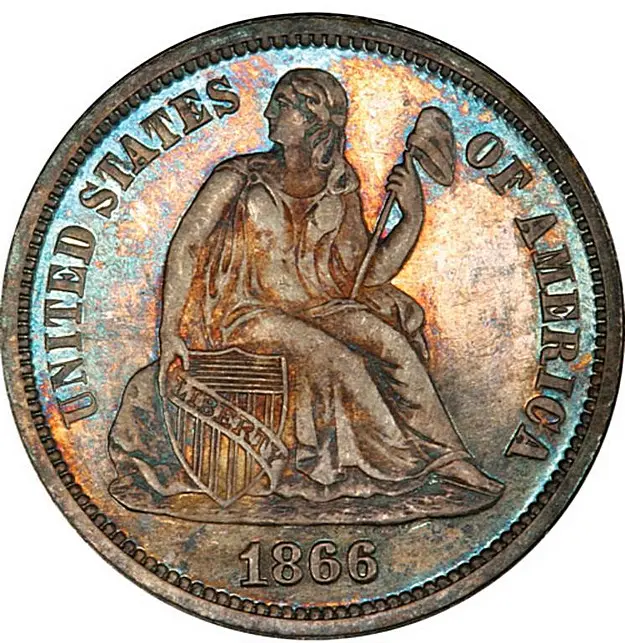
For collectors who can afford the jump, the relatively compressed spread between better circulated examples and Choice Mint State coins can make an attractive Mint State example a compelling target.
One Business-Strike Die Marriage – But Two Distinct Die States
The 1866 dime also offers an intriguing specialist story.
Liberty Seated dime specialist Gerry Fortin identifies two principal die marriages for the date. F-101 belongs exclusively to Proof production. F-102 produced both Proofs and business strikes.
Therefore, all known 1866 business strikes trace to the F-102 marriage.
However, that does not mean every circulation strike looks exactly alike.
During the one-day business-strike production run, the obverse and reverse dies clashed when they came together without a planchet between them. The collision transferred portions of each design into the opposing die.
Collectors therefore recognize two F-102 die states.
Fortin identifies F-102a as the Perfect Reverse and F-102b as the Clashed Reverse. Specialists generally consider F-102a slightly more available. Nevertheless, F-102b examples dominate the current PCGS Condition Census.
Why Doesn’t the 1866 Dime Say “IN GOD WE TRUST”?
The year 1866 brought another major change to American coinage.
The Mint added IN GOD WE TRUST to gold and silver coins beginning January 1, 1866. However, the dime did not receive the motto.
The reason was simple: Mint officials considered the dime too small.
The U.S. Mint’s historical record specifically notes the dime as the exception when the motto reached gold and silver coinage in 1866. Therefore, the Liberty Seated Dime retained its existing design.
That small detail makes the dime an interesting companion to the larger silver and gold denominations of the same year.
Current Population Data Shows How Tough the Date Remains
Population reports require dates because collectors continually submit, cross, and sometimes resubmit coins.
When CoinWeek reviewed the issue in August 2025, PCGS and NGC together showed 72 grading events. Thirty-two fell within the MS63 and MS64 grade bands. At that time, CoinWeek recorded PCGS MS67 at two pieces, NGC MS68 at one grading event, and CAC at one MS67 stickered example with none then graded through CAC Grading.
The numbers have since changed.
As of the PCGS Population Report update dated August 25, 2026, PCGS lists 111 grading events for the regular 1866 dime. That total includes three MS67 grading events and none higher.
Meanwhile, NGC’s census, updated June 18, 2026, reports 58 grading events. NGC lists one coin at MS68, its highest grade for the issue.
These numbers represent grading events, not necessarily unique surviving coins. Resubmissions and crossovers can inflate certification totals.
PCGS also estimates only about 400 survivors in all grades, approximately 50 in MS60 or better, and only eight in MS65 or better. Those estimates underscore the difficulty of finding truly premium examples.
Market Data and Noteworthy 1866 Liberty Seated Dimes
Toning defines much of the upper end of the 1866 dime market.
Many condition-census pieces display blue, green, violet, gold, or russet patina. In contrast, the Dell Loy Hansen MS67 stands apart with bright, frosty surfaces.
Then, in 2023, another remarkable coin entered the modern marketplace.
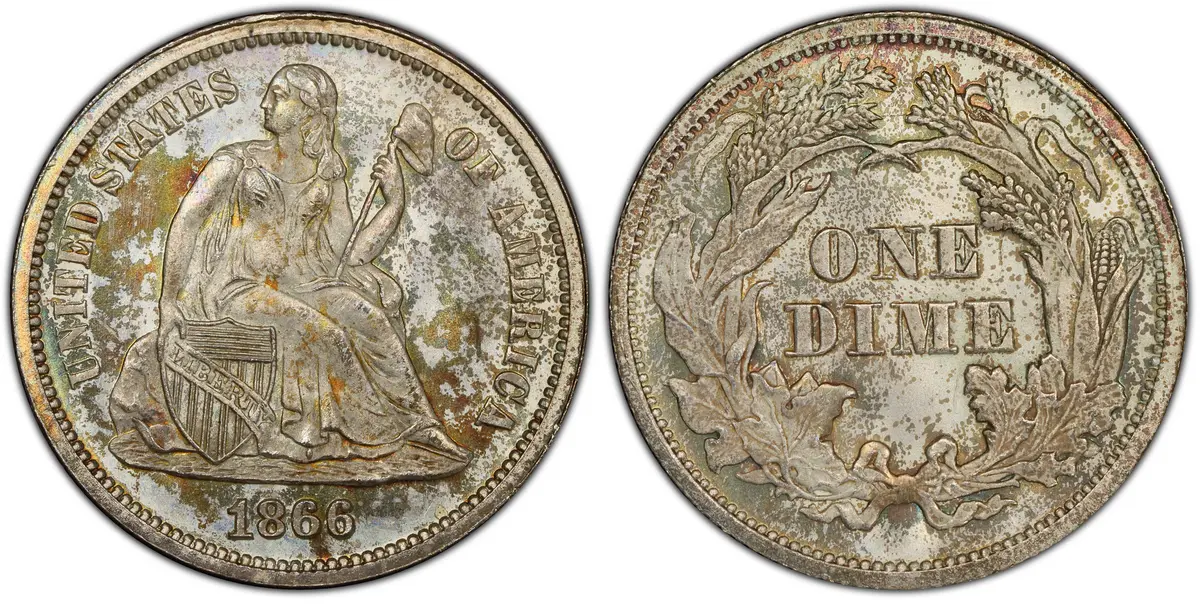
The James Allaire Millholland Collection produced a previously unknown PCGS MS67 example after Millholland’s estate had kept it away from the market for 112 years. Millholland lived from 1842 to 1911 and built a collection rich in high-quality uncirculated silver coins. Many pieces displayed attractive original toning when the collection finally reached auction. PCGS now lists that coin, the Hansen specimen, and an example in “Nic’s 1866 Philly Mint Set” at MS67.
Crossovers and upgrades often reshape condition censuses for classic U.S. coins. However, the original CoinWeek study found remarkably little movement among MS66-or-better 1866 dimes. The study identified one notable half-point upgrade involving an NGC MS66/PCGS MS66+ auction trail.
Noteworthy high-grade examples and auction appearances include:
PCGS MS67 #46212607 — James Allaire Millholland Collection. Stack’s Bowers sold the coin on March 21, 2023, Lot 3003, for $7,200. Millholland’s estate kept the coin for 112 years. PCGS identifies it as F-102b and describes olive, gold, and russet toning.
PCGS MS67 #84065944 — Dell Loy Hansen Collection. CoinFacts illustrates this brilliant, frosty F-102b specimen. It provides a striking visual contrast to the heavily toned coins that dominate the upper condition census.
PCGS MS67 — “Nic’s 1866 Philly Mint Set.” This coin joined the PCGS MS67 population after the original August 2025 CoinWeek article and now gives PCGS three MS67 grading events.
PCGS MS66+ CAC #39848029 / later PCGS #45091180. PCGS records an NGC MS66 appearance under certification #6060873-007 at Heritage on December 16, 2021, Lot 3049, for $3,960. It also records a PCGS MS66+ CAC appearance under #39848029 at Heritage on June 18, 2021, Lot 3411, for $5,160. Because the recorded auction dates do not support a simple chronological “NGC first, then PCGS” narrative, the auction trail deserves that qualification. PCGS describes the later holder as showing plum and red-gold toning around champagne centers.
PCGS MS66 #27382710 — New England Museum. Stack’s Bowers sold this vividly toned F-102b example on May 9, 2013, Lot 207, for $12,925. Antique olive, blue, and red toning cover the surfaces.PCGS MS66 CAC #06666750 — Bob R. Simpson Collection of Seated Dimes. Heritage sold the coin on September 23, 2010, Lot 3668, for $6,325. Lavender and seafoam-green toning distinguish the piece.
PCGS MS66 — New York Connoisseur’s Collection. American Numismatic Rarities sold this example on March 14, 2006, Lot 560, for $12,650. That price remains the PCGS auction record for the regular 1866 business strike. PCGS describes apricot toning with deep blue and green around the borders. Earlier CoinWeek research described the coin as predominantly blue and purple.

Design of the 1866 Liberty Seated Dime
Obverse
Liberty sits on a rock and turns her head toward her right shoulder. Flowing robes cover the seated figure.
Her left hand holds a pole topped by a Phrygian or Liberty cap, a long-established symbol of freedom and emancipation. Her right hand supports a Union shield. A curved ribbon crosses the shield and carries the word LIBERTY.
The legend UNITED STATES OF AMERICA arcs around the upper portion of the coin. The date 1866 appears beneath Liberty. Denticles frame the rim.
The 1866 design belongs to the Legend Obverse type that Chief Engraver James B. Longacre introduced in 1860. Longacre reworked the earlier Seated Liberty concept associated with Christian Gobrecht, Robert Ball Hughes, Thomas Sully, and Titian Peale.
Reverse
The denomination ONE DIME occupies the center.
A cereal wreath surrounds the denomination. The design includes corn, wheat, maple leaves, and oak leaves. A ribbon joins the two branches at the bottom. Denticles surround the rim.
This description corrects the older characterization of the reverse as simply a “wreath of wheat.”
Edge
The 1866 Liberty Seated Dime has a reeded edge.
1866 Liberty Seated Dime Specifications
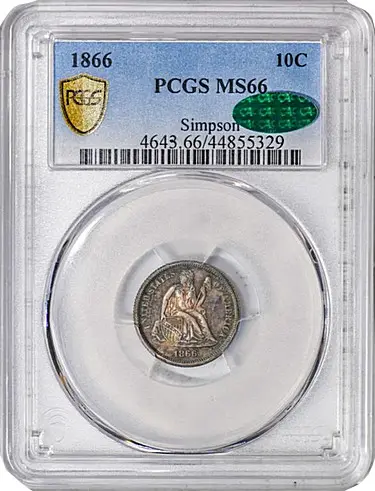
- Country: United States of America
- Year: 1866
- Denomination: One Dime (10 Cents USD)
- Mint: Philadelphia
- Mintmark: None
- Business-Strike Mintage: 8,000
- Proof Mintage: 725
- Composition: 90% Silver, 10% Copper
- Weight: 2.48 g according to PCGS; period/type references also commonly list 2.49 g
- Diameter: 17.90 mm
- Edge: Reeded
- Design Type: Liberty Seated Dime, Legend Obverse
- Primary: 1860-Type Designer James B. Longacre
- Design Lineage: Longacre modification of the earlier Gobrecht/Hughes Seated Liberty motif; Anthony C. Paquet has an engraving association with the cereal-wreath work
- Strike Type: Business Strike
PCGS currently credits James B. Longacre as designer for the 1866 issue and lists the coin at 2.48 grams, 17.90 mm, and 90% silver with 10% copper. CoinWeek’s broader type attribution documents the earlier Gobrecht-Hughes-Sully-Peale lineage and Paquet’s engraving role.
Why the 1866 Liberty Seated Dime Matters
The 1866 Liberty Seated Dime tells a much larger story than its small size suggests.
It emerged from a country struggling to rebuild after four years of civil war. Paper greenbacks dominated commerce. Gold and silver remained largely outside normal circulation. The Treasury faced the long road back toward specie payments. Meanwhile, the Philadelphia Mint concentrated much of its domestic output on base-metal coins and much of its precious-metal value on double eagles.
Against that backdrop, the Mint devoted only one January day to business-strike dimes.
Just 8,000 coins resulted.
Most collectors of the period showed greater interest in Proofs. Many ordinary business strikes therefore entered commerce. Generations of use and handling reduced the population further. Today, premium Mint State survivors rank among the most difficult Philadelphia dimes of the Reconstruction era.
Then there is the numismatic detail. Every known business strike traces to the F-102 die marriage. Die clashing created two distinct states. The finest survivors often carry spectacular original color. And pedigrees such as Millholland, Hansen, Gardner, Simpson, and the New England Museum connect the date to some of the most important collections in American numismatics.
Few coins capture the monetary uncertainty of 1866 so completely.
For collectors, that combination of tiny mintage, historical context, die-state interest, rarity, and pedigree gives the 1866 Liberty Seated Dime an importance that extends far beyond its 10-cent face value.



Great looking coin and great history.
Definitely a very cool looking coin for someone’s collection.
Interesting!
…I’ll be double-checking my change … lol
Interesting Article about a scare dime that’s part of our Numismatic History!!!
Great History on the seated dime
Great info
I really enjoy reading about the history of a coin and what was happening when the coin was made that influenced the making of the series
Well written article. Great history. Amazing rare coin.
What a cool coin!
such an amazing site to visit indeed
So much info in this article. Once again there is so much history attached to a little known coin.
Thanks for the great story.
Great article
Great, now I need one.
how very cool. limited edition
Nice one
Coin history is very interestng to me. CW provides articles that astound me with all the details.
History in metals, fascinating
Very cool!