This Tiny 1792 Coin Helped Launch U.S. Money. Now Its Famous Pedigree Is a Mystery
On the evening of July 13, 1792, Thomas Jefferson stopped in Chester, Pennsylvania, while traveling south from Philadelphia. Earlier that day, he had collected 1,500 newly struck silver half dismes with a combined face value of $75.
That evening, Jefferson recorded a 30-cent payment to servants at the inn. Six tiny silver coins may have changed hands.
Numismatic researchers consider that transaction the earliest documented commercial use of coins struck under the authority of the United States Constitution. In other words, America’s new federal monetary system did not enter everyday commerce with a silver dollar or a gold eagle.
It started with a five-cent coin.
Now, 234 years later, the finest certified survivor of that extraordinary coinage will return to auction.
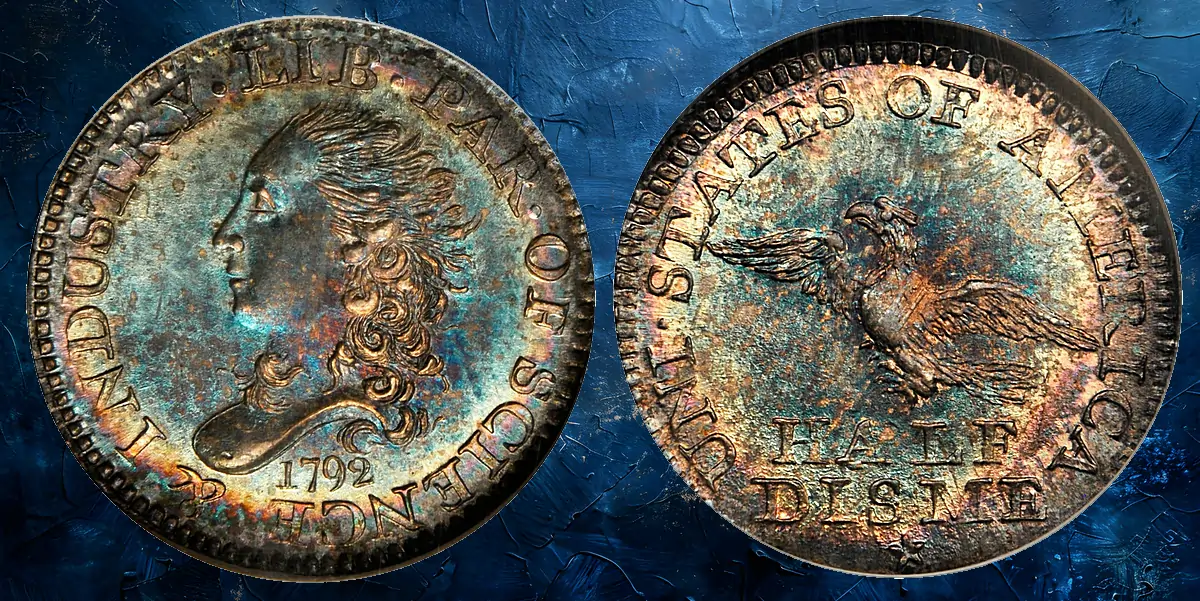
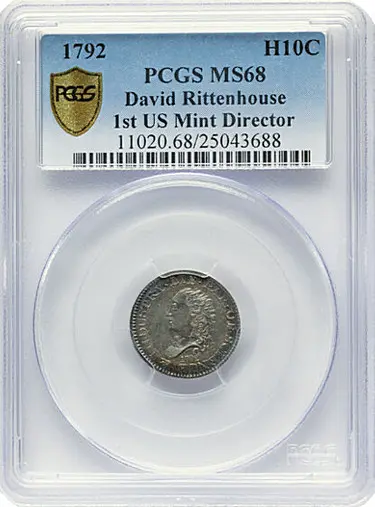
Heritage Auctions will offer the PCGS MS68 1792 Half Disme, Judd-7, Pollock-7, as Lot 3414 during its October 8, 2026, GACC U.S. Coins Signature Auction. Heritage calls it the sole-finest certified example, and the coin comes from the Ronald Firman Collection.
Yet the coin returns with something collectors may not expect. Its condition remains extraordinary and its importance remains unquestioned, but its famous David Rittenhouse pedigree now carries a significant question mark.
That makes this appearance far more than another auction of a million-dollar rarity. It has become a numismatic detective story.
America Needed Coins Before It Had a Mint
Congress passed the Mint Act on April 2, 1792. The law created the United States Mint and established a decimal coinage system based on dollars, dismes, cents, and milles.
The Act also authorized the half disme. Each coin carried a value of one-twentieth of a dollar.
President George Washington chose celebrated scientist David Rittenhouse to lead the new Mint, and Washington’s signed commission dates to April 14. Yet Rittenhouse faced an immediate problem: he had a Mint to operate, but he did not yet have a finished Mint building.
Therefore, early coinage work apparently took place at the Philadelphia premises of sawmaker John Harper near Sixth and Cherry Streets. Rittenhouse had access to coining equipment there while construction moved forward on the permanent Mint.
Henry Voigt also worked on the fledgling coinage operation. He served in an acting capacity before Washington formally appointed him Chief Coiner in January 1793.
Then events moved quickly.
On July 9, Rittenhouse asked Washington for authority to begin striking cents, half cents, dismes, and half dismes. Washington approved the plan.
Two days later, Jefferson entered a crucial transaction in his private memorandum book. He delivered $75 to the Mint for coinage.
On July 13, Jefferson recorded receiving 1,500 half dismes. The arithmetic matched perfectly: at five cents each, 1,500 half dismes equaled $75.
The United States suddenly had its first circulating silver coinage under the Mint Act.
The Two-Day Mystery
However, Jefferson’s entries created another puzzle. Turning $75 in raw silver into finished coins in roughly two days would have required a remarkable production effort.
Workers would have needed to melt and refine the silver, roll it into strip, cut the planchets, anneal them, prepare the edges, and strike 1,500 finished coins. Numismatist Eric P. Newman therefore proposed another possibility.
Perhaps someone had already converted the silver into coin-ready planchets. Jefferson may have delivered value rather than completely unprocessed bullion.
That explanation fits the timeline, but no surviving document proves it.
Therefore, the safest conclusion remains simple. Jefferson delivered $75 for coinage on July 11 and received 1,500 half dismes two days later.
What happened to the metal between those two entries remains uncertain.
Jefferson Did Something More Important: He Spent Them
This point separates the 1792 Half Disme from most other experimental coinage of that remarkable year. Jefferson did not simply place the coins in a cabinet.
He took them on the road.
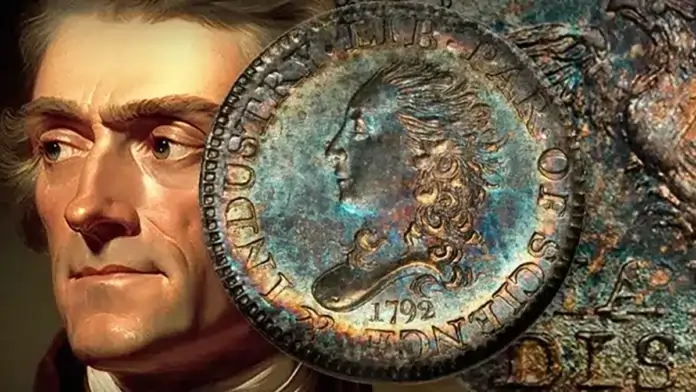
After leaving Philadelphia on July 13 with his daughter Maria, Jefferson stopped for the night at Chester. His 30-cent payment to servants almost certainly represented six of the new half dismes.
Then the pattern continued. Jefferson recorded numerous payments in five-cent multiples as he traveled through Pennsylvania, Delaware, Maryland, and Virginia.
Those small transactions largely disappear from his accounts after his return to Philadelphia in October. That spending trail gives historians powerful evidence that the July half dismes served as money rather than mere patterns.
Washington strengthened that interpretation in his November 6, 1792, address to Congress. He described a “small beginning in the coinage of half dismes” and directly connected the issue with the need for small coins in circulation.
That phrase became one of the most important statements in the history of American coinage.
The beginning really was small. A 1792 Half Disme measures only about 17.5 millimeters and weighs about 1.35 grams.
Yet it represented something enormous. The federal government had turned its constitutional authority to coin money into actual money that Americans could carry, tip, save, and spend.
Were More Than 1,500 Half Dismes Struck?
Collectors once treated Jefferson’s 1,500 coins as the complete mintage. Modern die-state research complicates that number.
Pete Smith, Joel J. Orosz, and Leonard Augsburger studied progressive changes in the reverse die. Later examples show rough raised areas consistent with die rust or spalling.
Their research points toward another striking around October 9, after workers had installed and prepared presses at the new Mint. They estimate that this later operation may have produced roughly 200 to 500 additional half dismes.
Some research also leaves open the possibility of another interruption and later use of the dies. Therefore, the actual total may have approached 1,700 to 2,000 coins rather than stopping at Jefferson’s documented 1,500.
PCGS continues to list the traditional mintage of 1,500.
The later striking could also explain another mystery. Most surviving 1792 Half Dismes show circulation, yet a notable group survives in Mint State.
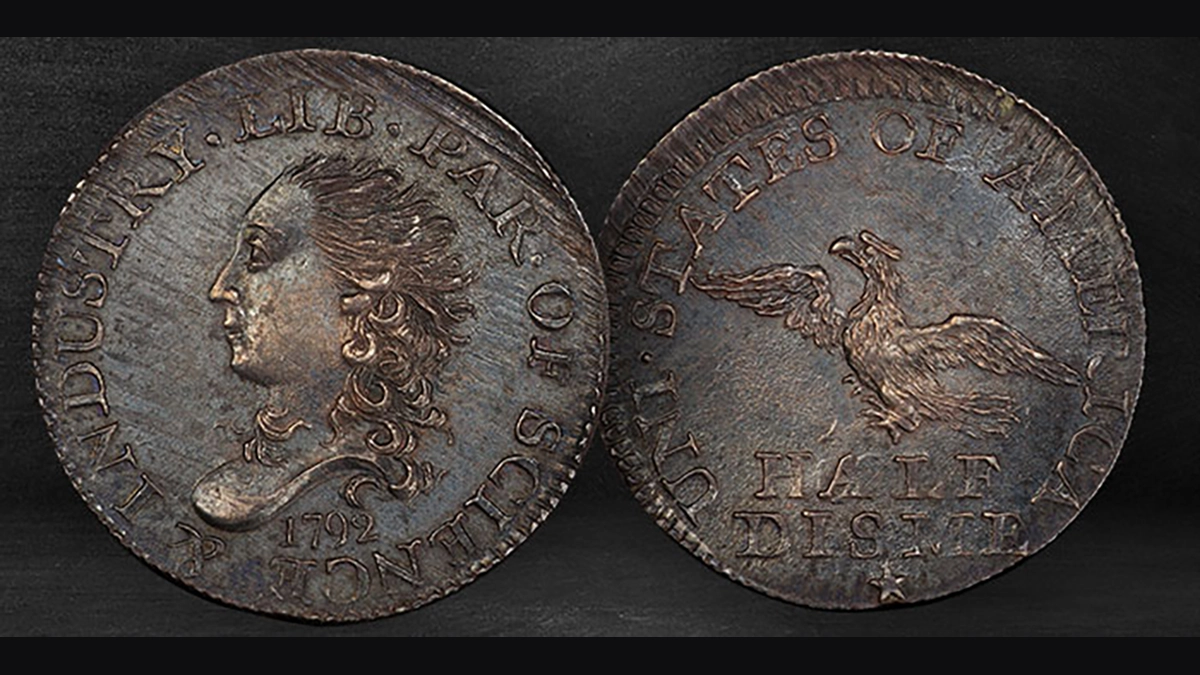
Heritage says its current census includes 24 confirmed Mint State coins and 24 About Uncirculated examples. It also lists several pieces once described as Uncirculated that researchers have not yet connected to known coins.
Some later strikes may never have entered normal commerce. Early Mint officials or other recipients may instead have preserved them as souvenirs.
That possibility becomes especially important when we consider the MS68 coin now returning to auction.
Washington, Martha, and a Story That Became Too Good to Die
Few American coins have accumulated more legends.
For generations, collectors heard that George Washington supplied the silver for the half dismes. An even more romantic version claimed that the metal came from Martha Washington’s table service.
Another story claimed that Martha herself posed as Liberty.
Neither claim rests on reliable contemporary evidence.
Much of the Washington story traces to an April 9, 1844, conversation between retired Mint official Adam Eckfeldt and Philadelphia antiquarian John A. McAllister Jr. McAllister recorded Eckfeldt’s recollection that Washington had supplied $100 in bullion or coin.
Eckfeldt also recalled that Washington distributed some half dismes to friends in Virginia and sent others overseas.
The memorandum itself has a fascinating history. Researchers initially misunderstood its authorship, and a copy that surfaced in 1943 received an incorrect attribution to Jonas R. McClintock.
Walter Breen later found another version. Then Carl Herkowitz acquired a third copy in 1995.
Herkowitz and Joel Orosz eventually established McAllister as the actual author. That discovery strengthened the memorandum because McAllister had earned a strong reputation as a Philadelphia historian and antiquarian.
Even so, historians must still treat Eckfeldt’s comments as memories recorded more than half a century after the event. Jefferson’s contemporary account book carries far greater evidentiary weight for the July coinage.
Therefore, one should treat Washington’s silver and Martha Washington’s supposed portrait as legends, not established facts.
The New Twist: Is This Really Rittenhouse’s Half Disme?
This question creates the biggest change from CoinWeek’s earlier coverage.
For years, the MS68 coin carried a direct pedigree to David Rittenhouse. PCGS still lists that traditional history.
Its CoinFacts pedigree begins with Rittenhouse, continues through his family to Henry Chapman’s October 1919 auction, then traces the coin through George L. Tilden and later owners.
However, Heritage’s new 2026 cataloging takes a much more cautious position.
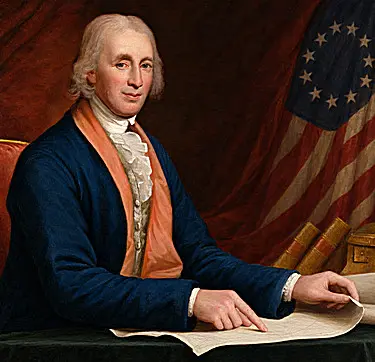
In 1919, Henry Chapman sold an Uncirculated 1792 Half Disme that he said represented one of four pieces David Rittenhouse had kept. According to Chapman, the coin had remained with the Rittenhouse family until that sale.
Chapman described an evenly centered obverse and noted planchet file marks above the obverse inscription. On the reverse, he described a slightly low strike with milling visible around only part of the border.
Finally, Chapman called the coin light steel in color and perfectly Uncirculated.
The problem is simple: Chapman did not publish a photograph of the coin.
That missing plate makes a positive identification extremely difficult.
Later researchers connected the Chapman coin to George Tilden’s 1792 Half Disme, which Thomas Elder sold in June 1921. Now Heritage says that link fails.
The 1921 catalog included an obverse photograph. Heritage compared that image with the present MS68 coin and concluded that they do not match.
Therefore, Heritage has removed the Tilden provenance from the secure pedigree.
Even more importantly, Heritage now states that no proof establishes the present MS68 coin as the same Rittenhouse-family specimen that Chapman sold in 1919.
Heritage does not rule it out. However, it no longer treats the attribution as established fact.
That distinction matters.
Seven Coins Could Fit Parts of Chapman’s Description
Heritage examined a census of 48 confirmed AU and Mint State 1792 Half Dismes. From that group, the firm identified seven pieces that share at least some characteristics with Chapman’s 1919 description.
They range from the present PCGS MS68 down to an NGC MS62.
The group also includes the famous John Jay Pittman MS67, a PCGS MS66 later associated with the Dell Loy Hansen Collection, two MS64 examples with long auction histories, a PCGS MS63, and the NGC MS62 that appeared at Heritage in 2024 and Stack’s Bowers in 2025.
None provides a conclusive match.
That fact turns the old pedigree from a simple ownership chain into an open research question. Strangely enough, it may make the story more interesting.
What We Can Prove About the MS68 Coin
The secure modern provenance begins in October 1988, when Stack’s offered the coin as part of the “Property of a New England Museum.” The firm did not identify the museum.
The coin later passed through several major hands and collections, including dealer Jay Parrino, the Knoxville Collection, Steve Contursi, and the Cardinal Collection.
The Cardinal Collection acquired the coin for $1.5 million while NGC graded it MS68. Then, in January 2013, Stack’s Bowers sold it for $1,145,625.
The coin later crossed into a PCGS MS68 holder. Classic Coin Company sold it by private treaty for $1,985,000 in May 2018.
That transaction established a record price for the half dime denomination at the time.
The coin also spent years in public view. It appeared at the Chicago ANA convention in 2013 and went on display at Mount Vernon in 2014 and 2015.
Collectors saw it at the Denver ANA convention in 2017. Finally, it remained on exhibit at the ANA Money Museum in Colorado Springs from 2018 through 2024.
Now it returns as a selection from the Ronald Firman Collection.
Why MS68 Matters Here
Grade alone cannot explain this coin. Still, MS68 represents an astonishing level of preservation for a silver coin from 1792.
PCGS places this example at the top of the regular-strike population, while Heritage calls it the sole-finest certified example. The famous Starr-Rodriguez specimen carries a PCGS Specimen-67 grade.
Heritage describes brilliant mint luster across both sides, while the fields create strong contrast with the devices.
Soft silver-gray forms the base color. Rose, amber, gold, and vivid blue emerge as the coin moves under light.
The surfaces also show remarkably little contact.
More importantly for researchers, the coin retains as-made characteristics that can function like fingerprints. Evidence of planchet preparation crosses the eagle’s breast, where the design does not reach complete definition.
Those characteristics may eventually prove more important than color or grade. They could help researchers trace the coin through old photographs, plates, or newly discovered records.
A Design Unlike Any Later American Coin
The 1792 Half Disme also looks unlike the federal coins that followed.
Liberty faces left on the obverse, and short curls frame her head. The date 1792 appears below.
Around her runs one of the most unusual legends in U.S. coinage:
LIB. PAR. OF SCIENCE & INDUSTRY
The inscription abbreviates “Liberty, Parent of Science and Industry.”
The reverse shows a small flying eagle. HALF DISME appears below, followed by a star, while UNI. STATES OF AMERICA follows the border.
Mint workers gave the silver coins diagonally reeded edges and medal-turn die alignment.
Only one silver die pair serves the issue. Specialists identify it as LM-1, Judd-7, and Pollock-7, Rarity-4.
A unique copper impression, Judd-8, also survives and may represent a die trial.
PCGS lists the designer as unknown.
1792 Half Disme Specifications
- Denomination: Half Disme, five cents
- Date: 1792
- Variety: LM-1, Judd-7, Pollock-7
- Rarity: R.4
- Documented July coinage: 1,500 pieces
- Estimated additional striking: Approximately 200–500 pieces
- Estimated possible total: Roughly 1,700–2,000 pieces
- Weight: 20.8 grains, approximately 1.35 grams
- Diameter: 17.5 mm
- Composition: Approximately 89.2% silver, 10.8% copper
- Edge: Diagonally reeded
- Die alignment: Medal turn
- Obverse: Liberty facing left; LIB. PAR. OF SCIENCE & INDUSTRY
- Reverse: Flying eagle; HALF DISME and star; UNI. STATES OF AMERICA
- Designer: Unknown
- Current grade: PCGS MS68
- Heritage lot: 3414
- Auction: October 8, 2026, GACC U.S. Coins Signature Auction #1397
Does the Pedigree Question Hurt the Coin?
For some rarities, losing a famous provenance could materially change the story. Here, the opposite may happen.
The MS68 1792 Half Disme does not need a Rittenhouse pedigree to rank among the most important early American coins. Its grade, physical characteristics, and market history already stand on their own.
Most importantly, the issue itself stands at the moment when the monetary ideas written into the Mint Act became physical objects that people could carry, tip, save, and spend.
PCGS currently estimates about 275 survivors in all grades. It estimates only 35 in Mint State and just seven at MS65 or higher.
Those figures remain estimates, but they show how dramatically the population narrows at the top.
The Rittenhouse question now adds another dimension.
Was this extraordinary coin one of the pieces the first Mint Director deliberately preserved? Possibly.
Can researchers prove it today? No.
And that difference matters.
For more than two centuries, the 1792 Half Disme has forced numismatists to separate history from legend. Researchers dismantled the Martha Washington portrait story.
Jefferson’s memorandum book challenged the Washington silver tradition. Die-state research changed the accepted mintage story.
Now provenance research has reached the finest certified example itself.
That is exactly how numismatic history should work. Great coins do not become less important when researchers question old assumptions.
Sometimes they become more fascinating.
The 1792 Half Disme began as Washington’s “small beginning.” More than two centuries later, this tiny silver coin still refuses to give up all of its secrets.