He Worked the Oil Fields for Half Dollars. Then He Built a Legendary Coin Collection
In 1945, 14-year-old Mack C. Chase went to work in the oil fields of rural New Mexico. Among the coins that represented his hard-earned pay was the Walking Liberty half dollar.
It was a coin he never forgot.
Over the following decades, Chase built a successful business career and assembled one of the finest collections of Walking Liberty half dollars ever brought to market.
Now, another chapter of that remarkable collecting journey is about to unfold.
More than 300 Walking Liberty half dollars from the Mack C. Chase Collection will headline a special session of Stack’s Bowers Galleries’ November 2026 Showcase Auction. The sale follows a spectacular September offering that realized nearly $2.5 million.
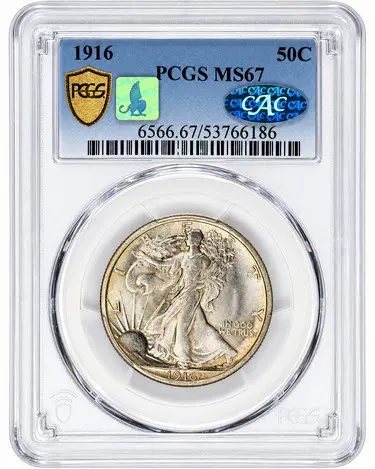
Among the November highlights is an extraordinary 1916 Walking Liberty half dollar graded MS-67 by Professional Coin Grading Service (PCGS), with additional approval from CAC and Collectible Market Qualified (CMQ).
More than a century after its creation, this superb survivor offers collectors a rare opportunity to acquire one of the finest PCGS-certified examples of the coin that launched an American classic.
A Collector’s Passion Began in the Oil Fields
Mack C. Chase was born in Texas but grew up in southeastern New Mexico, near the Permian Basin. He entered the oil industry at just 14 years old and began full-time work after high school.

Except for two years of Army service, Chase spent his life in the community he called home.
His business interests eventually expanded beyond oil and gas. They included ranching, livestock, land management, and pecan farming.
However, success never erased his memories of those early working years.
The Walking Liberty half dollar held special meaning. When Chase entered the workforce, it was the largest denomination the United States Mint still produced for regular circulation.
As his financial resources grew, so did his collection.
Chase favored exceptional quality, difficult dates, and coins with outstanding visual appeal. Moreover, he pursued these treasures without seeking public recognition.
His patience and determination ultimately produced an extraordinary cabinet of American silver coins.
For Chase, the Walking Liberty half dollar was more than a collectible. It connected his success to the humble beginnings of his working life.
The 1916 Walking Liberty Half Dollar: An American Classic Is Born
The featured 1916 Walking Liberty half dollar takes collectors back to an important turning point in American coinage.
In 1916, the United States Mint began replacing the Barber dime, quarter, and half dollar designs. The changes marked a new chapter in the artistic development of American circulating coins.

New York sculptor Adolph A. Weinman created the winning designs for the dime and half dollar.
His Walking Liberty half dollar presented a striking departure from the conventional portraits of Liberty that had dominated American silver coinage.
Instead of a stationary portrait, Weinman showed Liberty moving confidently toward a rising sun.
The American flag flows around her shoulders. Her right arm reaches forward, while her left arm carries branches of oak and laurel.
On the reverse, a powerful eagle stands on a rocky outcrop beside a mountain pine.
Together, the designs convey optimism, strength, and national identity.
Weinman’s achievement became one of the most admired designs in American numismatics. The Mint continued producing Walking Liberty half dollars through 1947.
Then, in 1986, the United States Mint revived Weinman’s celebrated Liberty design for the obverse of the American Silver Eagle.
The design that first appeared on a 50-cent coin had become an enduring American symbol.
A Superb Gem 1916 Half Dollar With Exceptional Eye Appeal
One of the leading attractions in the November Chase offering is a 1916 Walking Liberty half dollar graded PCGS MS-67, with CAC and CMQ approval.
The Philadelphia Mint struck just 608,000 Walking Liberty half dollars in 1916.
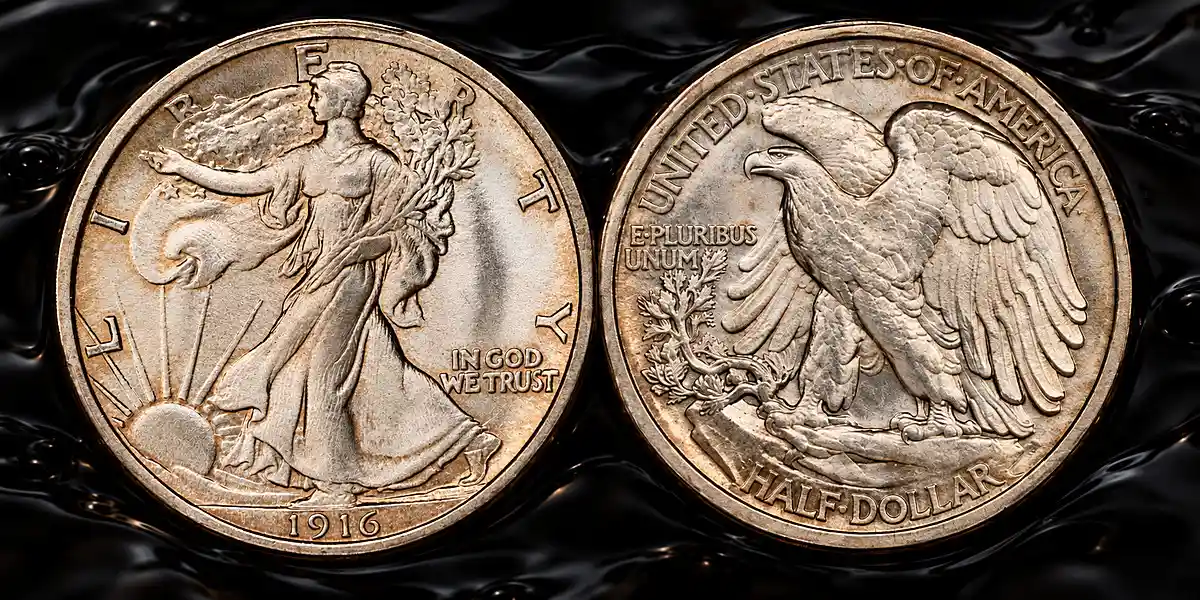
Although collectors saved examples of this first-year issue, few survive in the extraordinary condition that distinguishes an MS-67 coin.
The Chase specimen combines exceptional preservation with beautiful original-looking toning and impressive striking detail.
According to the Stack’s Bowers catalog, delicate champagne-apricot coloration moves toward the coin’s borders. Meanwhile, the central surfaces display a silky texture and remarkably clean appearance.
Both sides exhibit a sharp to virtually complete strike. Consequently, Weinman’s intricate design stands out with exceptional clarity.
The coin’s visual qualities matter because Walking Liberty half dollars can suffer from striking weakness, particularly on some early branch-mint issues.
Moreover, its CAC and CMQ approvals provide additional assessments of the coin’s quality and eye appeal.
PCGS reports just one 1916 Walking Liberty half dollar at a higher numerical grade than MS-67. That example carries the MS-67+ designation.
This places the Chase specimen among the elite survivors of the Philadelphia Mint’s inaugural production.
The market has already demonstrated its enthusiasm for such coins.
A different 1916 Walking Liberty half dollar, also graded PCGS MS-67 with CAC and CMQ approval, realized $56,120 during the September 2026 Global Showcase offering of the Chase Collection.
That result provides an important comparison as bidders prepare for November.
September’s $2.45 Million Auction Set the Stage
The first major offering from the Mack C. Chase Collection took place on September 3, 2026.
Stack’s Bowers sold 253 lots for a combined $2,448,125, including buyers’ premiums.
The results demonstrated strong demand for high-grade Walking Liberty half dollars, especially scarce early dates.
A remarkable 1921-D half dollar graded PCGS MS-66, with CAC and CMQ approval, led the offering at $183,000.
Another major rarity, a 1917-D with the reverse mintmark, graded PCGS MS-67, realized $122,000.
Meanwhile, an MS-66 1918-D half dollar brought $115,900. A 1921-S graded PCGS MS-65 achieved $109,800.
Several coins established important auction records.
These results reinforced a lesson that serious collectors know well. Original mintage figures tell only part of the story. Exceptional preservation can make an already desirable coin extraordinarily difficult to acquire.
Rare Early Dates Dominate the November Offering
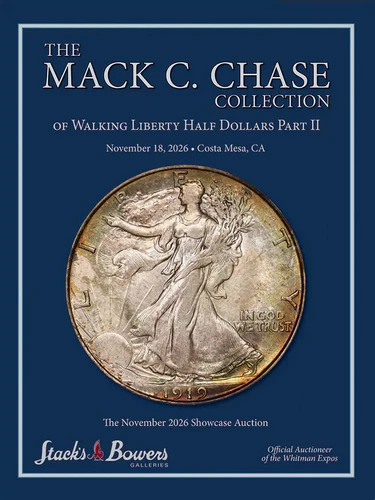
The November auction promises another impressive selection of early Walking Liberty half dollars.
Among the highlights is a 1916-S graded PCGS MS-66 in an old green-label holder. The early-date offerings also include a 1918-D and a 1918-S, both graded NGC MS-66.
Collectors will also find an outstanding trio of 1919 issues.
A Philadelphia 1919 half dollar carries a PCGS MS-66 grade and CAC approval. A 1919-D grades PCGS MS-65 CAC, while a 1919-S grades PCGS MS-66 CAC.
The 1920 issues continue the high-grade theme. They include a 1920-D graded PCGS MS-65 CAC and a 1920-S graded PCGS MS-66 CAC.
However, the 1921 issues may attract particularly intense interest.
The November lineup includes a 1921 graded PCGS MS-65 CAC, a 1921-D graded NGC MS-66, and a 1921-S graded PCGS MS-65 CAC.
All three dates rank among the most challenging issues in the series. Their low mintages and limited high-grade populations have made them longstanding targets for advanced collectors.
Brian Kendrella, president of Stack’s Bowers Galleries, described the Chase Collection as a world-class cabinet.
He also emphasized that some coins have remained outside the marketplace for decades.
Consequently, the November offering gives today’s collectors an opportunity to pursue coins that rarely appear at public auction.
Beyond Walking Liberty: A Remarkable Collection of American Rarities
Although Walking Liberty half dollars defined Chase’s collecting passion, his numismatic interests extended much further.
The November Showcase’s main catalog will also include selected coins from other areas of his collection.
These offerings span small cents, Buffalo nickels, Mercury dimes, gold coins, type coins, and patterns.
One particularly notable piece is an 1879 Flowing Hair four-dollar gold Stella.
The Stella represents one of the more unusual experiments in American coinage. The Mint developed the proposed denomination during an era of interest in international monetary compatibility.
Although the four-dollar gold piece never entered regular circulation, it became a prized rarity among advanced collectors.
Its presence demonstrates both the breadth of Chase’s interests and his appreciation for important American coins.
1916 Walking Liberty Half Dollar Specifications
- Denomination: 50 cents
- Year: 1916
- Mint: Philadelphia
- Mintage: 608,000
- Designer: Adolph A. Weinman
- Composition: 90% silver, 10% copper
- Silver Content: 0.3617 troy ounce
- Weight: 12.50 grams
- Diameter: 30.6 mm
- Edge: Reeded
- Obverse: Liberty advancing toward a rising sun, draped in the American flag
- Reverse: Eagle perched on a rocky outcrop beside a mountain pine
- Featured Specimen: PCGS MS-67, CAC, CMQ
A Collection That Began With a Half Dollar
Few collections offer such a compelling connection between a collector’s early life and the coins he ultimately pursued.
For Mack C. Chase, Walking Liberty half dollars once represented the rewards of hard work in New Mexico’s oil fields.
Decades later, they became the focus of an extraordinary collecting achievement.
The November auction will give a new generation of collectors the opportunity to acquire pieces from that achievement.
From a Superb Gem 1916 first-year issue to the formidable rarities of 1921, the offering celebrates both Weinman’s artistry and Chase’s determination to preserve its finest surviving examples.
And perhaps that is the most enduring legacy of the Mack C. Chase Collection.
A coin worth just 50 cents in everyday commerce helped inspire a collecting journey worth remembering.
Auction Information
Stack’s Bowers Galleries will conduct its November 2026 Showcase Auction from November 16 through 20 in Costa Mesa, California.
The sale serves as the official auction of the Whitman Expo. Collectors may view lots at the Baltimore Whitman Expo location from November 10 through 13.
The special Mack C. Chase Walking Liberty half dollar session appears as Session 4, Part II, covering lots 4001 through 4303.
Collectors can review the November Chase Collection catalog and the featured 1916 Walking Liberty half dollar through Stack’s Bowers Galleries.
###############################