One California collector found both known 1975 No-S Roosevelt Dimes.
Nearly 50 years later, their remarkable histories offer a story of discovery, secrecy, and one of America’s greatest modern coin rarities.
In July 1977, a California coin collector sent an unusual Roosevelt dime to Coin World’s Collectors’ Clearinghouse. The coin carried the date 1975, but something important was missing.
There was no S mintmark.
The dime came from a United States Proof Set. Therefore, it should have carried the San Francisco Mint’s identifying letter. Yet the staff at Coin World could not immediately confirm that the coin was a genuine Proof strike.
What they did not know made the discovery even more remarkable.
The collector owned a second 1975 No-S Roosevelt Dime.
Both coins had come from an order of just five Proof Sets. Eventually, the two dimes would follow very different paths through the rare coin market.
One spent decades with an Ohio family that considered it a financial safeguard. The other passed through important numismatic collections and briefly changed hands twice in a single week.
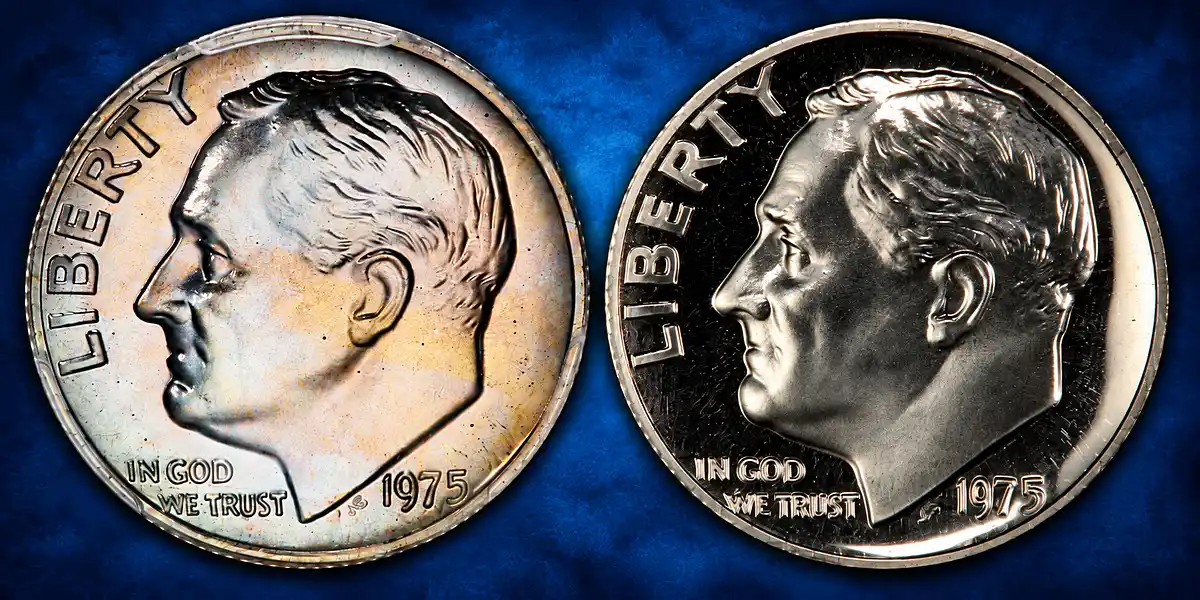
Almost half a century after their discovery, only two authentic examples remain known.
A $7 Proof Set During America’s Bicentennial Celebration
The story begins in 1975, as the United States prepared to celebrate its 200th anniversary.
That year’s Proof Set offered collectors something different. The quarter, half dollar, and Eisenhower dollar featured special Bicentennial reverse designs and the dual date 1776-1976.
Meanwhile, the Lincoln cent, Jefferson nickel, and Roosevelt dime retained their regular 1975 dates.
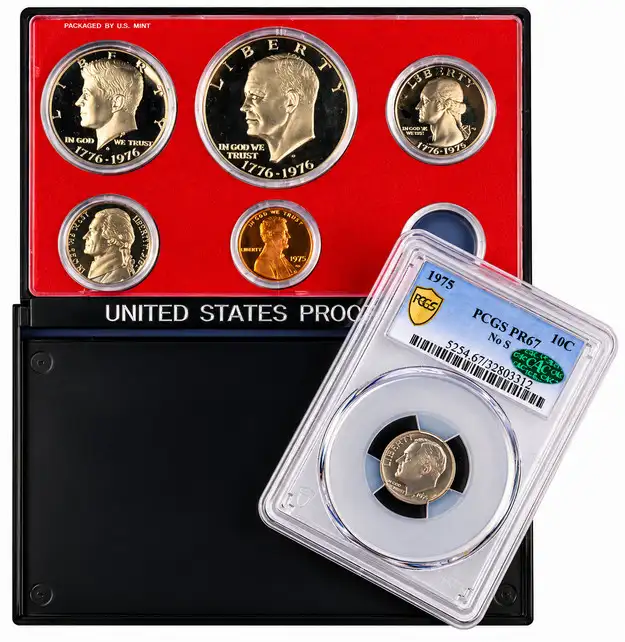
The Mint produced 2,845,450 Proof Sets that year. Each set contained six coins in rigid plastic packaging and originally sold for $7.
The San Francisco Assay Office manufactured the Proof coins using specially prepared dies and planchets. Consequently, the 1975 Proof dime should have displayed an S mintmark.
The California collector who ordered five sets noticed that two Roosevelt dimes lacked the letter.
That single missing mintmark would eventually place both coins among the most celebrated rarities in modern American numismatics.
However, their path to recognition proved anything but straightforward.
The 1975 No-S Dime Discovery That Took Months to Confirm
When Coin World examined the first dime in July 1977, its staff could not establish that the piece was a full Proof strike.
The magazine’s Collectors’ Clearinghouse considered whether the coin might represent another type of minting irregularity. In fact, San Francisco also manufactured ordinary circulation-quality dimes without mintmarks during 1975.
The collector subsequently submitted the coin to the American Numismatic Association Certification Service, better known as ANACS.
This time, specialists confirmed its Proof status.
ANACS announced the authentication in January 1978. Then, Coin World reported the discovery in its February 22 issue.
The second dime also received ANACS authentication in 1978.
At first, the collecting community did not know that one person had discovered both coins. That connection remained largely outside public knowledge until 2011.
Nevertheless, the publicity sent collectors searching through their own 1975 Proof Sets.
The search produced no additional confirmed examples.
Ironically, the California collector had accomplished something that thousands of other collectors would spend decades trying to duplicate.
She had found both known examples of the rarest No-S Proof Roosevelt dime.
A Coin Dealer, a Letter, and a Ten-Minute Advantage
The two dimes next entered the hands of Fred J. Vollmer, an Illinois dealer.
Vollmer acquired the first Proof Set in February 1978. Rather than offer it indiscriminately, he contacted collectors who had previously purchased similar errors from his company.
One letter reached an Ohio collector who already understood the significance of No-S Proof coinage.
The collector quickly telephoned Vollmer and agreed to purchase the set.
According to Coin World’s 2011 account, Vollmer later told the buyer that another interested collector had called roughly 10 minutes after he committed to the sale.
Those few minutes proved decisive.
The Ohio collector and his mother purchased the rarity for $18,200. They arranged installment payments, including a $3,800 down payment. After completing the payments, the family traveled to Illinois in 1980 to collect the set.
For perspective, that purchase represented a substantial commitment in 1978. Yet the family believed the dime’s extraordinary scarcity justified the expense.
Then something unusual happened.
The coin virtually disappeared from the public numismatic marketplace.
The Ohio Family’s 46-Year Secret
The family kept the 1975 No-S Roosevelt Dime for decades.
Unlike collectors who frequently trade important coins, the Ohio owners maintained their position through several market cycles.
Their decision also reflected something beyond numismatic enthusiasm.
According to the Associated Press, the family operated a dairy farm and regarded the rare dime as a financial safety net.
Meanwhile, researchers and collectors continued to speculate about the whereabouts of the two missing-mintmark Proofs.
In 2011, the Ohio family brought its coin and supporting paperwork to Coin World’s offices. The documents included purchase records and correspondence.
More importantly, researchers compared the dime with photographs taken during the original 1977 examination.
The diagnostic evidence confirmed that the Ohio specimen was the same coin examined by the publication more than three decades earlier.
That confirmation established an important link in the coin’s documented history.
Eventually, the original collector’s son died, and his three sisters inherited the dime.
The family decided to sell.
The 1975 No-S Roosevelt Dime Reaches $506,250
On October 27, 2024, GreatCollections brought the Ohio family’s dime to auction for the first time.
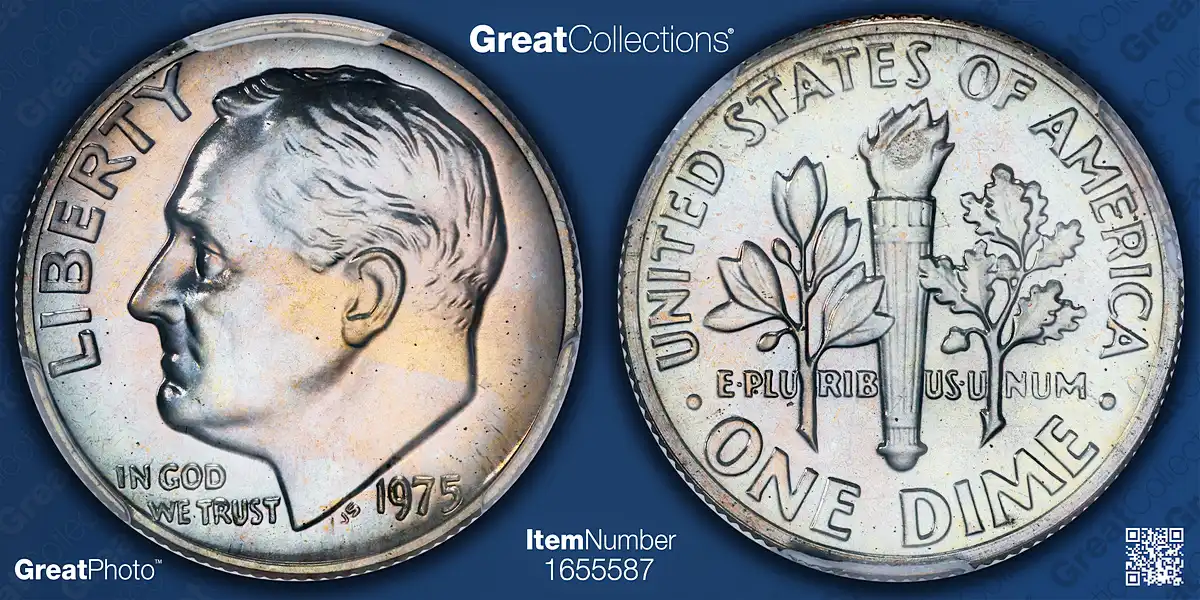
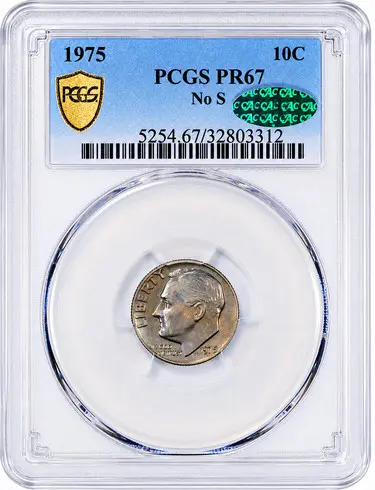
By then, Professional Coin Grading Service had certified the coin as Proof-67. Certified Acceptance Corporation also approved it with a green CAC sticker.
The dime displayed attractive toning, including shades of blue, purple, and gold.
However, the coin itself represented only part of the offering.
GreatCollections also included the remaining coins from the original Proof Set and historical documentation, including the invoice from Vollmer.
The accompanying material strengthened the coin’s provenance and helped tell its extraordinary story.
Bidding attracted international interest. GreatCollections recorded 212 bids, and the final price reached $506,250, including the buyer’s premium.
The sale established a new public auction record for the 1975 No-S Roosevelt Dime.
For the Ohio family, the result represented almost 28 times the original $18,200 purchase price, before expenses and without adjusting for inflation.
The dime, which GreatCollections identified as the Ruth E. Discovery Coin, entered another private collection.
Yet the other known example had already developed an equally remarkable history.
The Second No-S Dime: From $38,550 to $516,000
The California collector sold her second 1975 No-S Proof Set to Vollmer in 1979.
In 1980, the dealer offered it to collectors for $38,550.
The Ohio family that owned the first example had an opportunity to acquire the second but declined.
Eventually, the coin entered another private collection.
More than three decades passed before it reached a public auction.
In August 2011, Stack’s Bowers Galleries offered the dime during its Chicago ANA Rarities Night sale. PCGS graded the coin Proof-68, making it the finer of the two known examples.
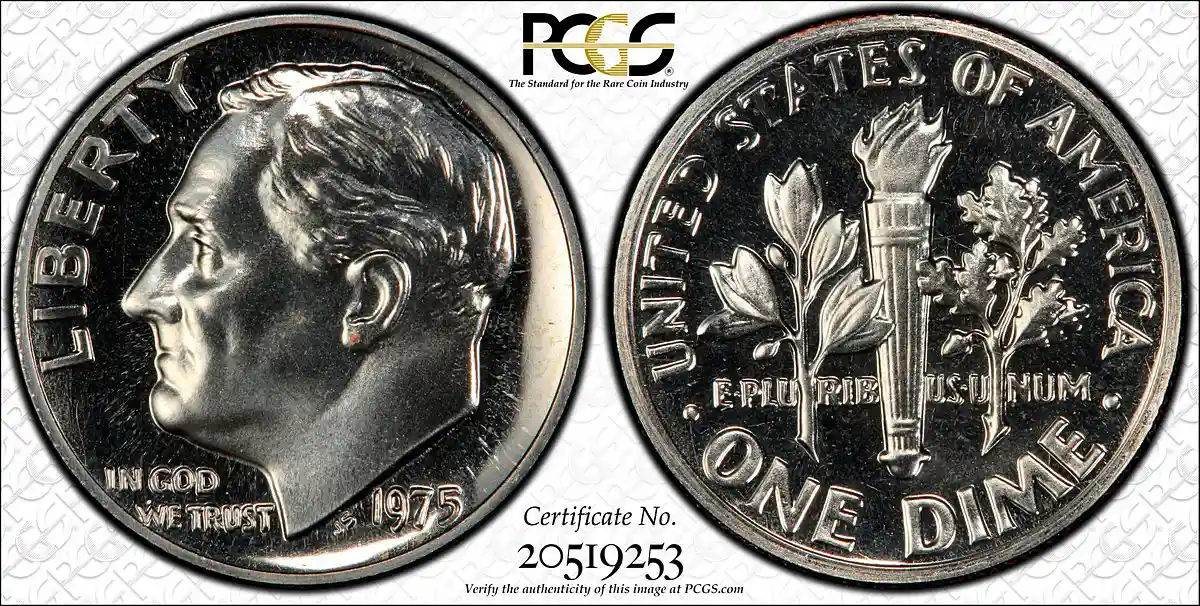
Lot 7297 realized $349,600.
The price demonstrated that a modern copper-nickel dime could compete in the marketplace with some of the most desirable classic American rarities.
The coin subsequently entered the Poulos Family Collection.
Then, on September 6, 2019, Heritage Auctions sold the Proof-68 dime for $456,000 as Lot 4715 in its Long Beach sale.
However, the story did not end with that auction.
Modern coin specialist Mitch Spivack, his son Justin, and collector Steven Heller jointly acquired the dime. Just five days later, they sold it through agent Nick Cascio for a reported $516,000.
The buyer added the rarity to the Halcyon Collection, a major Roosevelt dime collection associated with the PCGS Set Registry.
That $516,000 transaction was a private sale, not a public auction result. Consequently, it does not replace the $506,250 GreatCollections result as the highest documented public auction price.
The two coins had started together in a small California Proof Set order. Yet their journeys through the rare coin market could hardly have been more different.
How Did the San Francisco Mint Make This Mistake?
The 1975 No-S Roosevelt Dime presents an intriguing production mystery.
During the 1970s, the Philadelphia Mint manufactured dies for use at other Mint facilities. Proof coin dies intended for San Francisco ordinarily carried the S mintmark.
However, the San Francisco Assay Office had another responsibility in 1975.
It also produced 71,991,900 circulation-strike Roosevelt dimes without mintmarks to supplement national coin production.
Meanwhile, Philadelphia struck another 513,682,000 circulation dimes without mintmarks.
Together, those facilities produced 585,673,900 ordinary 1975 dimes without a mintmark. Denver also struck 313,705,300 dimes bearing a D.
Therefore, missing-mintmark circulation dimes were entirely normal in 1975.
The extraordinary error occurred when a die without the S mintmark entered Proof production.
One explanation suggests that Mint personnel prepared an unmarked die, originally intended for circulation-strike production, for use on a Proof press.
That scenario fits the production practices of the period. However, researchers have not established the precise circumstances through surviving Mint documentation.
Another possibility involves an error that Mint inspectors discovered before most affected Proof coins could leave the facility.
Again, that remains an explanation rather than a documented conclusion.
The Mint also produced other No-S Proof errors during this era, including Roosevelt dimes dated 1968, 1970, and 1983, a 1971 Jefferson nickel, and a 1990 Lincoln cent.
Yet none matches the documented rarity of the 1975 dime.
Only two examples have emerged.
Why Two Known Coins Does Not Mean a Mintage of Two
Here, an important numismatic distinction deserves attention.
Researchers have documented two genuine 1975 No-S Proof Roosevelt Dimes. However, that number represents the known surviving population, not a confirmed original mintage.
The Mint has not established how many coins the missing-mintmark die actually struck.
It remains possible that additional pieces once existed. Inspectors may have discovered the error and prevented most examples from reaching collectors.
Nevertheless, no available evidence establishes how many coins the Mint rejected, destroyed, or released.
Likewise, no third example has gained widely recognized authentication.
As of October 2026, the two documented specimens remain the complete known population. The latest public auction appearance CoinWeek could verify was the October 2024 GreatCollections sale.
That extraordinary scarcity explains why the 1975 No-S dime occupies the top position in later editions of 100 Greatest U.S. Modern Coins by Jeff Garrett and Scott Schechter.
Could Another 1975 No-S Roosevelt Dime Still Exist?
Collectors continue to ask whether an undiscovered example might remain in an unopened Proof Set.
The possibility cannot be excluded.
However, the experience of the past five decades offers an important perspective.
Collectors have searched 1975 Proof Sets since the discovery became public in 1978. Despite that attention, the known population has remained at two.
Moreover, the genuine error is a Proof coin, not an ordinary Roosevelt dime from circulation.
Even an unusually brilliant business strike does not qualify.
The two known Proofs display the carefully prepared, mirror-like surfaces associated with Proof production. Neither carries a Cameo designation.
Anyone who believes they own a third example should consult a qualified numismatist and arrange authentication through PCGS or NGC.
For more information about distinguishing ordinary 1975 dimes from this extraordinary Proof error, see CoinWeek’s 1975 No-S Roosevelt Dime Collector’s Guide.
The Real Legacy of the 1975 No-S Dime
The 1975 No-S Roosevelt Dime tells a story that reaches well beyond auction records.
A California collector ordered five Proof Sets and recognized something unusual. A specialist dealer understood the rarity’s potential. Two families and their successors preserved coins that most collectors would never see in person.
Then, decades later, auction records confirmed their extraordinary place in modern American numismatics.
The $506,250 result commands attention. However, the more compelling story began with an observant collector and a dime that looked almost identical to millions of ordinary coins.
Almost identical. One missing letter made all the difference. And nearly half a century later, the numismatic world still knows of only two.
1975 No-S Roosevelt Dime Specifications
- Country: United States of America
1975 Roosevelt Dime No S PCGS Proof-67 (CAC Green) - Year: 1975
- Denomination: 10 Cents
- Place of Manufacture: San Francisco Assay Office
- Mintmark: None; S mintmark omitted in error
- Strike: Proof
- Original Mintage: Unknown
- Confirmed Examples: Two
- Composition: Copper-nickel clad, 75% copper and 25%
- Weight: 2.27 grams
- Diameter: 17.90 mm
- Edge: Reeded
- Designer: John R. Sinnock
- PCGS Coin Number: 5254
- Finest Known Grade: PCGS Proof-68
- Public Auction Record: $506,250, GreatCollections, October 27, 2024