


The Tiny 1792 Coin That Launched America’s Mint
It arrived before the first Philadelphia Mint building stood ready. It carried a new national promise in silver. Also, it passed through the hands of men who shaped the early republic.
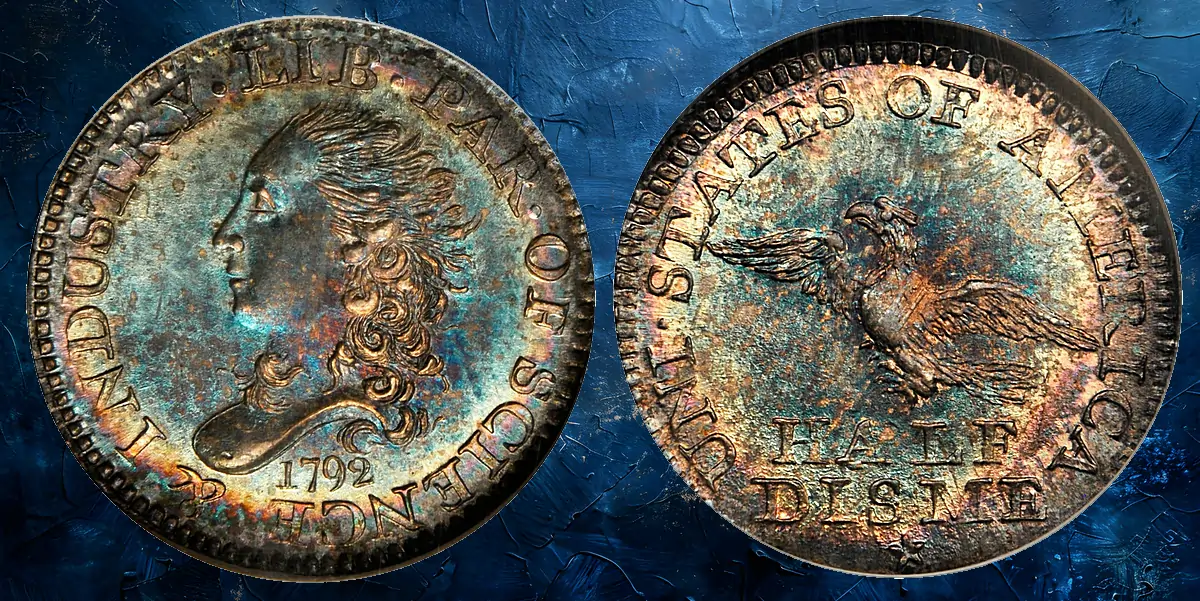
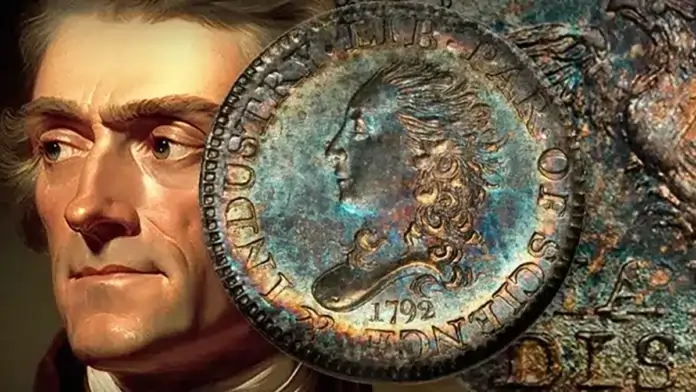
This Superb Gem 1792 Half Disme, graded MS-68 , ranks among the greatest survivors of the issue. Even more important, its pedigree traces directly to David Rittenhouse, the first Director of the United States Mint.
Few American coins combine this level of preservation, provenance, and historical force.
A Landmark Coin From the Birth of the U.S. Mint
This coin is the 1792 Half Disme, LM-1, Judd-7, Pollock-7. It comes from the only known die pair for the silver issue. Specialists classify the variety as Rarity-4.
Mint workers struck the issue in silver. A unique copper impression, Judd-8, also survives. The silver half dismes feature a diagonally reeded edge.
The obverse shows Liberty facing left. She wears short, curly hair. The date 1792 appears below the curved truncation of the bust.
Around Liberty appears the legend:
LIB. PAR. OF SCIENCE & INDUSTRY
The inscription abbreviates “Liberty, parent of science and industry.”
The reverse presents a small eagle with spread wings. The eagle faces left. Below it appears the denomination HALF DISME, with a single star beneath. The legend UNI. STATES OF AMERICA surrounds most of the reverse border.
Although “disme” looks unusual today, it reflects an early spelling connected to the decimal system. The nation had just adopted a coinage structure based on dollars, dimes, cents, and mills.
A Sharp Strike With Early Mint Character
The obverse shows excellent centering. It sits within a bold and nearly even denticulated border. The detail remains sharp in the center and around the periphery.
Liberty’s hair curls show strong definition. Most curls appear fully formed. The remaining curls still show clear emerging detail.
The reverse sits slightly off center. The strike draws toward the lower border, so denticles disappear in that area. However, this feature appears on many surviving 1792 half dismes. It does not distract from the coin’s importance.
Across the rest of the reverse, the detail ranges from bold to full. Most devices appear razor sharp. Only the eagle’s breast shows a slight softness at the highest point. The breast itself rises in bold relief, but the feather detail fades at the center.
This small weakness gives the coin character. It also reflects the technical limits of America’s first federal coinage experiment.
Superb Gem Surfaces and Extraordinary Eye Appeal
This coin’s surfaces explain its legendary status.
At the time of its Stack’s Bowers offering, NGC certified it as MS-68. It stood above the famous Floyd T. Starr specimen, which PCGS had graded Specimen-67. The Starr coin had previously carried a PCGS Specimen-66 grade and shows a vertical scratch in the left obverse field in front of Liberty’s face.
By contrast, this Rittenhouse specimen offers remarkable preservation. Both sides combine an expert strike with extraordinary surface quality.
The luster is bright and active. It moves across the surfaces with a satin to semi-prooflike texture. Much of the reflectivity appears in the fields. It also glows around the protected areas near the peripheral lettering.
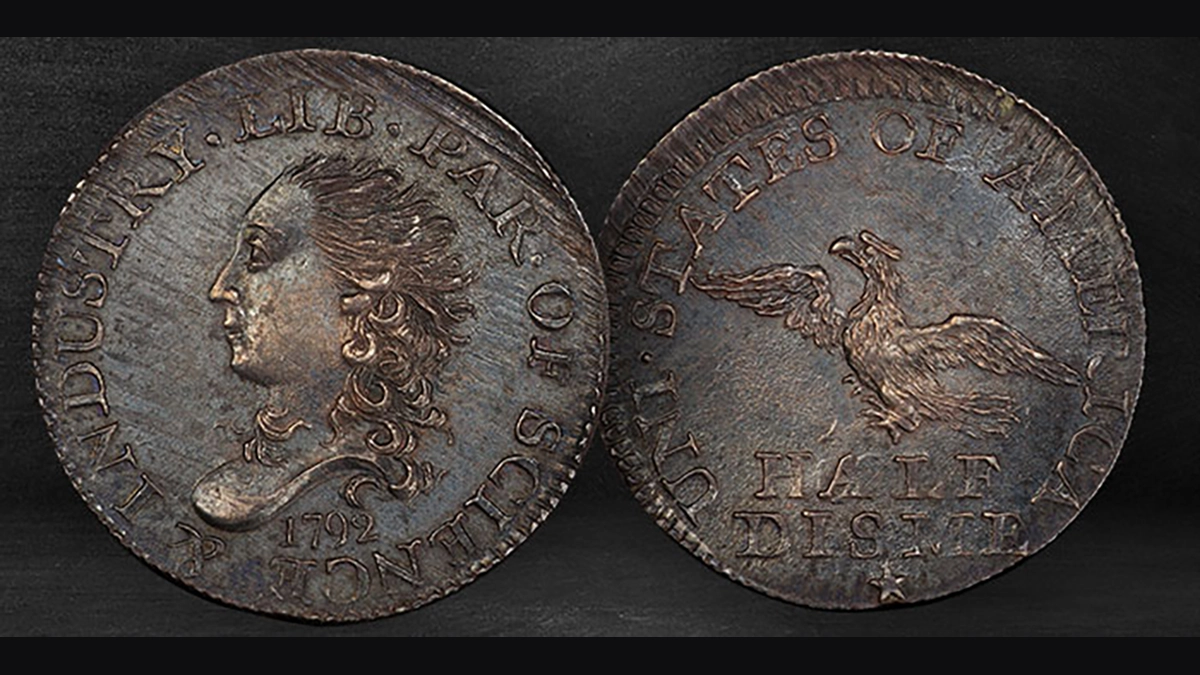
No distracting abrasion appears. Even under strong magnification, the coin keeps its pristine look.
However, closer inspection reveals a few as-made features. These include faint traces of die rust in the reverse field. The reverse also shows short, shallow planchet striations.
The most important striations cross the eagle’s breast. They relate to the slight softness in that area. They also serve as useful pedigree markers for future researchers.
Rainbow Toning From a Classic Collection Era
The toning adds another layer of appeal.
A light and even dove-gray color covers much of the coin. Then, as the coin turns under light, vivid undertones appear. Bright pink, gold, and electric blue flash across the surfaces.
This target-like toning likely developed during long-term album storage. The pattern suggests a Wayte Raymond album. The coin almost certainly spent many years in that type of holder during the early to mid-20th century.
As a result, the coin offers both technical perfection and visual drama. It is not merely historic. It is beautiful.
A Pedigree Back to David Rittenhouse
The pedigree gives this coin a special place in American numismatics.
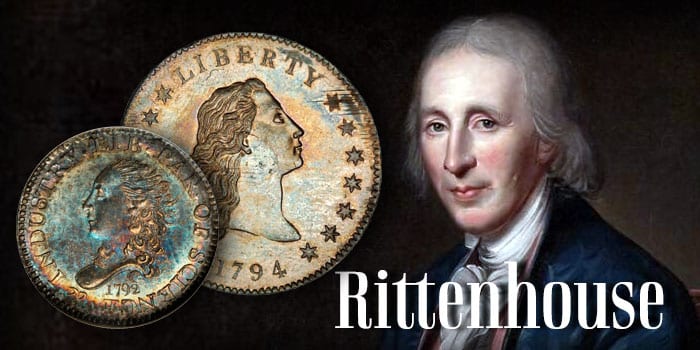
David Rittenhouse served as the first Director of the United States Mint. His descendants kept this half disme within the Rittenhouse family from July 1792 until its sale in 1919.
The known pedigree runs as follows:
David Rittenhouse, first Director of the United States Mint; Rittenhouse family; Henry Chapman’s October 1919 ANA Convention Auction, lot 249, where it realized $56; George L. Tilden; Thomas L. Elder’s June 1921 sale of the George L. Tilden Collection, lot 2029, where it realized $62; a private collector, who apparently stored the coin in a Wayte Raymond album; an unnamed museum in New England; Stack’s October 1988 sale, lot 536, where it realized $68,750; unknown intermediaries; dealer Jay Parrino, early 1990s, as agent for the anonymous Knoxville Collection; the Knoxville Collection, early 1990s to 2003; a private collector, 2003 to January 2007; dealer Steve Contursi, January to July 2007; and the Cardinal Collection, acquired for $1,500,000.
The coin later sold through Stack’s Bowers for $1,145,625 in 2013.
That sale result only tells part of the story. The coin’s direct link to Rittenhouse gives it an importance that price alone cannot measure.
The Knoxville Collection Connection
Dealer Jay Parrino examined the coin in the early 1990s. At that time, the Rittenhouse connection had not yet come to light.
Even so, Parrino immediately recognized the coin’s quality. He believed it stood above the Starr specimen. Therefore, he selected it for the now-famous Knoxville Collection.
That decision proved sound. In 2002, while preparing the Knoxville Collection for market, NGC certified the half disme as MS-68.
Parrino first planned to sell the Knoxville Collection intact. Then another private collector made a strong offer for the 1792 Half Disme. The buyer was both a serious numismatist and a historian.
Parrino accepted the offer. As a result, the half disme left the Knoxville Collection before dealer Steve Contursi acquired most of the remaining coins in 2003.
Then, in 2007, the private collector offered the half disme to Contursi. This allowed Contursi to reunite the great rarity with the broader Knoxville story. He later placed the coin with the Cardinal Collection Educational Foundation.
Among Cardinal Collection coins, this ultra-high-grade 1792 silver half disme ranked as a major highlight.
Why the 1792 Half Disme Matters
The 1792 Half Disme is one of the most popular coins in American numismatics. Jeff Garrett and Ron Guth ranked the issue among the greatest U.S. coins in their influential book 100 Greatest U.S. Coins.
Its importance comes from several firsts.
The 1792 Half Disme was among the first coins struck under the authority of the federal Constitution. It also represented the first federal coinage produced after the Mint Act of April 2, 1792.
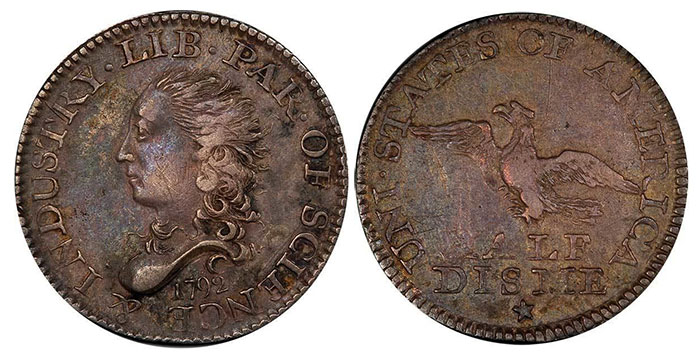
Additionally, the coins entered circulation. That point matters. These were not simply presentation pieces or isolated patterns. They helped announce a national coinage system.
The issue also holds a unique place because Mint personnel struck the first pieces outside the completed U.S. Mint facility. The North Seventh Street Mint building in Philadelphia did not yet operate when the first half dismes appeared.
Few coins tell the country’s founding story so directly.
The Harper Cellar and the Unfinished Mint
David Rittenhouse accepted his appointment as Mint Director only days before the half dismes appeared. Yet the Mint building on North Seventh Street was not ready.
Therefore, early coinage work likely took place in the cellar of John Harper. Harper was a Philadelphia saw maker and sometime Mint contractor. His property stood near Cherry and North Sixth streets.
That intersection no longer exists. Late 20th-century construction connected with the National Constitution Center erased it from the modern street grid.
The first clear public reference to Mint operations at the North Seventh Street address came later. On September 20, 1792, the Mint solicited old copper through Dunlap’s American Daily Advertiser. That notice used the Seventh Street address.
So, the half disme belongs to a moment before the Mint had a fully functioning home.
What the Records Say
Rittenhouse and Chief Coiner Henry Voigt left no surviving production record for the half disme. Or, if they did, historians have not found it.
Correspondence from the spring of 1792 shows Rittenhouse working with President George Washington and Secretary of State Thomas Jefferson. Those letters discuss the Mint property and the hiring of skilled craftsmen. However, they say little about the half disme beyond permission to coin them.
As a result, historians long relied on two main documentary sources.
The first source came from John McAllister Jr., a Philadelphia numismatist. In 1844, McAllister summarized the recollections of Adam Eckfeldt. Eckfeldt later served as the second Chief Coiner of the United States Mint. In 1792, he had not yet joined the Mint staff, but he worked as an occasional contractor.
The McAllister Memorandum preserved several claims. Eckfeldt recalled that the half dismes were struck before the North Seventh Street Mint opened. He placed the work in John Harper’s cellar. He also said President Washington supplied $100 in silver bullion or coin. Finally, he remembered that the pieces served as presents for Washington’s friends in Europe and Virginia.
Like many memories recorded decades later, the account mixes strong information with doubtful details.
Eckfeldt was likely correct about the early timing. He also may have been correct about Harper’s cellar. However, researchers have not found hard proof that Washington supplied the silver. Also, the worn condition of most survivors contradicts the idea that all pieces served as presentation coins.
The McAllister Memorandum did not appear in print until 1943. Yet its story reached collectors much earlier. The February 6, 1853 issue of the Philadelphia Dispatch summarized its key points. The article quoted Franklin Peale and William E. Dubois. Peale succeeded Eckfeldt, while Dubois was Eckfeldt’s son-in-law. Eckfeldt had died exactly one year earlier.
Through that newspaper account, Eckfeldt’s memories entered numismatic tradition.
Thomas Jefferson’s Crucial Memorandum Book
The second source carries even greater weight.
Thomas Jefferson kept a personal Memorandum Book. In 1792, he oversaw Mint affairs as Secretary of State.
On July 11, 1792, Jefferson wrote that he delivered $75 “at the Mint to be coined.” Two days later, on July 13, he recorded receiving 1,500 half dismes of the new coinage.
These entries changed the historical picture.
Since the North Seventh Street Mint site had not yet opened for coinage work, Jefferson’s “Mint” almost certainly meant a temporary working location. Harper’s cellar remains the leading candidate.
Jefferson left Philadelphia that same day for Monticello. Older writers asked whether he took the half dismes with him. They also wondered whether he transferred some or all of them to Washington when the two men met at Mount Vernon on October 1, 1792.
The written record does not confirm such a transfer.
More recent research points in another direction. Jefferson’s own spending entries show many payments in five-cent increments after he received the half dismes. That evidence strongly suggests he spent at least many of the coins during his trip and summer stay.
Therefore, modern scholarship treats Jefferson as the central figure in the July 1792 silver deposit.
Washington, Jefferson, and the Silver Question
For generations, collectors repeated a dramatic tradition. According to that story, George Washington supplied silver for the half dismes. Some versions even claimed the silver came from Martha Washington’s household silver.
The story has great appeal. However, evidence does not support it as fact.
Jefferson’s Memorandum Book shows that he delivered $75 to be coined and received 1,500 half dismes. That matches the arithmetic exactly: 1,500 coins at five cents each equals $75.
So, the safer conclusion credits Jefferson with the July 1792 silver deposit. Washington still played a major role. He signed the Mint Act. He appointed Rittenhouse. Also, he mentioned the half dismes in his November 1792 address to Congress as a “small beginning” in coinage.
Yet the silver itself should not be assigned to Washington without qualification.
Did Rittenhouse Keep Some Half Dismes?
The story does not end with Jefferson.
Frank H. Stewart published History of the First United States Mint in 1924. In that book, he printed a letter from George S. Gerhard, a great-grandson of David Rittenhouse.
Gerhard stated that David Rittenhouse Sergeant, the Mint Director’s grandson, had inherited eight or nine Uncirculated half dismes.
Stewart personally saw one. He wrote that Gerhard showed him an Uncirculated half disme wrapped in tissue paper. Gerhard said the coin had remained in the family since the time David Rittenhouse directed the Mint.
That account matters because it explains how the present coin could pass directly through the Rittenhouse family.
It also raises an important question. If Rittenhouse kept several pieces, did the Mint strike more than Jefferson’s 1,500 coins? Or did Rittenhouse reserve a small number at the time of the July delivery?
Researchers have debated that point. Later die study has suggested that a second striking may have occurred on October 9, 1792. Therefore, the total number struck may have exceeded Jefferson’s first 1,500-piece delivery.
Still, the July 1792 half dismes remain the central event. They launched the nation’s federal silver coinage.
Questions That Still Fascinate Collectors
Even after more than two centuries of study, the 1792 Half Disme still holds mysteries.
Who designed it? Who sank the dies? Did one person handle both tasks? Why did Jefferson record the transaction in his personal Memorandum Book rather than in formal State Department records?
Earlier researchers, including Leonard Augsburger, Joel J. Orosz, and Pete Smith, explored these questions as part of a broader study of 1792 coinage. Their work examined the silver-center cent, the Birch cent, the half dismes, the dismes, and the Joseph Wright eagle-on-globe quarter patterns.
Those issues belong together. Each one shows a young nation testing its symbols, technology, and monetary identity.
Yet the half disme stands apart. It was small. It was practical. Also, it circulated.
A Coin Once Held by History Makers
Collectors often say that coins let us hold history in our hands. Usually, the phrase works as a metaphor.
With the 1792 Half Disme, it becomes more literal.
Thomas Jefferson personally handled the July 1792 coinage transaction. David Rittenhouse, the first Mint Director, likely preserved this very coin. George Washington recognized the issue as the beginning of federal coinage.
Then, generations later, the Rittenhouse family carried this coin into the numismatic marketplace.

That chain gives this MS-68 specimen rare power. It is not only the finest certified example of a foundational American coin. It is also a physical link to the first days of the United States Mint.
Market Significance
The coin realized $1,145,625 when Stack’s Bowers sold it as part of the Cardinal Collection offering. Earlier, Steve Contursi had placed it with the Cardinal Collection after acquiring it from a private collector in 2007.
Before that, Cardinal had acquired the piece for $1,500,000.
The coin crossed from NGC MS68 to PCGS MS68 sometime between the January 22, 2013 Stack’s Bowers sale and the ANA’s July 10, 2013 announcement of its Chicago display. PCGS CoinFacts records that same sequence, then later lists it as PCGS MS68, cert. #25043688. PCGS CoinFacts records the Rittenhouse/Cardinal specimen’s pedigree, Stack’s Bowers sale, NGC MS68 holder, later PCGS MS68 holder, and 2018 private sale at $1,985,000.
The price history reflects more than grade. It reflects provenance, rarity, beauty, and national importance.
For many advanced collectors, a 1792 Half Disme already represents a major prize. However, this example goes further. It offers the Rittenhouse pedigree, Superb Gem quality, vivid album toning, and a documented path through some of the most important American coin collections of the last century.
It belongs in the highest tier of American numismatic cabinets.
Coin Specifications
- Coin: 1792 Half Disme
- Variety: LM-1, Judd-7, Pollock-7
- Dies: Only known die pair for the silver issue
- Rarity: Rarity-4
- Grade: MS-68 NGC at the time of sale
- Composition: Silver
- Edge: Diagonally reeded
- Obverse: Liberty bust left with short, curly hair
- Reverse: Eagle facing left above HALF DISME and star
- Notable Pedigree: David Rittenhouse family; George L. Tilden; Knoxville Collection; Cardinal Collection
- Sale Price: $1,145,625 Stacks Bowers 2013 – and in 2018 sold at private sale for $1,985,000
Final Thoughts
The finest 1792 Half Disme is more than a rare coin.
It is a witness to the first federal coinage system, and connects Jefferson’s decimal vision, Washington’s Mint Act, and Rittenhouse’s leadership. It also shows how a tiny silver coin could carry the ambitions of a new republic.
In 1792, America needed small change. Instead, it created a numismatic landmark.
More than 230 years later, this Rittenhouse Half Disme still tells that story with unmatched clarity.





thank you
I need to read a lot more about this coin. Just amazing history. Thanks.
Amazing coin. Can’t find comments? Thanks.