


By Alex Sim at First Mint
Collectors notice the finished coin first.
They see the mirror surface of a Proof coin. They study the crisp strike of a Britannia. They feel the weight of a one-kilo silver coin in hand.
Yet long before a press strikes the design, one hidden factor has already shaped the final result.
That factor is the coin planchet.
In modern bullion production, the blank, or planchet, serves as the quiet gatekeeper of quality. It carries no design. It shows no face value. It offers no obvious collector appeal. In many cases, planchets from different suppliers look nearly identical to the untrained eye.
Blanks and planchets are the metal discs that eventually become coins. A blank comes first in the minting process. After the an upsetting mill raises the rim, the disc becomes a planchet, ready to receive the coin’s design during striking.
However, the planchet controls far more than most collectors realize.

A milk spot, grain issue, surface flaw, or weight problem often begins before the coin ever reaches the press. Therefore, planchets do not function as a simple commodity. They form the foundation of trust, precision, and quality in the bullion industry.
Without a quality planchet, even the best minting operation faces an uphill fight.
What Is a Coin planchet?
In basic terms, a coin planchet starts as a flat metal disc. After the rim-forming stage, many mints and collectors call it a planchet. In common bullion language, however, the two terms often overlap.
Either way, the concept matters.
The planchet carries the metal, the weight, the surface, and the internal structure that the die must later transform into a coin. If the planchet contains a flaw, the press cannot always hide it. In fact, striking often reveals the problem.
For that reason, planchet production ranks among the most important steps in the entire minting chain.
The Business Behind the Disc
At first glance, planchet production appears simple.
A producer takes precious metal. Then it casts that metal into strip or rod. Next, the producer rolls or extrudes the metal. After that, high-speed presses punch discs from the strip. Finally, the facility ships the planchets to a mint.
For companies that can produce millions of planchets each month, the business may look highly lucrative.
In practice, it ranks among the most unforgiving segments of the bullion supply chain.
Margins often remain thin. In some cases, producers measure them in fractions of a dollar per unit. However, the cost of failure can become enormous.
A rejected shipment from a sovereign mint does not create only one lost sale. It creates a logistical problem. It creates a reputational problem. Moreover, it may signal a deeper issue inside the production process.
For some planchet suppliers, losing one key customer can threaten the entire business. The reason is simple. Only a small number of sovereign and private mints produce bullion at major scale. As a result, each large customer carries major value.
This tension defines the plancheting business. Producers must balance low margins against high consequences. That also explains why relatively few companies can operate at scale.
It also explains the attention surrounding Gold.com’s April 2026 acquisition of Sunshine Minting. Gold.com, formerly A-Mark Precious Metals, added one of the most important North American mint-product and planchet suppliers to its platform. The deal highlighted a larger point. Control over planchets does not only support vertical integration. It also supports risk management.
More Than Melt and Stamp
A planchet begins its journey in the furnace.
From there, producers usually follow one of two routes. They may cast metal into strip. Or they may cast it into rod and then extrude it.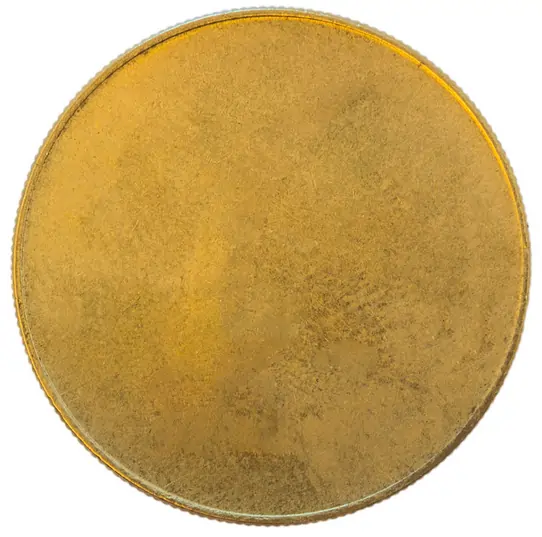
Each route offers advantages. Each route also creates risks.
Continuous strip casting remains a strong option for many high-volume producers. The process melts metal and solidifies it into a continuous strip. It offers speed, efficiency, and throughput that few alternatives can match.
However, that efficiency carries tradeoffs.
Cooling rates must remain tightly controlled. Otherwise, the metal may develop uneven grain formation. Surface consistency can also drift if process parameters move even slightly.
Those small changes matter. A minting die will often reveal them.
Why Some Producers Choose Extrusion
Extrusion offers another path.
In this process, a producer casts metal into a rod. Then the producer cuts the rod into specific lengths. Next, the producer heats the metal and forces it through a die. That die creates a strip with a tighter and more controlled grain structure.
Extrusion runs slower than continuous strip casting. It also uses more energy. In addition, it can limit throughput.
However, extrusion dies offer strong control over strip width and thickness. Therefore, they also help producers control later reductions during rolling.
For high-specification clients, that control matters. A mint such as the United States Mint can notice subtle inconsistencies once a die strikes the metal. Extrusion can provide metallurgical uniformity that strip casting may struggle to match.
Still, strip casting can reach a high standard. The producer must control casting, rolling, and annealing with discipline. In other words, the team must treat rolling and annealing as a science.
[IMAGE: Production image or diagram showing rolled precious-metal strip before plancheting.]
Rolling Defines the Coin Before the Strike
After casting or extrusion, the strip enters the rolling mills. It may also pass through annealing ovens several times.
At this stage, the producer reduces the strip to its final thickness. That sounds simple. Yet thickness alone does not define success.
The real goal is consistency.
The strip must hold a tight tolerance across its full length and width. In many cases, producers measure that control in microns. Even small variations can later create weight differences. Those differences can turn into compliance risks.
Rolling also shapes the internal structure of the metal. Each pass refines the grain. It compresses and aligns the metal in ways that affect how the planchet behaves under striking pressure.
If the producer applies too little reduction, the grain can remain coarse. That can lead to duller strikes and a more granular appearance.
However, aggressive reduction can create another problem. It can build internal stress inside the strip. Then the producer may need more time in the annealing oven. If the team mismanages that step, downstream defects may appear later.
By then, the cause can become hard to diagnose.
Where Metal Becomes Money, or Scrap
plancheting presses turn the process into something visibly industrial.
High-speed dies punch discs from the rolled strip in rapid succession. A strong production line can produce thousands of planchets per hour.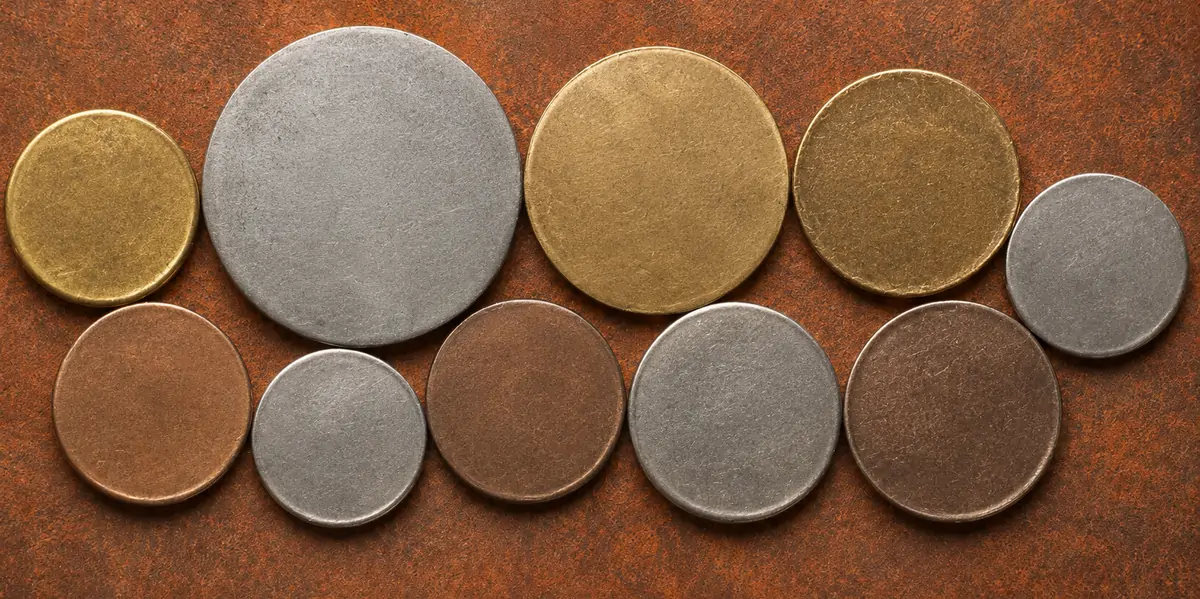
However, plancheting also makes inefficiency unavoidable.
No matter how carefully a producer lays out the pattern, a large share of the strip remains after the press punches out the discs. In some layouts, that webbing can approach half the original strip.
That leftover metal still has full intrinsic value. Operationally, though, it becomes another process. The producer must collect it, remelt it, and bring it back into production.
At the same time, tooling begins to wear.
Even the hardest dies degrade. As they wear, edge quality declines. Burrs form. Dimensions drift. Reject rates rise.
Therefore, operators must manage a constant balancing act. They want to extend tool life. However, they must protect product quality.
When something goes wrong at this stage, the problem can scale quickly. A misaligned die or inconsistent strip feed can produce thousands of out-of-spec planchets before an operator catches the issue.
In a volume business, errors move as fast as production.
[IMAGE: plancheting press, punched strip, or webbing/scrap after plancheting.]
The Minuscule Weight Problem No One Sees
One concept captures the hidden complexity of planchet production better than almost any other: the Metal Accountability Factor, often called MAF inside the trade.
Every bullion planchet must meet or exceed its stated weight. The planchet cannot run underweight. An underweight one-ounce coin can damage a mint’s reputation and create a serious customer-confidence problem.
Therefore, producers usually manufacture planchets slightly overweight.
In silver, that overage may amount to only a few thousandths of a troy ounce. In gold, the margin can run even tighter because the metal value rises so sharply.
However, small numbers become large numbers at scale.
A facility that produces five million one-ounce silver planchets per year can absorb 25,000 ounces of silver into MAF if each planchet carries an extra .005 troy ounce.
Those ounces do not disappear. No one stole them. They also will not sit neatly in inventory at year-end.
Instead, the producer distributed them to customers.
For operators, auditors, and accountants who do not understand the phenomenon, MAF can look like a troubling discrepancy. For experienced planchet producers, it becomes another variable to manage.
And in a low-margin business, that variable matters.
How Silver Prices Turn MAF Into a Bigger Risk
Rising precious metal prices make MAF even more important.
From 2023 into early 2026, silver moved from the low-$20s per ounce to a high near $120 per ounce. That dramatic rise changed the economics of every small overage.
Consider a mint that builds .005 troy ounce of MAF into each silver planchet. At about $21 silver, that extra metal costs roughly 10 to 11 cents per planchet. Near $120 silver, the same overage costs about 60 cents per planchet.
That difference can erase margin.
As a result, many mints now address MAF directly in quotes. For example, they may bill 1,005 ounces of silver for an order of 1,000 one-ounce rounds.
This approach helps prevent unexpected losses during extreme market conditions. It also makes the true cost of precision easier to see.
Grain Structure and the Cost of Rejection
Most end users judge a coin in simple terms. The coin either looks right, or it does not.
Often, that judgment begins with the strike. Does the coin show crisp detail? Does the surface look clean? Does the finish match expectations?
For planchet producers, that outcome reflects countless earlier decisions. None matters more than grain structure.
Metallurgists use the term “reduction” to describe the mechanical compression or working of the metal after heating. Current industry practice often points to a substantial reduction after initial heating as the route to better results in precious metals. Many producers target a range around 70 to 80 percent, depending on the alloy, process, and product.
That deformation creates the internal strain energy needed for fine, uniform grains during later cooling and recrystallization.
However, excessive heat can undo that work. So can prolonged heating cycles.
When metal remains too hot for too long, grains can grow into larger sections through a process known as grain coarsening. Oversized grains can make the metal more brittle. They can also create surfaces that do not strike cleanly.
Fine and uniform grains allow metal to flow into die cavities with greater consistency. That helps create sharp detail and even surfaces.
Coarse or irregular grains interrupt that flow. As a result, coins may show weak strikes, visual artifacts, or uneven reflectivity.
For a buyer who only wants bullion by metal weight, those issues may not matter much. For a buyer who wants Proof coins or high-end collector bullion, they matter a great deal.
That helps explain why demanding mint clients focus so closely on planchet quality. A mint can polish dies, tune presses, and inspect finished coins. Yet the planchet still sets the limit.
Why One Bad planchet Can Reject a Pallet
Within the industry, producers have shared accounts of large shipments coming back because inspectors found a small number of substandard planchets.
Sometimes the rejected shipment may involve entire pallets.
The operational cost can become substantial. The supplier must rework material. It must absorb delays. In many cases, it must also protect the customer relationship.
Grain structure makes this problem especially difficult. A producer cannot fix it at the end of the line.
The final grain reflects the entire production history. Casting matters. Extrusion matters. Rolling reductions matter. Annealing temperatures matter. Cooling conditions matter.
Once the planchet reaches final form, the opportunity to repair the internal structure has largely passed.
That is why an established and repeatable process matters so much.
Surface Quality, Chemistry, and Time
For planchets destined for high-quality finishes, surface preparation becomes its own discipline.
After punching, producers often burnish planchets to create a more uniform and polished surface. This process improves appearance. It also changes the surface state of the metal very slightly.
That change can make the surface more chemically active.
In a controlled environment, producers can manage that risk. In a less controlled environment, the same sensitivity can create defects.
Time matters. Humidity matters. Airborne contaminants matter.
The longer a burnished planchet sits before striking, the greater the risk that surface quality may suffer.
Impurities add another layer of complexity. Even .999 fine silver can contain trace elements. Copper, in particular, can influence surface behavior during annealing. Oxidation may create a cloudy or uneven appearance, especially on unburnished planchets.
Often, producers can correct these effects. Still, they can create concern at the customer level if expectations do not align.
The Economics of Scale
planchet production leaves little room for inefficiency.
Wholesale premiums for silver planchets typically fall within a narrow band. Depending on volume and quality, that range may run from about 35 cents to 85 cents per unit.
Now compare that margin with the value of the metal.
A standard COMEX silver contract represents 5,000 troy ounces before fabrication. At roughly $80 silver, a 5,000-ounce production batch carries about $400,000 in metal value.
A run of 5,000 one-ounce planchets may produce only about $2,500 in gross margin. From that margin, the producer still must cover labor, power, tooling, equipment, financing, insurance, scrap handling, quality control, and overhead.
That math explains why scale is not optional.
planchet producers carry high fixed costs. Their variable costs remain small by comparison. Therefore, higher volume usually improves profitability. However, downtime, yield loss, tool wear, and excessive scrap handling can quickly erase the gains.
The successful producers do more than make planchets. They make planchets consistently. They make them efficiently. Most important, they make them with minimal deviation.
Precision as a Business Model
planchet production comes down to control.
The producer must control dimensions measured in microns. It must control weight measured in thousandths of an ounce or milligrams. It must control metallurgical structures that no buyer can see with the naked eye.
However, those hidden structures become obvious after the die strikes the metal.
That creates an unusual business reality. Success rarely draws attention.
A perfect planchet does not win awards. It does not appear on a label. It does not create the marketing story. Instead, it disappears into the finished coin.
Collectors admire the design. Dealers quote the premium. Mints promote the product.
Yet the planchet did the quiet work first.
The Unseen Disc That Decides the Coin
Modern bullion markets often focus on what buyers can see and sell. They focus on finish, design, mintage, packaging, and brand.
However, the fate of a coin starts earlier.
It starts with the humble planchet.
That small disc sets quality. It locks in cost. It reduces risk, or it quietly introduces it.
For bullion mints, planchet production does not represent a background function. It represents the moment when the finished coin begins.
And for the best producers, the goal remains simple.
Make the planchet so well that no one ever notices it.






Interesting article. While not precious metsl, I recently found what appeared to be an unhinged planchet in a roll of dollar coins.
Very interesting and informative article. I would love to find a blank planchet in a coin roll.
Great article! My first 2 blank planchets were found in a roll of cents I had procured from the bank in search of wheat-backs. I was a teenager and my Dad was looking over my shoulder while I was looking through the rolls I had bought. When I came to the blank planchets (both in the same roll), he said that it looked like someone was trying to cheat whoever got that roll. I recognized them as blank planchets and told him that’s what they were. My diagnosis was corroborated later when I had the chance to have them weighed and they both weighed in at 3.10 grams. Since then I have added another copper cent blank that I got in change at Walmart and a zinc blank that I bought at a coin shop, as well as one each of nickel, dime and quarter planchets.