


A Tiny Weight Change Created America’s Rarest Carson City Coin that Sold for $3.6 Million
A microscopic change in federal law created one of the greatest rarities in American numismatics.
Congress increased the dime’s authorized weight by only 0.18 grain. That equals roughly 0.012 gram. Yet that almost invisible difference condemned virtually all freshly made Carson City dimes to destruction.
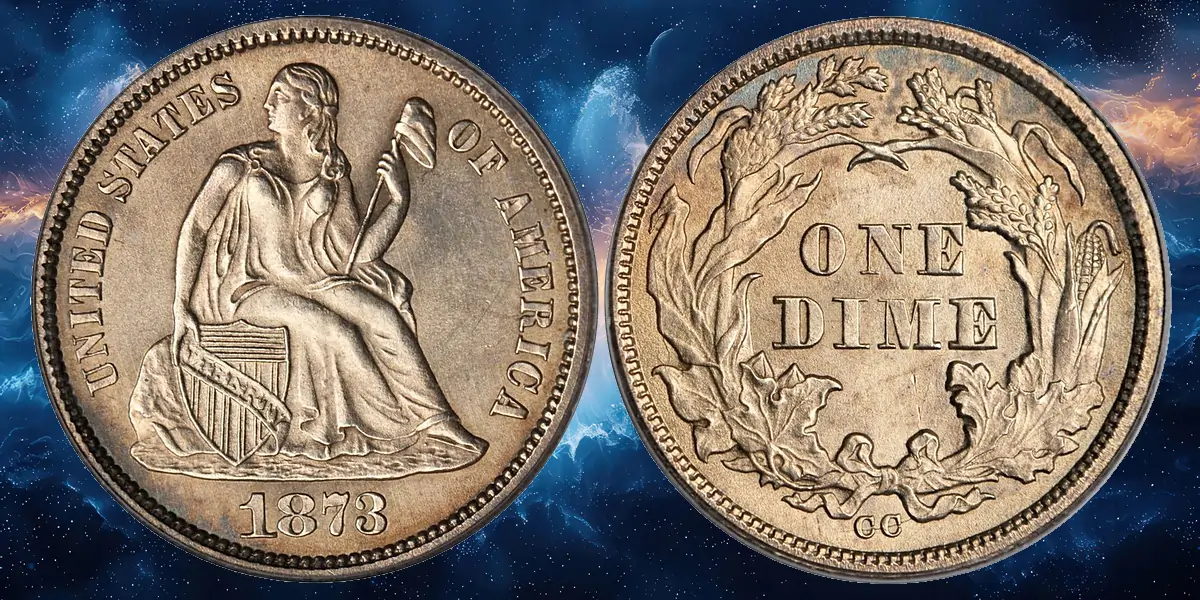
A federal weight change doomed 12,400 Carson City dimes, but one survived. Its journey from a 17-cent auction lot to a $3.6 million rarity forms one of the greatest stories in American numismatics.
Today, that lone 1873-CC No Arrows Dime ranks as the undisputed king of Carson City coinage.
No collector can build a complete date-and-mint collection of United States coins without it. Moreover, no one can assemble all 111 Carson City coin issues without owning this single dime. It completed the legendary Louis E. Eliasberg Collection. It also later completed the Battle Born Collection.
The coin does not merely represent a rare date. It controls the completion of entire collecting disciplines.
A 12-Centimetric Change With Million-Dollar Consequences
President Ulysses S. Grant signed the Coinage Act of 1873 on February 12. However, the law did not take effect until April 1.
Section 15 established new metric weights for America’s subsidiary silver coins. It set the half dollar at 12.5 grams. Therefore, the quarter weighed half that amount, while the dime weighed one-fifth. That calculation produced a new dime standard of exactly 2.50 grams.
The previous dime standard stood at 38.4 grains, or approximately 2.49 grams. Consequently, the new law added only 0.18 grain of metal.
That tiny increase hardly changed the coin’s appearance or intrinsic value. Nevertheless, it created an immediate production problem. The Mint needed a clear way to separate old-standard coins from new-standard pieces.
Officials chose a familiar solution.
They placed a small arrowhead on each side of the date.
The Mint had used arrows from 1853 through 1855 after reducing the weight of its subsidiary silver coins. In 1873, the arrows signaled the opposite. They identified the new, slightly heavier dime, quarter, and half dollar.
The Coinage Act also removed the standard silver dollar from the list of authorized domestic silver coins. In its place, Congress authorized the heavier Trade Dollar, primarily for commerce in East Asia. The law also ended the half dime. These changes later helped inspire the politically charged nickname “Crime of ’73.”
However, far from Washington, the Carson City Mint had already started its 1873 production.
That timing created the rarity.
March 3, 1873: A Remarkable Carson City Delivery
On Monday, March 3, Carson City coiner Chauncey N. Noteware delivered 12,400 No Arrows dimes to Superintendent Henry F. Rice.
The coining department also delivered 1,300 Liberty Seated Dollars and 40,000 No Arrows half dollars. In total, the delivery included 53,700 coins. The work pushed the young western mint’s single steam-powered press through a demanding production run.
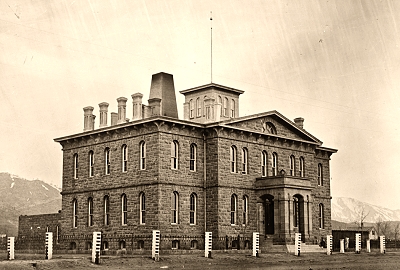
The Carson City Mint had opened for coinage only three years earlier. Nevada had joined the Union in 1864, and Carson City remained a small frontier community. Yet the mint stood close to the Comstock Lode, one of the richest silver discoveries in American history.
Therefore, the building served a practical purpose. It converted western bullion into federal coinage without forcing depositors to ship their metal hundreds of miles to San Francisco.
The 12,400 dimes looked normal. They met the legal standard that still governed coinage before April 1. In addition, nothing on their faces suggested that nearly every example would soon disappear.
Five Dimes Leave Carson City
Superintendent Rice selected five dimes from the delivery for the annual Assay Commission.
The Assay Commission examined samples from each mint to confirm that federal coins met legal standards for weight and fineness. Mint officials placed these samples, often called pyx coins, into sealed parcels and sent them to Philadelphia.
Records show that the 1874 Assay Commission tested one of the five Carson City dimes. That test coin weighed 38.05 grains. Although it fell about 0.35 grain below the nominal standard, it remained within the legal tolerance.
The commission likely destroyed that example during testing.
However, four other pieces from the parcel remained.
Researchers generally believe that today’s unique survivor came from this group. Its exceptional preservation supports that theory. The coin shows no evidence of circulation and survives in Gem Mint State.
Still, no surviving document proves exactly how it escaped.
That distinction matters. The Assay Commission explanation remains the strongest theory, but it does not qualify as an established fact. Heritage Auctions also noted that, after 150 years, researchers cannot state with certainty what happened to every pyx coin.
The Melting Pot Claims 12,399 Dimes
After April 1, the old-standard dimes no longer matched the new specifications.
Carson City could not release the remaining No Arrows coins as current production. Therefore, Mint workers apparently melted the undistributed pieces and recycled their silver into new coinage.
Once Carson City received the proper dies, the mint struck 18,791 heavier dimes with arrows beside the date. Those coins entered circulation. Many survivors show heavy wear, corrosion, or other surface problems.
The No Arrows issue followed a dramatically different path.
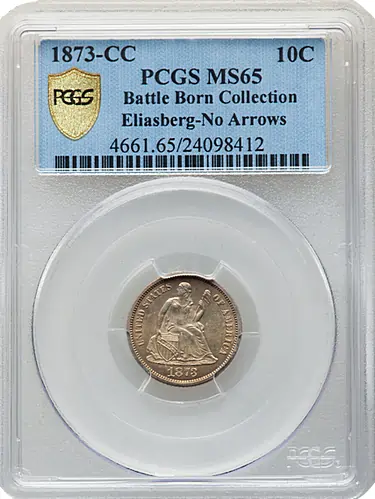
From an original mintage of 12,400, only one example remains known. PCGS continues to list a survival estimate of one coin in all grades. Its current Population Report also lists one example, graded MS65.
That represents a survival rate of roughly 0.008%.
In practical terms, the survival rate equals zero—except for one extraordinary coin.
The 17-Cent Rarity Nobody Recognized
The dime first appeared publicly in May 1878.
Coin dealer Edward Cogan offered the John Swan Randall Collection through Bangs & Co. in New York. Lot 902 carried a remarkably plain description:
“1873 Old style. C.C. Mint. Fine impression.”
The words “Old style” separated the No Arrows design from the newer With Arrows type. Meanwhile, “Fine impression” did not necessarily indicate a modern Fine grade. Nineteenth-century catalogers often used broad and inconsistent grading language.
More strikingly, Cogan did not call the dime rare.
The coin sold for 17 cents.
That result remains one of the great ironies in numismatic auction history. A coin that would eventually sell for $3.6 million brought only seven cents above face value at its first recorded sale.
At the time, collectors had not yet embraced mintmark collecting. Moreover, no reliable census existed for Carson City coins. The bidders could not know that no second example would appear.
A Provenance That Challenges an Old Numismatic Legend
For decades, numismatists repeated a dramatic story about the dime’s origin.
According to that account, the coin left the Mint around 1909 during a Treasury exchange involving William H. Woodin, Capt. John W. Haseltine, Stephen K. Nagy, and two 1877 gold $50 Half Union patterns.
The government reportedly recovered the Half Unions by trading Woodin a group of rare patterns and coins. Some writers later claimed that the 1873-CC No Arrows Dime formed part of that exchange.
However, the dime’s documented 1878 auction appearance makes that origin impossible.
Later provenance research strengthened the case. Dr. Thomas P. Hall reportedly acquired the coin in 1896 and sold it to DeWitt S. Smith in December 1900. Smith’s ownership also appears in John M. Clapp’s notebook. After Smith died, Henry O. Granberg acquired much of his silver collection, perhaps with Woodin’s assistance.
Therefore, Woodin may still belong in the ownership chain. Yet the dime did not emerge from the 1909 Treasury exchange.
The documentary trail places it in private hands more than 30 years earlier.
The Numismatic World Finally Notices
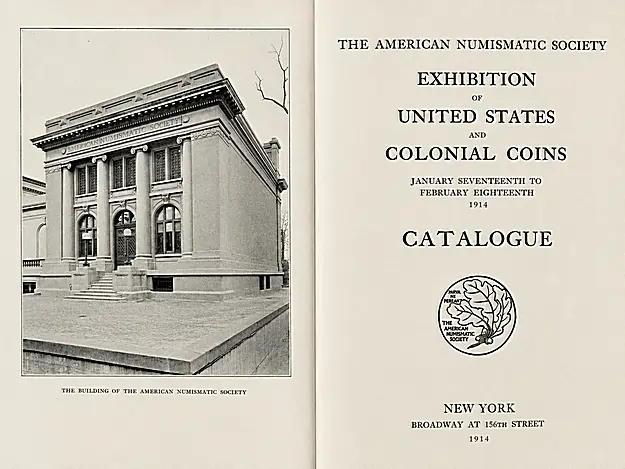
Granberg displayed the dime at the American Numismatic Society’s 1914 Exhibition of United States and Colonial Coins in New York.
This time, the cataloger recognized its importance.
The description declared it the “only specimen known.”
One year later, Wayte Raymond offered the coin in the sale of a collection attributed only to a “Prominent American.” The catalog called the dime uncirculated, described it as probably unique, and labeled it the rarest and most important coin in the mintmark series.
Rudolph Kohler, a New York coin dealer, purchased it for $170. He may have acted for another buyer.
The coin then entered the collection of Waldo C. Newcomer, one of the great American collectors of the early 20th century. Newcomer held it until financial trouble during the Great Depression forced him to disperse his holdings.
Dealer B. Max Mehl handled the collection. In 1933, he sold Newcomer’s dime collection to Cincinnati insurance executive Charles M. Williams.
The unique coin then disappeared from public view for 17 years.
Some collectors even questioned whether it truly existed.
Eliasberg Loses the Coin He Needs Most
Williams consigned his collection to Numismatic Gallery in 1950. Because he wanted anonymity, the auction carried the glamorous name of actor Adolphe Menjou.
The collection contained many major rarities. Yet the 1873-CC No Arrows Dime created a special problem for cataloger Abe Kosoff.
No recent auction result existed. The previous public sale had occurred in 1915. Price guides valued the coin at only a few hundred dollars.
Kosoff initially considered a $2,000 estimate. Complaints from clients pushed him to reduce it to $1,000.
Louis E. Eliasberg Sr. understood the coin’s real importance.
By 1950, Eliasberg had assembled the only collection designed to include every then-known United States coin by date and mint. However, he still lacked the 1873-CC No Arrows Dime.
He traveled to California to buy it.
During the auction, Eliasberg battled dealers James Kelly and Sol Kaplan. The bidding climbed far above the estimate. Finally, Eliasberg stopped.
Kelly and Kaplan won the dime for $3,650.
Eliasberg left California without the coin.
For five months, his unprecedented collection remained one piece short.
The $4,000 Transaction That Made History
In November 1950, Kaplan contacted Eliasberg and asked what he would pay.
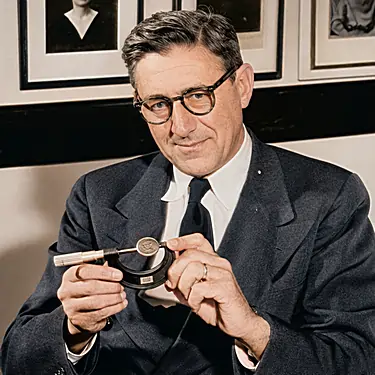
Eliasberg offered $4,000.
Kaplan accepted.
On November 7, 1950, Louis Eliasberg acquired the 1873-CC No Arrows Dime. With that purchase, he completed the only comprehensive collection of United States coins ever assembled by a single collector.
The dime had become more than a rarity. It had become the final piece in numismatics’ most famous collecting achievement.
Eliasberg kept the coin until his death in 1976. His family retained it for another 20 years.
During that period, the dime appeared in major exhibitions and publications. It also gained a permanent place among the icons of American coinage.
From $550,000 to $3.6 Million
When Bowers and Merena offered the Eliasberg dime in May 1996, the catalog described it as the only known example and the final coin acquired to complete the collection.
Waldo E. “Pat” Bolen Jr. purchased it for $550,000.
Just three years later, Heritage Auctions sold Bolen’s 1873 Carson City set. Dealer Jasper “Jay” Parrino acquired the dime for $632,500.
In July 2004, Parrino consigned the coin to Bowers and Merena. Carson City specialist Rusty Goe purchased it for $891,250 on behalf of the anonymous Battle Born collector.
That purchase completed the Battle Born Collection.
Like Eliasberg, the Battle Born collector now owned all 111 Carson City coins by denomination, date, and major subtype. Only those two collectors have accomplished that feat.
Stack’s Bowers auctioned the Battle Born Collection in August 2012. The 1873-CC No Arrows Dime sold for $1.84 million, setting a record for the denomination.
The coin returned to auction in January 2023 as part of the Prestwick Collection, Part II.
Heritage sold it for $3.6 million to an internet bidder. The auction house did not publicly identify the buyer.
From 17 cents in 1878 to $3.6 million in 2023, the coin’s recorded price increased more than 21 million times.
How Experts Identify the Unique Dime
The coin carries several important diagnostics.
First, it has no arrows beside the date. It also displays a Closed 3 in 1873.
Most importantly, a diagonal die crack crosses the CC mintmark. The crack begins to the left of the first C, passes upward through both letters, and continues toward the ribbon at the base of the wreath.
The coin also shows a partial wire rim.
On the reverse, two repeating marks appear in the field below the M in DIME. Heritage suggested that the minting process may have created them. The same reverse die later struck 1873-CC With Arrows dimes and 1874-CC dimes.
These features provide a clear fingerprint.
They also make casual claims about discovering another example easy to test. A genuine second specimen would need to match the correct dies, weight standard, style, mintmark placement, and other production characteristics.
After more than 150 years, no second coin has passed that test.
A Gem Survivor
PCGS grades the unique dime MS65.
Heritage described a sharp strike and soft, satiny luster. Golden-brown and auburn patina covers the surfaces, while blue accents appear in selected areas. Die-polishing lines remain visible on Liberty.
The coin shows only minor contact marks. Its exceptional preservation strongly suggests that someone saved it before it could enter circulation.
That condition adds another layer to the mystery.
The lone survivor did not merely escape melting. It survived virtually untouched.
Why the 1873-CC No Arrows Dime Matters
Many famous coins owe their status to low mintages. Others carry celebrated designs, dramatic errors, or connections to major historical figures.
The 1873-CC No Arrows Dime combines several forms of importance.
It documents the implementation of the Coinage Act of 1873 and represents the frontier Carson City Mint. It survives as a unique regular-issue federal coin and carries one of the strongest pedigrees in numismatics. Finally, it completed two of the greatest collections ever assembled.
Its uniqueness also creates an absolute barrier.
A collector can own an 1804 Dollar without controlling the only one. The same applies to a 1913 Liberty Head Nickel or an 1894-S Barber Dime.
However, only one person can own an 1873-CC No Arrows Dime.
Therefore, only one person at any given moment can own a complete collection of Carson City coinage. Only that owner can pursue a truly complete date-and-mint collection of regular United States coins.
The dime holds the key.
Design of the 1873-CC No Arrows Dime
Obverse
Liberty sits on a rock and turns her head to the viewer’s left. Her right hand supports a Union shield. A ribbon across the shield carries the word LIBERTY.
Her left hand holds a pole topped by a Liberty cap.
UNITED STATES OF AMERICA surrounds the upper border. The date 1873 appears below Liberty.
The Seated Liberty motif originated with Christian Gobrecht and designs associated with Thomas Sully and Titian Peale. However, the later Legend Obverse and cereal-wreath type also incorporates modifications made during James B. Longacre’s tenure.
Reverse
A wreath surrounds the denomination ONE DIME.
The wreath includes corn, wheat, oak, and maple elements. A ribbon ties the branches at the bottom.
The CC mintmark appears below the bow.
The edge carries reeding.
1873-CC No Arrows Dime Specifications
- Country: United States
- Denomination: 10 Cents
- Mint: Carson City
- Mintmark: CC
- Original Mintage: 12,400
- Known Survivors: One
- Composition: 90% silver, 10% copper
- Old Standard Weight: 38.4 grains, approximately 2.49 grams
- Recorded Weight of the Unique Coin: 2.49 grams
- Diameter: 17.9 mm
- Edge: Reeded
- Strike: Business Strike
- Grade: PCGS MS65
- PCGS Number: 4661
The King of Carson City Coins
The difference between an ordinary 1873 dime and America’s greatest Carson City rarity came down to two missing arrows and 0.012 gram of silver.
Yet the coin’s story extends far beyond its specifications.
Mint workers made 12,400 examples. Federal law rendered them obsolete. The melting pot claimed almost every piece. One dime somehow escaped and began a journey through the collections of Randall, Hall, Smith, Granberg, Newcomer, Williams, Eliasberg, Bolen, Battle Born, Prestwick, and others.
It sold for 17 cents when no one understood it.
It later became the coin Louis Eliasberg could not live without.
Today, it remains unique, irreplaceable, and essential.
The 1873-CC No Arrows Dime does not simply occupy an empty space in a coin album. It decides whether the album can ever become complete.




Well – I won’t find that in an old coin purse dropped from the stagecoach line
great article probably never see this coin in circulation
Hard to fine, but I will be looking.
Nice article
That’s one coin that will never be in my collection!
I’m thinking there just has to be another out there somewhere.
I have a 1872 CC quarter. The
Carson City mint states it minted 9100 coins. This is in the museum. All the coin books I have looked at state that 22,000 plus were minted. I can’t find any information on the discrepancy. Any answer would be appreciated