1794 Flowing Hair Dollar Brings $1.647 Million at Stack’s Bowers
An exceptional 1794 Flowing Hair dollar returns to auction, bringing nearly $600,000 more than its previous appearance in 2020.
In 1794, the fledgling United States Mint struggled to produce America’s first silver dollar. Its equipment was inadequate, precious metal supplies were limited, and many of the finished coins showed evidence of the Mint’s growing pains.
Yet one remarkable survivor of that historic first coinage has just sold for $1,647,000.
The 1794 Flowing Hair Silver Dollar, graded MS-62+ by Numismatic Guaranty Company (NGC), achieved the seven-figure result on November 17, 2026, during Stack’s Bowers Galleries’ November Showcase Auction Rarities Night session.
Known as the Austrian-Wittlin-Willing specimen, the coin was among the highlights of the Property from an Alabama Family offering.
The result also marked a substantial increase over its previous auction appearance. In December 2020, the same coin brought $1,050,000 in the Stack’s Bowers sale of the Larry H. Miller Collection.
Six years later, its auction price climbed by $597,000, or approximately 57%.
However, the coin’s financial history tells only part of the story. Its greater significance reaches back to the earliest days of American coinage.
The First American Silver Dollar Almost Didn’t Happen
When Congress passed the Coinage Act of April 2, 1792, it established the United States Mint and authorized a national coinage system based on the dollar.
The legislation represented an important step toward monetary independence. However, transforming those ambitions into actual coins presented enormous difficulties.
The Mint’s earliest operations in Philadelphia suffered from inadequate equipment, limited personnel, and difficulties securing precious metals.
Moreover, the Mint depended on private deposits of silver and gold rather than maintaining its own substantial bullion reserves.
The first major silver deposit arrived from the Bank of Maryland in July 1794. However, the material required extensive refining before the Mint could use it for coinage.
Mint Director David Rittenhouse eventually supplied silver of his own to move production forward.
Rittenhouse considered the silver dollar especially important. After all, it represented the basic unit of the nation’s monetary system and the largest silver denomination authorized under the 1792 legislation.
Despite the Mint’s mechanical limitations, production began.
On October 15, 1794, Chief Coiner Henry Voigt delivered 1,758 silver dollars to Rittenhouse.
That figure remains the accepted official mintage.
Some researchers believe the Mint initially struck approximately 2,000 examples but rejected several hundred because of poor strikes or other production problems. Others question whether the larger production figure can be established.
At least one surviving 1795 dollar bears evidence of an earlier 1794 strike. This remarkable overstrike supports the possibility that the Mint reused rejected 1794 dollars as planchets.
Whatever the exact original production total, the 1,758 accepted coins established the American silver dollar as a physical reality.
A Coin That Reveals the Mint’s Earliest Struggles
Chief Engraver Robert Scot created the Flowing Hair dollar’s design.
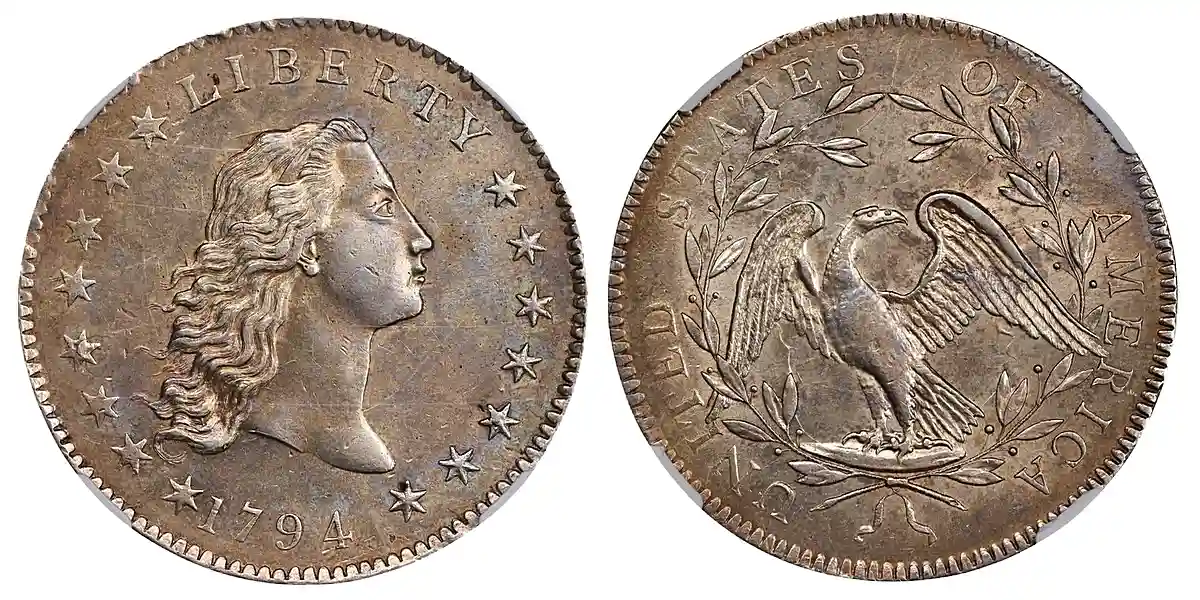
The obverse depicts Liberty facing right, with her hair flowing behind her. Fifteen stars represent the number of states in the Union in 1794.
The reverse features a small eagle surrounded by a wreath, with UNITED STATES OF AMERICA around the border.
Interestingly, neither face identifies the coin’s denomination.
Instead, the edge carries the inscription HUNDRED CENTS ONE DOLLAR OR UNIT, separated by ornamental devices.
The coin measured approximately 40 millimeters in diameter and weighed roughly 27 grams. Congress had specified a weight of 416 grains and a statutory silver fineness of approximately 89.24%. However, the Mint used an alloy closer to 90% silver during its initial dollar production.
Producing such a large coin challenged the Mint’s available screw press.
Consequently, many 1794 dollars display weak details along the left portions of their obverse and reverse borders.
In addition, workers sometimes filed overweight silver planchets before striking them. These filing lines, known as adjustment marks, remain visible on numerous survivors.
Such imperfections provide a direct connection to the methods and limitations of America’s first federal minting operation.
What Makes This $1.647 Million Dollar Exceptional?
The Austrian-Wittlin-Willing specimen stands apart from many surviving 1794 dollars because of its unusually strong strike and impressive preservation.
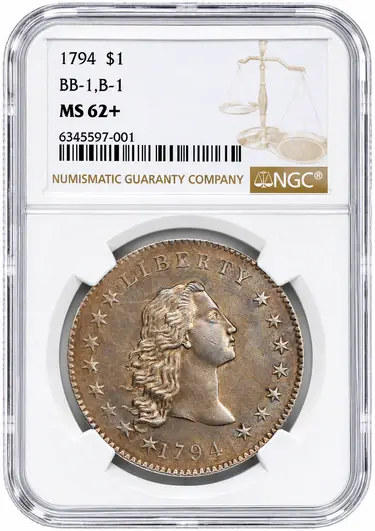
Stack’s Bowers cataloged the coin as BB-1, B-1, Rarity-4, representing the single known die marriage used for the 1794 dollar issue.
The coin displays nearly complete denticles around both sides. These small, toothlike border elements often appear weak or incomplete on other examples.
Furthermore, all 15 obverse stars remain clearly defined, while the four digits of the date appear bold and legible.
Liberty’s flowing hair retains considerable detail. On the reverse, the eagle’s feathers and surrounding lettering also show unusually strong definition.
Only minor softness appears in portions of the border.
The coin also displays relatively few adjustment marks. The catalog identifies a small area near the reverse lettering where traces of the original planchet preparation remain visible.
Meanwhile, subtle golden-tan and powder-blue toning complements the surviving satin luster.
One especially useful identifying feature appears near the center of the eagle’s breast: a shallow, circular planchet flaw created during manufacture.
The coin represents BB Die State II and exhibits light die-clash marks, evidence that the dies contacted one another during the striking process.
These details help distinguish the specimen from other surviving 1794 dollars and establish its identity through earlier appearances.
A Remarkable Pedigree Spanning Generations
The coin’s nickname reflects several important chapters in its collecting history.
Its earliest reported provenance suggests ownership in an Austrian private collection, although that attribution remains uncertain.
The documented collecting trail includes Paul H. Wittlin and an appearance in James Kelly’s 1956 American Numismatic Association auction.
Later, the coin passed through several numismatic firms and private hands before appearing in the June 1976 sale of the Dr. Edward B. Willing Collection.
It subsequently crossed the auction block in Superior Galleries’ May 1990 Father Flanagan’s Boys Home sale.
Eventually, it entered the celebrated collection of Larry H. Miller.
Stack’s Bowers offered the coin again on December 17, 2020, as lot 1089 of the Larry H. Miller Collection, Part Two. At that time, NGC had graded it MS-62, and it realized $1,050,000.
For its November 2026 appearance, the coin carried the higher designation of NGC MS-62+ and appeared as lot 2075.
The latest sale therefore adds another chapter to a collecting history that stretches across multiple generations and several important American coin auctions.
Only About 150 Examples Survive
The 1794 Flowing Hair dollar ranks among the most historically significant issues in American numismatics.
Researcher Martin Logies documented 134 distinct surviving examples in his 2010 census. Broader contemporary estimates suggest that approximately 150 specimens survive today.
Many show extensive circulation wear, cleaning, repairs, or other impairments.
Mint State examples are especially rare.
Indeed, the combination of preservation, striking quality, and documented pedigree places the Austrian-Wittlin-Willing specimen within a small and distinguished group of surviving first-year silver dollars.
For perspective, another 1794 Flowing Hair dollar, graded PCGS MS-63+ and approved by CAC and CMQ, realized $4.5 million in Stack’s Bowers’ November 2025 Rarities Night auction.
The latest $1,647,000 result does not establish a new record for the date. Nevertheless, it demonstrates the substantial demand for surviving examples with exceptional historical importance.
More than two centuries after its creation, the 1794 Flowing Hair dollar continues to fascinate collectors.
It represents far more than an early American denomination. It is tangible evidence of the country’s determination to establish an independent monetary system, even when the machinery, materials, and expertise needed to accomplish that goal were still taking shape.
And on November 17, 2026, that remarkable piece of American history found another owner for nearly $1.65 million.