


This Rare 1885 Morgan Dollar Pattern Hid Its Secret on the Edge
An 1885 Pattern Morgan Dollar in aluminum offered collectors a rare look at one of the Philadelphia Mint’s most intriguing anti-counterfeiting experiments. Stack’s Bowers Galleries sold the coin for $13,200 in its March 2018 Baltimore Auction, Session 3, Rarities Night Including the ESM Collection.
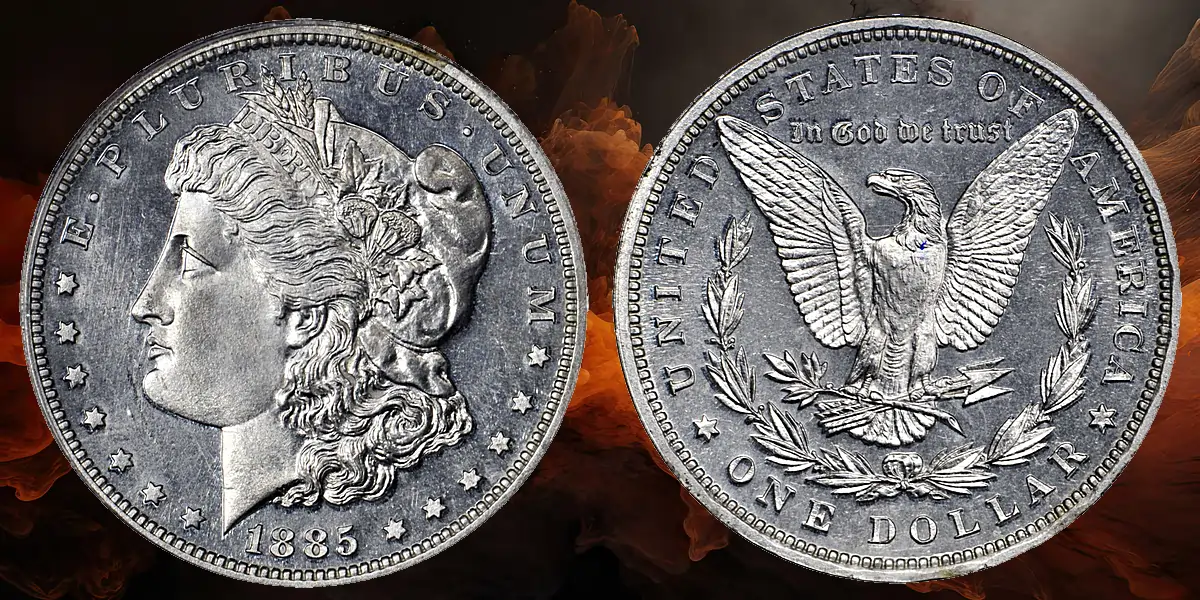
The coin carries the attribution Judd-1749, Pollock-1961. It ranks as Rarity-7- and holds a grade of Proof-65 from PCGS. It also remains in an old green holder, often called an OGH by collectors.
Most importantly, this pattern Morgan dollar carries raised edge lettering. That feature tells the real story.
A Morgan Dollar With a Third-Side Secret
At first glance, this 1885 Pattern Morgan Dollar looks familiar. The Mint struck it from the same dies used for regular-issue 1885 Morgan silver dollars.
However, the edge changes everything.
Instead of a standard reeded edge, this pattern features the following raised lettering:
* * * * * * E * / PLURIBUS * / UNUM * * * * *
The collar held the lettering in three separate segments. Each segment covered one-third of the coin’s circumference. As a result, the Mint could test a practical method for adding words to the edge during production.
Stack’s Bowers described the coin as a lovely silver-white Gem. It shows a full strike, brilliant surfaces, and an overall pristine appearance.
Snowden’s Anti-Counterfeiting Mission
The backstory starts with Archibald Loudoun Snowden, superintendent of the Philadelphia Mint. Snowden believed raised edge lettering could better protect American gold and silver coins.
He did not view the edge as empty space. Instead, he saw it as the coin’s “third side.”
That mattered. Counterfeiters could copy designs. Criminals could also file or clip precious metal from coin edges. Therefore, the edge had long served as a line of defense.
The idea reached far back in history. In 1658, the English government under Oliver Cromwell issued silver half crowns and crowns with raised edge lettering. That stands as the earliest known use of the feature.
Early United States gold and silver coins used other edge protections. Some carried sunken relief lettering. Others used reeding. Yet by 1860, counterfeiting and filing had become serious problems. Mint officials needed new answers.
Snowden saw one possible solution.
As early as 1867, while serving as chief coiner, Snowden recommended raised edge lettering. However, the Mint did not pursue the idea with full force until 1885.
Two Counterfeiters Changed the Conversation
The key moment came in 1884. Authorities arrested two skilled counterfeiters. Their work alarmed Snowden.
That arrest pushed him to act. Soon afterward, he began developing a mechanism that could produce coins with raised edge letters in an efficient way.
The experiment worked well enough to create patterns like this Judd-1749 Morgan dollar. Even so, the project did not survive for long.
Snowden resigned as superintendent before the end of 1885. After that, the Mint abandoned the raised-lettering project.
Still, the idea did not disappear forever. In 1907, the United States finally adopted raised edge lettering for regular-issue coins with the introduction of Augustus Saint-Gaudens’ eagle and double eagle.
That connection gives the 1885 aluminum Morgan pattern extra importance. It sits between an urgent 19th-century counterfeiting problem and one of the most famous gold coinage redesigns in American history.
Aluminum Makes Judd-1749 Even Rarer
In 1885, under Snowden’s supervision, the Mint struck raised-edge-lettering Morgan dollar patterns in silver, copper, and aluminum.
The silver and copper pieces show similar rarity today. Stack’s Bowers cited about 15 to 20 known examples in each metal.
Aluminum impressions prove much harder to find. According to the source’s reference to uspatterns.com, only nine examples survive.
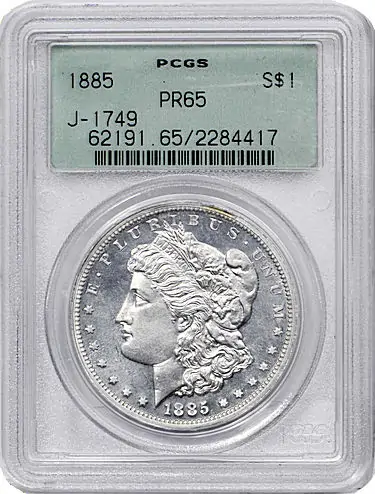
That tiny population explains the coin’s strong collector appeal. It combines the famous Morgan dollar design, experimental Mint technology, and a metal that makes the variety far more elusive.
Provenance and Auction Result
This example came from the Janet Nakushian Collection.
Stack’s Bowers offered it in the March 2018 Baltimore Auction, during Session 3, Rarities Night Including the ESM Collection. The coin realized $13,200.
For Morgan dollar specialists, pattern collectors, and students of Mint history, Judd-1749 offers more than rarity. It captures a moment when the Mint tried to stay one step ahead of counterfeiters. It also shows how one official’s idea later found new life on America’s 1907 Saint-Gaudens gold coinage.
In that sense, this aluminum 1885 Pattern Morgan Dollar does not just test a design. It previews a future chapter in U.S. coinage.





Interesting. Had no clue that there was ever an aluminum coin.
Neat coin
I had three buffalo knickers, but the same as the one on the picture exactly with no date no Mint mark
Now this is a real beauty and love the value too.
Would be nice to have a picture of the lettered edge as well as the coin itself.
So neat!
Good to know. I wonder if anyone had one and tossed it thinking it was fake?
Aluminum itself was rare and as valuable as gold until the first industrial large-scale production method was developed in 1886, a year after this coin experiment.
Seems to me that using aluminum, a softer metal, would make it easier to counterfeit. Even with the raised edge lettering. Were there any other coins made of aluminum?
Very Interesting Article
Great information
Another coin in aluminum!
I never had any idea that a Morgan dollar was minted in aluminum. That would be a cool coin to see.
Your articles are helpful I learn alot.
Great idea, for security of the makers mark on coins, should be similar
Practicing today little features – insignificant but nessacary marks?
But with technology today could probably be a get around to
Sometimes get away with counterfeit even easier?
Wow
crazy story!!
Nice