


A small silver dime can carry a big story.
The 1928-D Mercury Dime does exactly that. Denver struck just 4,161,000 examples that year. As a result, the issue ranks among the better dates in the Mercury dime series. It also becomes much more interesting when collectors find one in Gem Mint State with sharp Full Bands detail. PCGS lists the 1928-D Mercury Dime as a Denver issue with a mintage of 4,161,000, a 90% silver and 10% copper composition, a 2.50-gram weight, and a 17.90 mm diameter.
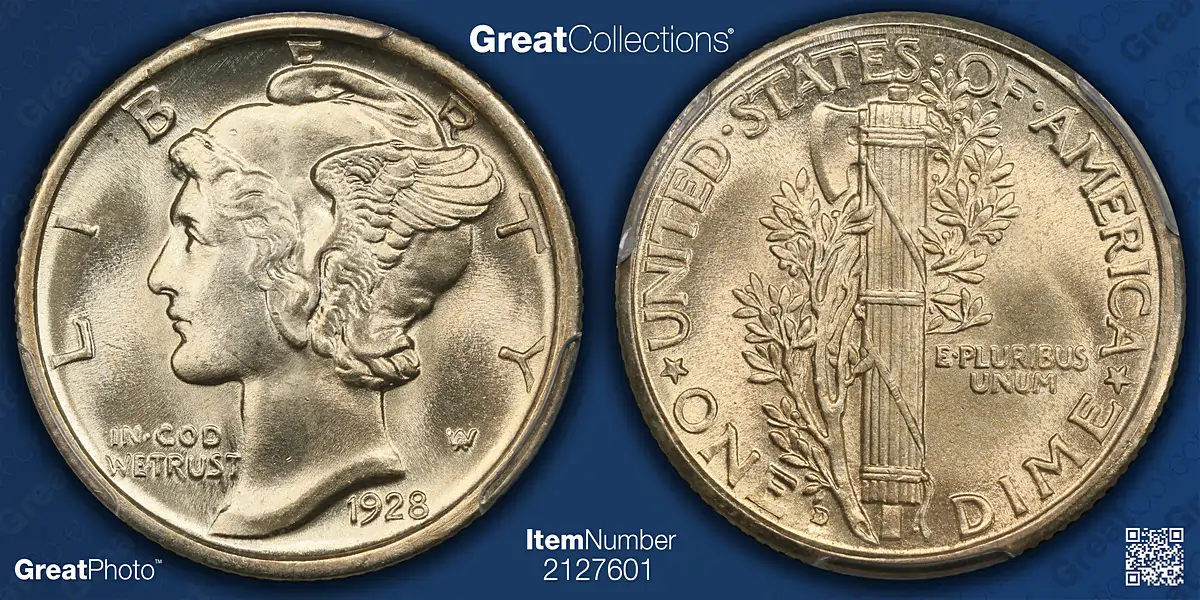
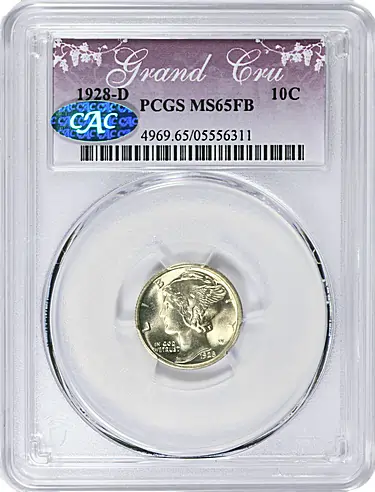
Now one premium example has surfaced at GreatCollections. The coin carries a PCGS MS-65 FB grade, CAC Green approval, and a Grand Cru Label. Together, those details make this 1928-D Mercury Dime stand out from the crowd.
The “Mercury” Dime That Is Not Mercury
Collectors call it the Mercury dime. However, the name tells only part of the story.
The United States Mint properly identifies the design as the Winged Liberty Head dime. Adolph A. Weinman designed it, and the Mint produced the type from 1916 through 1945. The obverse shows Liberty wearing a winged cap. According to the U.S. Mint, the wings represent freedom of thought. The public quickly connected the portrait with the Roman god Mercury, who also wore a winged head covering. Therefore, the nickname stuck.
The reverse carries more symbolism. Weinman placed a fasces at the center. He also added an olive branch. The U.S. Mint describes those symbols as military readiness and the desire for peace. That message fit the era. The coin debuted as America moved toward World War I. Then it remained in commerce through the Great Depression and World War II.
Weinman’s Liberty and the Elsie Stevens Backstory
The Mercury dime belongs to the great artistic revival in American coinage. President Theodore Roosevelt had pushed the Mint toward more beautiful designs in the early 20th century. Weinman’s dime became one of the most admired results of that movement.
For generations, collectors also repeated another story. Many believed that Elsie Stevens, wife of poet Wallace Stevens, served as the model for Liberty. Weinman never publicly named the model. However, later research strengthened the Stevens connection. Coin World reported that a Wallace Stevens scholar found family correspondence that supported the long-held Stevens family claim.
That backstory adds life to the coin. The portrait does not feel like a stiff emblem. Instead, Liberty looks young, alert, and modern. She wears a cap of freedom. Yet she also seems ready for the storm clouds of the 20th century.
Why the 1928-D Mercury Dime Matters
The 1928-D does not carry the fame of the 1916-D. Still, collectors know it as an important semi-key date.
Denver struck fewer than 4.2 million pieces. That total sits far below the mintages of many later Mercury dime issues. In circulated grades, collectors can still locate examples. However, the challenge grows quickly in Mint State. It grows even more when a buyer demands a strong strike and Full Bands.
That strike matters because many Mercury dimes show weakness. The small design leaves little room for error. In addition, the reverse bands often fail to separate fully. So, when a 1928-D shows clean surfaces, strong luster, and full central band separation, collectors take notice.
Full Bands: The Detail That Changes the Coin
Full Bands, or FB, gives this coin much of its market force.
The Mercury dime reverse centers on the fasces. Three sets of twin bands bind the rods. PCGS grants the Full Bands designation when the central set shows a complete split. PCGS also notes that this detail signals a sharp strike and often brings a strong premium over softly struck examples.
This point matters even more on early branch-mint issues. Denver coins often saw heavy use. Many also left the dies with less-than-perfect detail. Therefore, a 1928-D dime in PCGS MS-65 FB offers more than high grade. It offers the strike detail that advanced Mercury dime collectors chase.
What PCGS MS-65 FB and CAC Green Mean
PCGS graded this coin MS-65 FB. That grade places it in Gem Mint State. It also confirms the Full Bands detail.
Next, CAC added its Green approval. CAC states that a green sticker identifies a coin that meets its standard for quality within the assigned grade. CAC also notes that fewer than half of submitted coins receive the green sticker.
For buyers, that matters. A PCGS MS-65 FB holder already tells collectors that the coin has strong technical merit. The CAC Green sticker adds another layer of market confidence. It signals that CAC found the coin solid for the grade.
The Grand Cru Label Adds Presentation
The GreatCollections listing identifies this coin with a Grand Cru Label. That label does not change the PCGS grade. It also does not replace the importance of the Full Bands designation or CAC approval.
However, it does add presentation appeal. Many collectors like coins that combine technical quality with a premium holder format. In this case, the Grand Cru Label gives the coin a curated look that fits its Gem quality.
The Wow Factor: A Dime From the Edge of the Depression
Denver struck this dime in 1928. America still looked prosperous. The stock market crash sat one year away. Within a short time, millions of Americans would hold, spend, and save silver coins like this one as the Great Depression reshaped daily life.
Most 1928-D dimes served their purpose. They bought newspapers, streetcar rides, coffee, and meals. They moved from cash drawers to pockets and back again. As a result, most survivors show wear.
This coin escaped that fate.
It survived with Gem Mint State surfaces. It also retained the Full Bands detail that collectors use to measure strike quality. That combination turns a small silver coin into a powerful 20th-century artifact.
Collector Takeaway
The 1928-D Mercury Dime offers several layers of appeal.
First, it belongs to one of America’s most beautiful coin designs. Next, it carries a lower Denver mintage. Also, it holds a Gem MS-65 grade from PCGS. Most importantly, it earned the Full Bands designation. Finally, CAC Green approval adds another mark of confidence.
For Mercury dime specialists, that package matters. For type collectors, it offers a sharp example of Weinman’s classic design. And for buyers who want a coin with history, beauty, and technical strength, this 1928-D dime deserves close attention.
For Sale at GreatCollections
This 1928-D Mercury Dime PCGS MS-65 FB CAC Green with Grand Cru Label is currently offered by GreatCollections.
GreatCollections lists the coin as GC Item ID 2127601. The listing also records PCGS certification number 05556311. The auction ends Sunday, May 24, 2026, at 5:02:45 PM Pacific Time.
Bidders can view the coin and auction details at GreatCollections.




I have a 1928 dime it’s put in a safe place I have several old coins
I got the 1916 dime and two of the nickels.
I have a few Mercury dimes don’t know how to sell them
I have a 1914 liberty head dime,pretty good shape.Is this dime worth anything?
@Barbara Lopes You have a coin commonly called a “Barber” dime, named for its designer Charles E. Barber. 1914 is a fairly common date regardless of mint mark; in average condition it would retail in the $10 range. In better condition and with an S mint mark it could bring a few dollars more. In any case it’s a cool coin to have from more than a century ago.
I have alot of old coins looking g you sale them
Have alot of old coins looking to sale.them..anyone looking to buy .hit me up
@Marylin Kay Cruz: If you’re just starting out in coins, you might take yours to a local show and get offers from different dealers. Trying to sell* them privately requires knowledge of their fair values, which can be tough to determine if you’re not already an experienced collector.
(*) rather than “sale”; also “a lot” rather than “alot” Hope that helps!
Marylin, I may would be interested. Can you take a picture of what you have.Send it to me and maybe I can make an offer that would satisfy. Brett
I have 1928 quarter,I have 1890 Morgan dollar,1901-02-03-04 indian head pennies,1945 half dollar also and several 1935 1945 mercury dimes as well
I am interested What do you have? Could you msg me on phone
I just sold my mercry dime and 1944 silver dime and silver quarter for 30 dollars and I feel like I just lost a fortune
I have a bunch of coins of old wheatbacks but when I try to get a hold of heritage actions or any coin actions places they don’t call back
Unfortunately Wheat Pennies are not rare and explains why you aren’t getting call backs. They are found online in such places as WhatNot streams, eBay, coin stores, etc. They sell them in rolls some random dated then from earliest on… I have seen earlier dated rolls selling for $50+ at auction. Try rolling them and keep dates in mind. Good luck with your endeavor.
I have some old coins, but don’t know the real value of them. I have a about six dimes,but not all of the have the same year. How can I find out if they are worth anything
Everlenabaggs The go-to reference for retail numismatic values is the famous “Red Book”. There are also a number of good online sources, but be careful to use only those curated by major numismatic agencies or other experts. General auction sites can be all over the map, with lots of good information but likely even more hype or just plain misleading slop that can be hard to discern unless you’re already an experienced collector.
I have a bunch of old silver coins that my grandma gave to me too bad she didn’t know how to take care of them. So there not in the best shape! But I’m sure someday they will be worth something.
I have some old silver coins that my Grandfather gave me. But he never took care of them so they are marked up some. But hopefully someday they’ll be worth something
If that’s a 1928-D, is that not a w mint mark?
No, it is a Denver (D) Mintmark
The mint mark is on the reverse for mercury dimes. The mark on the obverse bottom right is the engraver’s initials.
I have a1909 Indian head with error on rim and I know it’s a transitional error on
I was wanting to sell
My 1909 Indian head penny I know it has a transition error plus it has an erro on the rim
I love the Mercury dimes and I do have 2 1928 D dimes
Great article
Another great article!
I understand the preservation factor, and I understand how professionals guaranteeing the grade of a coin enhance its value, but I still won’t collect coins in “slabs.”
I have a 1936 1/2 penny front and a 1936 mercury rear on back I call it a silver penny. It is the reason they quit making pennies.