

A Royal French Coin With a Mint Error Twist
The Paris Mint struck millions of silver 5 francs coins during the 19th century. Most served their purpose. They passed from hand to hand. They paid debts, bought goods, and moved through the daily life of France.
However, one 1830 French 5 francs escaped that ordinary fate.
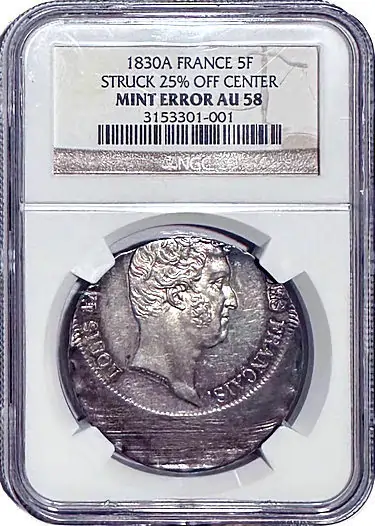
This remarkable coin carries the portrait of King Louis-Philippe. Yet it also carries something far more dramatic. The Paris Mint struck it 25% off center. That means the dies hit the silver planchet far away from the proper center point.
As a result, part of the design never reached the coin. That visual drama now makes the piece one of the most important world mint errors known.
Even more important, Mint Error News describes this coin as unique. Major off-center errors on crown-sized silver coins almost never appear. Crowns, talers, 5 francs, 5 marks, and pesos all fall into that large-size category. Only a few major off-center examples from these formats survive today.
What Is an Off-Center Strike?
An off-center strike happens when the planchet does not sit correctly between the dies at the moment of striking. Then the press comes down. The dies strike only part of the blank. Therefore, part of the design appears, while part of the planchet remains blank.
PCGS notes that a true off-center strike must miss part of the design. If the full design still appears on the coin, then the coin does not qualify as an off-center strike. Collectors describe these errors by percentage. For example, a 20% off-center coin shows about 20% blank planchet. A 50% off-center coin shows about half blank planchet.
This French 5 francs shows a major 25% shift. That percentage gives the coin strong visual appeal. It also leaves enough of the design to identify the date, type, and historical context.
That balance matters. Collectors want drama. However, they also want identity. This coin delivers both.
The First Year of Louis-Philippe’s Coinage
The year 1830 changed France.
The July Revolution forced Charles X from power. Soon after, Louis-Philippe became king of the French. His reign lasted from 1830 to 1848. Britannica notes that his government rested heavily on the support of the upper bourgeoisie. History remembers him as the “Citizen King.”
That background gives this 1830 5 francs extra power.
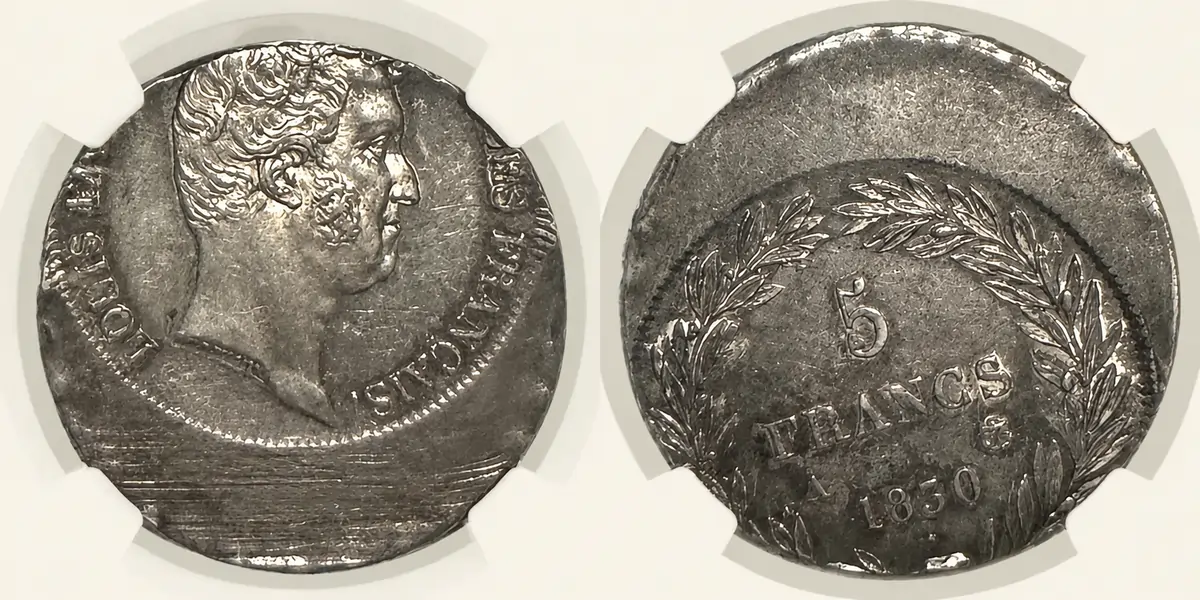
This coin does not come from the middle of a long, settled reign. Instead, it comes from the first year of a new monarchy. France had just changed rulers. The country had just redefined its political direction. Then, at the Paris Mint, this silver 5 francs left the press in spectacularly wrong form.
The timing raises an intriguing question. Was this an accident? Or did someone at the Mint create and save it as a pièce de caprice?
Mint Error News raises that possibility because the coin comes from the first year of the Louis-Philippe design. A pièce de caprice refers to a whim or special curiosity rather than a normal production piece. Still, no record proves intent. Therefore, the safest conclusion keeps both possibilities open. The coin may represent a mint accident. Or it may represent a deliberately saved curiosity from a moment of political transition.
Either way, someone valued it from the start.
Saved, Not Spent
That point matters.
A 25% off-center silver 5 francs should not have survived ordinary circulation. A teller, merchant, or Mint worker likely would have noticed it right away. The size alone would have made the error hard to miss. The missing design made it impossible to ignore.
Yet the coin survived for almost 200 years.
NGC graded the piece AU 58. That grade places it just below Mint State. Mint Error News suggests the grade may reflect its use as a pocket piece rather than true commercial wear. In other words, someone may have carried it as a curiosity, keepsake, or conversation piece.
That explanation fits the coin’s story. A normal coin enters commerce. A special coin enters memory.
This one appears to have entered memory almost immediately.
Why Large Off-Center World Coins Matter
Collectors see many off-center Lincoln cents. They also see modern off-center nickels, dimes, and quarters. These errors still attract interest. However, they come from a world of high-speed production and massive mintages.
Large 19th-century silver world coins tell a different story.
Mints handled crown-sized silver coins with more care. The metal carried meaningful value. The coins also received greater scrutiny. As a result, major errors usually never left the Mint. Workers caught them. Officials melted them. Or the pieces disappeared into institutional channels.
That is why this 1830 French 5 francs stands out.
It combines size, silver, age, history, and a major striking error. It also links directly to the first year of Louis-Philippe’s reign. Few world errors offer that much context in one object.
The Closest Comparison: An 1897-A Dominican Republic Peso
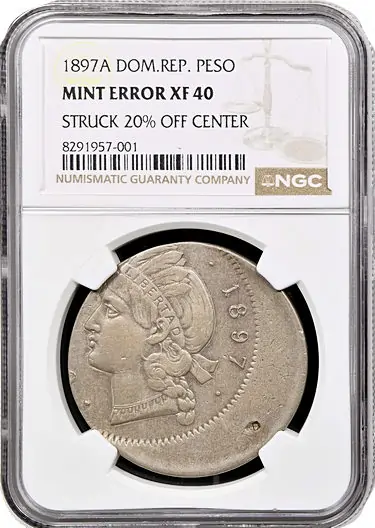
Mint Error News points to one close comparison. Stack’s Bowers sold an 1897-A Dominican Republic Peso struck 20% off center in its January 16, 2026 auction. NGC certified that coin EF-40. Mint Error News reports the sale at $15,600. NumisBids lists the same lot, Stack’s Bowers lot 41053, with a $13,000 realized price, which appears to reflect the hammer price before buyer’s premium.
That peso also came from a major crown-sized format. It also retained key identifiers, including its date and mintmark. NumisBids described it as a rare and prominent Philadelphia Mint error struck from dies engraved in Paris.
Even so, the French 5 francs goes further. It is older. It dates to a regime change. It shows a larger off-center percentage. And according to Mint Error News, it stands alone as a unique survivor.
A Coin With the “Wow” Factor
Great error coins do more than show a mistake. They freeze a moment that should not have survived.
This 1830 French 5 francs does exactly that.
It began life at the Paris Mint during a year of revolution, replacement, and reinvention. It carried the portrait of a new king. Then the press struck it off center, giving it a second identity. A normal silver coin became a witness piece.
That is the magic here.
The coin tells two stories at once. One story belongs to France and Louis-Philippe’s July Monarchy. The other belongs to the Mint floor, where one misaligned planchet created a world-class rarity.
Nearly two centuries later, collectors can still see that split-second mistake in silver. That survival gives this coin its power. It is not only a French 5 francs. It is a royal-era error with a backstory that refuses to fade.
My question is how rare both coins are. How many pieces of each still exist? A fella wants to know if he has a chance at getting one. Ok, getting one is basically a fantasy but can you blame me!
Nice way of collecting foreign minors.