A rare bronze window into James Earle Fraser’s 1913 Buffalo nickel
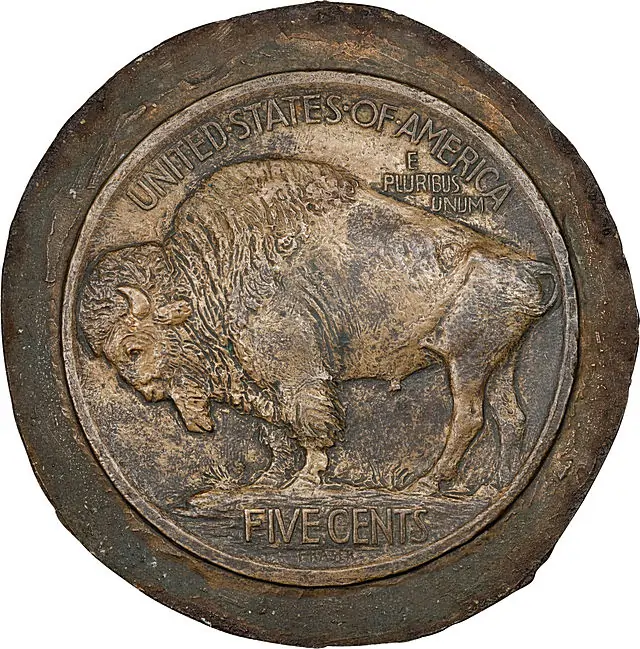
Stack’s Bowers Galleries sold a remarkable bas-relief bronze galvano of James Earle Fraser’s reverse design for the 1913 Buffalo nickel for $180,000 during its Spring 2024 Auction, Session 4: Rarities Night.
The piece carries major importance. Stack’s Bowers described it as believed unique. In addition, the firm noted that it had never before handled a galvano of either the obverse or reverse of Fraser’s famous Buffalo nickel design.
For advanced Buffalo nickel collectors, that point matters. This piece does not simply relate to the coin. It reaches into the workshop stage of one of America’s most beloved coinage designs.
A Bronze Model From the Birth of the Buffalo Nickel
The galvano measures 101 mm in inner diameter. It also has an irregular border of about 25 mm. At its thickest point, it measures about 4 mm. The piece weighs 247.17 grams.
Its format gives it a striking physical presence. It looks less like a production tool and more like a sculptural artifact. Yet it connects directly to the development of the Buffalo nickel, first issued in 1913.
Stack’s Bowers compared its size and execution to another major artistic relic: the bas-relief bronze cast of Hermon A. MacNeil’s approved obverse design for the 1916 Standing Liberty quarter. That Standing Liberty quarter cast appeared in the firm’s March 2013 Baltimore Auction, as lot 2042.
However, one key difference stands out. The Standing Liberty quarter cast carried a nickel or similar plating. This Buffalo nickel galvano did not. Instead, its bronze surface shows a deep natural character.
The Backstory: Fraser Kept Control
James Earle Fraser did not leave his nickel design to chance. That fact gives this galvano its “wow” factor.
Numismatic researcher Roger W. Burdette, in his 2007 reference Renaissance of American Coinage 1909-1915, argued that Fraser’s Buffalo nickel stayed closer to the artist’s original concept than any other U.S. Mint coin design from the 1907-1921 period.
That outcome did not happen by accident. Fraser prepared his early models with great care. Then he defended the core of his design with unusual force. As a result, the finished coin retained more of his original artistic vision.
Fraser also gained an advantage by working with the Medallic Art Company. That private firm handled all except the final reductions and hubs from his designs. Therefore, Fraser avoided deeper reliance on the Mint’s Janvier reducing lathe and on Mint staff who lacked full training for that work.
Chief Engraver Charles E. Barber still cut the final pair of hubs used to make production dies. Yet by that stage, Fraser and Medallic Art had already set the artistic standard. Barber had little room to alter the design.
That backstory turns this bronze galvano into more than a pattern-related object. It represents a moment when the sculptor still held the reins.
Close to the Coin, But Not the Coin
At first glance, the galvano looks very close to the final reverse design used on 1913 Type I Buffalo nickels. A casual viewer might even think the two designs match exactly.
However, the details tell a deeper story.
The similarity creates a challenge for researchers. Burdette noted that Fraser’s original concept and the finished coin stayed very close. So, placing this galvano on the exact production timeline requires careful study.
A possible clue appears in Burdette’s discussion of a model that he tentatively dated to November 1912 or February 1913. On that model, the bison’s forelegs stand on higher ground than the rear legs. This galvano shows that same design feature.
That detail points toward a likely date around 1912.
The Bison on Higher Ground
The galvano’s reverse shows the bison with its forelegs placed on higher ground. Stack’s Bowers highlighted that feature in the lot description.
Burdette also illustrated two additional reverse designs attributed to 1912 on pages 232-233 of his reference. This galvano appears closer to the second of those designs.
Several details support that conclusion. The bison’s left foreleg shows less fine detail than some earlier versions of Fraser’s work. Also, both the head and tail sit very close to the rim.
Meanwhile, the field has fine texture. It suggests prairie grass and gives the design a rugged American feel. That rustic texture drew praise at the time. In addition, the earliest Buffalo nickels struck by the Mint carried a similar finely textured look.
Why the FRASER Signature Matters
One feature separates this galvano from the final coin design. The artist’s name, FRASER, appears prominently at the lower border below FIVE CENTS.
The final Buffalo nickel reverse does not show the signature in that position. Burdette’s pictured models and patterns also do not show it there.
That placement gives researchers an important clue. Stack’s Bowers suggested that Fraser likely made the galvano for evaluation by himself, the Medallic Art Company, or others involved in the design process. The piece likely did not serve as a direct production model for dies.
That distinction adds to its appeal. It may show Fraser’s thinking before the final compromises of coinage production.
Surface, Color, and Condition
The bronze has rich natural toning. Stack’s Bowers described a mix of antique gold, olive, and steel hues on the front. The back shows an overall reddish cast, along with raised rough areas made during production.
With patience, faint outlines of the design appear on the reverse side. The edge also shows roughness and other irregularities. These features appear original to the making of the piece.
Importantly, Stack’s Bowers saw no obvious post-production damage. The design rises in medium relief. It remains fully visible, attractive, and highly sculptural.
The result delivers a rustic look that fits the subject. This is a bronze bison with frontier weight, not a polished souvenir.
A Trophy for Buffalo Nickel Specialists
Original casts and galvanos for U.S. coin designs rarely enter private hands. This piece ranks among the few available to collectors.
Stack’s Bowers called it likely unique. Even if another example existed somewhere, the firm indicated that this piece almost certainly stands alone in private collecting circles.
That rarity explains the strong interest. Buffalo nickel specialists, pattern collectors, and American art enthusiasts all had reason to compete for it.
The final price of $180,000 reflects that broad appeal. It also reflects the object’s unusual place in numismatic history.
A Survivor From the Design Room
The Buffalo nickel has become one of the most recognizable American coins. Yet collectors usually encounter the design only as a finished five-cent piece.
This galvano brings the story back to the beginning.
It shows Fraser’s bison before mass coinage flattened the romance into pocket change. It also reminds collectors that America’s coinage renaissance did not unfold only inside the Mint. Artists, private firms, and strong personalities shaped the final results.
For that reason, this bronze galvano stands as both a numismatic rarity and an American art object. It captures a critical step in the creation of the 1913 Buffalo nickel. More importantly, it preserves the moment when Fraser’s vision still lived in full sculptural form.