


A Great Early Half Dollar Rarity
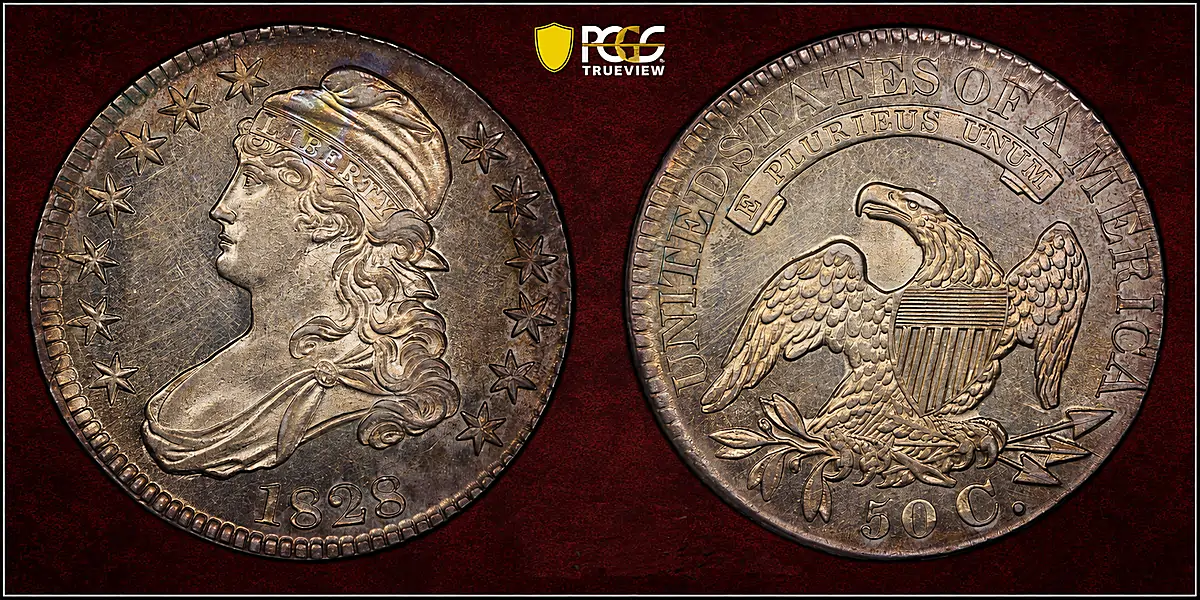
An 1828 Capped Bust Half Dollar with extraordinary proof status sold for $192,000 in Stack’s Bowers Galleries’ August 2023 Global Showcase Auction, Session 6, Rarities Night.
The coin, graded Proof-58 by PCGS, carries the attribution Overton-118a. It shows the Square Base 2, Small 8s, Large Letters design combination. More importantly, Stack’s Bowers describes it as unique as a Proof.
That claim gives the coin its headline power. As of the 2023 offering, this specimen stood as the only Proof 1828 half dollar of any Overton variety certified by PCGS or NGC. It also stood as the only example positively confirmed as a Proof in the modern market.
A Proof Coin Hiding in a Circulation-Strike World
Most 1828 Capped Bust Half Dollars survive as circulation strikes. This coin tells a different story.
Stack’s Bowers had handled the piece before. The firm last offered it in its October 2006 sale of the famous George “Buddy” Byers Collection of United States Half Dollars. At that time, the coin already carried a major reputation. Walter Breen had mentioned the specimen in his Proof Encyclopedia. However, Breen called it “unverified” because he had not examined it in person.
The coin itself makes a stronger argument.
Its fields show the deep reflectivity expected of a Proof. In addition, its devices display clear frost. That contrast gives the coin the visual character that specialists seek in early Proof coinage.
Yet the coin also shows a small but fascinating Mint-made clue. The coiner did not fully polish the field between the eagle’s neck and its left wing. As a result, that area shows frost like the raised devices. This detail gives collectors a rare look at the way early Mint preparation could vary from one small surface area to another.
That unfinished patch adds real drama. It turns the coin into more than a rarity. It becomes a surviving record of the coiner’s hand.
The Diagnostics Make This Coin Unmistakable
Stack’s Bowers recorded several important identifiers for the coin.
First, the piece shows a splash of lemon-yellow color on Liberty’s cap. Then, darker russet-gold toning appears near the rims. Bright steel color fills other portions of the surfaces.
Also, the strike sits about 1% off-center toward the one o’clock position. Because of that shift, the denticles disappear in that area.
In addition, a tiny planchet flaw appears on the border between the first two stars. This small marker further helps identify the coin.
The reverse tells its own story. The die shows an encircling crack through the legend and denomination. That crack adds another diagnostic feature. It also gives the coin more personality.
Together, these traits create a detailed fingerprint. Therefore, future researchers can track the coin with confidence.
Why the Overton-118a Proof Matters
The coin carries the Overton-118a attribution. Stack’s Bowers noted that this piece may represent the only example from these dies with Proof surfaces. Other reported examples from the die pairing appear as circulation strikes.
That distinction matters.
A prooflike surface alone does not make a coin a Proof. Specialists look for a combination of preparation, reflectivity, device frost, striking quality, and overall fabric. This example met that test for Stack’s Bowers and for PCGS.
Another Proof 1828 half dollar has appeared in the numismatic literature. That coin carried the O-113 die pairing and appeared in the Norweb Collection, Part III, sold by Bowers and Merena in November 1988 as lot 3092. It realized $3,190.
However, the modern census paints a much tighter picture.
Breen once reported four to six Proof 1828 half dollars. Later, in his Complete Encyclopedia, he raised the reported total to eight to 10, combining all varieties. Stack’s Bowers cautioned that those totals likely included duplicate appearances and coins that today’s stricter standards would not recognize as Proofs.
That point carries weight. If many true Proof 1828 half dollars existed, major cabinets would likely have contained one. Yet the date did not appear in the famous Pittman, Eliasberg, or Garrett collections.
That absence speaks loudly.
A Coin Built for a World-Class Cabinet

Great coins often combine rarity, surface quality, history, and traceable ownership. This 1828 Capped Bust Half Dollar checks every box.
It has the format collectors love. It belongs to the classic Capped Bust Half Dollar series. It has a major die attribution. It also has a dramatic proof-status story that continues to invite study.
Most importantly, it carries a known ownership trail.
Stack’s Bowers offered the coin from the Legacy Collection. Earlier, it appeared in the firm’s sale of the Winner F. Delp Collection in November 1972, lot 72. Then it appeared in the Stack’s sale of the Dr. George F. Oviedo, Jr. Collection of U.S. Half Dollars in September 1983, lot 804. Later, Stack’s offered it again in the George “Buddy” Byers Collection of U.S. Half Dollars in October 2006, lot 1071.
The Delp and Oviedo lot tags accompanied the coin.
That provenance matters. It anchors the coin in respected collections across more than half a century. It also helps confirm its identity through multiple major sales.
The $192,000 Result Confirms the Market’s Verdict
The $192,000 price reflects more than grade. It reflects status.
Collectors had a chance to pursue the only PCGS- or NGC-certified Proof 1828 half dollar known for the date. They also had a chance to own a coin that Stack’s Bowers called the only positively confirmed Proof 1828 half dollar in the 2023 market.
That kind of opportunity rarely appears.
Early Proof United States coins already command deep interest. However, a unique Proof Capped Bust Half Dollar with this level of documentation reaches another level. It belongs in the front rank of early federal silver rarities.
In the end, the coin delivers the “wow” factor in a quiet but powerful way. It does not need a dramatic mintage figure. It does not need a famous error. Instead, it offers something better: a single known survivor, a visible record of early Mint preparation, a celebrated provenance, and a place in the ongoing debate over America’s earliest Proof coinage.
For advanced collectors, that combination creates the real prize.



I have 1828 half cent but need this one.
I have old money papers and coins for sale
Wow. Coin-collecting -and this website- so great for history buffs!
‘m Broke! Dabbnabbit!
Great story for this coin. And an amazing value.
Very interesting article on the 1828 Capped Bust Half Dollar.
This 1828 Proof Half Dollar is a real beauty and would be prized by every collector of U.S. Coins!!!