


Before the Morgan Dollar: The Unique 1877 Half Dollar Pattern
A great coin sometimes tells collectors what came next. The 1877 Pattern Morgan Half Dollar, Judd-1520, does exactly that.
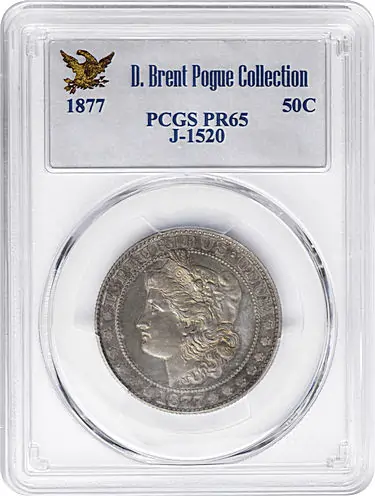
This unique silver pattern appeared in Stack’s Bowers Galleries’ March 2020 offering of The D. Brent Pogue Collection Part VII: Masterpieces of United States Coinage. The coin carried a $50,000 to $70,000 estimate. Then bidders pushed it to $96,000. That result made sense. This coin does not merely belong to the famous 1877 Morgan half dollar pattern series. It stands alone as the only known silver Judd-1520. Stack’s Bowers’ archive confirms the Judd-1520, Pollock-1684 attribution, PCGS Proof-65 grade, March 2020 sale context.
A Morgan Dollar Portrait Before the Morgan Dollar
The wow factor starts with the date: 1877.
George T. Morgan’s silver dollar did not enter regular production until 1878. Yet this pattern half dollar already carried the Liberty portrait that collectors now link to the Morgan dollar. In other words, Judd-1520 shows the famous Morgan Liberty before she became one of the most recognized images in American numismatics.
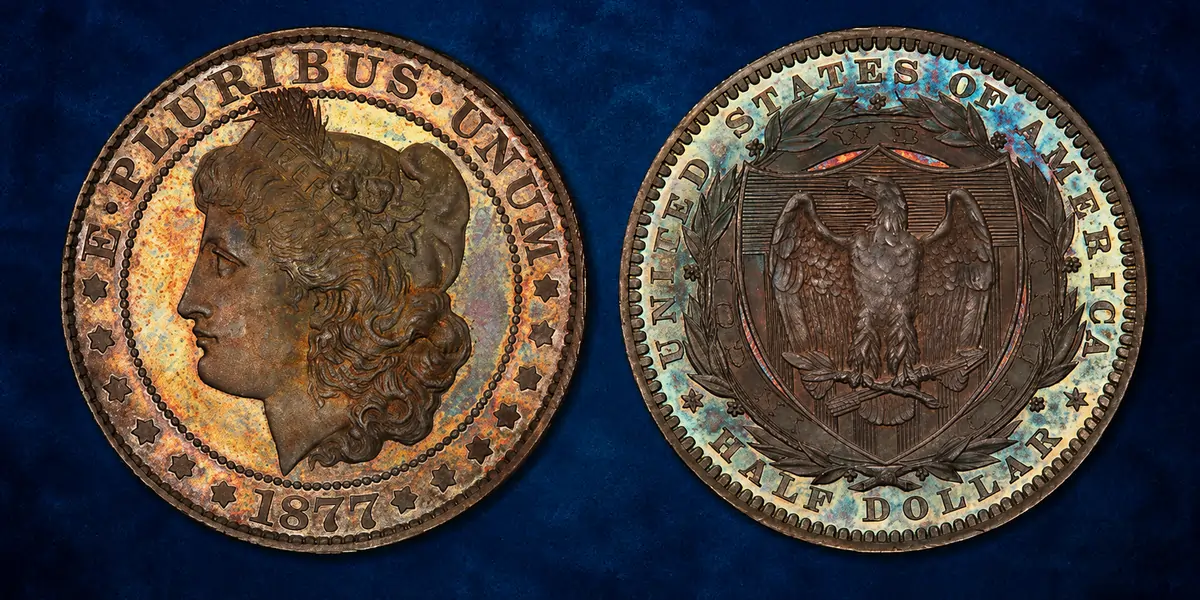
Stack’s Bowers describes the obverse as a left-facing Liberty head inside a beaded circle. The motto E PLURIBUS UNUM runs along the upper border. The date 1877 sits below. Thirteen stars fill the border between the motto and date, with six stars on the left and seven on the right.
Liberty wears a cap. Morgan enriched the cap band with ears of wheat, cotton leaves, and cotton bolls. Those agricultural symbols gave the portrait a distinctly American character. They also helped separate Morgan’s Liberty from older classical traditions.
The connection to the later dollar adds major importance. Stack’s Bowers’ own Morgan dollar reference lists George T. Morgan as the designer and gives the regular Morgan dollar issue dates as 1878-1904 and 1921. It also notes that the Philadelphia Mint enlisted Morgan to create a new silver dollar design after the Bland-Allison Act of 1878.
A Reverse Built Around Power and Union
The reverse gives this unique pattern its own personality.
An eagle appears on a spade-shaped shield. The bird clutches three arrows in its left talon and an olive branch in its right. The shield partially overlaps a band that carries the motto IN GOD WE TRUST.

A laurel wreath surrounds the central device. The legend UNITED STATES OF AMERICA appears above. The denomination HALF DOLLAR appears below.
This reverse creates a striking contrast with the familiar Liberty portrait. The obverse points forward to the Morgan dollar. The reverse stays rooted in the experimental spirit of the pattern room. Together, the two sides show the Mint testing ideas, themes, and national symbols before choosing designs for regular coinage.
[IMAGE PLACEHOLDER]
Why Judd-1520 Ranks Among the Great 1877 Morgan Half Dollars
For pattern specialists, the 1877 Morgan half dollar series has long held “Holy Grail” status. The reason comes down to artistry, history, and rarity.
Many collectors consider Morgan’s designs among the most beautiful of the era. Also, the series documents Morgan’s early American work at the Mint. According to the Stack’s Bowers catalog, research by R.W. Julian confirms that this obverse represents the first of four half dollar obverse dies that Morgan prepared. The patterns themselves came from February 1877. PCGS also summarizes Julian’s research and states that Morgan produced the first of the four Morgan dies of 1877 in February of that year.
That timing matters. The coin sits at the beginning of Morgan’s American legacy. It predates the Morgan dollar by one year. Yet it already contains the portrait that would define a generation of silver dollars.
Specimens that combine this Liberty obverse with the spade-shaped shield reverse rank as major rarities. Stack’s Bowers reports that only three or four copper impressions exist under Judd-1521. One of those copper pieces appeared as lot 4224 in Stack’s Bowers’ March 2012 sale of the Samuel J. Berngard Collection.
The silver Judd-1520 offered from the Pogue cabinet stands higher still. The Pollock reference, the 10th edition of Judd, and uspatterns.com all confirm it as unique, according to the Stack’s Bowers catalog description.
A Gem With Original Color and Strong Eye Appeal
The coin also brings exceptional quality.
PCGS graded it Proof-65. Stack’s Bowers described it as a wonderfully original Gem. The obverse shows blended olive, pearl gray, and rose-russet patina. Meanwhile, the reverse displays antique gold and steel-olive color at the periphery around a mauve-gray center.
Direct light adds more drama. The catalog notes champagne-pink, powder blue, and pale gold undertones. Those colors matter because advanced pattern collectors often prize originality. They want coins that show age, care, and stable surfaces.
The finish adds another layer. Stack’s Bowers noted a modest cameo effect, although PCGS did not mention cameo contrast on the holder. The fields show semi-reflective character. The devices show frosty texture and sharp impression.
As a result, the coin offers more than rarity. It also delivers the visual presence that collectors expect from a trophy pattern.
[IMAGE PLACEHOLDER]
A Provenance That Runs Through Elite Cabinets
The ownership chain gives Judd-1520 even more weight.
The provenance begins with George W. Cogan on March 17, 1883. Then the coin passed to T. Harrison Garrett. It descended to Robert Garrett and John Work Garrett in 1888. Robert Garrett’s interest passed to John Work Garrett in 1919, with the transfer completed in 1921.
John Work Garrett later gave the coin to Johns Hopkins University in 1942. Bowers and Ruddy then offered it in the Garrett Collection sale for Johns Hopkins University, Part I, in November 1979, as lot 386.
After that landmark appearance, the coin passed through Ken Goldman, D. Novoselsky, and Kagin’s. It later appeared in Superior’s Elite Coin Auction of July 2003, lot 462. Finally, it entered the D. Brent Pogue Collection, one of the great modern cabinets of United States coinage.
That chain matters. Great patterns often travel from one serious cabinet to another. Judd-1520 did exactly that for more than a century.
From Garrett to Pogue: A Coin With Institutional Gravitas
Stack’s Bowers last offered this coin, as Bowers and Ruddy, in November 1979 as part of the Garrett Collection. Its return in the Pogue Collection gave collectors another rare chance to pursue it.
That gap underscores its importance. Unique coins do not follow normal market rhythms. They appear when major collections form, mature, and finally disperse. Therefore, the 2020 offering represented more than an auction lot. It marked a generational opportunity.
The coin’s $96,000 result reflected that reality. It surpassed the $50,000 to $70,000 estimate and confirmed collector demand for elite Morgan-related patterns.
Why This Pattern Still Captures Collectors
Collectors chase this coin for three clear reasons.
First, it connects directly to George T. Morgan’s most famous design. The Morgan dollar became one of the most collected United States coin series. Stack’s Bowers notes that high mintages and large numbers preserved in Uncirculated condition helped make Morgan dollars a longtime favorite with numismatists.
Second, Judd-1520 offers true uniqueness. Many rare coins exist in small groups. This silver striking stands alone.
Third, the coin has a museum-level pedigree. Cogan, Garrett, Johns Hopkins, Bowers and Ruddy, and Pogue all belong to the story. That kind of provenance gives collectors confidence. It also adds romance.
The CoinWeek Takeaway
The 1877 Pattern Morgan Half Dollar, Judd-1520, deserves attention far beyond the pattern community.
It shows George T. Morgan working out the face of Liberty before the Morgan dollar reached the public. It combines experimental design, Gem Proof quality, unique rarity, and a provenance that touches some of America’s greatest numismatic names.
Most importantly, it reminds collectors that pattern coins often preserve the “what might have been” moments of United States coinage. Judd-1520 does more. It preserves the moment before one of America’s most famous silver coins found its face.





Very interesting
I like this pattern. The reverse design is quite bold and attractive.
I like everything about this coin.
Very informative article on the 1877 Morgan Half Dollar.