

The Secret Service Thought It Was A Fake
The 1969-S Doubled Die Lincoln Cent stands among the most dramatic modern U.S. Mint errors. It also carries one of the strangest backstories in American numismatics.
At first, federal agents treated it as a counterfeit.
Today, collectors treat it as a trophy.
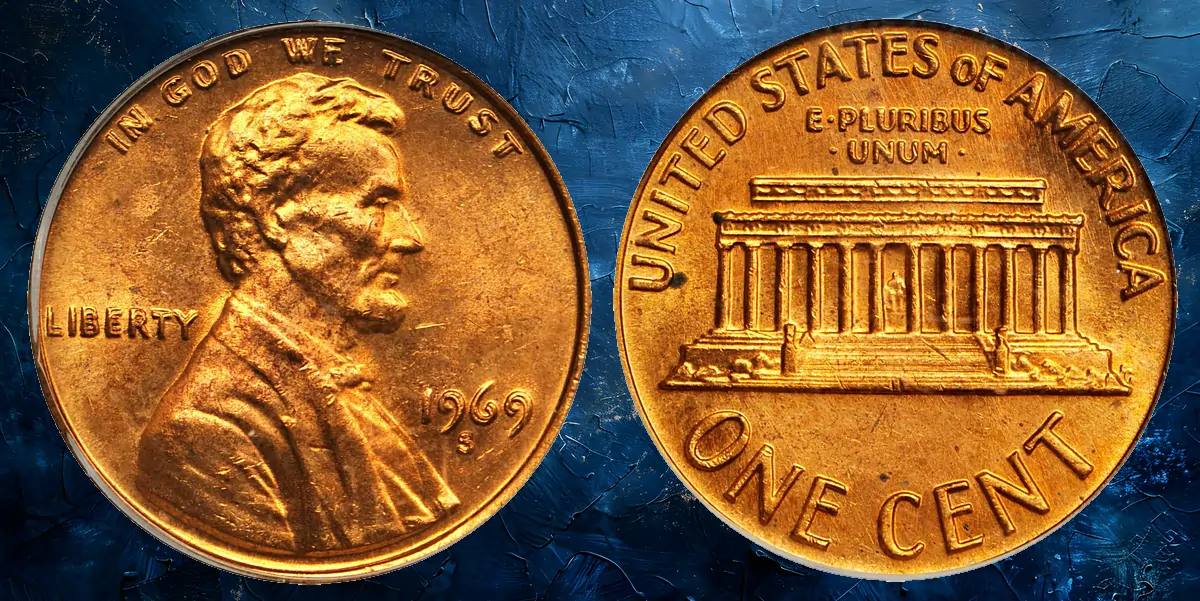
That transformation explains why the 1969-S Doubled Die Obverse, FS-101, ranks as one of the most coveted Lincoln cents of the Memorial reverse era. It also explains why a Choice Red example can command five and six figures when it reaches the auction market.
A Red 1969-S Doubled Die Cent With Elite Appeal
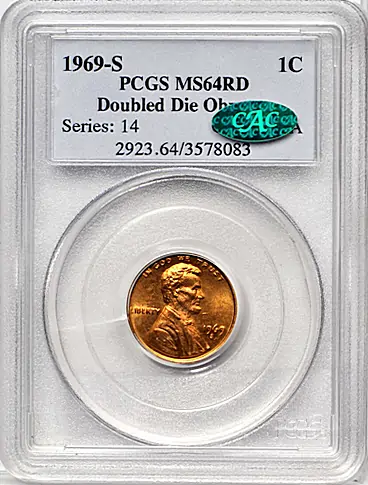
Stack’s Bowers Galleries offered a major example in its March 2018 Baltimore Rarities Night sale. The coin came from the ESM Collection and carried the grade MS-64 RD from PCGS, with CAC approval.
It sold for $126,000.
At the time, Stack’s Bowers described the coin as tied for the finest certified at PCGS. The auction house also called it an “extraordinarily rare” 1969-S Doubled Die Obverse Lincoln Cent.
The piece showed strong Red color, warm medium-orange luster, and only tiny marks. In addition, its eye appeal gave advanced Lincoln cent collectors a rare chance at a Registry-quality coin.
That same coin had appeared earlier in Stack’s Bowers’ November 2010 Baltimore Auction, where it sold as lot 1264.
However, the population picture has changed since 2018. PCGS now records higher Red examples, including an MS66RD coin and an MS64+RD coin. Even so, the 2018 MS64RD CAC cent remains a major condition rarity.
Why the 1969-S Doubled Die Is So Famous
The 1969-S Doubled Die Obverse does not require imagination. The doubling leaps off the coin.
Collectors can see dramatic separation on the date. They can also see bold doubling on LIBERTY and IN GOD WE TRUST. As a result, the variety belongs in the same visual class as the famous 1955 and 1972 Doubled Die Obverse cents.
Yet the 1969-S is far rarer.
Stack’s Bowers has estimated 40 to 50 examples from combined certification data. However, the firm also noted that PCGS experts have suggested a lower figure of about 30 known coins. PCGS CoinFacts states that fewer than 100 authentic examples likely were produced.
That tiny survival pool makes every certified example important. Red Mint State coins sit at the top of the demand curve.
The Secret Service Backstory
Here is were the story gets interesting.
The 1969-S Doubled Die Lincoln Cent became tangled in a federal counterfeiting case before the hobby fully understood it.
In 1969, Roy Gray and Morton Goodman produced fake 1969 doubled die Lincoln cents. Their counterfeits drew the attention of the United States Secret Service. The case involved counterfeit dies, fake coins, and a major federal investigation.
Then, in 1970, collectors Cecil Moorhouse and Bill Hudson discovered genuine 1969-S Doubled Die Obverse cents. Walter Breen later noted that two collectors independently reported the variety in June and July of that year.
The timing could not have been worse.
Because agents were already chasing fake 1969 doubled die cents, they viewed the newly found 1969-S pieces with suspicion. The Secret Service seized examples and treated them as counterfeits. PCGS reports that some genuine coins were ordered destroyed before the government accepted the San Francisco Mint variety as authentic.
Once experts confirmed the truth, federal agents returned remaining coins to their owners.
That mistake helped create the legend. It may also have reduced the number of survivors.
How to Identify a Genuine 1969-S Doubled Die
A genuine 1969-S Doubled Die Obverse shows strong hub doubling. It does not show simple strike damage.
The strongest doubling appears on:
- The date 1969
- LIBERTY
- IN GOD WE TRUST
However, the “S” mintmark should not show true doubled die doubling. In 1969, the Mint punched the mintmark into the working die after the hubbing process. Therefore, the mintmark did not receive the same doubled image as the lettering and date.
This point matters.
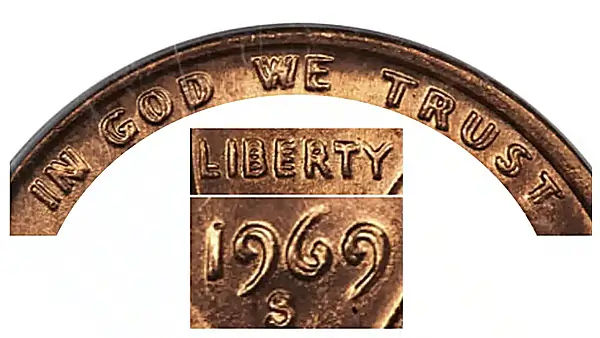
Many 1969-S cents show machine doubling. That doubling can affect the mintmark. However, machine doubling comes from die movement during striking. It adds little or no premium.
So, collectors should not buy a raw 1969-S cent as a Doubled Die Obverse without expert authentication. PCGS, NGC, or CACG certification offers essential protection.
A Modern Rarity With Classic-Coin Energy
The 1969-S Doubled Die Cent sits in a special place in the Lincoln series.
Collectors know the 1955 Doubled Die Obverse. They also know the 1972 Doubled Die Obverse. In addition, specialists pursue earlier and later Lincoln doubled dies, including varieties from 1909 V.D.B., 1917, 1936, 1943, 1958, 1970-S, 1983, 1984, and 1995.
Still, the 1969-S brings something different.
It combines naked-eye drama, extreme rarity, federal seizure, and modern-market power. That mix explains why Scott Schechter and Jeff Garrett ranked it #2 in 100 Greatest U.S. Modern Coins.
It also explains why the variety has never lost its hold on collectors.
Market Strength for Red Examples
The 2018 Stack’s Bowers MS64RD CAC example sold for $126,000. That result showed the strength of top Red examples at the time.
More recently, GreatCollections sold a PCGS MS64RD example on September 21, 2025, for $70,312.50, including the buyer’s fee. That coin drew 28 bids.
Meanwhile, the finest PCGS Red example has reached a different level. The Stewart Blay Red Copper Collection coin, graded PCGS MS66RD with CAC approval, sold through GreatCollections in January 2023 for $601,875.
Those results show the coin’s broad market range. They also show how color, grade, surface quality, and provenance can transform price.
Why Collectors Still Chase It
The 1969-S Doubled Die Lincoln Cent remains a dream coin because it feels discoverable.
Unlike many classic rarities, it began as a modern pocket-change coin. It emerged from rolls. It appeared at a time when collectors still searched cents by hand. Even today, the story tempts every roll hunter who sees a 1969-S cent.
That possibility drives the legend.
Yes, the odds remain long. However, genuine examples have surfaced from circulation, rolls, and collections. Therefore, the 1969-S Doubled Die Obverse still carries one of the most powerful ideas in numismatics:
A one-cent coin can become a major rarity.
For advanced Lincoln cent specialists, the 1969-S Doubled Die Obverse is not just another variety. It is the Memorial cent that fooled the Secret Service, survived the government’s mistake, and became one of the great modern trophies of U.S. coin collecting.
Coin Specifications
- Year: 1969-S
- Denomination: Lincoln Cent
- Mint: San Francisco
- Variety: Doubled Die Obverse
- FS Number: FS-101
- Obverse Designer: Victor David Brenner
- Reverse Designer: Frank Gasparro
- Composition: 95% copper, 5% zinc
- Weight: 3.11 grams
- Diameter: 19 mm
- Edge: Plain
- Strike: Business Strike
- Featured Example: PCGS MS-64 RD, CAC
- Provenance: ESM Collection; earlier Stack’s Bowers Baltimore Auction, November 2010, lot 1264
- Auction Result: Stack’s Bowers March 2018 Baltimore Rarities Night, lot 2148, sold for $126,000
It always amazed me that error coins are worth so much.
I’ve searched rolls for years now trying to find this unicorn. Still searching. Side note, in 1955 my great grandfather had yet to become a coin collector, but he did find a 1955 Lincoln cent that didn’t look right to him, he put it away in his desk drawer, time passes and my great grandmother needs change to buy a stamp off the mailman, you can see where this story leads. In Later years my great grandfather does take interest in coin collecting, and after it’s gone, later learns what he discovered in 1955. He wasn’t to upset with his wife, but he did say that paying $22 years later for a replacement did upset him. We still have his replacement coin. It’s raw still. My amateur grading puts it AU 50 ish. I’m sure what he had was a beautiful coin in its day.
One was found where I live and I got to see the coin close up
I never knew there was a doubled die that year
I’d love to own a doubled-die Lincoln of any of the years they occurred. Iconic pieces!
nice
Thanks for the interesting article.
I don’t suppose I have much of a chance of getting one of these in change.
Pulled out my Whitman penny folder from my childhood. Mine is not double die, darn.
Been roll searching for 25 years and have yet to find one but, I have found a handful of the machine doubling type. Just toss them into a bucket of pre ‘82 cents that I will revisit someday. Great article.
Thanks again for a great Lincoln Cent coin and article!
Very interesting, indeed !
Still hiding in grandpas’ garage in a jar somewhere.
I never knew about this double die. Very interesting article
Looks like it’s time to empty my jars of copper cents and search through them again! I was previously unaware of this error!
Hope springs eternal, maybe I’ll find a rarity yet
What a beautiful error
Nice one cent coin to have. Good luck on the coin giveaway everybody!
It would be crazy to find one of these in a roll that had just been put away by someone back in the day without knowing to look for this rare error!
Sweet!
I generally don’t have the eyes to spot errors anymore but I think I could see this one, I’d probable grab a counterfeit one!
I didn’t realize that the S mintmark wasn’t also doubled, but that would stand to reason given that they were hand-stamped during that time.
Cool story with the Secret Service involvement. I’d love to have a doubled die penny or any other coin.
Interesting story!
Yes, information is interesting about the pennies out there? Had
Heard of a few, didn’t know that many existed will be watching for
A few more?
Very Nice Article.
I have a Weimar-era German pfennig with doubling as dramatic as the 1955 Lincoln. Upon closer inspection, there is clear evidence of a third strike from the hub, making it a triple die. Unfortunately, I have not found any information about it, even from some German dealers I’ve met at coin shows. Foreign errors don’t seem to generate much enthusiasm.
Legend in the coin world
love the backstory
Errors have always fascinated me. I have discovered only one major error in my life. The feeling of the “find” is an exhilarating event. The knowledge that errors are “out there” (somewhere) keeps me looking . . . . Thank you for the article.
Thank you for another interesting piece of coin history.
Neat!
I looked for one for years with no luck.. Great double die!
Been looking for a long time without luck.