


Stack’s Marketplace Offers a PCGS MS-65+ CAC Carson City Morgan Dollar
The 1891-CC Morgan Silver Dollar tells a very different Carson City story.
At first glance, the mintage looks generous. The Carson City Mint struck 1,618,000 examples. However, that number does not explain today’s market.
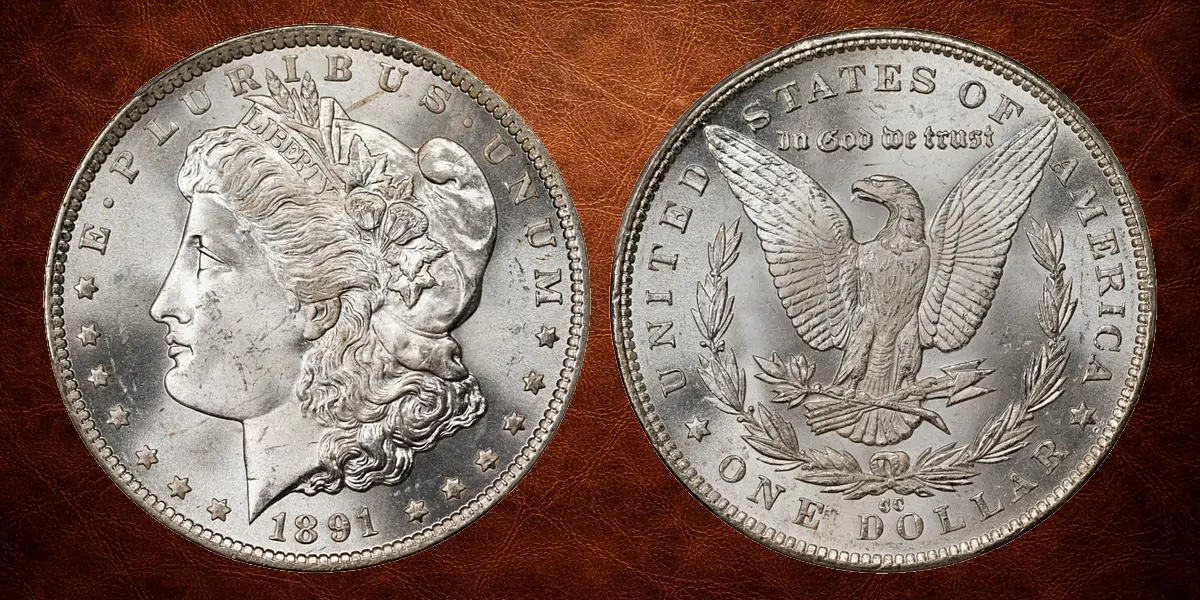
Stack’s Marketplace lists an 1891-CC Morgan Silver Dollar graded MS-65+ by PCGS with CAC approval. The coin carries a $10,500 asking price and entered the marketplace on June 4, 2026.
For Morgan dollar collectors, those details matter. This coin combines the legendary “CC” mintmark, a Gem-plus grade, and CAC approval. Moreover, it represents one of the more deceptive Carson City dates in Mint State.
The Carson City Backstory Still Drives Demand
No mintmark in the Morgan dollar series creates more emotion than “CC.”
Congress established the Carson City Mint to serve the coinage needs of the Comstock Lode. That silver strike transformed Nevada. It also changed American coinage.
The mint opened for coinage in 1870. In fact, the first coins struck there carried the “CC” mintmark on Liberty Seated Dollars. Later, Carson City became forever linked with the Morgan dollar.
That link still shapes the market today. Philadelphia, New Orleans, and San Francisco struck enormous quantities of Morgan dollars. Carson City did not. Its output remained small. Its story also remained bigger than the numbers.
The mint struck Morgan dollars from 1878 through 1885. Then politics interrupted production. The facility shut down in 1885 and stayed closed until 1889. After that, Carson City made coins for only a few more years. Coinage ended for good in 1893.
Therefore, the 1891-CC belongs to the final chapter of Carson City coinage. It comes from the reopened era. It also comes from a mint that had little time left.
Why the 1891-CC Morgan Dollar Is Scarcer Than Its Mintage Suggests
The 1891-CC mintage exceeds several famous Carson City Morgan dollar dates. It tops the mintages of the 1880-CC, 1881-CC, and 1885-CC. Yet collectors often find the 1891-CC tougher in Mint State than those lower-mintage issues.
That surprises many newer collectors. However, the reason makes sense.
Many earlier Carson City Morgan dollars sat in Treasury storage for decades. As a result, the GSA sales of the 1970s released large numbers of Mint State “CC” dollars into the collector market.
The 1891-CC did not benefit in the same way. Only 5,687 examples appeared in the GSA sales. That total equals less than one-half of one percent of the original mintage.
So where did the rest go?
Many 1891-CC dollars likely entered commerce soon after striking. They served the West as working money. People spent them, counted them, bagged them, and moved them. As a result, many survivors show wear, contact marks, or both.
This gives the 1891-CC its collector appeal. The date looks available on paper. Yet the real market tells a sharper story.
A Late Carson City Dollar Built for Specialists
The 1891-CC Morgan Dollar remains available in lower Mint State grades. Collectors can locate examples through MS-64 with patience.
However, the issue changes character at Gem.
MS-65 examples become scarce. Coins finer than MS-65 become rare. PCGS estimates only 1,400 to 2,200 examples survive in MS-65 or finer. That range includes the full high-grade population, not just plus-graded or CAC-approved coins.
Therefore, this Stack’s Marketplace coin stands in a strong position. Its MS-65+ grade places it above the standard Gem threshold. Its CAC approval adds another market signal.
Collectors prize that combination. They want the “CC” mintmark. They also want quality. With the 1891-CC, quality becomes the hard part.
Strike, Luster, and the Hunt for the Right Coin
The 1891-CC Morgan Dollar can show strong luster. Many examples display the frosty character that collectors expect from Carson City dollars.
Still, the date demands caution.
Strike quality varies. Some coins show sharp hair detail on Liberty and strong feathers on the eagle. Others look softer. In addition, bagmarks often limit the grade. That issue matters because silver dollars spent decades in bags, vaults, banks, and commerce.
Consequently, collectors should study each 1891-CC as an individual coin. A certified holder confirms the grade. However, it does not describe the strike in detail.
That makes the MS-65+ CAC grade especially important here. It signals that this example rises above the large population of lower-end Mint State survivors.
[IMAGE SPACE: Reverse close-up with CC mintmark]
The GSA Hoard Twist
The GSA sales changed the Morgan dollar market forever.
Between 1972 and 1980, the government sold millions of Carson City Morgan dollars from Treasury holdings. Those sales made some “CC” dates far more available in Mint State than their mintages once suggested.
The 1891-CC took the opposite path.
Its GSA total stayed tiny. That absence created a lasting market gap. Collectors still notice it today.
This is the “wow” factor behind the date. The 1891-CC was not simply rare because the mint struck too few. Instead, it became elusive in high grade because the coins did their job. They entered the economy. They moved through the Old West. They survived as money first and collectibles later.
That history gives the 1891-CC a different personality from the more common GSA-era Carson City dates.
The Spitting Eagle Connection
The 1891-CC also claims a famous Morgan dollar variety.
Collectors know the VAM-3 “Spitting Eagle” for its die gouge near the eagle’s beak. The raised line gives the eagle the appearance of spitting. That dramatic nickname helped make the variety one of the best-known Carson City Morgan dollar die marriages.
However, the Stack’s Marketplace listing does not attribute this coin as VAM-3. Therefore, collectors should not assume the variety without direct confirmation.
Even so, the variety adds another layer to the 1891-CC story. It shows how specialists continue to study this date far beyond mintage and grade.
Coin Specifications
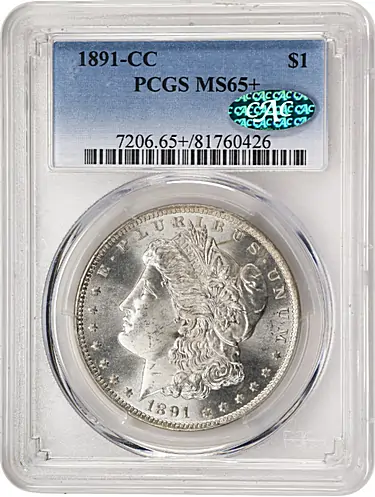
Coin: 1891-CC Morgan Silver Dollar
Denomination: Silver Dollar
Mint: Carson City
Mintmark: CC
Designer: George T. Morgan
Strike: Circulation Issue
Composition: 90% silver, 10% copper
Weight: 26.73 grams
Diameter: 38.10 mm
Edge: Reeded
Mintage: 1,618,000
PCGS Number: 7206
NGC UCID: 255H
Greysheet Number: 7568
Stack’s Marketplace Listing Details
Grade: MS-65+
Grading Service: PCGS
CAC: Green
Plus Grade: Yes
Star: No
Certification Number: 81760426
Listed: June 4, 2026
Price: $10,500
Why Collectors Should Watch This Coin
The 1891-CC Morgan Dollar gives collectors three powerful stories in one coin.
First, it carries the “CC” mintmark. That alone ties it to the Comstock Lode, the Old West, and the final years of the Carson City Mint.
Next, it offers a deceptive rarity profile. The mintage looks high. Yet the GSA numbers and Mint State survival pattern tell a different story.
Finally, this example reaches MS-65+ with CAC approval. That matters because most 1891-CC dollars fall below the Gem level.
For collectors building a Carson City Morgan dollar set, the 1891-CC deserves more respect than its mintage suggests. It is not the lowest-mintage “CC” dollar. It is not the most famous key date. However, in Gem-plus condition, it becomes a serious condition rarity with a story that feels unmistakably Western.
The 1891-CC Morgan Dollar did not wait quietly in a Treasury vault. It went into the world. That journey makes surviving Gem examples far more compelling today.



One of the best coins ever made. Iconic
Interesting facts about the CC Mintmark that I was not aware of.
Interesting: “The 1891-CC did not benefit in the same way. Only 5,687 examples appeared in the GSA sales. That total equals less than one-half of one percent of the original mintage.
So where did the rest go?
Many 1891-CC dollars likely entered commerce soon after striking. They served the West as working money. People spent them, counted them, bagged them, and moved them. As a result, many survivors show wear, contact marks, or both.
This gives the 1891-CC its collector appeal. The date looks available on paper. Yet the real market tells a sharper story.”
A very interesting article.
Very nice looking coin. a must have
Just visited the Nevada (mint) museum in Carson City last week. Well done. There’s just something about that CC mintmark.
Just a beautiful coin!
Carson city coins are the best.
I remember my uncle talking about the silver dollar sales in Washington. Coin dealers got a room in a hotel across the street from the Mint. They’d buy a bag of coins, cherry pick, return the non-collectible ones for cash, and then buy another bag.
It needed to get out of the vault and into my collection!!!!!
Beautiful coin
Iconic US coin
As an investment, you can’t go wrong with Morgans
Maybe some day I’ll have one
Old Morgan Dollars are such beautiful coins !!
Not sure I’ve ever seen a CC minted coin. Would be nice to have.
Still think the Morgan dollar is one of the most overrated US coins.
Carson City Mint just sort of rolls off your tongue. What a coin. Thanks.
My comment does not show up like it use to?? Thanks.
The overall collection of Morgan dollars is rare, especially from the point of present day prices. As to the 1991-cc, this is a rare date in excellent condition.
Another great article!
This is one of my favorite coins!
What a story, and what a coin