


1916 Mercury Dime: The Common First-Year Coin With a Five-Figure Secret
The 1916 Mercury Dime looks modest at first glance but it is a small coin with a big story.
It carries no mintmark and no famous overdate. It also lacks the instant key-date power of the 1916-D, yet this Philadelphia issue marks one of the great turning points in American coinage.
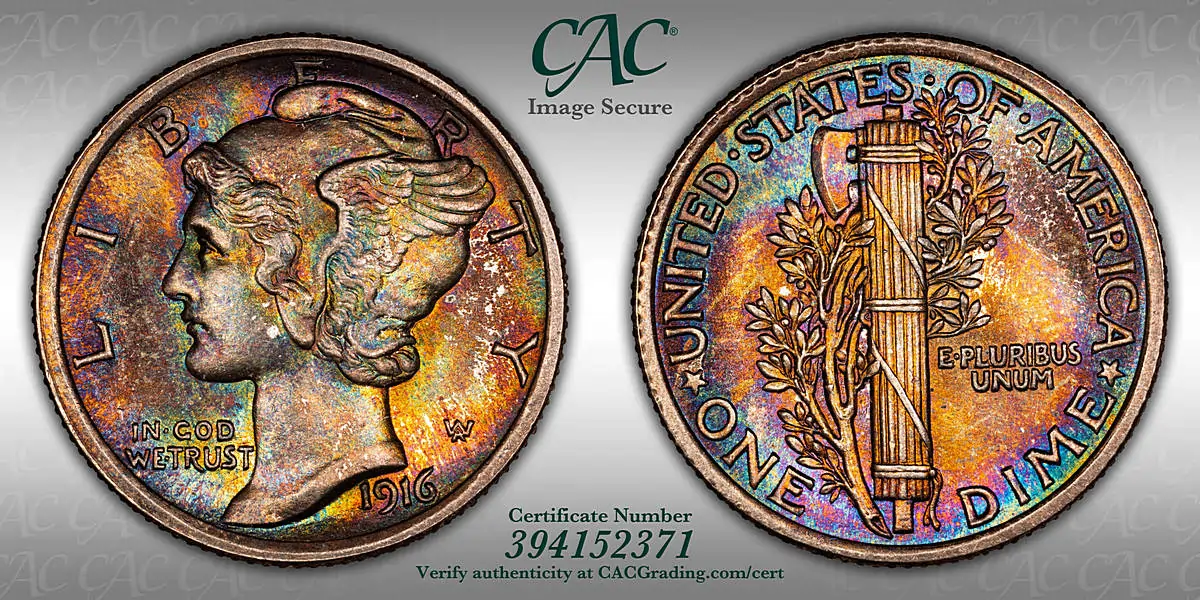
In 1916, the United States introduced three classic silver designs. Adolph A. Weinman created the Winged Liberty Dime and the Walking Liberty Half Dollar. Hermon A. MacNeil created the Standing Liberty Quarter.
Together, these coins changed the look of American pocket change.
They joined a remarkable lineup. Collectors still prize the Lincoln Wheat Cent, the Indian Head or Buffalo Nickel, Bela Lyon Pratt’s Indian Head Quarter Eagle and Half Eagle, and Augustus Saint-Gaudens’ $10 Eagle and $20 Double Eagle.
Therefore, the 1916 Mercury Dime belongs to more than one series. It belongs to the golden age of American coin design.
Why Collectors Call It the Mercury Dime
The official design shows Liberty.
Weinman gave Liberty a winged cap. The wings symbolize freedom of thought. However, many Americans saw the Roman god Mercury instead. The nickname stuck.
Today, collectors use both names. “Winged Liberty Dime” gives the coin its proper identity. “Mercury Dime” gives it its popular name.
The coin entered circulation at the end of October 1916. It remained in production through 1945. As a result, the series carried Americans through World War I, the Roaring Twenties, the Great Depression, and World War II.
It also became part of popular culture. The dime connected with the March of Dimes anti-polio campaign. It appeared in the world of Charles Atlas advertisements. And when Yip Harburg wrote “Brother, Can You Spare a Dime?”, this was the dime in American pockets.
The Dime Roosevelt Replaced
The Mercury Dime did its job well.
It avoided the chronic striking problems that complicated the Buffalo Nickel and the Walking Liberty Half Dollar. Yes, specialists still chase sharply struck examples with Full Bands on the reverse. Even so, the coin functioned well in daily commerce.
Then history intervened.
President Franklin D. Roosevelt died on April 12, 1945. Almost immediately, Americans called for a circulating coin to honor him. The dime made perfect sense. Roosevelt had battled polio. He also supported the March of Dimes.
So, the Winged Liberty Dime ended after a nearly 30-year run. The Roosevelt Dime began in 1946.
The Mercury Dime also holds one important silver distinction. It was the last regular U.S. dime series in which every issue used .900 fine silver. Roosevelt dimes continued in 90% silver through 1964. However, the Roosevelt series later changed to clad coinage.
The 1916-D Gets the Headlines
Collectors know the 1916-D as the key Mercury Dime.
The Denver Mint struck only 264,000 pieces. That tiny mintage created one of the great 20th-century U.S. key dates. Many examples entered circulation. Also, mintmark collecting had not yet reached its later popularity. As a result, countless 1916-D dimes wore down before collectors noticed them.

Philadelphia struck far more coins. Its 1916 Mercury Dime mintage totaled 22,180,080 pieces. San Francisco struck 10,450,000 pieces.
Because of those mintages, the 1916 Philadelphia and 1916-S issues remain available in all grades. Still, the Philadelphia coin attracts steady demand. Type collectors like it because it begins the series. Mercury Dime collectors like it because it often comes sharp.
The 1916 Philadelphia Issue Rewards Quality
The 1916 Mercury Dime does not rank as a major rarity in circulated grades. Most circulated coins trade near their silver and collector value.
Mint State coins also remain obtainable. However, they become more interesting as grade, strike, luster, color, and eye appeal improve.
Many first-year examples survived because the public noticed the new design. Still, the issue does not appear as often in Mint State as Mercury Dimes from the mid-1930s through 1945.
That difference matters.
A common late-date Mercury Dime can supply affordable brilliance. A superb 1916 Mercury Dime supplies first-year status, early-series appeal, and Registry-quality competition.
Full Bands: The Market Dividing Line
On the reverse, the fasces includes horizontal bands. When those bands show complete separation, grading services may award a Full Bands, or FB, designation.
Collectors also call this feature Full Split Bands.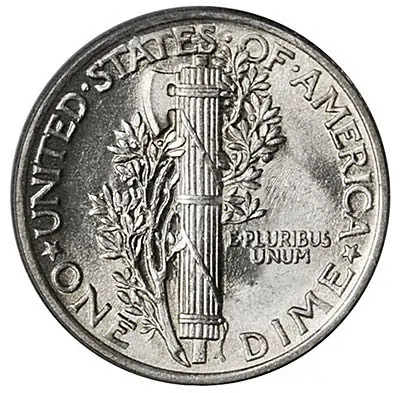
The 1916 Philadelphia issue often comes well struck. Many Mint State coins show strong crossbands. As a result, Full Bands examples exist in meaningful numbers.
However, top-grade Full Bands coins tell a different story. At MS68FB and higher, the market changes fast. Color, surfaces, luster, and Registry demand can send prices far beyond ordinary guide levels.
This explains a major gap in auction results. A brilliant MS68FB coin may bring one price. A rainbow-toned MS68FB coin with CAC approval may bring far more. At the top, collectors often buy the coin, not just the number.
Population Snapshot
PCGS MS68FB population growth tells the story. PCGS reported three MS68FB coins in June 2001. The number reached seven by January 2011. It reached 15 by summer 2015. By October 2024, PCGS listed 16 at MS68FB. One coin reached MS68+FB before summer 2020.
However, population reports require caution. Some coins get reholdered. Others cross between services. Therefore, auction appearances can count the same coin more than once.
Auction Record and Finest-Known Examples
The PCGS auction record for the 1916 Mercury Dime with Full Bands stands at $20,400. Stack’s Bowers sold the PCGS MS68+FB CAC example in August 2020.
That coin had appeared earlier as PCGS MS68FB #36099536. Legend Rare Coin Auctions sold it in September 2019 for $8,225. It later appeared as PCGS MS68+FB CAC #39478604 and brought $20,400.
Another important sale came in September 2019. Legend Rare Coin Auctions sold a PCGS MS68FB CAC example for $14,687.50. That coin showed rainbow toning near the bottom of the obverse and around the reverse.
GreatCollections sold a CACG MS68FB rainbow-toned example for $9,001.12 in October 2023. The coin had crossed from NGC MS68FB CAC to CACG at the same grade.
Meanwhile, a brilliant NGC MS68FB example sold for $3,249.60 in a January 2024 Heritage auction. That result shows how much toning, CAC approval, holder history, and collector demand can affect the top of the market.
Buying Advice
Collectors should treat raw “Mint State” 1916 Mercury Dimes with care.
Original surfaces matter. So does honest strike. Some raw coins show dipping, harsh cleaning, or other surface problems. Others may show tooled bands that try to imitate Full Bands detail.
Therefore, certification brings value at higher Mint State levels. It matters even more for coins offered as Full Bands.
A collector can still buy an attractive uncertified Mint State 1916 Mercury Dime. However, the buyer needs experience. Original luster, natural color, and undisturbed surfaces make all the difference.
Design of the 1916 Mercury Dime
Obverse
Adolph A. Weinman placed Liberty facing left.
A winged Phrygian-style cap covers her head. Loose hair curls around the cap and behind her ear. A braid wraps around the base of her neck.
LIBERTY arcs around the top. The letters appear widely spaced. Liberty’s cap partly hides the letters E and R.
The motto IN GOD WE TRUST appears to the left of Liberty’s neck in two lines. Weinman’s monogram, a W over an A, appears behind Liberty’s neck below the Y of LIBERTY.
The date 1916 appears below the bust truncation. A subtle basin gives the fields a dish-like look.
Reverse
The reverse centers on a fasces. The bundle of rods surrounds a central axe. The axe blade points left.
An olive branch curves behind the fasces. Together, the fasces and olive branch balance strength and peace.
UNITED STATES OF AMERICA arcs around the top. ONE DIME curves around the bottom. Two five-pointed stars separate the legend and denomination.
E PLURIBUS UNUM appears to the right of the fasces, slightly below center.
Edge
The edge is reeded.

Coin Specifications
- Country: United States of America
- Year of Issue: 1916
- Denomination: 10 Cents
- Mintmark: None
- Mint: Philadelphia
- Mintage: 22,180,080
- Alloy: .900 silver, .100 copper
- Weight: 2.5 grams
- Diameter: 17.9 mm
- Thickness: 0.053 inch / 1.35 mm
- Edge: Reeded
- Designer: Adolph A. Weinman
Market Data and Noteworthy Specimens
The following record tracks some of the major MS68 and MS68FB appearances noted for the 1916 Mercury Dime. Prices include buyer’s premium when reported by the auction source.
Certification / Holder Auction History and Notes
- PCGS MS68+FB CAC #39478604 Stack’s Bowers, August 2020, Lot 1180, $20,400. Dusting of dark red and green toning on both sides.
- NGC MS68FB #1600523-002 Heritage, February 2007, Lot 2973, $2,990. Heritage, January 10, 2024, Lot 3329, $3,249.60. Brilliant. Tick behind mouth. Small scratch on neck.
- CACG MS68FB #932304114 Formerly NGC MS68FB CAC #5748804-004. Heritage, July 14, 2022, Lot 3065, $7,800. Heritage, December 15, 2022, Lot 3425, $7,200. As CACG MS68FB #932304114, GreatCollections, October 22, 2023, Lot 1453375, $9,001.12. Rainbow toning on obverse and reverse.
- PCGS MS68FB CAC #36777014 GreatCollections, September 8, 2019, Lot 730930, $9,286.88. Legend Rare Coin Auctions, May 14, 2020, Lot 131, $9,693.75. Heritage, February 24, 2021, Lot 3671, $9,900. Dark red and gold toning.
- NGC MS68FB #4626461-003 Heritage, October 18, 2019, Lot 3551, $2,880. Light scattered toning over a mostly brilliant coin. Ken Bressett signature label.
- PCGS MS68FB CAC #35734616 Legend Rare Coin Auctions, September 27, 2019, Lot 425, $14,687.50. Peripheral rainbow toning on the lower obverse and around the reverse.
- NGC MS68*FB Stack’s Bowers, August 13, 2011, Lot 8465, $6,325. Brilliant.
- PCGS MS68FB CAC #21465056 Heritage, August 12, 2010, Lot 4489, $10,350, from the Joshua II Collection of Mercury Dimes, #1 All-Time Finest PCGS Registry Set. Brilliant..
- NGC MS68FB #115987-001 Heritage, April 2007, Lot 567, $2,875. Heritage, June 4, 2010, Lot 904, $2,990. Brilliant. Fleck of toning or hit just to the upper right of I in LIBERTY. ATES of STATES flatly struck. Certification no longer active.
- PCGS MS68 #3699816 Heritage, August 8, 2001, Lot 5755, $13,225. Brilliant. Certification no longer active.
Final Thoughts
The 1916 Mercury Dime proves that “common” can still mean important.
Collectors do not chase it because of a low mintage. They chase it because it opened one of America’s most beloved dime series. They also chase it because a superb Full Bands coin can transform a first-year type coin into an elite Registry prize.
That is the real story.
The 1916-D owns the legend. But the 1916 Philadelphia dime owns the beginning.


Like the mercury dime appearance
First coin I ever metal detected. Love the toning.
I have a 2007 Dime with the 2 pac on and broke leave on back side
Really great narrative concerning this
Wonderful little mercury dime.. It is a favorite of mine. Thank you for
The take on it
Thanks for anotger great history !!!
Why no one wants to buy my 1916 s dime ?
What decides who appears on a coin?
From the golden age of American coins. When a pocktful of change had such a stunning variety of beauty!
Love these!!!
Interesting
I have a 1916 with a mint mark that PCGS refused to encapsulate since the mint mark was too worn. My $1,000 coin is only worth its silver content.
When you want the best, it can cost you a pretty dime.
Interesting article, great looking coin
When I was a kid, I found the whole set of Mercurys in circulation, except the elusive 1916-D. I was proud of that set. I also found a complete set of walkers in circulation. Guess I’m telling my age.
Those are some beautiful, original Mercurys.
Still one of my favorite coins. Its a shame we abandoned the beauty of Weinman’s designs. In regards to tone. Maybe its just me, but I’d prefer a perfectly brilliant coun (not cleaned) to a rainbow one. To me the toning distracts from the design and at times makes it difficult to clearly see the design.
I came across.a 1916 d mint mercury dime any thoughts on a price?
I have always loved the Mercury Dime. I was given one by a friend’s dad when I was in 7th grade when I mentioned that I was beginning to collect coins. It’s one of the most beautiful coins we’ve ever made!
One of the first interesting coins of the Golden Age and through two World Wars.
The interesting one that lasted through two World Wars.
All three 1916 Coins introduced are all beautiful Coins, I love the Mercury head dime.
One of my favorite coins!
Its one of the series coins
This Is A Cool Coin. Thanks for the information.
The Winged Liberty dime is an interesting and beautiful design. Meaning no disrespect for President Roosevelt, but the design of the Roosevelt dime is boring. The reverse is not exciting, but it’s ok. Bothe the obverse and the reverse of the Winged Liberty are, well, awesome in my opinion. I really wish the designers would return to symbolic designs.
Fascinating article. One of our best designs.
I’ve got two merc dimes, just regular. Would love to have a rainbow one
great info thanks
I love the patina on those coins
Very Interesting, Learned more than I knew..
I wish I could afford the 1916 D
The recent re-designed dime for 2026 should be kept for the future: 80 years is long enough for the FDR design.
I love the toning in the first picture.
i really like this coin…great and informative article
These were beautiful coins.
LOVE this dime..Great story and I’ve always loved the look of the 1916.. THank you for sharing this story with the public one more time..
Common or not would love to add to my collection!
I wonder, how do you tell if a coin or round has natural toning or if its been applied?
I really like these little dimes
A wonderfully detailed article. Mercury dimes are great to collect!
Nice facts about a great coin.
That is an amazing looking dime! Thank you for the rich history.
Great article. I started collecting Mercury dimes in the late 50s. Even found a 1916-D in circulation. It graded AG, but it is still a 16-D
Try finding a FSB 1945 Philly!
I have a 1916 mercury dime and a1925 barber dime,I also have some Roosevelt dimes with some crazy errors and would like an expert to please contact me.I really need a n expert on my coin collection,I thought I had some weird coins until I got into error coins. Please someone contact me,you will be amazed to.
This coin has such a glorious design. They should do a re-release! So pretty.
The history of some coins is fasinating. Thanks CW
The patina is great on these
Absolutely beautiful Coin.
Good article. Keep up the good work CW!
The first year 1916 Mercury Dime is a beautifully designed coin. I was not aware of its Roman heritage nor its Italian dictator usage, information I will remember when viewing a Mercury Dime.
Love the aging on this one.
I started collecting these in the 1960s but still can’t touch that illusive 16D