


This 1899 $2 “Mini-Porthole” Note Hides an Incredible American Story
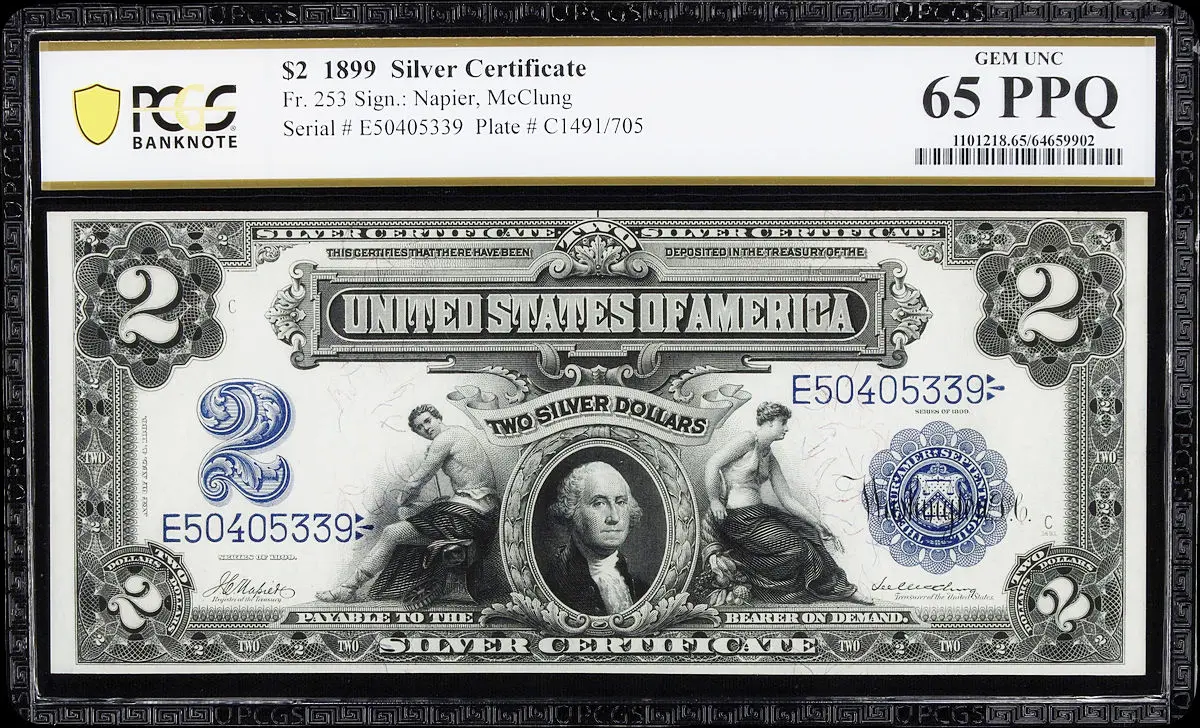
At first glance, the Series 1899 $2 Silver Certificate grabs attention for an obvious reason. George Washington stares from a compact portrait at the center of one of the most distinctive large-size notes America ever issued.
Collectors quickly gave the design a fitting nickname: the “Mini-Porthole.”
However, the example that Stack’s Bowers Galleries will offer in its Summer 2026 Global Showcase Auction tells a much deeper story.
This particular note carries the engraved signatures of James C. Napier and Lee McClung. That pairing identifies the note as Friedberg 253. More importantly, it ties a $2 bill to two extraordinary Americans whose careers crossed inside the Treasury Department for only a brief moment.
One became a leading Black lawyer, banker, businessman, and civil-rights advocate. The other starred on Yale’s football field before becoming Treasurer of the United States.
Therefore, this is much more than an attractive old $2 bill. It offers a compact piece of American monetary, political, artistic, and social history.
Stack’s Bowers will offer the note as Lot 22032 in its Summer 2026 Global Showcase Auction. PCGS Banknote graded it Gem Uncirculated 65 PPQ. Stack’s Bowers estimates the note at $2,500 to $3,500. The auction house reports a PCGS Banknote population of two at the grade, with five finer. The broader U.S. Currency portion of the sale runs September 2-4, 2026.
Before the Mini-Porthole Came America’s Battle Over Silver
The story behind the 1899 $2 Silver Certificate begins decades before anyone printed the note.
During the 1870s, Americans fought bitter political battles over gold, silver, inflation, and the money supply. Congress intensified that fight with the Coinage Act of 1873. Among other changes, the law eliminated the standard silver dollar from the list of coins that the Mint could produce.
Silver advocates eventually branded the measure the “Crime of ’73.”
Western mining interests wanted a larger market for newly mined silver. At the same time, many farmers and debtors favored monetary expansion. They believed that a larger supply of money could raise agricultural prices and make debts easier to repay.
However, Congress did not simply restore unlimited silver coinage.
Instead, lawmakers passed the Bland-Allison Act on February 28, 1878. The legislation required the Treasury to purchase silver and coin it into dollars. It also authorized Silver Certificates. Congress enacted the measure over President Rutherford B. Hayes’ veto.
The arrangement solved a very practical problem.
Silver dollars weighed far more than paper money. Consequently, few people wanted to carry bags filled with heavy coins. Silver Certificates allowed holders to carry paper while the Treasury held silver dollars against the certificates.
Initially, Congress limited Silver Certificates to denominations of $10 and above. Then, in 1886, lawmakers authorized the much more useful $1, $2, and $5 denominations. Those smaller notes helped transform Silver Certificates into an important part of everyday American commerce.
From the Educational Series to the “Mini-Porthole”
The $2 denomination reached an artistic high point with the celebrated Series of 1896 Educational Silver Certificate.
That note used elaborate allegorical artwork. Collectors still rank the Educational Series among the most beautiful paper-money designs the federal government ever produced.
Then came the Series of 1899.
The new $2 certificate abandoned the sweeping neoclassical composition of 1896. Instead, the Bureau of Engraving and Printing adopted a more traditional layout with a strong central portrait and allegorical figures.
Yet the result hardly lacked personality.
George Washington appears inside a tight ornamental frame near the center. The framing creates the visual effect that inspired collectors to call the note the Mini-Porthole.
Meanwhile, allegorical figures of Mechanics and Agriculture flank Washington. Together, they represent two major foundations of the American economy at the turn of the 20th century.
A large blue “2” dominates the left side. Blue serial numbers and a blue Treasury seal add striking color to the face. In contrast, the reverse uses the familiar green ink associated with American currency and surrounds the denomination with elaborate lathe work and scrollwork.
The Bureau of Engraving and Printing identifies G.F.C. Smillie as the engraver responsible for the Washington portrait and the Mechanics and Agriculture vignettes. However, the BEP lists the designer of the 1899 note as unknown.
That distinction matters because some modern descriptions incorrectly credit Thomas F. Morris with the 1899 design. Morris played an important role in the 1896 Educational Series, but the BEP does not credit him as designer of the 1899 $2 certificate.

A Giant Compared With Modern Paper Money
The Mini-Porthole also comes from America’s large-size currency era.
Large-size federal notes measure approximately 7.375 inches by 3.125 inches. Modern U.S. notes measure about 6.14 inches by 2.61 inches.
Therefore, the older note offers roughly 44% more surface area than the money Americans carry today. That extra space gave engravers room to create designs with a visual presence that modern notes rarely match.
The Series of 1899 also became the final series of $2 Silver Certificates. However, “1899” does not tell collectors when every note entered circulation.
The BEP records production of $2 Silver Certificates from 1886 through 1926, while 1899 remained the final series date. During that long production run, changes in Treasury officials created a sequence of signature combinations. Collectors recognize 10 principal Friedberg numbers for the regular Series 1899 $2 certificates, from Fr. 249 through Fr. 258.
That brings us to Fr. 253.
James C. Napier: A Signature With a Remarkable American Story

The signature at the lower left belongs to James Carroll Napier.
His story gives Fr. 253 a historical dimension that extends far beyond currency collecting.
Napier entered the world in Nashville, Tennessee, in 1845 while his parents lived under slavery. His family gained freedom by 1848. He later studied at Wilberforce University and Oberlin College before earning a law degree from Howard University in 1872.
Napier returned to Nashville and built an extraordinary career.
He practiced law. He served on the Nashville City Council. He became the first Black man to preside over that body. Moreover, he pushed for Black teachers in Nashville schools and supported greater employment opportunities for African Americans.
Napier also became an important businessman. He helped establish the One Cent Savings Bank, which later became Citizens Savings Bank and Trust Company. He worked with Booker T. Washington and played a major role in Nashville’s Black business community.
Then President William Howard Taft appointed Napier Register of the Treasury in 1911.
Napier held that office until 1913. His engraved signature consequently appeared on United States paper money. He remains one of only a small number of African Americans whose signatures have appeared on American currency.
For collectors, that transforms Napier’s signature from a cataloging detail into an important piece of American history.
Lee McClung Went From Yale Football to the U.S. Treasury
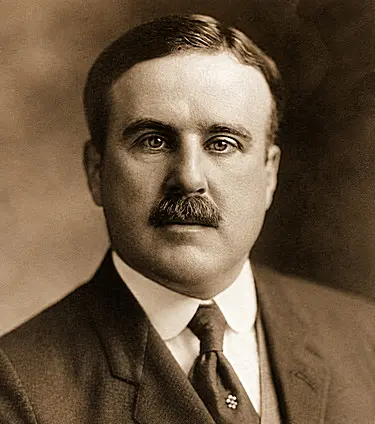
The second signature adds an entirely different story.
Thomas Lee “Bum” McClung became one of the great football players of the sport’s early era.
McClung played halfback at Yale from 1888 through 1891. He captained the team during his senior season. Decades later, the National Football Foundation inducted him into the College Football Hall of Fame in 1963.
Yet McClung also built a career in business and finance.
President Taft selected him as Treasurer of the United States. McClung began his term on November 1, 1909, and left office on November 21, 1912. Carmi A. Thompson of Ohio succeeded him the next day.
That timeline creates the key to Fr. 253.
A Signature Combination With a Narrow Window
President Taft placed Napier in the Register’s office on March 15, 1911. McClung remained Treasurer until November 21, 1912.
Therefore, their official terms overlapped for only about 20 months.
That narrow overlap explains why collectors pay close attention to the Napier-McClung combination.
Still, banknote production does not always line up perfectly with the dates when officials entered or left office. Stack’s Bowers notes that plates carrying McClung’s engraved signature continued through the transition after his resignation. Consequently, the auction house believes notes from this signature combination likely entered circulation from 1911 into early 1913.
In other words, the date 1899 on the face hides a note whose real production story belongs to the Taft administration more than a decade later.
That is one of the great quirks of collecting large-size U.S. paper money.
Why the PCGS 65 PPQ Grade Matters
Most large-size notes did exactly what the government intended. People folded them, carried them, counted them, and spent them.
More than a century later, that history makes truly Gem examples difficult to find.
PCGS Banknote assigned the Stack’s Bowers Fr. 253 a grade of Gem Uncirculated 65 PPQ.
PCGS requires every note grading 65 or higher to qualify for its Premium Paper Quality designation. In addition to strong margins and centering, a Gem note must retain the originality, ink strength, and embossing appropriate for its grade. Problems such as repairs, staining, pinholes, or other impairments can prevent a note from reaching Gem status.
Stack’s Bowers reports only two Fr. 253 notes at the PCGS 65 PPQ level, with five finer.
For a type that circulated for decades, surviving in this state represents a very different kind of rarity from a low-printing variety. It represents condition rarity.
The End of Silver Redemption
Eventually, the promise printed on Silver Certificates became part of monetary history.
Congress began ending the Silver Certificate system during the 1960s as silver prices rose and Treasury silver inventories declined. The Treasury ultimately stopped redeeming Silver Certificates for silver after June 24, 1968.
However, the notes did not lose their status as currency.
Silver Certificates remain valid U.S. currency at face value today. Of course, no collector would exchange an 1899 $2 Mini-Porthole for two modern dollars.
Why This 1899 $2 Silver Certificate Matters
Collectors can approach the 1899 $2 Silver Certificate from several directions.
The design collector sees one of the most distinctive large-size federal notes. The Silver Certificate specialist sees the final $2 series. The condition specialist sees a scarce Gem. Meanwhile, the signature collector sees the short-lived Napier-McClung pairing.
However, Fr. 253 offers something more.
One signature belongs to a former Yale football superstar who eventually controlled the Treasury’s cash operations. The other belongs to a Black lawyer, banker, businessman, and civic leader who rose from slavery-era Nashville to place his name on the currency of the United States.
All of that history sits beneath a portrait of George Washington inside a frame no bigger than a porthole.
That combination makes the Series 1899 $2 Silver Certificate one of those rare pieces of American paper money where the story becomes just as compelling as the design.
Note Specifications
- Country: United States
- Denomination: $2
- Type: Silver Certificate
- Series: 1899
- Friedberg Number: Fr. 253
- Register of the Treasury: James C. Napier
- Treasurer of the United States: Lee McClung
- Central Portrait: George Washington
- Allegorical Vignettes: Mechanics and Agriculture
- Engraver: G.F.C. Smillie
- Approximate Size: 7.375 x 3.125 inches
- Treasury Seal: Blue
- Serial Numbers: Blue
- Subject Note Grade: PCGS Banknote Gem Uncirculated 65 PPQ
- Auction: Stack’s Bowers Summer 2026 Global Showcase Auction
- Lot: 22032
- Auction Date: September 4, 2026
- Estimate: $2,500-$3,500
- PCGS Population Reported by Stack’s Bowers: 2 at grade, 5 fine





I had no idea about Napier. Now the hunt is on for his notes!!
Such a beautiful example!
Beautiful note!
Great piece o’ history. TY.
How very talented and well educated all of your are
Love the Silver Certificate! Historical!