The 1921 Peace Dollar Mystery Hidden in Treasury Shipment Records
The first distribution of 1921 Peace dollars left an accounting puzzle. Treasury shipment entries total 1,235,000 coins. Yet the Mint reported a mintage of just 1,006,473.[6] archive.org
That leaves a difference of 228,527. Remove the 505 coins that the Mint held for the Annual Assay Commission, and the gap grows to 229,032.[7] How do we reconcile those figures?
The Treasurer’s orders, shipment entries and cashier’s accounts record different stages of distribution. To understand the gap, we must follow the coins through those records.
Peace and Politics at Harding’s Washington Conference
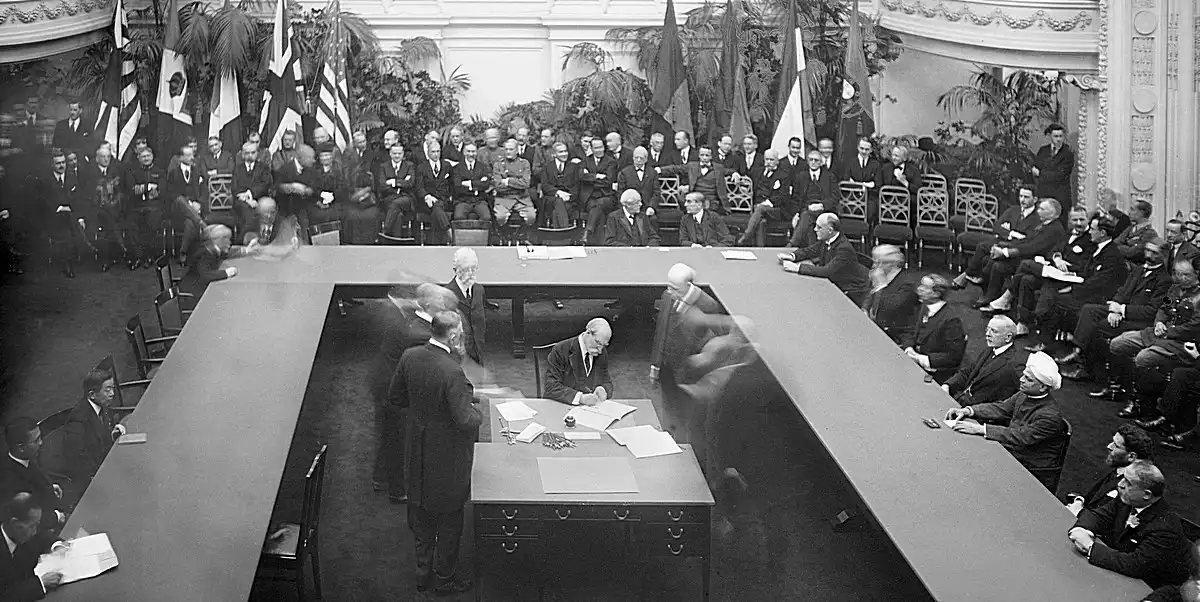
The Peace dollar commemorated peace between the United States, Germany and Austria after World War I.[6] In late 1921, it also became a hurried symbol of President Warren G. Harding’s Conference on the Limitation of Armaments. The conference met at Memorial Continental Hall in Washington, D.C., from November 12, 1921, through February 6, 1922.[1]
After the destruction of World War I, Americans welcomed a national expression of peace. The new dollar offered an appealing design and a message that anyone could carry in a pocket. It also served the Harding administration’s effort to promote arms reduction.
However, the word PEACE on the reverse raised a technical question. In my reading of the record, the addition lacked technical approval. Nevertheless, Harding and officials below him had approved the coin. The point drew no immediate objection, although criticism followed later.
A Deadline the Mint Could Not Ignore
Pressure from the White House and Mint Director Raymond T. Baker compressed the work of designing, revising and approving the coin. Sculptor Anthony de Francisci’s unusually high relief posed an obvious production problem. Even so, the Mint pushed ahead to place a 1921 date on the new dollar.
Philadelphia struck its 1921 Peace dollars during December 28–31. By year’s end, the Mint reported more than one million pieces. Meanwhile, the delivery accounts entered that output on two dates, December 29 and December 31.[6] coinweek.com
Meanwhile, Frank White of North Dakota, Treasurer of the United States, faced another deadline. He had to arrange national distribution while the conference still commanded public attention. State Historical Society of North Dakota
Where the First 1921 Peace Dollars Went
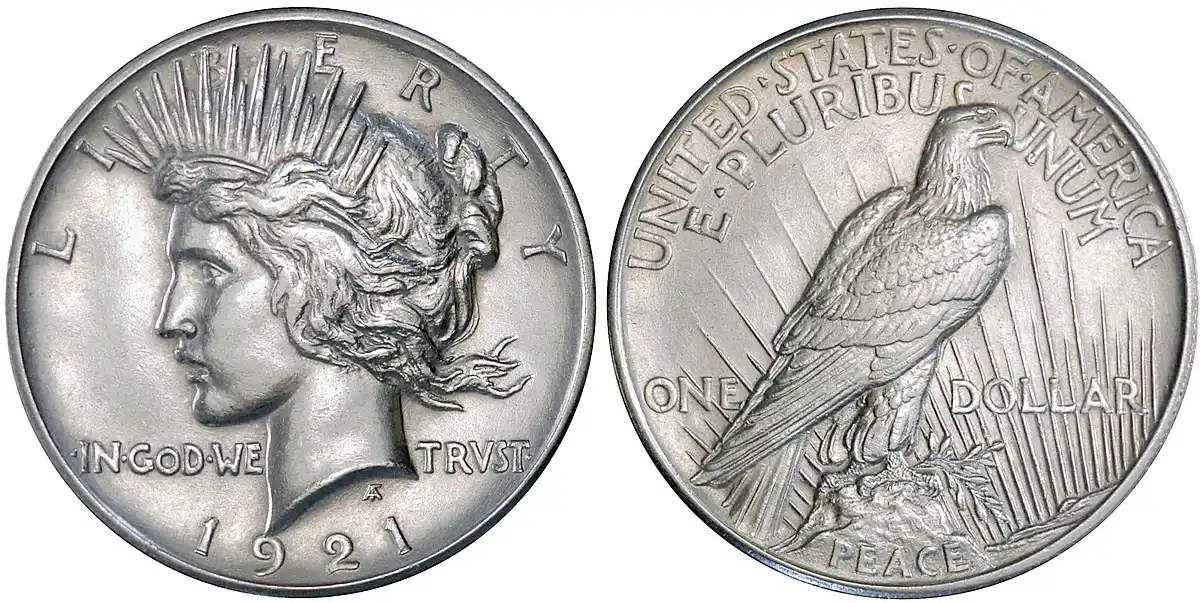
The Treasurer’s records place the first 10,000-coin shipment on December 28, 1921. The entry calls for ten bags from the Philadelphia Mint to the Cash Division of the Treasurer’s office in Washington, D.C.[2] The public release followed on January 3, 1922. pcgs.com
If that entry marks the actual dispatch date, the shipment contained coins from the first day of production. Those early pieces offer a promising place to look for superior design detail. However, the shipment record alone cannot establish the quality of every coin in the bags.
December Orders for Nearly Half the Mintage
On December 30, the Treasurer ordered another 475,000 of the 1921 Peace dollars to Federal Reserve banks, their branches and his own cashier.[3]
Every shipment entry below originates at the Philadelphia Mint. City names identify Federal Reserve banks unless the entry specifies a branch or the Treasurer’s cashier.
December 30, 1921
Boston — 40,000
New York — 75,000
Buffalo branch — 5,000
Philadelphia — 75,000
Cleveland — 15,000
Pittsburgh branch — 15,000
Cincinnati branch — 15,000
Richmond — 30,000
Baltimore branch — 10,000
Atlanta — 10,000
New Orleans branch — 10,000
Jacksonville branch — 5,000
Birmingham branch — 5,000
Nashville branch — 5,000
Chicago — 75,000
Detroit branch — 10,000
St. Louis — 10,000
Louisville branch — 5,000
Little Rock branch — 5,000
Memphis branch — 5,000
Minneapolis — 10,000
Kansas City — 15,000
U.S. Treasurer’s cashier — 25,000
Total — 475,000 coins.
Together with the initial 10,000-coin Treasury entry, these December records account for 485,000 dollars. That equals nearly half the reported mintage. However, an order date does not necessarily establish when a shipment left Philadelphia or reached its destination.
The Mint recorded deliveries of 200,103 pieces on December 29 and 806,370 on December 31. Together, those deliveries total 1,006,473.[6]
January Brings More Distribution Entries
The next schedule assigns another 60,000 of the 1921 Peace dollars to banks and branches that appear in the December records.[3]
January 3, 1922
Cleveland — 10,000
Cincinnati branch — 10,000
Pittsburgh branch — 10,000
Detroit branch — 5,000
Chicago — 25,000
Total — 60,000 coins.
Then, on January 4, the listed allocations rose to 185,000 coins.[4]
January 4, 1922
New York — 50,000
Boston — 25,000
St. Louis — 25,000
Little Rock branch — 5,000
Memphis branch — 5,000
Louisville branch — 5,000
Minneapolis — 20,000
Chicago — 25,000
Philadelphia — 25,000
Total — 185,000 coins.
More Peace Dollars for the Banks in February
The shipment sequence then paused while Mint personnel worked to correct the design’s relief problems. Entries for the distribution of 1921 Peace dollars resumed on February 10.[5]
February 10, 1922
Dallas — 30,000
El Paso branch — 5,000
Houston branch — 5,000
Daily total — 40,000 coins.
February 11, 1922
San Francisco — 25,000
Daily total — 25,000 coins.
February 13, 1922
Boston — 25,000
New York — 75,000
Buffalo branch — 10,000
Cleveland — 35,000
Cincinnati branch — 25,000
Pittsburgh branch — 10,000
Richmond — 20,000
Baltimore branch — 20,000
Atlanta — 5,000
New Orleans branch — 5,000
Jacksonville branch — 5,000
Birmingham branch — 5,000
Nashville branch — 5,000
Detroit branch — 10,000
St. Louis — 35,000
Louisville branch — 15,000
Memphis branch — 25,000
Chicago — 75,000
Philadelphia — 25,000
U.S. Treasurer’s cashier — 10,000
Daily total — 440,000 coins.
February 10–13 total — 505,000 coins.
Most destinations lay in the eastern half of the country. The schedules assign comparatively small amounts to Dallas, its two listed branches and San Francisco.
When the Shipment Records Exceed the Mintage
Adding the initial Treasury entry to the later schedules gives the following distribution record:
December 28 and 30 — 485,000
January 3 — 60,000
January 4 — 185,000
February 10–13 — 505,000
Combined total — 1,235,000 coins.
Of that amount, the entries assign 1,190,000 coins to Federal Reserve banks and branches. The remaining 45,000 went on the schedules for the Treasurer’s cashier. Thus, the combined total includes both banking channels and the Treasury’s own cash operation.
The official mintage of 1921 Peace dollars, however, stands at 1,006,473.[6] That figure includes 505 pieces for the Annual Assay Commission. Subtracting those coins leaves 1,005,968 for immediate circulation.[7]
Consequently, the shipment entries exceed the full mintage by 228,527 coins. Against the quantity available before release of the assay reserve, the difference reaches 229,032.
Why the Assay Coins Matter
The Mint kept the 505 assay coins under lock in Philadelphia’s “pyx box.” Officials could not release them until the President accepted the Commission’s report. In the normal course, that occurred around March 1 or later, provided the Commission found no discrepancies.[8]
Therefore, these coins could not supply the December-through-February distributions. Their temporary exclusion increases the accounting gap. It does not prove that the Mint struck additional dollars.
Three Possible Explanations
First, a transcription error could explain part of the problem. Copying figures from photographs of typed sheets into an article always leaves room for mistakes. However, the original entries clearly identify Peace dollars. Handwritten brackets also group several entries under that designation. I checked the shipment entries against the source images several times and found no transcription error.
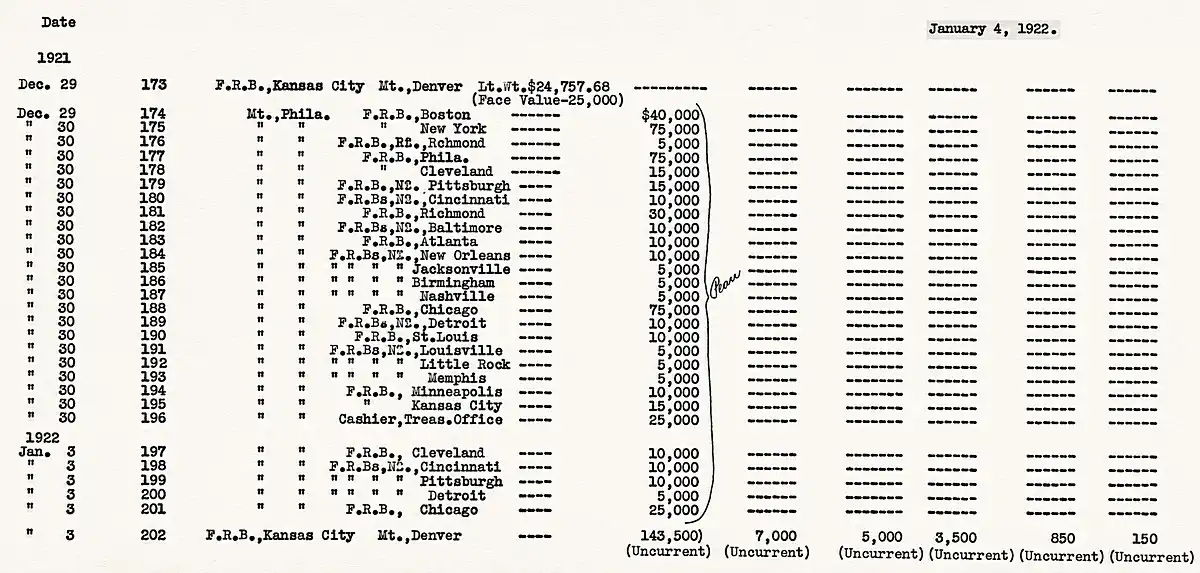
Second, a clerk might have included Morgan dollars within brackets that identified Peace dollar shipments. That seems unlikely in light of the distribution’s immediate purpose. Officials wanted the public to receive the new design and its message of support for Harding’s arms-limitation conference.
Third, banks might have returned coins from the December 30 allocation. The Mint could then have shipped those same coins again during February 10–13. In that case, the records would count more than one movement of some dollars.
That possibility seems the most likely of these three explanations. Nevertheless, the Treasurer’s records show no such returns during January or February 1922. The available records identify no further shipments of 1921 Peace dollars. The return-and-reshipment explanation therefore remains a hypothesis.
We must also keep the administrative sequence in view. An order, a dispatch and a cashier’s issue can carry different dates. Before we count distinct coins, we must establish exactly what each entry records.
The Cashier’s Accounts Present Another Problem
The Cashier’s Reports contain different quantities and do not always follow the dates of the Treasurer’s orders. Their delivery figures nevertheless reproduce the official mintage.[6]
The following entries use the same order throughout: delivery, issue, assay coins and cumulative issues.
December 29, 1921 — Delivered: 200,103. Issued: 10,000. Assay: 0. Cumulative issues: 10,000.
December 30, 1921 — Delivered: 0. Issued: 0. Assay: 0. Cumulative issues: 10,000.
December 31, 1921, supplemental — Delivered: 656,370. Issued: 0. Assay: 77. Cumulative issues: 10,000.
December 31, 1921, final — Delivered: 150,000. Issued: 0. Assay: 331. Cumulative issues: 10,000.
January 3, 1922 — Delivered: 0. Issued: 499,506. Assay: 0. Cumulative issues: 509,506.
January 3, 1922, in the vault — 499,962. Assay: 0. The transcription repeats the bracketed figure under delivery and issue. It provides no cumulative-issue figure. Treating the two appearances as one vault balance produces the reconstruction below.
Recorded deliveries — 1,006,473.
Listed assay entries — 408.
Issues plus the reported vault balance — 1,009,468.
That reconstruction plus the 408 assay pieces — 1,009,876.
A Balance We Cannot Yet Reconcile
The last two figures require care. Adding the 509,506 cumulative issues to the 499,962 vault balance yields 1,009,468. Adding the listed 408 assay coins raises that result to 1,009,876.
However, this calculation combines issues, inventory and assay entries. It does not independently establish a mintage of 1,009,876. In fact, that reconstruction exceeds the recorded deliveries by 3,403 coins.
The December 29 delivery presents a separate question. Its 103-piece component differs by two from the Commission’s count of 101. Meanwhile, the cashier’s two nonzero assay entries total 408. That falls 97 short of the Commission’s 505.[7]
The December 29 assay column itself shows zero. Thus, simply moving either 103 or 101 into that column would not reconcile all the figures. We do not have enough information to explain these differences. They must await additional evidence.
The Mint Moves to Lower Relief
The chronology cited here places Philadelphia’s start of regular low-relief Peace dollar production on February 13, 1922. Distribution of the revised design followed on February 18.[9]
Meanwhile, some 1921 dollars found their way back to the Mint. By April 28, 1922, the Cashier’s Report recorded returns of 158,378 pieces. That later total confirms returns in the account, but it does not establish a January-or-February return-and-reshipment cycle.
The rush to distribute the first Peace dollars soon lost its urgency. Some 1921 pieces remained in Treasury stocks for decades. Collector interest strengthened in the 1950s, although collectors had saved and acquired examples long before then. NGC
For now, the first distribution of 1921 Peace dollars leaves us with an unresolved record. We can identify the destinations and add the figures. We still cannot make the shipment entries, cashier’s accounts and assay totals agree.
Copyright 2026 by Roger W. Burdette. All rights reserved.
Citations
[1] Memorial Continental Hall reached completion in 1910. It is the oldest building in the Daughters of the American Revolution headquarters complex at 1776 D Street NW, Washington, D.C. It shares the block with the DAR Administration Building and Constitution Hall. The DAR’s building history confirms the completion date; the State Department’s Foreign Relations of the United States, 1922, Volume I, confirms the conference dates. Daughters of the American Revolution
[2] National Archives, RG 50, Entry UD-89 A, Vol. 1A, December 28, 1921.
[3] National Archives, RG 50, Entry UD-89 A, Vol. 1A, December 30, 1921. The manuscript also attaches this reference to the January 3, 1922 distribution; confirm the relationship between the order and shipment dates.
[4] National Archives, RG 50, Entry UD-89 A, Vol. 1A. The manuscript gives January 4, 1921; its accompanying distribution schedule gives January 4, 1922. Verify the year against the original record.
[5] National Archives, RG 50, Entry UD-89 A, Vol. 1A. The manuscript gives January 10, 1921 for the February 10–13, 1922 distribution. Verify both the month and year against the original record.
[6] Jeff Garrett, ed., A Guide Book of United States Coins—2023 (Whitman Publishing, 2022), p. 239; Report of the Director of the Mint, 1922, p. 9; National Archives, RG 104, Entry 330, Box 1, folder 2, “Cashier’s Daily Statements,” December 29, 30 and 31, 1921.
[7] National Archives, RG 104, Entry 279, Box 2, “Proceedings of the Assay Commission—1922” (coins of calendar year 1921), p. 8.
[8] By that time, Philadelphia was producing low-relief 1922 dollars in quantity. Any remaining 1921 Peace dollars likely joined routine coin stocks. This is an inference about their subsequent handling.
[9] Roger W. Burdette, A Guide Book of Peace Dollars (Whitman Publishing, 2008), pp. 55–56.