Almost 10 years to the day a Collector searching a $50 Bank Bag made a Remarkable Discovery
Only two examples of the rare 1982-D Small Date bronze Lincoln cent have surfaced. Here’s how a forgotten Mint transition created one of the most remarkable pocket-change discoveries in American numismatics.
On November 23, 2016, Minnesota coin collector Paul Malone searched through a $50 bank bag containing 5,000 Lincoln cents. He wasn’t looking for a five-figure rarity. Instead, he wanted to separate older copper-alloy pennies from newer zinc cents.
Then, one coin caught his attention.
It carried a 1982 date, a Denver Mint mark, and the distinctive Small Date design. More importantly, it weighed considerably more than a normal 1982-D Small Date penny.
Malone had discovered a coin that collectors had searched for over three decades without success.
In August 2017, that same penny sold for $18,800 at a Stack’s Bowers Galleries auction.
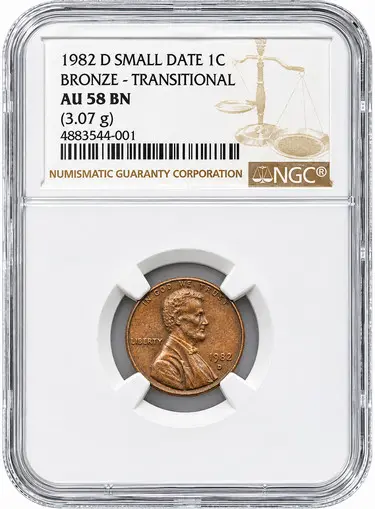
Today, numismatists recognize only two authenticated examples of the 1982-D Small Date bronze Lincoln cent. Both grade AU-58 Brown. Yet another example could still survive in an old coin jar, bank roll, or collection.
The mystery begins with an extraordinary year at the United States Mint.
Why 1982 Changed the Lincoln Cent Forever
By the early 1980s, the United States faced a problem with its smallest circulating coin. Copper prices and manufacturing expenses threatened the economics of producing the familiar one-cent piece.
The Mint had already explored alternatives.
During the 1970s, officials experimented with aluminum cents and other compositions. In 1974, Congress also gave the Treasury Department broader authority to change the cent’s metallic composition.
However, aluminum never replaced the traditional copper-alloy cent. By 1981, rising metal costs had forced officials to revisit the problem.
The Mint eventually settled on a copper-plated zinc composition.
The change dramatically reduced the amount of copper in each penny while preserving its familiar reddish appearance.
The traditional cent contained 95% copper and 5% zinc. It weighed 3.11 grams. In contrast, the new copper-plated zinc cent contained just 2.5% copper overall and weighed 2.50 grams.
That difference of roughly six-tenths of a gram would eventually help expose one of the greatest modern Lincoln cent errors.
The Denver Mint’s October 21, 1982, Transition
Although collectors often describe the 1982 composition change as a midyear transition, the Mint’s production history tells a more complicated story.
The West Point facility began striking copper-plated zinc cents on January 7, 1982. Philadelphia soon followed.
Denver, however, continued making traditional copper-alloy cents for most of the year.
Then came October 21, 1982.
According to research by numismatist David W. Lange, Denver struck its final regular copper-alloy cents that morning. Mint employees then suspended production for approximately one hour to complete the changeover.
Afterward, the facility began striking copper-plated zinc cents.
Meanwhile, Mint engravers had introduced another significant change: a revised obverse design.
The new master hub featured sharper, more delicate lettering and a smaller date. These adjustments helped improve striking performance with the new zinc-based planchets.
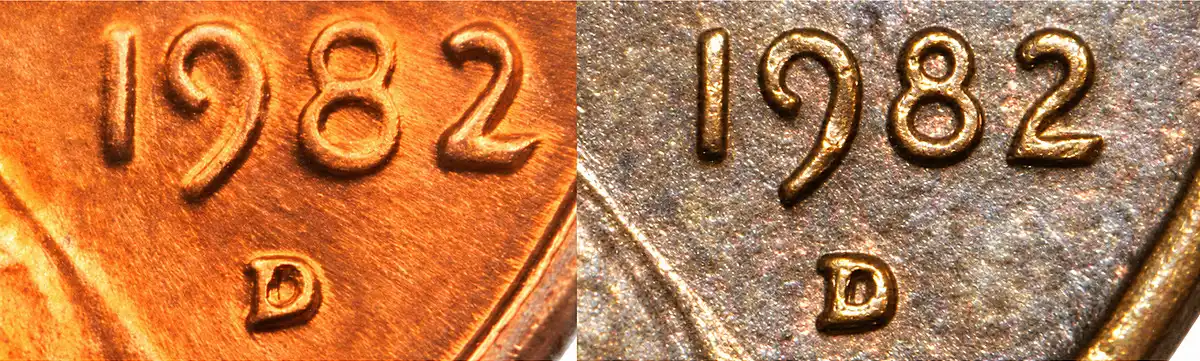
Together, the metallic and design changes created seven regular business-strike varieties in 1982.
Cents without mintmarks appeared in four combinations: Large Date copper alloy, Small Date copper alloy, Large Date zinc, and Small Date zinc.
Denver produced three regular combinations: Large Date copper alloy, Large Date zinc, and Small Date zinc.
One combination remained conspicuously absent.
The Denver Mint never intended to produce a 1982-D Small Date cent on the old copper-alloy planchet.
Yet at least two escaped into circulation.
How Did an Impossible 1982-D Penny Escape the Mint?
The most likely explanation involves leftover planchets.
During the Denver Mint’s transition, one or more older copper-alloy blanks apparently entered a press that already carried the revised Small Date dies.
The press struck each obsolete blank with the new design. Consequently, the finished cents looked like ordinary 1982-D Small Date pennies.
However, their weight revealed the mistake.
Collectors classify these pieces as transitional planchet errors rather than an eighth regular-issue 1982 cent variety.
The exact circumstances remain unknown. No published Mint documentation establishes precisely where the leftover blanks originated or how they reached the presses.
Nevertheless, the error belongs to a fascinating tradition in American numismatics.
In 1943, the Mint changed Lincoln cent production to zinc-coated steel to conserve copper during World War II. A small number of leftover copper-alloy blanks nevertheless entered production. Those famous 1943 bronze cents rank among the most desirable U.S. mint errors.
The 1982-D Small Date bronze cent follows the same basic principle.
An obsolete planchet encountered a new production process. The resulting mistake transformed an ordinary one-cent design into an extraordinary rarity.
The Minnesota Collector Who Found the First Example
Paul Malone had spent years sorting circulated Lincoln cents.
Beginning in 2011, he accumulated older copper-alloy pennies and searched through $50 bank bags containing 5,000 coins each.
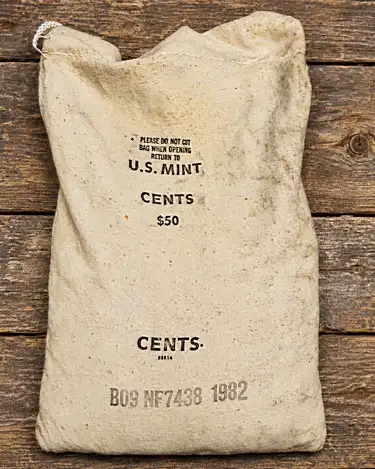
Rather than inspect every date first, Malone used a homemade weighing device to separate the heavier copper-alloy cents from their lighter zinc counterparts.
On November 23, 2016, that method produced an unexpected result.
Malone encountered a heavy 1982-D Small Date cent.
He subsequently sought assistance from numismatic specialists, including variety and error expert Ken Potter. The discovery soon attracted attention through Numismatic News.
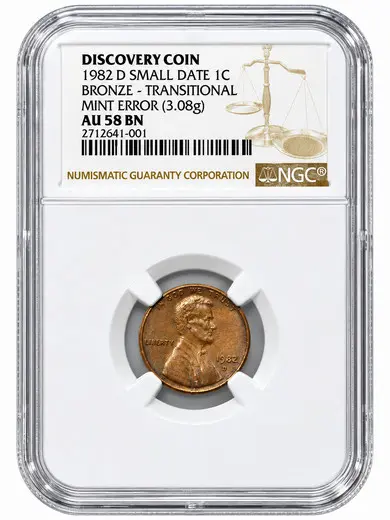
In February 2017, the Numismatic Guaranty Company (NGC) announced that it had authenticated the extraordinary find.
The coin weighed 3.08 grams, comfortably within the manufacturing tolerance for the original 3.11-gram copper-alloy cent.
NGC graded the specimen AU-58 BN (About Uncirculated, Brown) and identified it as the discovery coin.
More than 34 years after the Mint produced its last regular 1982-D cents, a collector had finally proved that the supposedly missing combination existed.
A Second 1982-D Small Date Bronze Penny Emerges
The story gained another chapter in 2019.
NGC authenticated a second 1982-D Small Date bronze cent. Like the original discovery, this piece graded AU-58 BN.
However, the second specimen weighed 3.07 grams, slightly less than Malone’s 3.08-gram discovery.
Heritage Auctions described the second coin as sharply struck, with relatively few marks and attractive walnut-brown toning.
The discovery established that Malone’s coin was not necessarily a unique accident. At least one other obsolete copper-alloy planchet had reached the Denver Mint’s Small Date production dies.
Both authenticated examples share the same numerical grade. Therefore, they currently hold equal standing as the finest-known specimens.
No Mint State example has surfaced in the verified records reviewed for this article.
A genuine uncirculated example would immediately establish a new condition benchmark for this remarkable error.
What Is the 1982-D Small Date Bronze Penny Worth?
Auction records provide an important measure of the coin’s rarity. However, they also demonstrate why collectors should distinguish an actual sale price from an estimated current market value.
- August 2017 — $18,800: Stack’s Bowers Galleries sold Malone’s discovery specimen, NGC AU-58 BN, during its ANA auction. The coin weighed 3.08 grams.
- April 2019 — $10,800: Heritage Auctions sold the second authenticated specimen, also graded NGC AU-58 BN. Its recorded weight was 3.07 grams.
- September 2019 — $8,400: Heritage offered Malone’s original discovery coin again. This sale included the same 3.08-gram specimen that Stack’s Bowers had sold for $18,800 two years earlier.
These prices include the applicable buyer’s premiums.
The 2019 resale demonstrates an important market reality. Even an exceptionally rare transitional error does not necessarily increase in value with every auction appearance.
Furthermore, the small number of transactions makes it difficult to establish a reliable current price.
Nevertheless, the 1982-D Small Date bronze cent remains an important modern American mint error with a documented five-figure auction history.
How to Identify a Rare 1982-D Small Date Bronze Penny
Finding the correct coin requires three separate checks.
First, examine the mintmark.
The coin must carry a clear D beneath the 1982 date.
A 1982 cent without a mintmark cannot qualify as the rare Denver transitional error. Likewise, an ordinary 1982-D Large Date copper-alloy cent does not qualify.
Next, examine the Small Date design.
The most useful differences appear in the numerals.
On the Large Date variety, the tops of the 9 and 8 extend above the adjacent numerals. The diagonal stroke of the 2 also appears comparatively straight.
On the Small Date, the tops of the numerals align much more closely along an imaginary horizontal line. The 2 features a gently curved diagonal stroke and sits noticeably farther from the coin’s rim.
Additionally, the upper loop of the 8 appears smaller relative to its lower loop.
The revised lettering in LIBERTY and IN GOD WE TRUST provides another diagnostic.
Collectors should compare questionable coins against clear photographs of authenticated Small Date examples.
Finally, weigh the coin.
This step separates the common zinc cent from the potential transitional error.
A normal 1982-D Small Date zinc cent weighs approximately 2.50 grams.
The rare copper-alloy variety carries a standard weight of 3.11 grams. The two authenticated examples registered 3.08 and 3.07 grams.
Manufacturing tolerances allow some variation. Therefore, a genuine copper-alloy cent need not weigh exactly 3.11 grams.
Use a properly calibrated digital scale that reads to at least 0.01 gram.
Remember, a 3.1-gram reading alone does not prove that you have found a rarity. Most heavy 1982-D cents are ordinary Large Date copper-alloy coins.
Likewise, millions of common 1982-D Small Date cents have the correct date style but the lighter zinc composition.
The genuine transitional error must satisfy all three tests: the D mintmark, the Small Date design, and the heavier copper-alloy composition.
1982-D Small Date Bronze Lincoln Cent Specifications
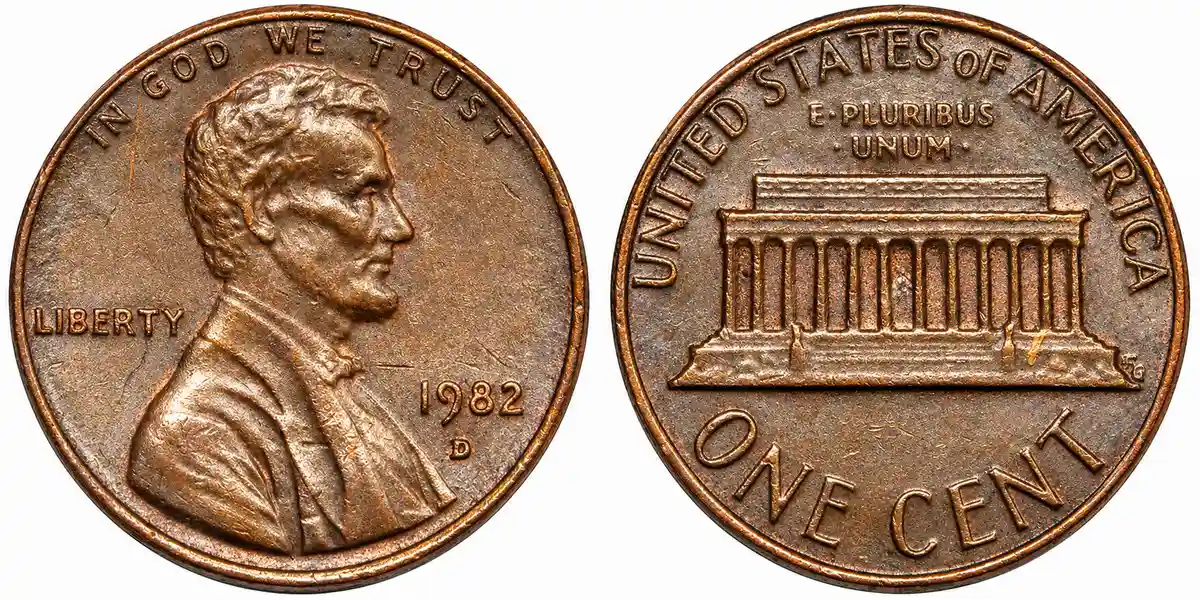
- Denomination: One cent
- Date and Mint: 1982-D, Denver Mint
- Composition: 95% copper, 5% zinc
- Standard Weight: 3.11 grams
- Known Specimen Weights: 3.08 grams and 3.07 grams
- Diameter: 19.05 mm
- Edge: Plain
- Obverse Designer: Victor David Brenner
- Reverse Designer: Frank Gasparro
- Obverse Design: Abraham Lincoln portrait with LIBERTY, IN GOD WE TRUST, the date, and D mintmark
- Reverse Design: Lincoln Memorial with UNITED STATES OF AMERICA, E PLURIBUS UNUM, and ONE CENT
- Known Population: Two authenticated examples
- Finest-Known Grade: NGC AU-58 BN, both specimens
- Mintage: Unknown; accidental production
One technical distinction deserves attention. Although collectors commonly call this coin a bronze cent, its 95% copper and 5% zinc alloy is technically brass. The Mint eliminated tin from the cent’s regular composition in 1962. Nevertheless, the term “bronze” remains standard numismatic terminology for this transitional error.
Could Another $18,800 Penny Still Be Hiding in Circulation?
The discovery of a third 1982-D Small Date bronze cent remains possible. However, no one can calculate reliable odds from the two known specimens.
Denver struck more than six billion cents in 1982 across its regular varieties. Only two authenticated Small Date copper-alloy errors have emerged from that enormous production.
Consequently, collectors should approach the search with realistic expectations.
Bank rolls offer one practical starting point. A standard $25 box contains 50 rolls and 2,500 cents. Searching older mixed-date rolls can reveal interesting Lincoln cent varieties.
CoinWeek has also documented the possibilities and limitations of this approach in its Lincoln Cent roll-searching article.
Older family collections present another opportunity. A neglected change jar, an estate accumulation, or a vintage piggy bank might contain cents that haven’t circulated for decades.
However, exercise caution with online listings.
Many sellers advertise uncertified 1982-D copper Small Date pennies without reliable proof. Some coins turn out to be common Large Date pieces. Others are ordinary copper-plated zinc cents.
Before paying a substantial premium, insist on professional authentication by a recognized grading service, such as NGC or PCGS. Also verify the certification details.
If you believe you have discovered a genuine example, avoid cleaning or polishing the coin. Instead, protect its surfaces and seek an experienced error-coin specialist’s opinion.
The Next Discovery Could Rewrite the Census
The 1982-D Small Date bronze Lincoln cent combines nearly everything collectors love about mint errors.
It emerged during an important manufacturing transition. It escaped detection for decades. Then an ordinary collector found one using a simple weighing device and a sharp eye.
Most importantly, the discovery proved that even a coin produced in an era of enormous mintages could hold an unexpected rarity.
The two authenticated examples have already demonstrated what makes the error special.
A third could provide another extraordinary chapter.
So, before you put away that old jar of Lincoln cents, take another look at the 1982-D pieces.
Check the date, than the mintmark, and finally… Check the weight.
Sometimes, the difference between one cent and a five-figure rarity is hiding in plain sight.