Three of America’s Rarest Currency Errors Are Coming to Auction
Imagine receiving a $20 bill in change. Andrew Jackson looks familiar, and everything appears perfectly normal. However, turn the note over, and suddenly you have a $10 bill.
How could the federal government make such a spectacular mistake?
For paper money collectors, this extraordinary printing blunder represents one of the greatest prizes in American currency. Collectors call it the dual denomination error, or, more affectionately, the “King of Errors.”
These remarkable notes rarely appear at auction. Finding three different examples in a single sale presents an exceptional opportunity.
Heritage Auctions will offer just such an opportunity during its FUN U.S. Currency Signature Auction #3603, which takes place January 13–15, 2027. Online bidding should begin around December 25.
Paper Money Guaranty (PMG) has authenticated and graded all three notes. Furthermore, each represents a different chapter in the history of American currency production.
Perhaps most remarkable, collectors recognize only four historically documented types of dual denomination errors on small-size United States currency. Heritage will offer three of them in January.
How Do Dual Denomination Errors Occur?
Unlike coins, which normally receive their obverse and reverse designs during the same striking operation, traditional American paper money requires several distinct printing stages.
Historically, the Bureau of Engraving and Printing (BEP) began by printing the backs of currency sheets in green ink. Workers then allowed the sheets to dry before transferring them to another printing operation.
Next, presses applied the face designs in black ink. A subsequent operation added identifying elements, including serial numbers and Treasury seals. Inspectors checked the currency throughout production.
However, on extraordinarily rare occasions, sheets carrying the backs of one denomination entered a production run for another.
For example, a sheet of $10 backs might receive $20 faces. If inspectors failed to catch the mistake, the BEP could complete production and release the mismatched notes into the banking system.
Consequently, both sides contain genuine government printing. Nevertheless, the two sides disagree about the value of the money itself.
For coin collectors, the closest comparison is a mule error. In both instances, the manufacturing process combines designs that should never appear together.
However, the dual denomination note takes that mistake one step further. It creates a genuine piece of American money that displays two completely different monetary denominations.
A Printing Error With Roots in the Civil War Era
Dual denomination errors date back to the early years of federal paper money.
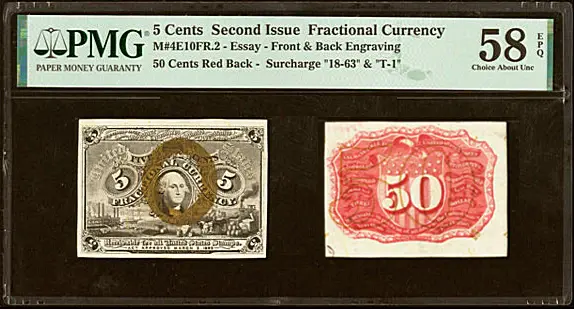
For example, a Civil War-era Second Issue Fractional Currency error combines a five-cent denomination with a 50-cent denomination. Heritage sold one such example for $32,400 in January 2024.
Later, similar errors occurred on large-size National Bank Notes. Some resulted from workers feeding sheets with multiple denominations into presses upside down. This mistake created mismatched denominations and inverted back designs.
However, the introduction of small-size currency in 1929 marked a major turning point.
The Treasury reduced the dimensions of American banknotes by approximately 30 percent to lower production costs. It also standardized designs across denominations, establishing the familiar currency format Americans recognize today.
Despite these improvements, a handful of extraordinary printing mistakes escaped the BEP during the following decades.
Numismatic researchers recognize four historic small-size dual denomination error combinations:
- Series 1928A: Richmond $10 face / $5 back.
- Series 1934D: Kansas City $5 face / $10 back.
- Series 1950A: New York $10 Federal Reserve Note face / $1 Silver Certificate back.
- Series 1974: Dallas $20 face / $10 back.
Heritage’s January auction brings together all but the exceptionally unusual New York issue.
1974 Dallas $20/$10 Error: The Incredible Story of the $30 Bill
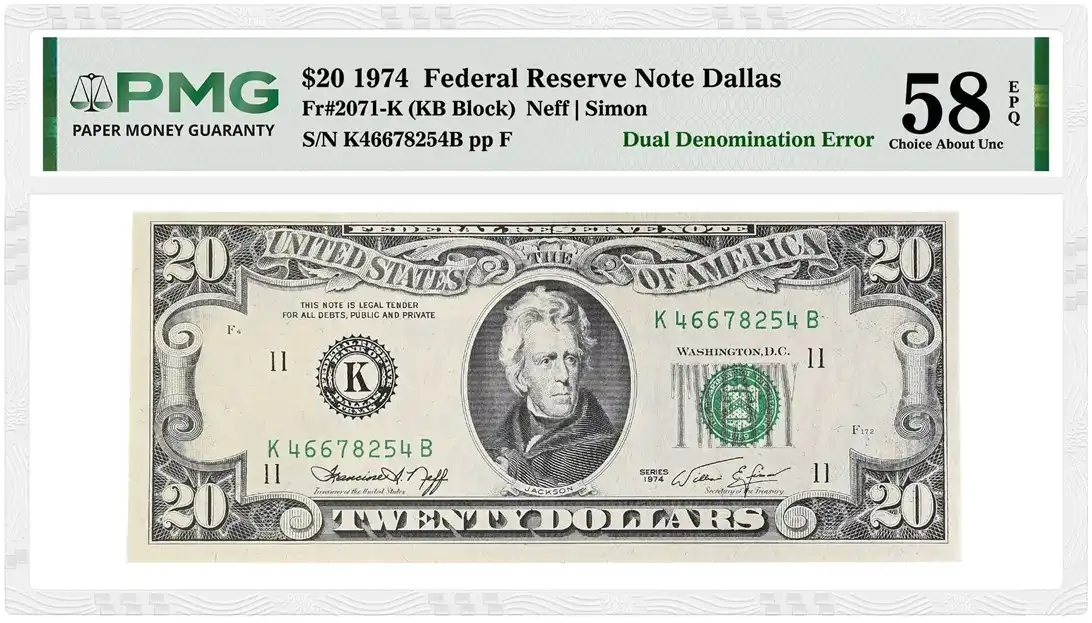
Of the three notes, the Series 1974 Dallas error arguably carries the most dramatic backstory.
Collectors sometimes refer to these notes as the “Dallas $30 bills.” The nickname, of course, reflects the combined denominations rather than an official monetary value.
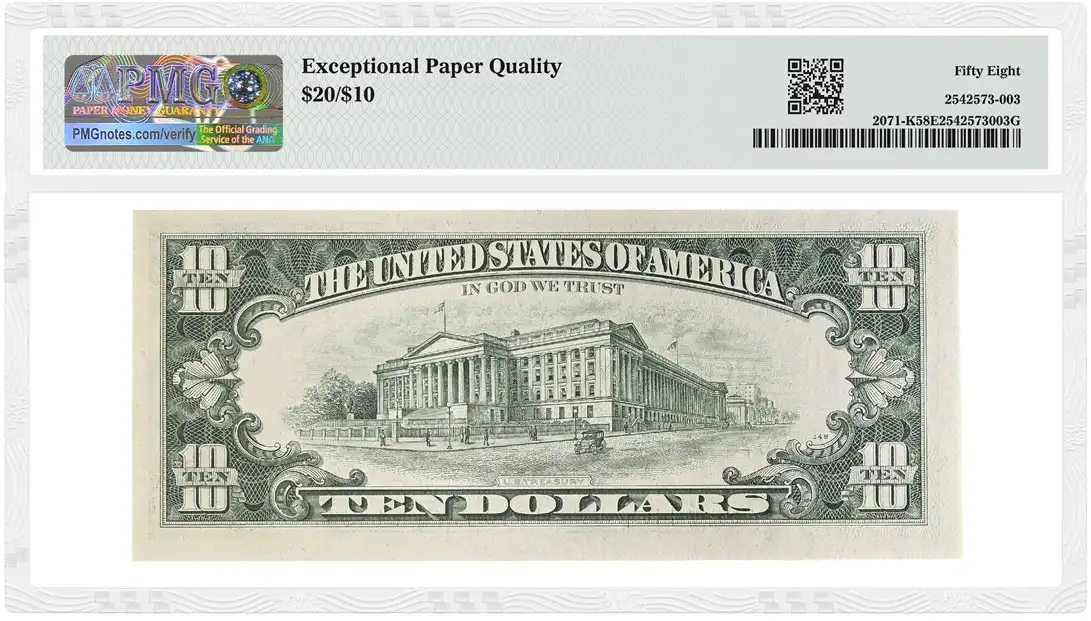
The front features President Andrew Jackson and the familiar $20 design. However, the back displays the United States Treasury Building and the denomination of $10.
News of these unusual notes emerged from Houston during the summer of 1978.
According to contemporary reporting cited by Heritage Auctions, the BEP believed that it had produced ten sheets of 32 mismatched notes. That meant as many as 320 examples originally existed.
Federal Reserve officials quickly recovered 160 notes from an unopened BEP shipment. Meanwhile, the Houston branch of the Dallas Federal Reserve Bank recovered another 120.
Authorities returned those 280 notes to the BEP for destruction
That left approximately 40 examples outside the recovery effort. Some eventually reached collectors. Others likely disappeared through routine banking operations and the destruction of worn currency.
Today, researchers have documented approximately 27 or more surviving examples.
The fifth edition of United States Paper Money Errors, by Dr. Frederick J. Bart and Bianca B. Bart, records the serial number of the note in Heritage’s upcoming auction.
Furthermore, Heritage identifies the Dallas issue as the last known dual denomination error type to escape the BEP into circulation.
PMG awarded this example a grade of Choice About Uncirculated 58 with Exceptional Paper Quality (EPQ).
Recent auction results demonstrate the strength of collector demand. In January 2022, Heritage sold a PCGS Banknote Choice Uncirculated 64 PPQ example for $55,200. More recently, a PMG Choice Very Fine 35 EPQ example brought $36,600 in October 2026.
The January offering carries a substantially higher grade than that most recent example.
Note Specifications
- Series: 1974
- Type: Federal Reserve Note
- Face Denomination: $20
- Back Denomination: $10
- Federal Reserve District: Dallas, Texas (K)
- Friedberg Number: Fr. 2071-K
- Serial Number: K46678254B
- Face Design: Andrew Jackson
- Back Design: United States Treasury Building
- Grade: PMG Choice About Uncirculated 58 EPQ
1928A Richmond $10/$5 Error: A Survivor From a Legendary Collection
While the Dallas note offers a fascinating modern discovery story, the Series 1928A Richmond error boasts extraordinary rarity and an equally impressive pedigree.
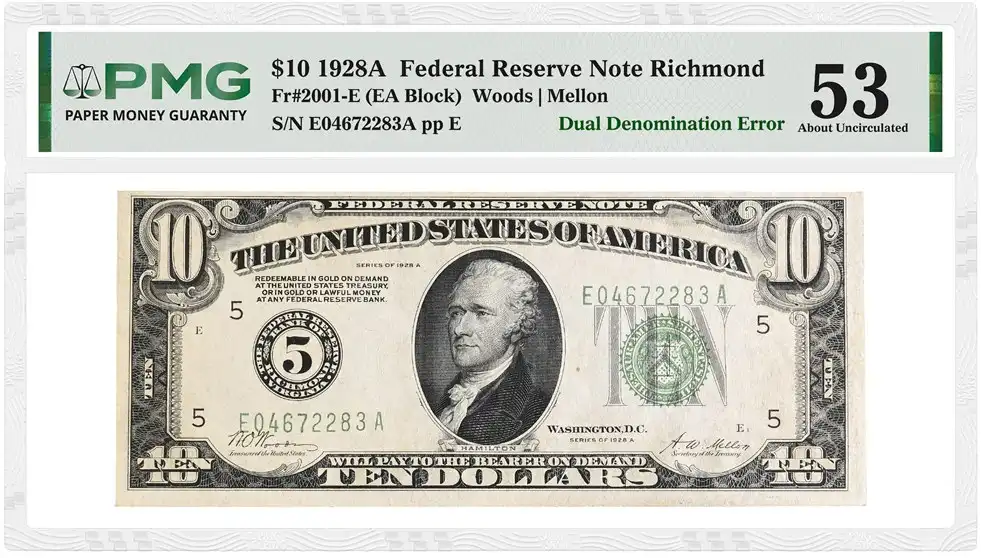
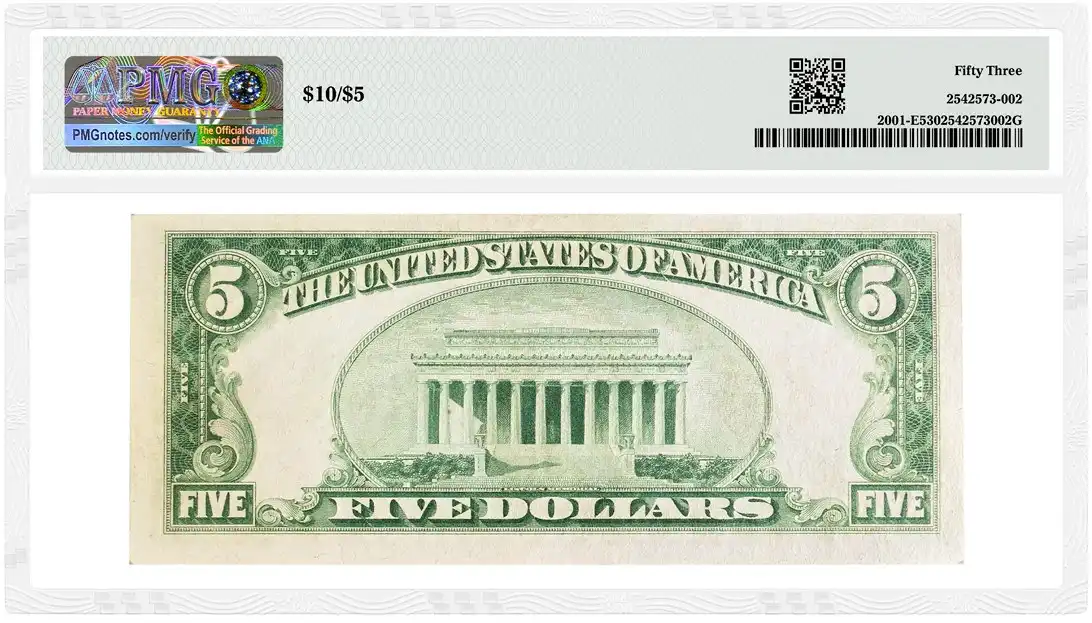
The note combines a $10 face featuring Alexander Hamilton with a $5 back depicting the Lincoln Memorial.
However, its history extends far beyond the printing floor of the Bureau of Engraving and Printing.
This particular example once belonged to Albert A. Grinnell, one of the most celebrated collectors in the history of American paper money.
On November 30, 1946, auctioneer Barney Bluestone conducted Part VII of the legendary Grinnell Collection sale.
Two consecutive lots contained half-sheets of six Richmond dual denomination notes. Together, they formed the original 12-note printing sheet.
The first group contained plate positions A through F. The second contained positions G through L.
The example in Heritage’s January auction occupied plate position E and originally appeared in Grinnell lot 5696.
Therefore, collectors can trace this particular banknote through approximately 80 years of documented numismatic history.
How many Examples Can Be Traced?
Heritage currently accounts for only about 10 examples of the Richmond error. Research into the original printing sheet suggests a maximum original population of 12 notes from that documented production incident.
Unlike many currency rarities, collectors can reconstruct the origin of this error through serial numbers and printing plate positions.
Heritage previously sold a PCGS Banknote Choice Uncirculated 63 example for $38,400 in September 2024. Another example, which carried a PMG 35 grade with comments, realized $20,400 in May 2025.
The upcoming example carries a PMG About Uncirculated 53 grade.
Its combination of exceptional rarity, early small-size currency history and Grinnell provenance makes it particularly appealing to advanced collectors.
Note Specifications
- Series: 1928A
- Type: Federal Reserve Note
- Face Denomination: $10
- Back Denomination: $5
- Federal Reserve District: Richmond, Virginia (E)
- Friedberg Number: Fr. 2001-E
- Serial Number: E04672283A
- Plate Position: E
- Face Design: Alexander Hamilton
- Back Design: Lincoln Memorial
- Grade: PMG About Uncirculated 53
- Pedigree: Albert A. Grinnell Collection, November 1946, Lot 5696
1934D Kansas City $5/$10 Error: A Remarkable Uncirculated Survivor
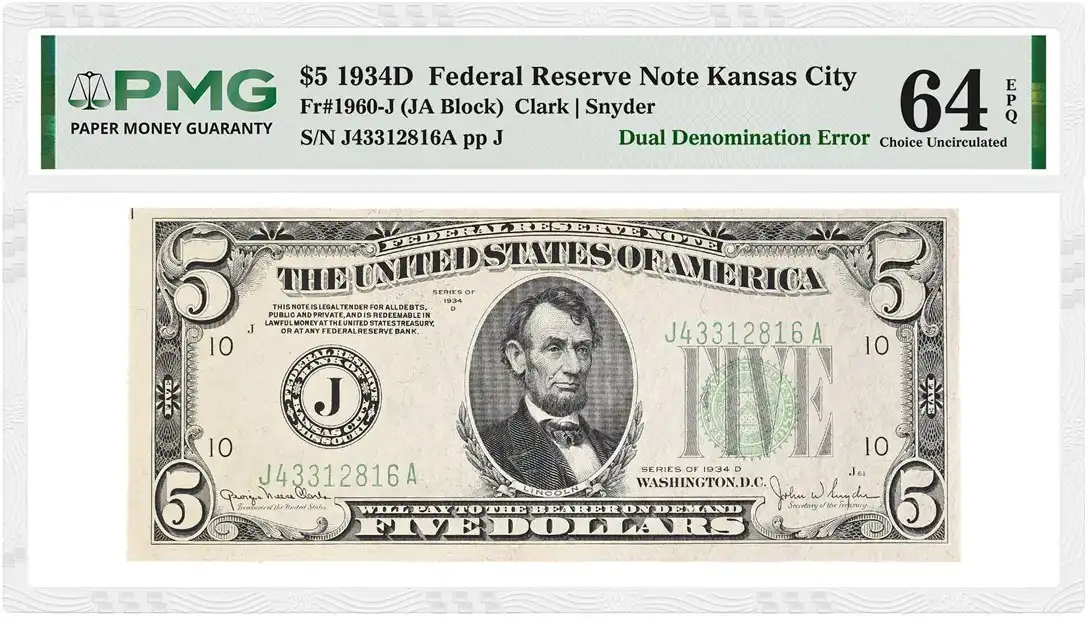
Image: 1934D Kansas City $5/$10 Dual Denomination Federal Reserve Note, PMG 64 EPQ. Courtesy of Heritage Auctions.
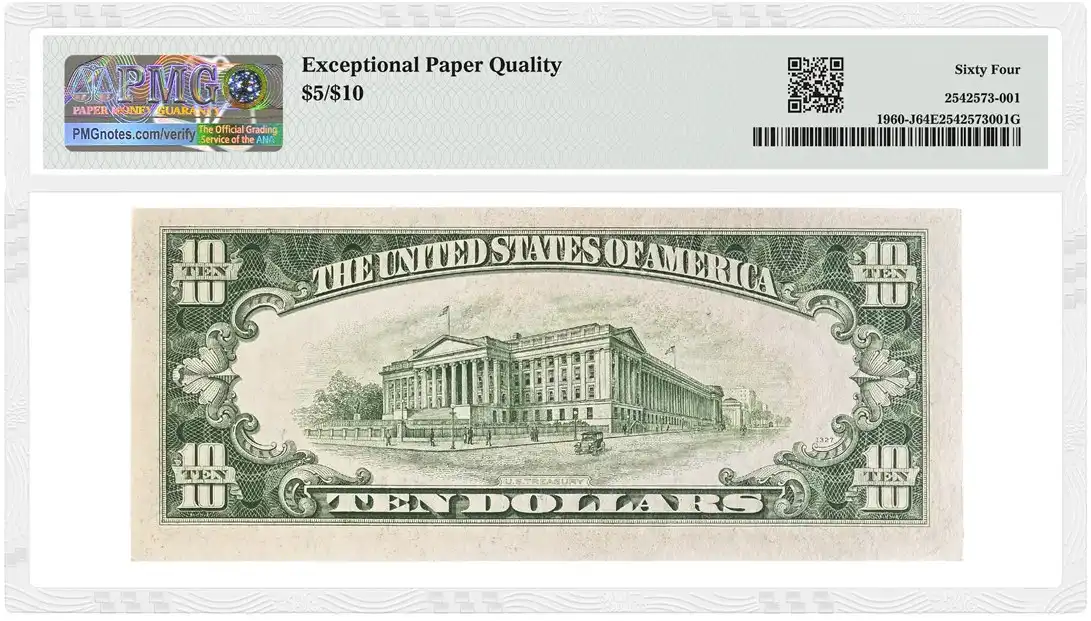
The third dual denomination error features Abraham Lincoln on the face of a $5 Federal Reserve Note. Turn it over, however, and the United States Treasury Building occupies the back of a $10 bill.
Interestingly, the Series 1934D designation does not mean the error occurred in 1934.
According to Heritage, these mismatched notes entered circulation between late 1950 and January 1951.
Approximately 40 examples appear in collector census records. Although that makes the Kansas City error the most plentiful of the four historic small-size dual denomination types, it hardly makes the note common.
Moreover, the upcoming example carries an impressive grade of PMG Choice Uncirculated 64 EPQ.
Its Serial Number also offers an Interesting Distinction
Heritage reports that neither of two major published error-note censuses lists this particular example.
In other words, the note adds another documented serial number to the surviving population.
Collectors place considerable importance on the EPQ designation.
PMG uses this designation when its graders consider a note’s paper original and find no processing intended to improve its apparent grade.
Previous auction results illustrate the desirability of high-grade Kansas City examples.
A PMG 65 EPQ specimen realized $38,400 at Heritage in January 2023. Additionally, a PMG 64 EPQ example brought $28,800 in May 2025.
For collectors seeking an outstanding uncirculated representative of the “King of Errors,” the January offering deserves close attention.
Note Specifications
- Series: 1934D
- Type: Federal Reserve Note
- Face Denomination: $5
- Back Denomination: $10
- Federal Reserve District: Kansas City, Missouri (J)
- Friedberg Number: Fr. 1960-J
- Serial Number: J43312816A
- Face Design: Abraham Lincoln
- Back Design: United States Treasury Building
- Grade: PMG Choice Uncirculated 64 EPQ
All three notes follow the standard small-size U.S. currency format of approximately 6.14 × 2.61 inches (156 × 66.3 mm). Standard American currency paper consists of 75 percent cotton and 25 percent linen.
Why Collectors Consider Dual Denomination Notes the King of Errors
Paper money collectors pursue a wide range of printing mistakes. These include inverted backs, missing serial numbers, misaligned printing, gutter folds and cutting errors.
However, dual denomination errors occupy a special place within the hobby.
First, they combine extreme rarity with immediate visual appeal. Even someone with no knowledge of numismatics can recognize the mistake.
Second, they challenge the most fundamental purpose of money: communicating its monetary value clearly and consistently.
Finally, each surviving note documents an extraordinary breakdown in currency production and quality control.
The BEP today employs sophisticated computer-assisted inspection systems that examine both sides of currency sheets. These technological advances make a similar error considerably more difficult to escape detection.
As a result, the surviving historic examples offer tangible evidence of an earlier era of American currency manufacturing.
Three Rare Notes and a History of Five-Figure Auction Prices
According to PMG, approximately two dozen examples of BEP-produced, PMG-certified dual denomination errors have crossed the Heritage auction block during the past decade. Every one realized a five-figure price.
PMG anticipates that each of the three notes in the January 2027 auction will bring well over $10,000.
Of course, individual rarity, condition, provenance and competition among bidders will ultimately determine their prices.
Nevertheless, the opportunity to acquire three of the four historic small-size dual denomination error types in one auction stands out.
Each represents a mistake that government officials never intended the public to see. Today, those same mistakes rank among the most desirable treasures in American paper money.
For the Bureau of Engraving and Printing, they represented costly production failures.
For collectors, they represent some of its most fascinating creations.
Heritage Auctions’ FUN U.S. Currency Signature Auction #3603 runs January 13–15, 2027.