Five Pieces of American Money That Bring Thanksgiving History to Life
From the Pilgrims’ voyage aboard the Mayflower to a new dollar coin honoring Native American generosity, America’s money offers a remarkable perspective on the history behind Thanksgiving.
A silver half dollar carries a portrait of a man whose actual appearance remains a mystery. A rare $10,000 bill depicts a prayer aboard a ship that never completed its voyage to America. Meanwhile, a new 2026 dollar coin honors a woman whose generosity helped sustain George Washington’s army.
Together, these pieces tell a remarkable American story.
For generations, American coins and currency have preserved elements of the history behind Thanksgiving. Their designs celebrate exploration, religious faith, diplomacy, perseverance, and generosity.
However, they also reveal how America’s interpretation of its early history has changed.
From classic silver commemoratives to modern gold coins, collectors can assemble a fascinating numismatic tribute to Thanksgiving. Some pieces remain within reach of beginning collectors. Others rank among the great treasures of American numismatics.
Before the First Thanksgiving: A Remarkable $10,000 Bill
One of America’s most extraordinary banknotes tells a story that begins more than a year before the celebrated harvest gathering of 1621.
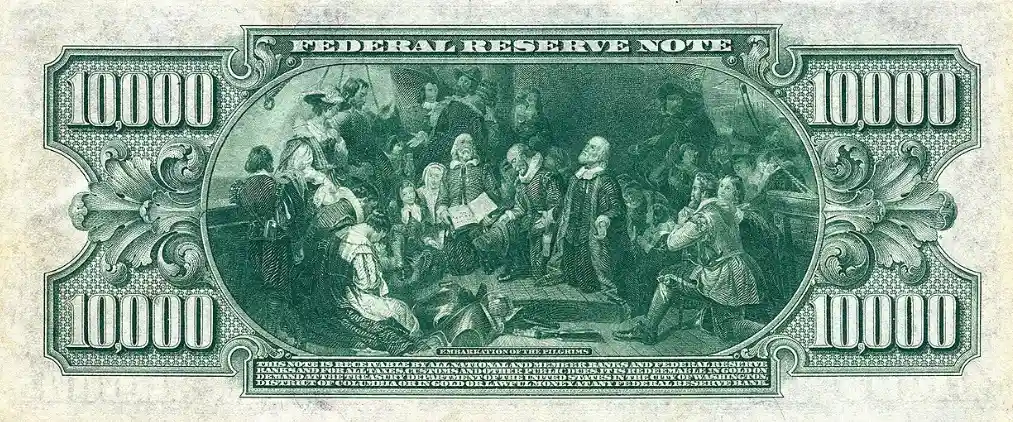
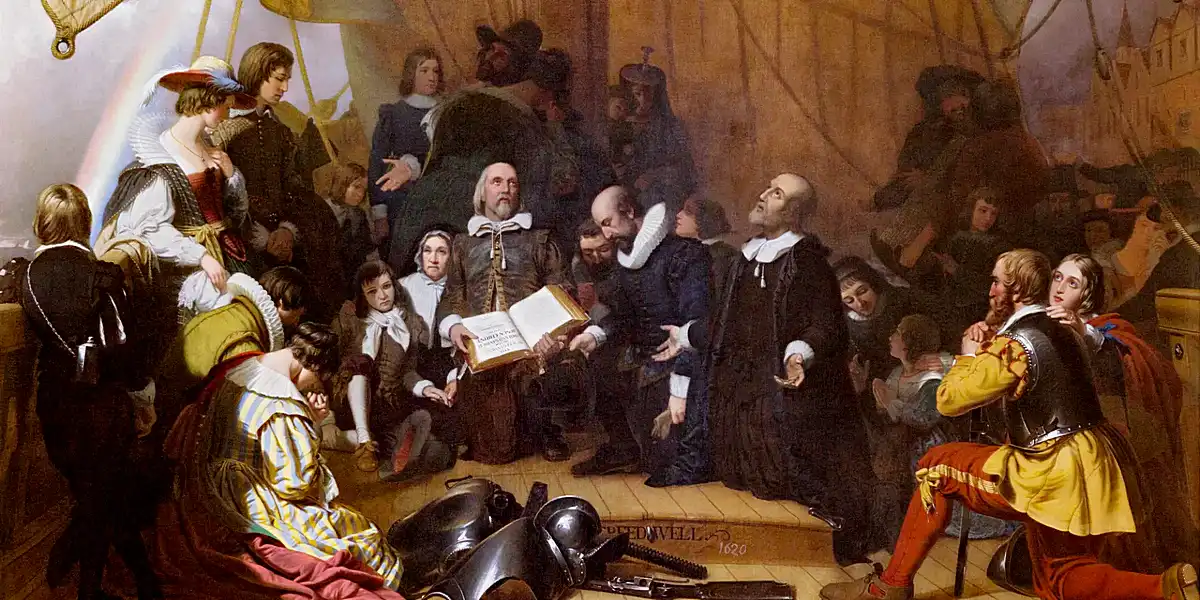
The reverse of the Series 1918 $10,000 Federal Reserve Note features an engraving derived from Robert Walter Weir’s painting, Embarkation of the Pilgrims.
Surprisingly, the ship in the painting is not the Mayflower.
Instead, Weir depicts the Pilgrims aboard the Speedwell at Delfshaven, Holland, on July 22, 1620. Before leaving, the passengers gather in prayer.
William Brewster holds a Bible. John Carver kneels with his head bowed. Pastor John Robinson raises his arms toward heaven.
The passengers sought divine protection for their uncertain journey.
However, the Speedwell developed leaks after leaving England. Eventually, its passengers abandoned the ship, and some continued their journey aboard the Mayflower.
Weir completed his monumental Capitol painting in 1843. Measuring 12 by 18 feet, it remains on display in the United States Capitol Rotunda.
Interestingly, Weir produced a smaller version in 1857. According to the Architect of the Capitol, engravings of this later painting appeared on American currency, including the $10,000 Federal Reserve Note.
The banknote’s obverse features Salmon P. Chase, who served as Secretary of the Treasury under Abraham Lincoln and later as Chief Justice of the United States.
Although the enormous denomination had little practical use for ordinary Americans, the government did issue $10,000 notes to the public.
Today, the Series 1918 issue represents an exceptionally difficult acquisition for collectors.
Its historical significance, elaborate engraving, and extraordinary denomination make it one of the most compelling pieces of American paper money connected with the Thanksgiving story.
The Pilgrim Half Dollar: A Ship With a Historical Mistake
In 1920, the United States celebrated the 300th anniversary of the Pilgrims’ arrival at Plymouth.
To help finance the celebrations, Congress authorized a commemorative silver half dollar on May 12, 1920.
The Pilgrim Tercentenary Half Dollar belongs to America’s classic commemorative coin series. However, its design contains two interesting historical peculiarities.
American sculptor Cyrus E. Dallin created both sides of the coin.
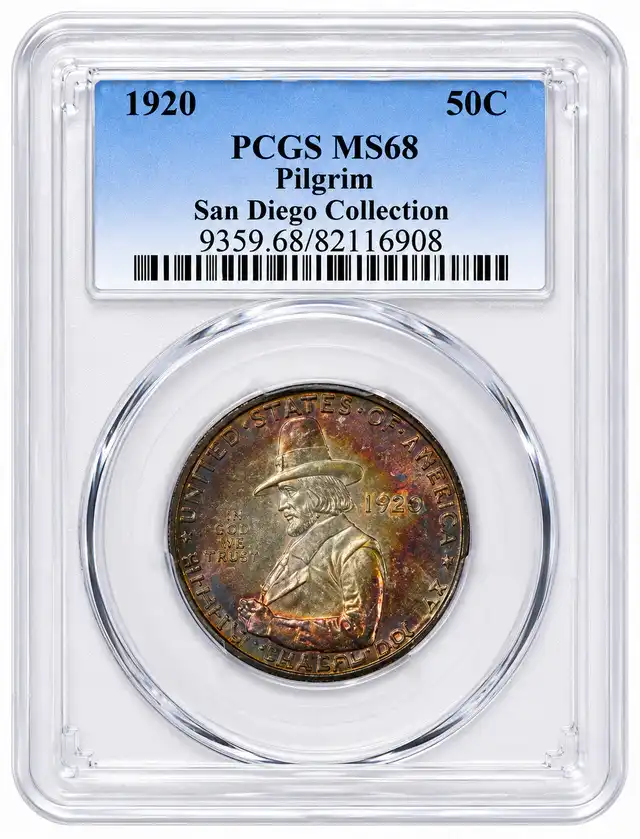
The obverse portrays William Bradford, who served as governor of Plymouth Colony for much of its early history. Bradford wears traditional Pilgrim clothing and carries a Bible.
Yet no authenticated contemporary portrait of Bradford survives. Consequently, Dallin created an artistic interpretation rather than a documented likeness.
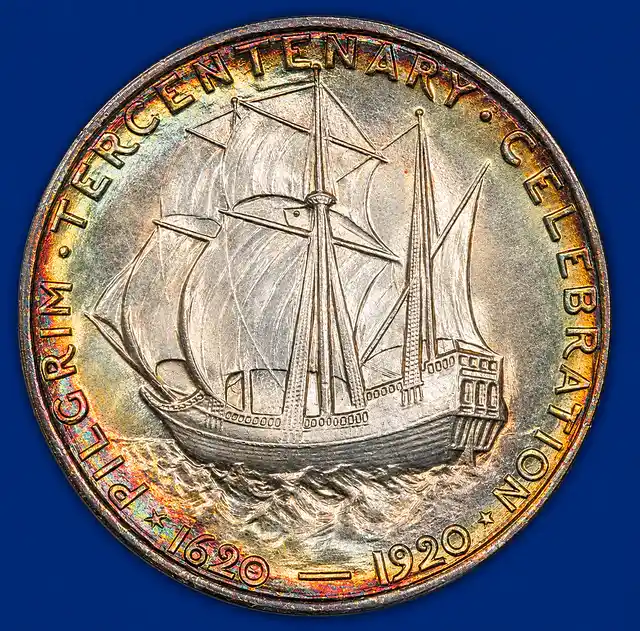
Meanwhile, the reverse depicts the Mayflower under sail.
Look closely at the ship’s rigging. Dallin included a triangular sail that numismatic references identify as inappropriate for the historical vessel.
Despite this discrepancy, the design remains one of the most recognizable maritime images on classic American commemorative coinage.
Why the 1921 Pilgrim Half Dollar Is Scarcer
The Philadelphia Mint produced the Pilgrim half dollar in both 1920 and 1921.
The coins contain 90% silver and 10% copper. Each weighs 12.5 grams and contains approximately 0.3617 troy ounces of pure silver.
The Pilgrim Tercentenary Commission originally offered the coins for $1 each, twice their face value.
However, sales ultimately fell short of expectations.
The commission returned substantial quantities to the Mint for melting. As a result, the two issues have dramatically different net mintages.
- Pilgrim Half Dollar: 1920 – 1921
- Original production, including assay coins: 1920 – 200,112 1921 – 100,053
- Returned for melting: 1920 – 48,000 1921 – 80,000
- Net mintage: 1920 – 152,112 1921 – 20,053
- Original selling price: $1
Sources: Q. David Bowers’ commemorative coin reference and GreatCollections auction records. The 1921 issue has roughly one-seventh the net mintage of its predecessor. Consequently, collectors typically pay more for the second-year issue.
The 1921 coin also carries an additional date on the obverse, making the two issues easy to distinguish.
Pilgrim Half Dollars at Auction
More than a century after their introduction, exceptional Pilgrim half dollars continue to attract competition at major numismatic auctions.
In January 2026, GreatCollections sold a toned 1921 Pilgrim half dollar graded PCGS MS-67. Additional Superb Gem examples appeared throughout the year.
In March, Heritage Auctions sold a PCGS MS-67 example of the 1921 issue for a reported $2,074.
Meanwhile, GreatCollections offered a particularly attractive 1920 Pilgrim half dollar graded PCGS MS-67+ with CAC Green approval in September 2026.
In November, another 1921 Pilgrim half dollar graded PCGS MS-67 with CAC Green approval attracted 34 bids at GreatCollections.
These appearances demonstrate that collectors continue to pursue exceptional examples of both dates. Original surfaces, attractive toning, strong luster, and exceptional preservation remain important considerations.
The 2011 Wampanoag Dollar: The Alliance Behind Thanksgiving
While the Pilgrim half dollar emphasizes the settlers’ voyage, a modern United States dollar tells another essential part of the story.
In 2011, the United States Mint honored the historic alliance between the Wampanoag people and the English settlers at Plymouth.
The agreement dates to March 1621.
The colonists had endured a devastating winter. Meanwhile, the Wampanoag people faced their own challenges, including the consequences of epidemics and regional political rivalries.
Under the leadership of Ousamequin, also known as Massasoit, the Wampanoag entered into an agreement of mutual protection with the Plymouth settlers.
The alliance helped the fledgling colony survive.

Several months later, the English celebrated their successful harvest.
Edward Winslow, a participant in the gathering, recorded that Ousamequin and approximately 90 of his men joined the colonists for three days of festivities. The Wampanoag contributed five deer.
However, the surviving account leaves many questions unanswered. Historians cannot establish precisely why the Wampanoag joined the gathering or identify everyone who participated.
Moreover, Native American traditions of giving thanks long predate the arrival of European settlers.
Only centuries later did Americans widely associate the 1621 harvest celebration with the modern Thanksgiving holiday.
A Dollar Coin Celebrates Diplomacy
The reverse of the 2011 Native American dollar features the hands of Ousamequin and Plymouth Governor John Carver symbolically presenting a ceremonial peace pipe.
Richard Masters designed the reverse, and United States Mint sculptor Joseph Menna executed the design.
The inscription WAMPANOAG TREATY 1621 identifies the historical agreement.
On the obverse, Glenna Goodacre’s familiar portrait depicts Sacagawea carrying her infant son, Jean Baptiste.
The coin also carries its date, mintmark, and E PLURIBUS UNUM inscription along the edge.
Unlike the rare $10,000 banknote, the Wampanoag dollar offers collectors an inexpensive way to acquire a piece of American money with a direct connection to Thanksgiving history.
The Mint produced Philadelphia and Denver business strikes, as well as San Francisco Proof examples.
The coin’s importance lies not in its monetary value, but in its recognition of the diplomacy that preceded the celebrated harvest gathering.
The 2020-W Mayflower Gold Coin: A Different Perspective
A century after the introduction of the Pilgrim half dollar, the United States Mint returned to the story of the Mayflower.
This time, however, the Mint approached the anniversary differently.
In 2020, the United States Mint partnered with Britain’s Royal Mint to commemorate the 400th anniversary of the transatlantic voyage.
Artist Chris Costello developed a series of complementary designs that explored the experiences of both the European settlers and the Indigenous people whose homeland they entered.
The American $10 gold coin presents a particularly striking example.
Rather than focusing exclusively on the arriving settlers, its obverse depicts a Wampanoag family observing the Mayflower from their homeland of Patuxet.
A young boy steps across the border of the design. According to the Mint, this artistic device represents the meeting of the two communities.
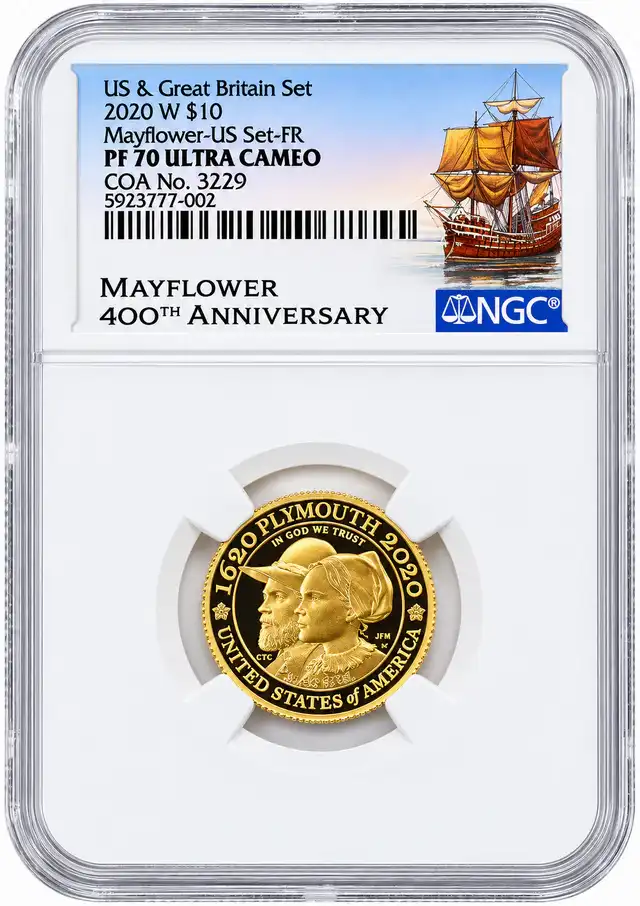
On the reverse, a Pilgrim man and woman look toward their future. Two mayflower blossoms frame their portraits.
Phebe Hemphill sculpted the obverse, while Joseph Menna sculpted the reverse.
The West Point Mint produced the coin in .9999 fine gold, with a weight of one-quarter troy ounce and a diameter of 22 millimeters.
A Limited-Edition Reverse Proof
The United States Mint offered the conventional Proof gold coin alongside a British £25 gold coin in a special two-coin set.
However, collectors could also purchase the American gold coin individually in a Reverse Proof finish.
The Mint released the individual Reverse Proof on November 17, 2020, with a maximum mintage of 5,000.
Published numismatic references report a final mintage of 4,881.
Unlike a traditional Proof, the Reverse Proof features brilliantly polished design elements against frosted fields.
The effect gives the coin a distinctive appearance and emphasizes the figures within Costello’s design.
During 2026, GreatCollections recorded multiple auction appearances of the Reverse Proof gold coin in grades 69 and 70, including examples in March, April, May, July, August, and November.
The coin offers an appealing combination of precious-metal content, limited production, artistic merit, and historical significance.
A Companion Silver Medal Worth Collecting
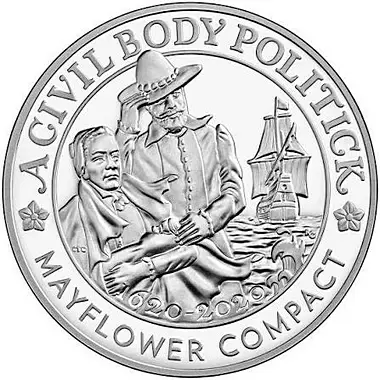
The anniversary program also included an American silver medal that deserves attention from Thanksgiving-themed collectors.
One side depicts a Pilgrim family enduring the cold weather associated with their arrival.
The other portrays a Wampanoag man and woman tending crops.
The inscription SUSTAINERS OF LIFE recognizes Indigenous agricultural knowledge and practices.
Together, the gold coin and silver medal provide complementary perspectives on the difficulties of settlement and the importance of Native American assistance.
New for 2026: The Dollar Coin That Celebrates Generosity
In 2026, the United States Mint added another remarkable chapter to this numismatic story.
Although the coin does not commemorate the Pilgrims or the 1621 harvest celebration, its subject embodies one of Thanksgiving’s enduring themes: generosity in times of hardship.
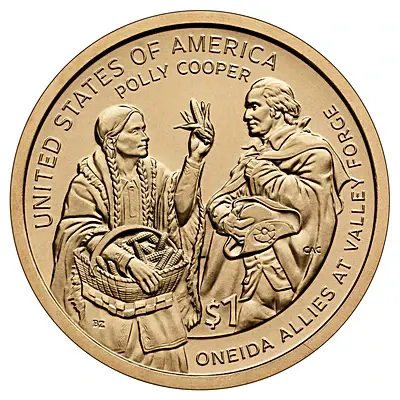
The 2026 Native American $1 Coin honors Polly Cooper and the Oneida Indian Nation for their contributions during the American Revolutionary War.
During the winter encampment at Valley Forge in 1777–1778, George Washington’s Continental Army faced severe hardships.
The Oneida, who supported the American cause, provided food and assistance.
According to Oneida oral tradition, Polly Cooper helped American soldiers prepare dried white corn. She also remained with the troops to continue providing assistance after other members of her community returned home.
The United States Mint released the 2026 Native American dollar in rolls and bags on January 27.
Its reverse depicts Cooper holding a basket of corn as George Washington holds his hat in acknowledgment.
The inscriptions include POLLY COOPER and ONEIDA ALLIES AT VALLEY FORGE.
More than 150 years separate the Wampanoag alliance at Plymouth from the Oneida assistance at Valley Forge. Nevertheless, both dollar coins recognize important Indigenous contributions to American history.
Together, the 2011 and 2026 Native American dollars make a particularly meaningful pairing for Thanksgiving.
Collecting the American Story of Thanksgiving
Few collecting themes span such a remarkable range of American numismatics.
The Pilgrim half dollars represent the classic commemorative era. The Wampanoag dollar recognizes diplomacy. The Mayflower gold coin explores the encounter between two cultures. The 2026 Polly Cooper dollar honors generosity and sacrifice.
Meanwhile, the extraordinary $10,000 Federal Reserve Note preserves one of America’s most ambitious historical artworks in miniature.
Not every collector can own all these pieces. Fortunately, a meaningful Thanksgiving collection need not require a substantial investment.
A pair of Native American dollars offers an excellent starting point. A classic Pilgrim half dollar adds a century-old connection to America’s commemorative coinage.
Ultimately, these coins and banknotes preserve more than portraits, dates, and denominations.
They document how successive generations of Americans have remembered their history, reconsidered its meaning, and expressed those interpretations through the art of money.
That is something worth reflecting upon this Thanksgiving.
For additional reading, see CoinWeek’s 2025 feature, Thanksgiving Day Reflections Through Numismatics.