

1937-D 3-Legged Buffalo Nickel: Value, History, and the $84,000 Stack’s Bowers Specimen
By CoinWeek Notes
The 1937-D 3-Legged Buffalo Nickel ranks among the most famous modern United States coins. It also stands as the best-known issue in the Buffalo, or Indian Head, Nickel series.
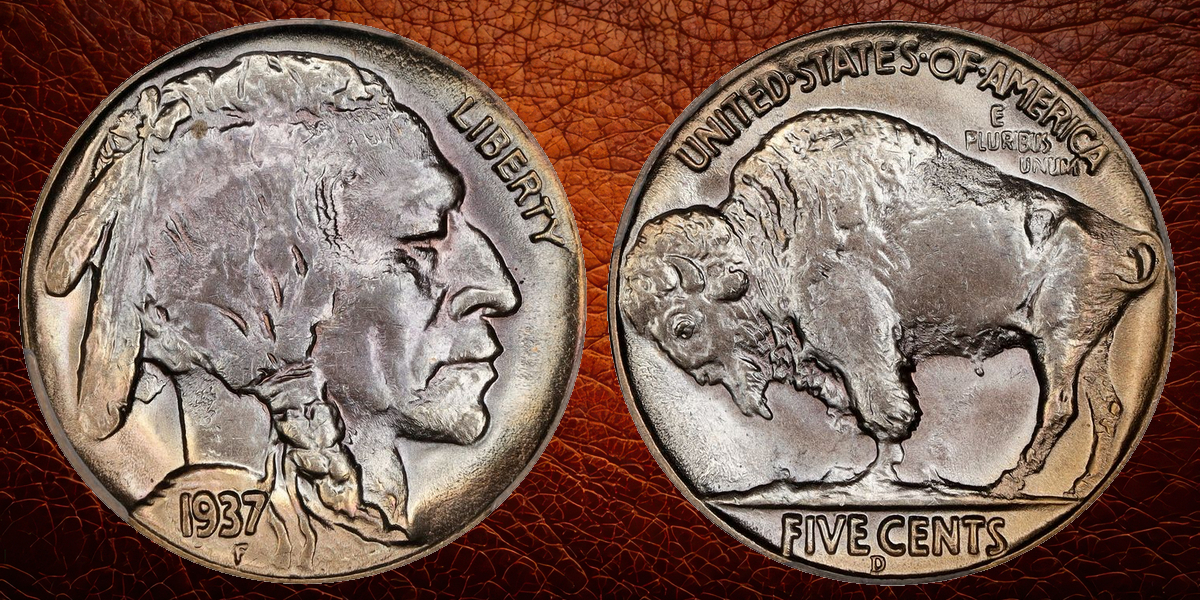
Collectors love it because the coin tells a complete story. It has Mint pressure, a dramatic die failure, Montana discovery lore, and a market that still rewards top-quality survivors.
Yet the nickname can mislead new collectors. The Denver Mint did not create a new design with three legs. The bison’s missing foreleg came from a damaged and heavily polished reverse die. For that reason, specialists classify the coin as an Abraded Die Reverse. PCGS also recognizes it as the 1937-D 5C 3 Legs, FS-901, and lists the standard 1937-D mintage at 17,826,000.
How the 1937-D 3-Legged Buffalo Nickel Happened
The story begins with a worn reverse die at the Denver Mint.
Clash marks likely triggered the repair. Clash marks appear when the obverse and reverse dies strike each other without a planchet between them. Under normal Mint practice, workers would remove a badly clashed die from service.
>However, the Denver Mint needed to produce nickels quickly. So, instead of retiring the die, Mint employees tried to repair it. They polished the reverse die too heavily. As a result, they removed most of the bison’s front right leg between the hoof and the thigh. The hoof remained.
That mistake created one of the most recognizable coins in American numismatics.
A.D. Craig offered one early version of the story in 1963. Later, Walter Breen added detail and named a press operator, “Mr. Young,” as the person who used a polishing rod to remove clash marks rather than replace the dies. Other numismatists favor a simpler explanation. The Mint may have tried to extend the life of a worn and rusted die pair. Many genuine examples show deep die rust on both sides, which supports that possibility.
Either way, the die work went too far. It removed the shallowest part of the reverse design. Then the Mint placed the die back into service.
Why the Coin Entered Circulation
The 1937-D 3-Legged Buffalo Nickel did not leave the Mint as a special issue. Instead, it entered normal commerce through Treasury shipments to banks.
Mint employees either missed the missing leg or chose not to stop production. Every genuine example came from one reverse die. Because of that, experts have long estimated that only about 20,000 pieces may have been struck, although PCGS notes that certification totals may suggest a higher production figure. PCGS currently estimates about 10,000 survivors in all grades, with about 1,400 in Mint State and about 100 in MS65 or better.
C.L. “Cowboy” Franzen and the Montana Discovery
The 3-Legged Buffalo Nickel became famous almost immediately.
Montana coin dealer C.L. “Cowboy” Franzen found examples in late 1937. Soon afterward, he marketed them to collectors through The Numismatic Scrapbook. Early reports point to Montana as the main distribution area, especially around Bozeman. Heritage Auctions also notes that C.L. Franzen either discovered or first publicized the variety in 1937-38.
Early offerings likely involved small groups. In some cases, dealers may have sold individual coins cherry-picked from circulation. As a result, most pieces continued to circulate. By the time collectors and dealers recognized many of them, those coins had already picked up wear.
By 1965, Laguna Hills, California dealer Ken Nichols offered examples from Fine to About Uncirculated for $40 to $95 each. Earlier inflation adjustments placed that range at roughly $377 to $895. Current inflation math pushes the modern equivalent somewhat higher.
What Is the 1937-D 3-Legged Buffalo Nickel Worth?
The 1937-D 3-Legged Buffalo Nickel remains scarce in circulated grades. However, it does not qualify as rare in the same way that many low-mintage classics do. Demand drives much of the value.
That demand starts in low grades. In Good-4 to Good-6, collectors should expect strong prices, often in the hundreds of dollars. Earlier CoinWeek market data placed low-grade examples around $200 to $500. More recent guide data show that circulated examples can range much higher depending on grade, surface quality, and certification. NGC’s April 2026 guide summary lists circulated 1937-D 3 Legs nickels at $350 to $1,950.
Prices rise quickly in Extremely Fine. XF coins often trade around $900 to $1,500. In AU55 to AU58, many examples bring roughly $1,250 to $2,000 or more.
Auction results show why certification and images matter. In August 2022, an eBay seller offered a self-graded AU58 example that sold for $427. The photo looked blurry, so buyers could not easily confirm the attribution. By contrast, Heritage Auctions sold an attractive AU58 with subtle orange-purple toning and a green CAC sticker for $2,100 that same month. By 2024, CoinWeek estimated a similar certified AU58 at about $2,100 to $2,300.
Mint State Demand Remains Strong
Mint State examples bring a much larger premium.
Many Uncirculated pieces show soft strikes, dull luster, or other limitations. As a result, MS60 to MS63 examples appear more often than true Gems. Stack’s Bowers and Heritage have both noted that certified populations in lower Mint State grades likely include many resubmissions. In other words, the numbers may count grading events, not distinct coins.
>Even so, Gem survivors stand apart. At MS64, examples regularly trade in the $5,000 to $9,000 range. The market climbs sharply for MS65, MS66, and MS66+ coins.
PCGS lists the auction record at $99,875 for a PCGS MS66+ example sold by Legend Rare Coin Auctions on October 28, 2021.
The $84,000 Stack’s Bowers MS66+ CAC Coin
One of the great modern appearances came in Stack’s Bowers Galleries’ August 2023 Global Showcase Auction.
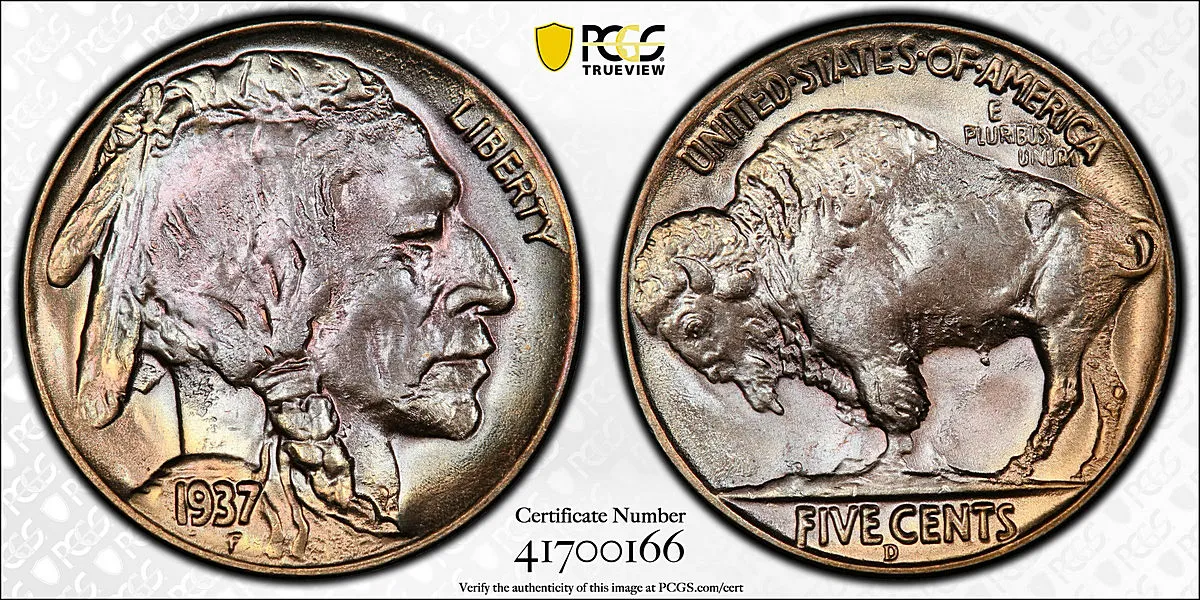
Stack’s Bowers offered Lot 5021 in Session 6, Rarities Night, on August 16, 2023. The coin carried a PCGS MS66+ grade and CAC approval. It sold for $84,000.
PCGS confirms the same specimen’s path through several major sales. The coin appeared first in an NGC MS67 holder as certification #3051481-016. Heritage Auctions sold it on April 28, 2016, for $85,187.50. Heritage later offered it in the Black Diamond Collection on January 10, 2019, where it brought $66,000. After crossover to PCGS MS66+ CAC, Legend Rare Coin Auctions sold it in October 2021 for $99,875. Stack’s Bowers then sold it on August 16, 2023, for $84,000.
The coin’s appearance explains its status. It shows booming luster on both sides. It also carries a bold strike, including detail at the central obverse high point and across the bison’s shoulder. In addition, the toning forms rings of golden-apricot and silver-lilac color. Stack’s Bowers cataloger JLA ranked it among the finest 3-Legged Buffalo Nickels he had handled.
The coin also served as the primary plate coin for the variety on PCGS CoinFacts, according to the Stack’s Bowers provenance note.
Other Noteworthy Specimens
Top-population data can change. Therefore, collectors should always confirm live PCGS, NGC, and CAC reports before bidding.
As of March 2025, CoinWeek listed the top census points as PCGS MS66+ with five examples, NGC MS67 with two examples, and CAC MS66 with eight stickered examples and none graded by CAC at that level. PCGS currently lists multiple MS66+ examples in its condition census and also records a December 17, 2025 Legend sale at $88,125 for another PCGS MS66+ coin.
Two pieces deserve special mention:
- PCGS MS66+ CAC #41700166
This coin once resided in an NGC MS67 holder as #3051481-016. Heritage sold it in April 2016 for $85,187.50. Heritage sold it again in January 2019 for $66,000. Legend sold it as PCGS MS66+ CAC in October 2021 for $99,875. Stack’s Bowers sold it in August 2023 for $84,000. The coin shows flashy luster with pastel violet, gold, and latte-toned color. - PCGS MS66+ #37816200
Heritage Auctions sold this example on January 9, 2020, for $72,000. Heritage described it as sharply detailed, vibrant, and tied for finest certified at PCGS at that time.
How to Identify a Genuine 1937-D 3 Legged Nickel
Collectors should look for more than a missing leg.
A genuine 1937-D 3-Legged Buffalo Nickel keeps the hoof. The bison’s rear right leg often looks rough or pock-marked. Many genuine coins also show a raised die-rust line between the foreleg area and the rear leg. Specialists sometimes call this diagnostic the “Urinating Buffalo” line.
Counterfeits and altered coins exist. For that reason, buyers should favor PCGS, NGC, or CAC-certified examples. They should also compare the coin with known diagnostics before buying raw pieces.
Obverse Design
James Earle Fraser designed the Buffalo Nickel.
The obverse shows a large right-facing portrait of a Native American man. Fraser did not create a portrait of one person. Instead, he built a composite image. Numismatic tradition names Iron Tail of the Sioux, Two Moons of the Cheyenne, and Big Tree, often identified as a Kiowa figure, as the principal models. Other claimants, including John Big Tree of the Seneca, also entered the story over time.
The portrait shows two feathers woven into the hair. A braid runs down the side of the head. On the 1937-D 3-Legged Buffalo Nickel, die rust often appears at the nape of the neck.
The date 1937 sits on the truncation of the bust. LIBERTY appears near the rim at about 2 o’clock.

Reverse Design
The reverse shows an American bison. Numismatic tradition identifies the model as Black Diamond, a bison associated with New York’s Central Park Zoo. Scholars continue to debate details of that story, but the Black Diamond connection remains central to Buffalo Nickel lore.
Normal 1937-D nickels show all four legs. The 3-Legged variety lacks most of the front right foreleg. It keeps the hoof. The rear right leg also shows weakness and roughness.
The bison stands on a small strip of ground. Below it, the coin displays FIVE CENTS and the D mintmark for Denver. UNITED STATES OF AMERICA arcs above the bison. E PLURIBUS UNUM appears between AMERICA and the bison’s back.
The design does not include IN GOD WE TRUST. According to numismatic researcher Roger Burdette, Mint Director George Roberts told Fraser that the motto was not required on the nickel.
Edge
The 1937-D 3-Legged Buffalo Nickel has a plain edge. It carries no lettering, reeding, or ornamentation. PCGS lists the edge as plain.
James Earle Fraser
James Earle Fraser worked as one of America’s major sculptors in the first half of the 20th century. He was born in Winona, Minnesota, and grew up with strong ties to the American West. He later attended the Art Institute of Chicago.
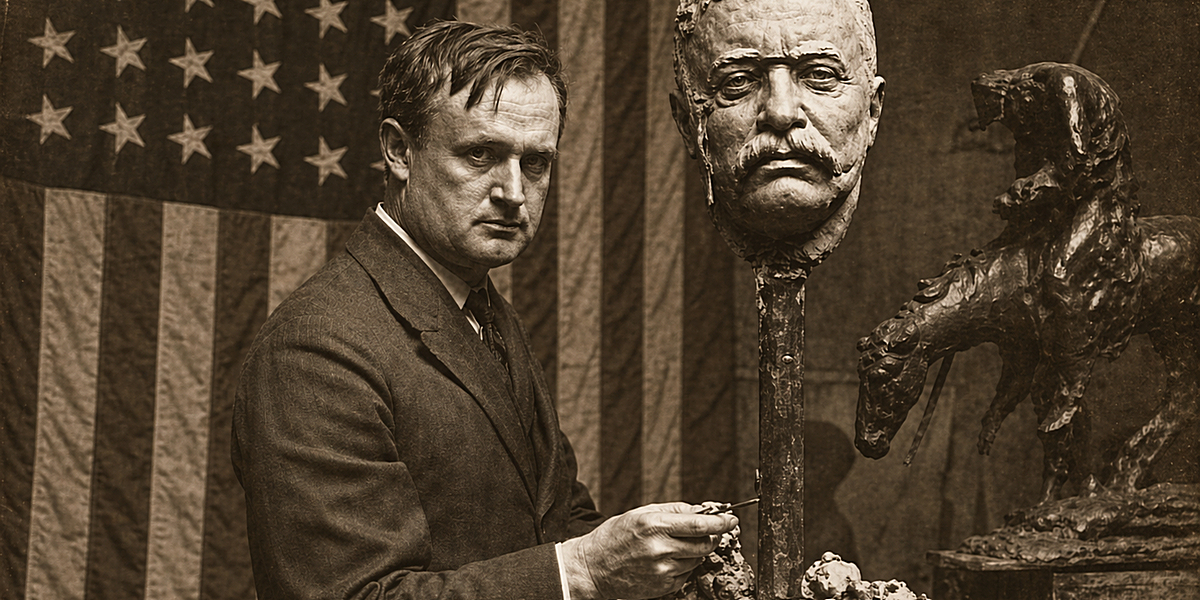
Fraser’s best-known sculpture, End of the Trail, gained national attention after its monumental plaster version appeared at the 1915 Panama-Pacific International Exposition in San Francisco.
His Native American and Western subjects shaped much of his career. They also shaped his 1913 Indian Head, or Buffalo, Nickel design.
Coin Specifications
- Country: United States of America
- Year of Issue: 1937
- Denomination: Five Cents
- Mintmark: D
- Mint: Denver
- Mintage: Unknown for the 3-Legged variety; part of the standard 1937-D issue of 17,826,000
- Variety: FS-901, 3-Legged
- Alloy: 75% copper, 25% nickel
- Weight: 5.00 grams
- Diameter: 21.20 mm, listed by PCGS; often rounded in references to 21.1 mm
- Edge: Plain
- Designer: James Earle Fraser
- Quality: Business Strike
Why Collectors Still Chase It
The 1937-D 3-Legged Buffalo Nickel has everything collectors want.
It has a dramatic look, simple nickname, and a real Mint story. It also has enough surviving examples to keep the market active, but not enough top-grade pieces to satisfy advanced collectors.
That balance explains its lasting power. Circulated examples remain attainable for many collectors. Meanwhile, coins like the Stack’s Bowers MS66+ CAC specimen show how intense demand becomes when strike, luster, preservation, color, and provenance meet in one coin.
The Denver Mint created the problem by trying to save a die. Collectors created the legend by searching their change. Nearly 90 years later, the 1937-D 3-Legged Buffalo Nickel still commands attention every time a premium example crosses the auction block.
How much would a no date Denver mint indian head nickel with the 3- legged buffalo on reverse bring in value?
Unless there’s some way to prove it’s a 1937, it’s doubtful the coin is worth much. Buffalo nickels had a design flaw that caused the dates to wear off very quickly. In general no-date buffs are considered to be grab-bag candidates, sad to say. You may still want to have it checked in person, though, just to be sure.
FWIW a “date restorer” like Nic-a-Date can often reveal a worn date, but these liquids use acid to etch the metal. That will significantly reduce – sometimes destroy – the coin’s value as a collectible.
I have a 1937 s four legged buffalo nickel is it worth much
Walter Breen, convicted pedophile who died in prison. The article is tainted by mention of him.
Never heard of this but I’m glad I did. I looked up to this person in Numismatics!
Pockmarked, not “pot-marked”.
You can’t cause this 3-leg error by polishing a die..a die is a negative image. The hub contains the positive image and could be abraded to cause the defect, however the more practical and generally accepted cause of the defect is metal debris in the leg hollow on the die.
What about a discussion of the myriad copy of the 37-D three leg that look AU, don’t say “copy” on them and are selling for 19.95 to $40 on Shopify and other sites. How is a buyer supposed to buy a raw coin with these around. Also, is it possible that the certification slabs are faked and contain the counterfeit? Looks like a used coin certified and in slab is my option?
Interesting
Would a 4 legged version 1937-D buffalo from the same dies use for the 3 legged nickel be worth anything more?
Always on lookout for any error coins
I’ve also heard reference to a 3 1/2 leg Buffalo. Not sure if it’s the 37-D or another year and mint. Has anyone ever heard of it?
I need to check my Dad’s collection.
One of the best looking US coins ever.
Nice!
It’s hard to ride a 3 legged buffalo I hear!
Some really beautiful examples shown in the article.
Agree, these are terrific pictures. I’ve seen pictures of some circulated coins that were so worn it was hard to pick out the error.
I don’t have any 3 legged ones but have many buffalos and these, along with war nickels, are my favorite, 2nd to the wheat penny. !!
this is one variety I do not have. I owned a 1955 DDO cent, but never a 3 leg. I may have to go out and get one now.
When I was a little kid, my grandmother told me to watch out for a 3-legged buffalo nickel, explaining to me they were rare and quite valuable. Been watching out for one ever since.
Impressive Coin
I keep looking – maybe someday
I’m always looking to find one.
I’ve looked for one for years and years.
Very interesting article. Well researched and well written.
Wish I had looked through all those nickels when I was a kid in the fifties.
Fascinating story. What history!
I think the buffalo nickel is one of our nicest coins.
I have NEVER found one of these! 1000’s of nickels looked through, 100 ish bufs and not a single 3 leg! lol
Interesting coin!
20th century classic.
Definitely interesting
Good article on how and why these error coins were most likely to have been made and circulated.
I always check undated “D” Buffalo nickels for this variety. You never know, you might get lucky
I would love to find one of these.
Ive been looking for a 1937-D three legged buffalo for many years. I would be happy with any AU version.
Thank you for the good article.
During my early years I looked at a lot of ’37Ds. Never found a “Three Legged” one.
I have a graded MS 64 CAC 3-legged buffalo nickel for sale.