


By Charles Morgan and Hubert Walker for CoinWeek Notes …..
- The Kennedy Half Dollar is the longest-serving half dollar design in United States history
- Debut issue released months after national tragedy
- Only issue in the series to be struck in 90% silver
* * *
A Half Dollar Struck to Honor a Slain President
The Franklin Half Dollar entered into production in early 1948, replacing the revered but difficult to strike Walking Liberty design. Statutorily, the Franklin design would have served the nation until at least 1973, but the assassination of President John Fitzgerald Kennedy on November 22, 1963, in Dallas, Texas, hastened the end of its run.
Within days of the assassination, Treasury Secretary C. Douglas Dillon informed United States Mint Director Eva Adams that he wanted to honor Kennedy by placing his likeness on the half-dollar coin. Congress had bestowed a similar honor on President Franklin Delano Roosevelt when it placed his portrait on the dime in 1946.
On November 27, Eva Adams instructed Mint Chief Engraver Gilroy Roberts to get to work on the Kennedy Half Dollar as Congress drew up legislation to authorize the new design. Given the short time frame, Roberts adapted the Kennedy portrait he designed for the President’s inaugural medal. For the reverse, Roberts tasked Assistant Engraver Frank Gasparro with creating a design based on the Presidential Seal.
Production of the Kennedy Half Dollar got underway in January 1964, and the Treasury released the memorial coinage on March 24 to significant public interest. Lines formed around the Treasury Department’s cash window in Washington, D.C., and the Mint’s allocation of 70,000 pieces sold out quickly and the 26 million coins that the Mint had struck were hoarded upon release.
Similar scenarios played out nationwide as banks and department stores tried to keep up with demand. By the end of its 1964 production run, the Philadelphia Mint had struck 273,304,004 business strike Kennedy Half Dollars, while the Denver Mint had produced 156,205,446.
How Much Is the 1964 Kennedy Half Dollar Worth?
Even with a mintage of more than a quarter of a billion coins, very few 1964 Kennedy Half Dollars circulated. Besides the public hoarding of the coins for sentimental and patriotic reasons, the era of circulating 90% silver coins was ending.
The Coinage Act of 1965, signed into law by President Lyndon B. Johnson on July 23, 1965, eliminated silver from the dime and the quarter and lowered the silver composition of the half dollar to 40%. This debasement of the half dollar pushed the 90% coins out of circulation following the economic principle known as “Gresham’s Law”.
These circumstances directly impact the value of the 1964 Kennedy Half Dollar today.
As a baseline, every 1964 Kennedy half is worth considerably more than its stated 50 cents face value due to its silver composition. At the current silver spot price (as of July 2025), each 1964 Kennedy half is worth $13.52 at a minimum. Uncirculated coins sell for a premium over spot price, with the typical Choice Uncirculated example retailing for between $17 and $20.
CAC, NGC, and PCGS report a combined population of 44,500 certified business strike 1964 Kennedy Half Dollars. This number has increased by nealy 8,000 coins in the past year and half. As CAC is a relatively new grading service, most ’64 halves in certified holders will have been graded by NGC and PCGS.
The typical grade of these coins is MS64 or MS65, and one would expect that most of them were submitted through the bulk or modern tier grading lines. The firms’ most experienced graders likely reviewed the coins found in the highest grades.
MS66 and MS67 coins remain affordable to most collectors, but superb gem examples at MS67+ or higher (the NGC top grade is is MS68) command premiums starting at about $3,000.
* * *
Market Data and Noteworthy Specimens
The PCGS MS67+ population increased from 18 to 21 since May 2024. The NGC MS68 population has increased from two to four from January to May 2024, but has remained unchanged since.
Top Population: PCGS MS67+ (21, 7/2025), NGC MS68 (4, 7/2025), and CACG MS67 (3, 7/2025).

- NGC MS68* #8207706-010: Heritage Auctions, May 9, 2024, Lot 4362 – $57,600.
- PCGS MS67+ #43773834: Heritage auctions, December 16, 2021, Lot 3108 – $3,840. Rainbow toning on the obverse.
- PCGS MS67+ #38446398: Heritage Auctions, January 9, 2020, Lot 3945 – $3,360. Wispy brown and ice blue toning along the left of the obverse. Brown, gold, green, and violet toning on the reverse.
- NGC MS67+ #3974649-001: Heritage Auctions, December 9, 2019, Lot 3955 – $4,320. Kennedy 50th Anniversary insert.
- PCGS MS67+ #83660512: GreatCollections, February 18, 2018, Lot 550633 – View. Vivid rainbow toning is on the right side of the obverse, and ice blue and purple toning covers the rest of the obverse.
- PCGS MS67+ #25206696: Heritage Auctions, April 23, 2015, Lot 4722 – $5,640; Heritage Auctions, April 25, 2019, Lot 3660 – $3,840.
* * *
Design
Obverse:
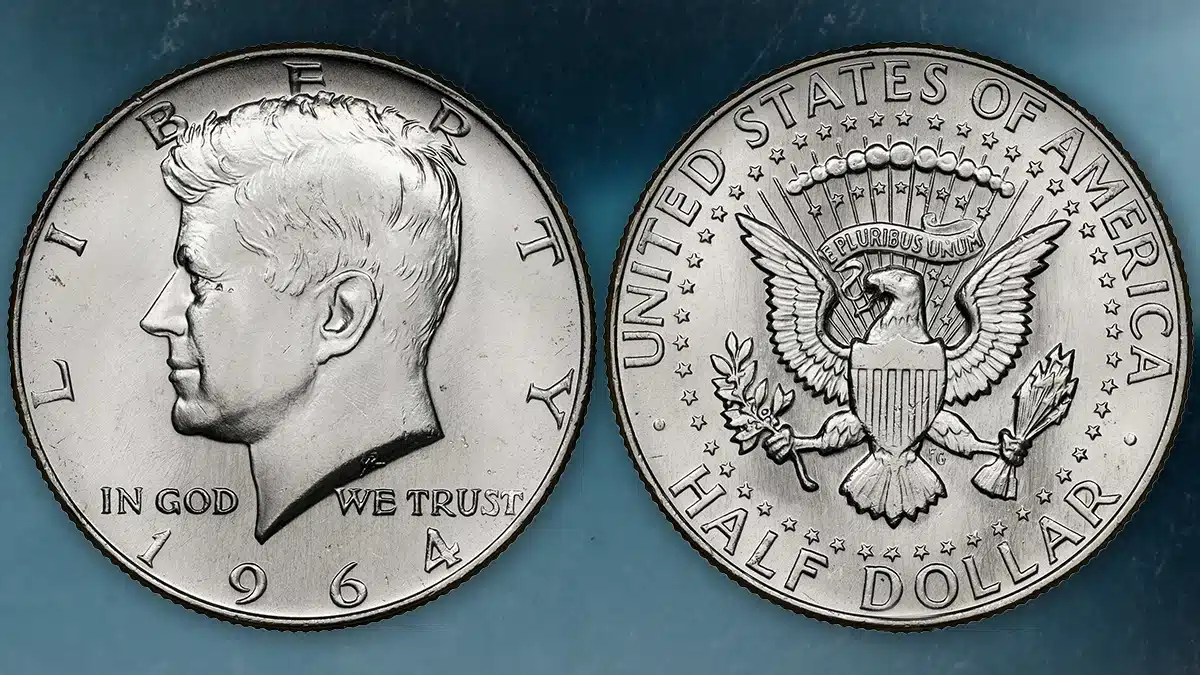
Gilroy Roberts adapted the Kennedy half-dollar obverse from his work on Kennedy’s Inaugural medal. Kennedy’s left-facing portrait is the design’s central motif. Wrapping around the upper portion of the rim is the inscription LIBERTY. The national motto IN GOD WE TRUST is inscribed in a straight line that extends from the left edge to the right edge of the coin, with “GOD” and “WE” separated by the truncation of Kennedy’s neck. The date 1964 wraps around the bottom of the design. Roberts’ initials appear on the truncation of Kennedy’s neck above the word “WE”.
Reverse:
Frank Gasparro adapted the Kennedy Half Dollar reverse design from the Seal of the President of the United States. A heraldic eagle is splayed, its chest protected by the Union shield. Clutched in its beak is a ribbon emblazoned with the motto E PLURIBUS UNUM. A glory of rays, clouds, and stars fans out from behind the eagle. The 13 stars represent the original British American colonies, while the rays and clouds signify heaven and the divine providence the founders believed inspired the formation of the United States. The eagle’s talons grip an olive branch in its dexter and a spray of arrows in its sinister. Fifty stars surround this central motif.
The legend UNITED STATES OF AMERICA wraps around the top of the design. The denomination HALF DOLLAR wraps around the bottom. Frank Gasparro’s initials FG appear between the eagle’s left leg and tail feathers.
Edge:
The edge of the 1964 Kennedy Half Dollar is reeded.
Coin Specifications
| Kennedy Half Dollar | 90% Silver Type |
| Year of Issue: | 1964 |
| Denomination: | Half Dollar (50 Cents USD) |
| Mintmark: | None (Philadelphia) |
| Mintage: | 273,304,004 |
| Alloy: | 90% Silver, 10% Copper |
| Weight: | 12.5 g |
| Diameter: | 30.6 mm |
| Edge: | Reeded |
| OBV Designer: | Gilroy Roberts |
| REV Designer: | Frank Gasparro |
| Quality: | Business Strike |
* * *
Additional References
Bowers, Q. David. The Experts Guide to Collecting & Investing in Rare Coins. Whitman Publishing.
–. A Guide Book of United States Type Coins. Whitman Publishing.
Breen, Walter. Walter Breen’s Encyclopedia of U.S. Coins. Doubleday.
Guth, Ron and Jeff Garrett. United States Coinage: A Study by Type. Whitman Publishing.
Taxay, Don. The U.S. Mint and Coinage. Arco Publishing.
Yeoman, R.S. and Jeff Garrett (editor). The Official Red Book: A Guide Book of United States Coins. Whitman Publishing.
* * *
Discover more about the 1964-D Kennedy Half Dollar by reading our collector profile of the Denver Mint version.
* * *





In retrospect it’s arguable that in creating the Kennedy half, the Mint and Congress set in motion a perfect storm for the disappearance of the denomination. As the article pointed out nearly all of the 64’s vanished as mementos, and the foolish decision to continue minting in clad silver until 1969 sealed its fate. The latter led to an enormous amount of “myth”information; even 4 decades later I still encounter people who are hoarding post-1971 halves in the mistaken belief that those coins contain silver as well.
I’m afraid that once the cent vanishes as it has in Canada and Australia, we’ll be making change using only 3 denominations.
I just read your comment, which I know was made almost a year ago. I must say that I am in complete agreement with you. My great grandmother in her 80’s use to buy a roll of half dollars every month with her SSI check. When she passed away, she left behind probably $500 in coins. In any given store, you will not find a designated slot for half dollars in the cash register. The denomination is rarely ever seen in use. Cash for that matter is a dying medium of exchange as more people prefer to use a credit or debit card. So what does this mean for the future of coins? Time will tell.
I ha e a 1964 kennedy half dollar no mint mark. It also has a third set of ignitals. “GR” is on the right side between the eagles leg and the bottom if olive branch where the mintmark should be. Do you have information on the origins of this coin?
Initials are FG
@Alex jervis As B.R. Geiser noted, the initials on the reverse are FG; GR is on the front. If you check the “Coin Specifications” section of this article GR is the monogram of designer Gilroy Roberts and FG is the monogram of Frank Gasparro.
Uhmmm… Eventually, almost 430 million half dollars dated 1964 were struck, a sum greater than the total struck for circulation in the sixteen years of the Franklin half dollar series.
I’ve got 9 1964 that my buddy found in his attic in a bank bag dimes nickels quarters halfs all in total 200.00 face vale coins were between 64-1967 with a drivers license that expired in 1967
I got 1943 copper Steel
I got 1/4 0f a dólares
I have this coin and many more how can I find out what they are worth.
Bring back Ben. He was short CHANGED having only gotten 16 years instead of the required 25.
This was & still is the law that governs the minting of all denominations ……….. Period !
I’m not going to politicize the merits of how Ben was a truly greater American & a founding father BUT, Kennedy was dirty & this has nothing to do with his hygiene regiment. I’m saying 60 years is ENOUGH already
I have a 1943 and 1944 steel pennies. I also have a 1944 copper penny I would like to sell I appreciate any help I get I have over 100 wheat pennies and I have corns going back into 1800s.
@David Lowe I’m afraid that at least two of the specific coins you mention aren’t going to pay off your mortgage. Over a billion 1943 “steelies” were minted and many were saved as mementos. Even today most circulated ones retail for 25¢ to a dollar. Similarly, huge numbers of 1944 bronze cents were struck; in circulated condition they’re generally worth less than it would cost to put them up for sale.
I have questions about a possible 1944 steel cent. Only a tiny number of these errors are known so you have to be very careful about mis-identification or fakery. The two easiest tests are to use a magnet and to weigh the coin. A steel cent will of course stick to a magnet while an altered bronze cent won’t. Also a steel cent will weigh around 2.7 gm while a bronze cent will weigh 3.11 gm.
How can I find out if my JFK coins are proofs?
Where can I find a book and those plastic containers that you put coins in to keep them from getting damaged. Been looking around and can’t find them
Go to a local coin and stamp dealer. Or ebay
Temu has them Mary E. Knudsen I have a.it of old time penny’s and others I need appraised and put in a auction somewhere good ! One of those is a 1970s which I ,now one ,ike this sold way up there at auction at heritage auction, and I have plenty more of coins , my husband came home one day with two of the 5 gallon buckets full of coins lol so it’s took me two years to clean them up and I’m still have some that’s not finish, lol
@Tanya I’m sorry to be the bearer of bad news, but cleaning your coins wasn’t a good idea. Unless you have professional equipment, cleaning will damage their surfaces and allow further deterioration. Even if the coins _look_ better at first, cleaning can cause microscopic damage that reduces their value as collectibles.
I have a book full of them
Would love to have a coin like this!
I have a gold key I have a gold kenendy half dollar that is in a plastic case . Believe to b a 76.
@Glenda S Reed Your “gold” 1976 half is almost certainly plated. During the Bicentennial a lot of private companies took ordinary cupronickel 1776-1976 coins, plated them with a thin layer of gold, and sold them as “instant rarities”. Despite often appearing quite attractive, the amount of gold is usually too small to add any significant precious metal value. Plus nearly all numismatists consider plating to be a post-mint alteration that reduces or destroys any possible collector’s value.
I have a kennedy half that was in a roll of quarters. Guessing it’s worth a quarter. Someone made a huge mistake. About all you can see is his head. Acquired it around 1968. Made the local newspaper!!
@Dinah Lea Hart It’s not possible to give a firm answer without seeing your coin but based on your description you may have a wrong-planchet error. That mistake happens when a blank for a different denomination somehow (accidentally or sometimes on purpose) gets mixed in with standard blanks for that coin.
If your item can be authenticated it’ll be worth quite a bit more than a quarter! My advice would be to have it examined in person by a dealer, and if it appears to be what I suspect, you should send it to one of the major numismatic agencies for evaluation.
Are the silver dollars worth any money.and silver half dollars
@Velma Hughes ALL silver coins are worth more than face value, at a minimum they’re worth their melt value for their precious-metal content. But you still need to know the standard criteria of denomination, date, mint mark, and condition to determine if they’re worth more as collectibles.
I have a coin from James Monroe,president since 1817-1827 is a gold coin .How much is worth?
Reply
@Anne M Desir A guick image search will tell you the coin is brass rather than gold, and isn’t from 1817. It’s a modern presidential dollar minted in 2008. Unless it’s uncirculated or proof it’s only worth face value.
I have a silver uncirculated Kennedy half dollar, would it be worth money?
I have a 1964 silver Kennedy half dollar could you tell me what it is worth
1964 miss print lift off o in of
He wants a lot $, help
My mum passed away and I have a 1964 half dollar which she had mounted in a silver chain. As I am in England I am not sure where to take this. It is D under one leg and FR I think under the other.
@MT The D on the reverse side is a mint mark indicating your half dollar was struck by the US Mint in Denver Colorado. The other letters are the designers’ monograms and are explained in the Specifications part of this article.
So many 1964 halves were made that there’s very little difference in value between those with a D for Denver and those from Philadelphia that lacked a mint mark. The semi-good news is that 1964 halves were made of .900 fine silver which would give it a melt value of around £10 at this writing.
Since 1968 US coins have carried their mint marks on the coins’ obverse side rather than the back. Mint mark letters are a broad topic in themselves: sizes, locations, even their presence and absence have all varied over the years. Without a guide such as the Red Book it can be challenging to decode them.
If they get rid of coins the con is on. Once coins are gone they eliminate all in person banking centers and bank employees. I bet you would expect an attractive interest rate or no fees… but once cash is gone there will always be a vig simply to access your money. Fools.
Angry customer…Im pulling all my money out of this bank…. no your not sir.
If every U.S. resident used clad coins for 2 daily transactions over 30 years:
It would use ~4.4x less energy than using digital payment systems.
That’s a saving of ~5.5 billion megajoules, equivalent to:
~1.5 billion kilowatt-hours
Coins are actually green when it comes to climate change.
great information in this article
very informative articles
I have a beautiful 1964 non minted half dollar that’s noticeably heavier than my later year half dollars. It’s a beautiful silver and looks practically uncirculated. I also have a 1966 non mint half dollar in excellent condition and a 1968 D half dollar in excellent condition. Wondering if these are worth getting appraised, where to do so , and what that costs?
I have a frend that owns a clock that has 1964 Kennedy half dollars for the number spots. Is this clock worth money ?
I have a very clean and mostly uncirculated 1964 Kennedy half dollar. It does have the artist initials on both front and back. The liberty is standard and there’s no markings as to when or where it was cast. It is 900% silver or nine.00 but anyways I was told it was worth what the market value is as it stands right now which is $21