


Five American coins crossed the million-dollar mark during Heritage Auctions’ 2026 ANA sales
One extraordinary gold pattern stood above them all.
The finest-certified 1879 Liberty Head Quintuple Stella realized a record $2,562,000. That result led Heritage’s August 31-September 5 ANA U.S. Coins Signature Auction, which generated $39,918,268.
Meanwhile, Heritage’s September 1-5 World & Ancient Coins Auction realized $26,415,000. Its September 3 Physical Cryptocurrency sale added another $850,798.
Together, the three events generated $67,184,066.
Yet the headline number tells only part of the story.
The ANA auctions brought together some of the most formidable trophies in American numismatics. They included stellas, unique patterns, early Proof gold, condition rarities, and a spectacular New Orleans Mint error pair. At the same time, major Scandinavian, Russian, Brazilian, Latin American, and ancient coins rewrote auction records.
A $2.562 Million Quintuple Stella Leads the Heritage ANA Auctions
The auction’s biggest prize carried one of the most intriguing names in American numismatics: the 1879 Liberty Head Quintuple Stella.
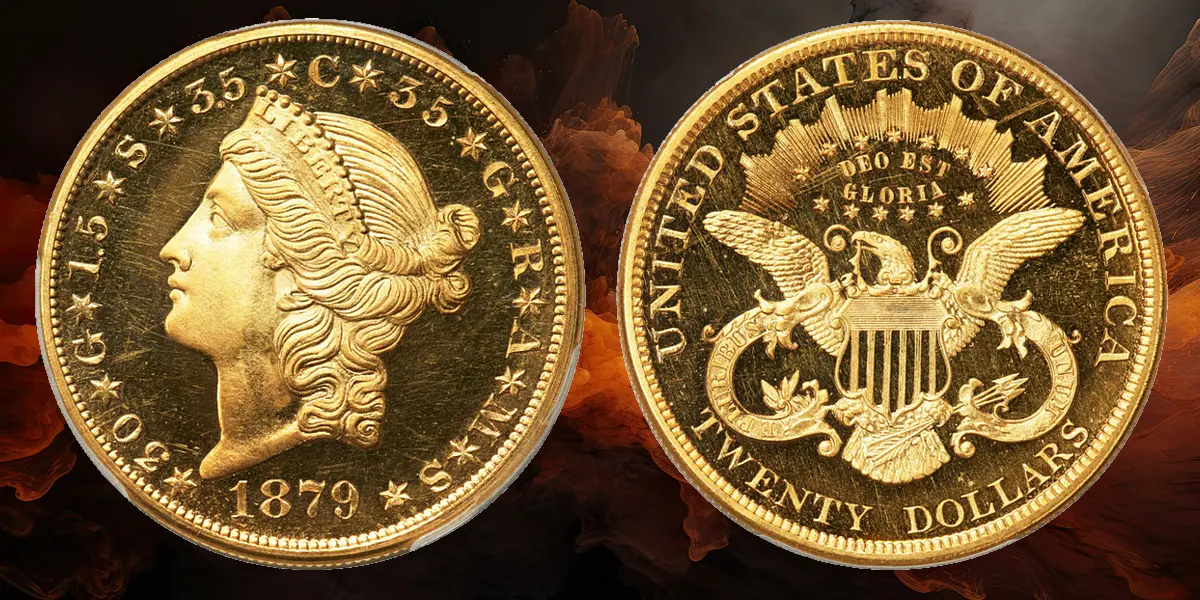
Cataloged as Judd-1643, Pollock-1843, Low R.7, the coin earned a grade of PR64+ Deep Cameo from PCGS. It came from the celebrated Bob R. Simpson Collection.
The coin realized $2,562,000, surpassing the previous $2.16 million auction record that Heritage established in 2025.
Collectors commonly call the issue the “Metric double eagle.” It shares its experimental monetary heritage with the famous $4 stellas of 1879 and 1880. However, the Quintuple Stella takes rarity to another level.
Researchers trace only five examples. The Smithsonian Institution’s National Numismatic Collection holds one of them. Moreover, the offered coin once belonged to legendary collector Virgil Brand.
Unlike a regular $20 Liberty Head Double Eagle, this piece represented an experimental concept tied to efforts to make American gold coinage compatible with international metric standards. That connection gives the Quintuple Stella a remarkable place within the wider story of the stella experiments.
Heritage Executive Vice President Todd Imhof emphasized the unusual combination of extreme rarity, top certification, and the Simpson pedigree. In his view, the opportunity placed the coin among the most important pieces of American numismatic history that Heritage has offered.
Five U.S. Coins Reach Seven Figures
The Quintuple Stella did not stand alone.
Four additional U.S. rarities crossed $1 million. Together, the group turned the ANA sale into one of the strongest concentrations of seven-figure American coins in recent memory.
An 1879 Coiled Hair Stella, Judd-1638, Pollock-1838, JD-1, R.6, realized $1,891,000.
NGC graded the coin PR67 Cameo. It came from the Tacasyl Collection.
Researchers trace only 14 examples of the 1879 Coiled Hair Stella. In addition, this specimen shares the finest-certified position. Collectors traditionally place the issue within the U.S. pattern series, although many advanced gold specialists also pursue it alongside regular federal gold coinage.
Its combination of rarity, design, history, and visual quality also earned the issue a place among the 100 Greatest U.S. Coins.
Then came an extraordinary early Proof gold coin.
The 1824/1 Capped Head Left Quarter Eagle, BD-1, JD-1, reached $1,494,500. PCGS graded the coin PR67, and its pedigree traces to the legendary Harry W. Bass, Jr. Core Collection.
Business strikes of the 1824/1 quarter eagle already challenge collectors. Proofs move into an entirely different category.
Researchers have confirmed only two Proof examples. The Smithsonian holds one permanently. Consequently, collectors can pursue only the specimen that Heritage offered.
Moreover, neither PCGS nor NGC has certified another Proof example. That fact made the Superb Gem a singular opportunity for advanced collectors of early U.S. gold.
A Unique Centennial Double Eagle Returns After Decades
Another Simpson Collection pattern produced $1,403,000 and established a new auction record.
More importantly, researchers know only one example.
That distinction makes Judd-1490 an absolute stopper in any serious collection of U.S. patterns. Even the legendary collections of Major Lenox Lohr, Harry W. Bass, Jr., and Dr. J. Hewitt Judd never contained one.
The Mint created the transitional pattern while developing changes that led to the Type Three Liberty Head Double Eagle. The timing adds another historical dimension. The coin dates from 1876, when the United States celebrated its centennial.
Heritage’s ANA sale marked only the coin’s third auction appearance. It also marked its first trip across the auction block since the 1980s.
Finally, an 1880 Coiled Hair Stella completed the million-dollar group.
The Judd-1660, Pollock-1860, JD-1, Low R.7 pattern realized $1,189,500. PCGS graded it PR64 Cameo.
Collectors consider the 1880 Coiled Hair issue the rarest of the four major stella varieties. Researchers currently trace only 10 examples. Like the 1879 Coiled Hair Stella, it also appears among the 100 Greatest U.S. Coins.
Eliasberg Double Eagle Obliterates Its Previous Record
The seven-figure trophies dominated the headlines. Still, several other U.S. coins delivered results that deserve equal attention.
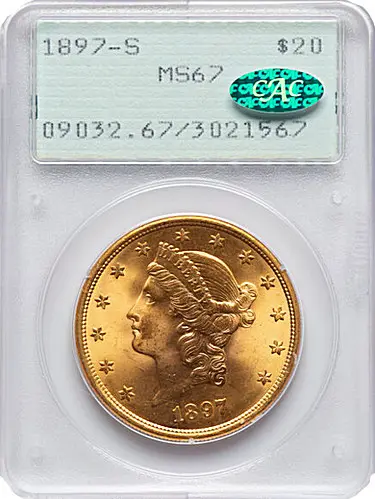
Perhaps no result better illustrates the power of condition rarity than the 1897-S Liberty Double Eagle, MS67 PCGS, CAC.
The coin soared to $390,400.
That price demolished the previous auction record of $60,375, established in 2005.
The coin also carries a formidable pedigree. It once belonged to Louis E. Eliasberg, Sr. Reports indicate that the Clapp estate supplied the coin after the family originally acquired it directly from the Mint at face value in 1897.
Remarkably, the coin still rests in its late-1980s PCGS holder. Its CAC approval further supports its status as the finest-known 1897-S Double Eagle.
The ANA appearance marked only its second documented auction offering.
A Unique 1797 Half Eagle Brings $317,200
Early federal gold supplied another major result.
Collectors have known the coin since the 19th century. However, researchers did not correctly identify it as a separate half eagle variety until 1972.
Today, specialists recognize it as unique.
PCGS CoinFacts illustrates this exact specimen. It also serves as the plate coin in Early U.S. Gold Coin Varieties, A Study of Die States 1795-1834.
Those credentials place the BD-4 among the great rarities of the early half eagle series.
Proof-Only 1884 Double Eagle Sets a Record
An 1884 Liberty Double Eagle, JD-1, R.6, PR64 Cameo NGC reached $268,400.
That result edged past the previous auction record of $264,500, set in 2006.
The Philadelphia Mint produced no circulation-strike double eagles in 1884. Instead, it made only 71 Proofs.
Research by John Dannreuther suggests that only 20 to 24 examples survive. Museums hold three of those coins.
The Heritage specimen combines a sharp strike, strong Cameo contrast, and unusually well-preserved surfaces. As a result, it ranks among the more impressive survivors of this unusual Proof-only double eagle issue.
An 1860-O Mint Error Survives as a Matched Pair
One of the auction’s strangest coins came from the New Orleans Mint.
An 1860-O Seated Liberty Half Dollar entered the press alongside a half dime planchet. The smaller blank indented the half dollar during striking.
Even more remarkably, both pieces survived together.
The resulting mated pair realized $219,600 in its first auction appearance.
Either piece would qualify as a major Mint error on its own. Together, however, they document the same striking event.
The pair has remained intact since 1860, giving collectors a remarkable mechanical snapshot of coin production at New Orleans on the eve of the Civil War.
1914 Proof Lincoln Cent Reaches $195,200
The Bolt Collection of Proof Lincoln Cents supplied another record.
Its 1914 Lincoln Cent, PR68+ Red PCGS, CAC, realized $195,200.
That result surpassed the previous $126,500 record that Heritage established in 2008. It also placed the coin among the most valuable Proof Lincoln cents ever sold at auction. PCGS still lists the earlier $126,500 transaction in its auction history.
The Philadelphia Mint produced only 1,365 Proof Lincoln cents in 1914.
At the time, collectors showed limited enthusiasm for these early Proof Lincoln cents. Their Matte Proof finish lacked the brilliant mirrored appearance that later generations came to expect from Proof coinage.
Time completely changed the equation.
PCGS now recognizes this specimen as the sole finest Proof Lincoln cent from the 1909-1916 period. It also stands as the only 1914 Proof cent that PCGS has graded PR68+.
More than a century after the Mint produced it, exceptional preservation transformed an unpopular Proof issue into a six-figure condition rarity.
Complete U.S. coin results appear in Heritage Auction 1396 at HA.com/1396.
World Gold Takes Over the Spotlight
The World & Ancient Coins Auction generated another $26.415 million.
Scandinavian gold played a starring role.
A Christian IV 10 Ducat of 1623, produced at the Glückstadt Mint, led the sale at $561,200.
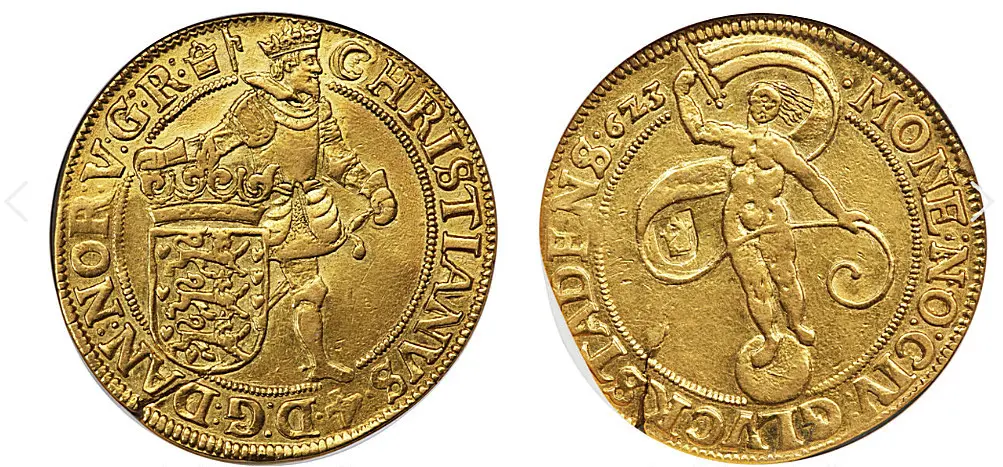
Christian IV ruled for nearly six decades. Today, researchers believe only four examples of this imposing gold issue survive.
The National Museum of Denmark holds one. The Hermitage Museum in St. Petersburg holds another.
The coin also carries a melting-pot countermark on its reverse. Authorities used that mark to guarantee the purity of the gold.
Meanwhile, the design features Fortuna, a particularly appropriate choice for a coin from Glückstadt. The town’s name translates as “Luck City.”
Kyle Johnson, Heritage’s Managing Director of World & Ancient Coins, said the results reflected growing collector interest in Scandinavian numismatics.
The rest of the sale supported that assessment.
Danish Rarities Cross the Half-Million-Dollar Mark
A Frederik III gold 10 Ducats, or Portugaloser, ND (1668-1669), MS63★ NGC, realized $512,400.
The monumental coin weighs 34.46 grams. Its surfaces show semi-reflective character, while lightly frosted and intricately engraved devices retain remarkable definition.
Researchers know only one other example. The National Museum of Denmark holds it.
Another Christian IV rarity followed at $488,000.
NGC graded the 1608 gold Sovereign, or 3 Guilder, MS62. The Elsinore Mint produced the coin.
Heritage found virtually no other registered public auction appearances for the type beyond this specimen from the Bruun Collection.
Sharp devices and flashes of orange-peel luster further distinguish the coin. More importantly, the denomination itself seldom reaches the market.
Russian and British Proof Gold Deliver Major Results
Russian Imperial gold also attracted six-figure bidding.
The Russian government produced only 300 pieces to commemorate the coronation of Czar Nicholas II.
Undoubtedly fewer survive today.
Collectors often encounter this large gold type with impairments. Therefore, a problem-free Proof with full mirrors and a bold strike carries particular importance.
Next, a George II gold Proof 5 Guineas of 1729, PR63 NGC, reached $329,400.
Any Proof from the reign of George II commands attention. A Proof of Britain’s largest contemporary gold denomination raises the stakes considerably.
The coin displays mirrored fields and Choice Proof preservation. Heritage suggested that those characteristics may point toward a special-purpose or presentation striking. Its distinguished provenance adds another layer to its importance.
A Four-Ounce Brazilian Gold Ingot Survives the Melting Pot
The Vila Rica Collection of Brazilian Gold Coins, Part II contributed one of the sale’s most historically evocative pieces.
A João VI gold Ingot of Mato Grosso dated 1818, certified Genuine by NGC, realized $317,200.
At roughly 139.5 grams, the bar contains more than four ounces of gold.
Its survival alone makes it remarkable. Brazil once produced large quantities of gold bullion, yet mints eventually converted much of that wealth into coinage.
Researcher Kurt Prober cataloged only 20 surviving Mato Grosso bars. Museums across Brazil and Portugal hold 13. Thieves stole three others from Brazil’s National Historic Museum in 1939, and researchers believe those pieces later went to the melting pot.
That history potentially leaves only four examples in private hands.
Prober personally studied this very ingot in 1940. At the time, Brazilian businessman Guilherme Guinle owned it. Guinle built Rio de Janeiro’s famed Copacabana Palace Hotel.
Magnentius Gold Medallion Surges to $268,400
Ancient gold also delivered a major surprise.
A Magnentius (AD 350-353) AV medallion of 3-solidi, measuring 34 mm and weighing 13.38 grams, realized $268,400 after racing beyond its pre-auction estimate.
NGC graded it AU★, 5/5 Strike and 4/5 Surface, Fine Style.
Magnentius presented himself as a champion of ordinary people. The medallion reinforces that political message.
Its reverse celebrates the liberation of the state from what Magnentius portrayed as the tyranny of Constantine’s sons. Authorities produced the issue to mark his entry into Aquileia in late AD 350 or early AD 351.
The First Pillar Dollar Date Sets a Record
Latin American coins formed another major pillar of the World & Ancient sale.
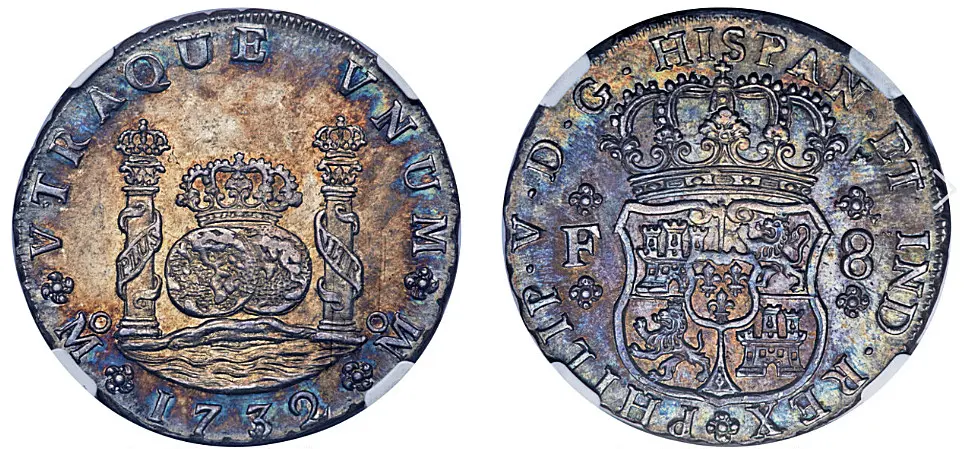
A Philip V “Milled” 8 Reales 1732 Mo-F, MS61 NGC, from the Grundy Collection of Latin American and Spanish Coins, realized a record $207,400 for the date.
The year matters enormously.
The 1732 8 Reales launched the celebrated Pillar Dollar series, one of the most recognizable silver coin designs in world numismatics.
A royal decree in 1728 authorized circular machine-made coinage across the Spanish realm. However, the Mexico City Mint did not produce its first Pillar 8 Reales until March 29, 1732.
The format soon spread across Spain’s American mints.
Moreover, Pillar Dollars circulated throughout the Americas and later played an important monetary role in the young United States.
Philip II Stater Sets an Ancient Coin Record
Another record came from the Randy & Nancy Best Collection.
A Macedonian Kingdom Philip II gold stater realized $158,600, a record for the type.
NGC graded the coin Choice MS★, 5/5 Strike and 5/5 Surface, Fine Style.
The late posthumous issue comes from Colophon under Philip III Arrhidaeus, circa 322-319 BC.
Its portrait nominally depicts Apollo. However, the facial features evoke Alexander III the Great.
Flashy surfaces and unusually strong centering further distinguish the coin. Its production also came during the unstable years following Alexander’s death in Babylon.
Brazilian and Mexican Rarities Rewrite Records
The Vila Rica Collection produced another record when a Maria I & Pedro III gold 1600 Reis 1780-B, MS64 NGC, reached $91,500.
The Bahia Mint produced this first-year issue.
Collectors rarely encounter these small Brazilian gold pieces in Mint State. Consequently, the offered MS64 stands out as the finest-known example.
Meanwhile, a Mexican War of Independence rarity from Zacatecas climbed to $56,120.
The Ferdinand VII “L.V.O.” 8 Reales 1810, AU55 NGC, established an auction record for any Zacatecas 8 Reales.
The coin belongs to the earliest provisional issues associated with the conflict. Its design shows the Cerro de la Bufa and El Grillo hills above the initials “L.V.O.”
The mint produced the 1810 issue for only two months.
NGC reports only five examples in its census, with just one graded higher.
Finally, the Grundy Collection produced another record with a Ferdinand VII 8 Reales 1808 So-FJ, MS61 NGC, from the Santiago Mint.
The coin realized $26,840, the highest auction price for the date.
Collectors know the type for its so-called “imaginary” military bust. Mint State examples rarely appear.
Heritage noted only one other auction appearance of this date and type during the previous two decades. That specimen, an AU58, crossed the Heritage auction block in 2011.
Complete World & Ancient results appear in Heritage Auction 3135 at HA.com/3135.
Physical Bitcoin Adds Another $850,798
Heritage’s September 3 ANA Physical Cryptocurrency sale added $850,798 to the week’s total. The auction featured The Otoh Collection, Part VIII.
A BTCC titanium Loaded (Unredeemed) 1 Bitcoin 2016, MS69 Antiqued NGC, led the event at $85,400.
BTCC produced the V Series piece from aerospace-grade titanium. The specimen shows softly lustrous surfaces and a vivid hologram.
More importantly, its digital history reaches back to an earlier Bitcoin era.
BTCC loaded the token before Bitcoin’s second halving in July 2016, when miners still received 25 BTC for each block. The lot also retained its original red box and product leaflet.
Heritage’s underlying auction records confirm that this BTCC piece alone realized $85,400. Two other loaded full-Bitcoin lots each realized $82,350.
When a $500 Post-it Becomes a $10,980 Collectible
Perhaps the sale’s strangest result had no precious metal content at all.
Kialara’s “FOMO” Conceptual Post-it Art Note, serial number 01 of 12, made its public auction debut and realized $10,980 including buyer’s premium.
Artist Maxfield signed and numbered the Post-it note. An irrevocable IOU accompanies it and promises redemption for $1,000, despite an original issue price of $500.
That creates the artwork’s central dilemma.
The owner can redeem the promise and destroy the collectible nature of the work. Alternatively, the owner can preserve the object and walk away from the guaranteed $1,000 redemption.
Therefore, the piece turns value, trust, speculation, and collector psychology into part of the artwork itself.
As serial number 01, the Heritage sale also created the project’s first public price discovery. The hammer fell at $9,000; Heritage’s 22% buyer’s premium brought the final price to $10,980.
Another contemporary issue, the Polymerbit x Zetra “1206/NOTE” Unloaded (Unfunded) 2026 Cold Storage Document, realized $2,074 including premium.
PCGS graded the piece Gem UNC 66 PPQ.
The note carries serial number 01 of 21 and represents the inaugural collaboration between Bitcoin cold-storage document producer Polymerbit and multidisciplinary artist ZETRA.
The $1,700 hammer price became $2,074 with Heritage’s buyer’s premium.
Complete Physical Cryptocurrency results appear in Heritage Auction 3140 at HA.com/3140.
What the $67 Million ANA Auctions Tell Collectors
The biggest story from Heritage’s ANA week goes beyond one $2.562 million pattern.
Collectors competed aggressively for several different forms of rarity.
Absolute rarity drove the unique 1876 Double Eagle pattern and the handful of surviving stellas. Condition rarity propelled the 1897-S Double Eagle and 1914 Proof Lincoln cent. Meanwhile, historical context strengthened demand for everything from the 1732 Pillar Dollar to the Mato Grosso gold ingot.
That distinction matters.
The strongest coins did more than carry low population numbers. They combined rarity with pedigree, preservation, design, history, and a story that collectors could immediately understand.
The 1879 Quintuple Stella brought all of those elements together.
It began as an experimental American gold coin tied to a larger 19th-century debate over international monetary standards. Only five examples can now be traced. Virgil Brand once owned this specimen. Bob Simpson later added it to one of the great modern collections.
Then, in September 2026, it became a $2.562 million coin.
That is why the best auction results often tell us much more than what a bidder paid.
They show which pieces collectors consider irreplaceable.





Fascinating.
I sure would like to win something from this website today
I have plenty wheat pennies just gotta go through them !⛩️ them too!