


This $1 Coin Shouldn’t Exist: Inside the Mystery of the Unique 1976 No S Eisenhower Dollar
A dollar coin reportedly pulled from a Washington, D.C., department-store cash register now ranks among the greatest rarities in modern American numismatics.
It carries a face value of one dollar. Yet specialists have placed its potential market value near or above $1 million.
More importantly, nobody can fully explain why the United States Mint made it.
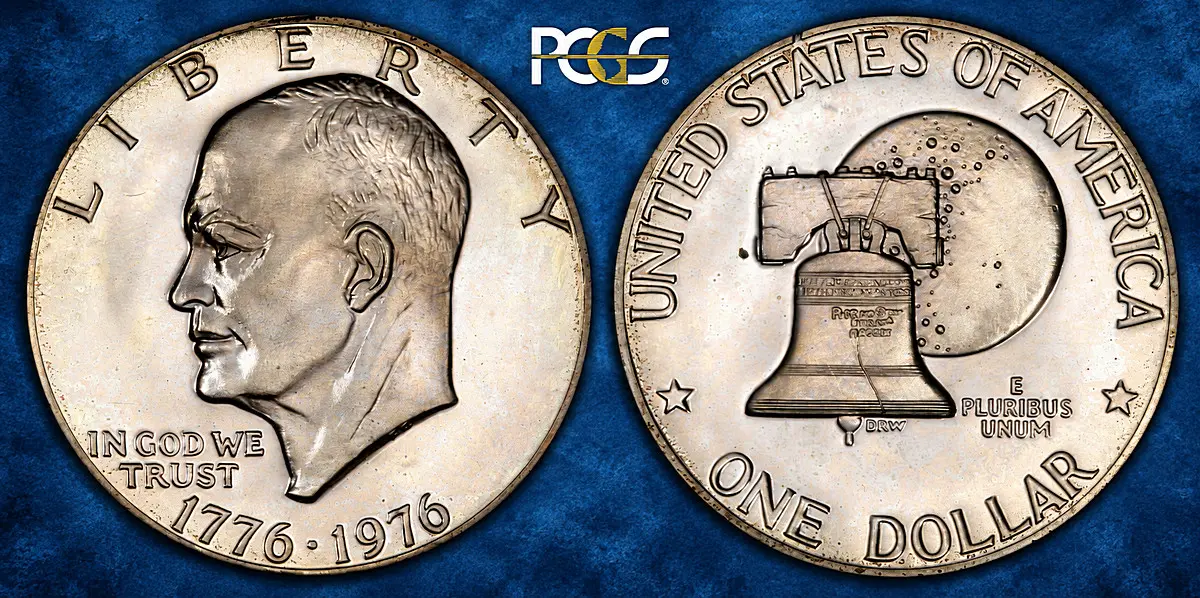
The unique 1976 Type 2 “No S” Silver Proof Eisenhower Dollar combines several attributes that should never have appeared together. It has Proof surfaces. It contains 40% silver. It carries the revised Type 2 Bicentennial reverse. However, it lacks the “S” mintmark that collectors expect on a Proof silver Eisenhower Dollar.
Only one example has surfaced.
And nearly half a century after its discovery, its origin remains a numismatic mystery.
As the United States marks its 250th anniversary in 2026, the coin created for America’s 200th birthday has reached its own 50-year milestone. That timing gives this already extraordinary Eisenhower Dollar even greater historical resonance.
America Needed a Bicentennial Coinage
Congress authorized special circulating coin designs to commemorate the 200th anniversary of American independence. The program changed the reverses of the Washington Quarter, Kennedy Half Dollar, and Eisenhower Dollar.
The Mint also replaced the normal dates with 1776-1976.
The Treasury Department launched a national design competition. It offered $5,000 to each winning artist. On March 6, 1974, officials announced the winning designs.
Dennis R. Williams, then a student at the Columbus College of Art and Design, won the dollar competition. His reverse paired two powerful American symbols. The Liberty Bell represented the nation’s founding. Behind it, the Moon represented America’s technological triumph during the Apollo era.
Frank Gasparro’s portrait of President Dwight D. Eisenhower remained on the obverse.
The result created an unusual visual bridge between 1776 and the Space Age.
It also created the stage for one of the Mint’s strangest modern rarities.
The First “No S” Bicentennial Proofs Were No Accident
The mystery begins before regular Bicentennial coin production.
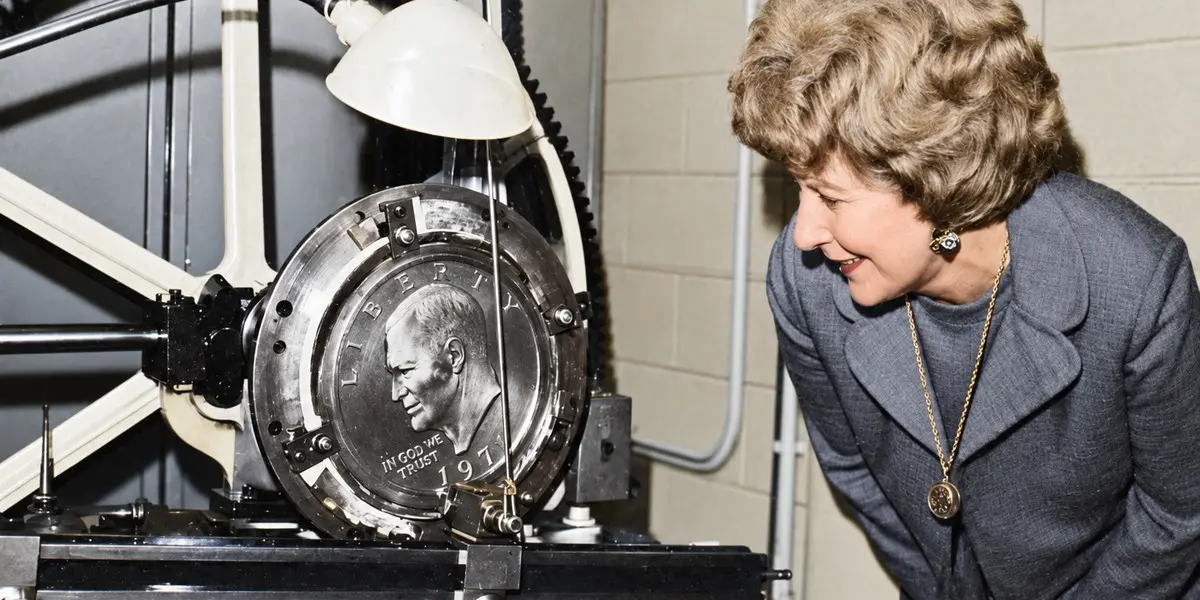
On August 12, 1974, Mint Director Mary Brooks joined Williams and the other two Bicentennial coin designers at the Philadelphia Mint. Together, they struck the first trial examples of the new quarter, half dollar, and dollar designs.
The U.S. Mint itself documented that Philadelphia event.
Those early Proof-like trial coins lacked an “S” mintmark because Philadelphia did not place a mintmark on its coins during that period.
The Mint then sent examples to the 1974 American Numismatic Association convention in Bal Harbour, Florida. According to PCGS research, Mint officials later had the No S trial pieces returned and destroyed. The Mint replaced presentation pieces with examples carrying the proper San Francisco “S.” Other Bicentennial sets presented to President Gerald Ford, the White House, and the winning designers also carried “S” mintmarks.
However, those early Philadelphia dollars had something else in common.
They carried the Type 1 reverse.
The surviving mystery coin does not.
One Design Change Created the Rarity
When the Mint prepared the Bicentennial Eisenhower Dollar, Williams’ original reverse used thick, block-like lettering.
Collectors now call that design Type 1.
During 1975, however, Mint officials refined the reverse. Chief Engraver Frank Gasparro contacted Williams about changing the lettering. The revision improved striking quality and made production easier.
The difference becomes obvious when collectors examine UNITED STATES OF AMERICA and ONE DOLLAR.
Type 1 uses heavy, blocky, sans-serif lettering.
Type 2 uses thinner, more elegant lettering with distinct serifs.
The Mint announced that regular 1976 Proof and Uncirculated Sets would contain the Type 2 Eisenhower Dollar. Meanwhile, the special 40% silver Bicentennial dollars normally used the earlier Type 1 design.
That difference transforms the unique No S coin from an interesting oddity into something far more important.
It represents the only known Type 2 Proof Eisenhower Dollar struck in 40% silver without the San Francisco mintmark.
That combination has no normal production explanation.
Did Frank Gasparro Strike a Secret Trial Coin?
One theory begins with the reverse redesign.
Gasparro needed to determine whether the thinner Type 2 lettering would solve the production problems that prompted the change. Therefore, he may have struck one or more Proof trials on silver-clad planchets at Philadelphia.
That would explain the Type 2 reverse.
It would also explain the missing “S.”
However, no surviving Mint documentation confirms that scenario.
PCGS considers it plausible, but not proven.
A second theory may prove even more intriguing.
Was It Made for Someone in Washington?
Mary Brooks frequently used special coins for presentations and official events. We know the Mint created Bicentennial presentation pieces for President Ford, the White House, and the coin designers.
Therefore, some specialists have proposed another possibility.
Perhaps Brooks ordered a Type 2 silver Proof for a politician, senior government official, or other Washington dignitary.
Then, somehow, someone spent it.
The theory sounds almost too good to be true. Yet the coin’s reported discovery location makes it difficult to dismiss.
The Million-Dollar Coin in a Cash Register
The surviving coin entered the numismatic record through an extraordinarily ordinary place.
A cash register.
The original owner reported finding the coin during 1977 at Woodward & Lothrop, the famous Washington, D.C., department store known locally as “Woodies.”
That location sat close to the federal world that may have produced the coin.
The owner eventually sent the piece for examination. In 1978, Thomas K. DeLorey, then working for Coin World, inspected it.
DeLorey performed weight and specific-gravity tests. He recorded a weight of 383.25 grains and a specific gravity of 9.55. He concluded that the piece represented a genuine, unaltered 40% silver dollar. Coin World reported the discovery in its June 7, 1978 issue.
However, DeLorey never completely accepted the discovery story.
He later recalled that he considered a more direct government connection possible. In other words, the coin might have originated with someone inside or connected to the federal government before entering ordinary commerce.
Nothing has proven either scenario.
That uncertainty remains part of the coin’s appeal.
Think About What Had to Happen
The surviving coin presents collectors with a remarkable chain of questions.
Someone apparently obtained a Proof-quality 40% silver dollar with a reverse that the Mint did not normally use for silver Proof production.
The coin lacked the San Francisco mintmark. Then it left government control.
Next, it reached Washington retail commerce.
Finally, somebody recognized that this one-dollar coin did not belong there.
Had the finder overlooked it, a cashier could have handed it to another customer. It could have suffered heavy circulation. Someone might have deposited it at a bank. A collector could even have mistaken it for one of the more than 100 million common Philadelphia Bicentennial dollars without mintmarks.
Instead, it survived.
Why Almost Every “No S” Ike Is Worth Only a Dollar or Two
This point matters because the unique coin generates an enormous amount of confusion.
A 1976 Eisenhower Dollar without a mintmark is not automatically rare.
Quite the opposite.
Philadelphia routinely struck circulating Eisenhower Dollars without mintmarks. PCGS notes that Philadelphia produced more than 117 million Bicentennial Eisenhower Dollars during the 1975-76 production period.
Those business strikes also exist with the Type 2 reverse. Therefore, millions of perfectly normal Bicentennial Eisenhower Dollars have no mintmark.
The unique rarity differs in three crucial ways.
- It has a Proof strike.
- It has the Type 2 reverse.
- Most importantly, it consists of the heavier 40% silver-clad composition used for special collector coins.
That combination identifies the great rarity.
A normal Philadelphia Type 2 clad Eisenhower Dollar weighs about 22.68 grams. The 40% silver version weighs approximately 24.59 grams.
For that reason, a missing mintmark alone proves nothing.
From $5,000 to a Potential Seven-Figure Coin
The coin’s documented commercial history begins in 1982.
Devonshire Rare Coin Galleries offered the uncertified coin that year. It sold for $5,000.
Dealers Martin Paul and Andy Lustig then participated in its ownership. Alan Hager later acquired it.
NGC eventually certified the coin PF65.
Martin Paul later reacquired it. Superior Galleries offered the NGC-certified rarity as Lot 1794 in 1997.
At some point afterward, PCGS graded it PR66. Then came its most important public auction appearance.
In 2002, Bowers and Merena offered the coin as Lot 647. It realized $41,400.
Modern-coin specialist Mitchell Spivack acquired it.
PCGS later added the Cameo designation, producing the grade under which PCGS currently catalogs the coin: PR66CAM.
PCGS said in July 2025 that the coin remained in private numismatic hands with a prominent collecting family.
So What Is the Unique 1976 No S Eisenhower Dollar Worth Today?
That question has no simple answer.
The coin has not crossed a major public auction block since 2002. Therefore, no recent transaction establishes a definitive market price.
Different published sources reach different conclusions.
For years, PCGS carried a valuation of $850,000. In July 2025, PCGS described the coin as worth nearly $1 million. Meanwhile, MintErrorNews publisher Mike Byers has argued that today’s market could support a seven-figure valuation.
The current Greysheet CPG retail listing provides a more conservative figure of $720,000 in PR66.
None of these numbers constitutes a sale price.
For a unique coin, the real value would emerge only if its owner decided to sell and two determined buyers decided how badly they wanted it.
That could produce a very different number.
A Modern Coin With Classic-Rarity Credentials
Collectors sometimes divide U.S. numismatics into two worlds.
- Classic coins supposedly offer history, mystery, and great rarity.
- Modern coins supposedly offer massive mintages and readily available examples.
The 1976 No S Eisenhower Dollar destroys that distinction.
It has everything collectors seek in a legendary American coin.
- A unique known population.
- An unexplained origin.
- A connection to the U.S. Bicentennial.
- And it may have ties to the Philadelphia Mint, Mary Brooks, Frank Gasparro, or even an unidentified Washington official.
Moreover, someone reportedly discovered it in everyday commerce.
PCGS has called it perhaps the rarest non-error modern U.S. coin. Today, no second Type 2 40% silver No S Proof has gained acceptance despite decades of searching.
The Great Irony of the Bicentennial Ike
The United States created Bicentennial coinage so nearly every American could hold a piece of the nation’s 200th birthday.
The Mint produced the coins by the hundreds of millions, which makes the fate of this single Eisenhower Dollar almost poetic.
One of America’s most mass-produced commemorative coin designs also produced a coin that stands alone.
Perhaps Frank Gasparro struck it as an experimental piece, or Mary Brooks ordered it for presentation.
Or a government official received it and later spent it without understanding what it was.
The real story might remainhidden somewhere in Mint records that researchers have yet to uncover.
For now, one fact matters above all others……. Only one is known.
And unlike the great rarities of the 19th century, collectors did not discover it in an old estate, an aristocratic collection, or a forgotten bank vault.
According to the story that has followed the coin for nearly 50 years, someone found America’s rarest Eisenhower Dollar in a department-store cash register.
That is difficult numismatic theater to beat.
1976 Type 2 “No S” Silver Proof Eisenhower Dollar Specifications
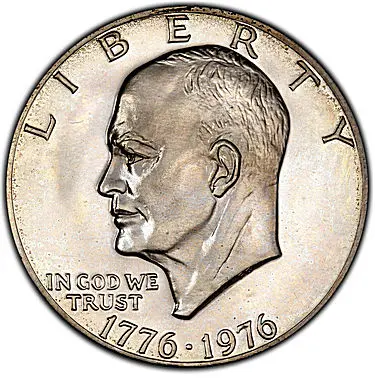
- Denomination: One Dollar
- Date: 1776-1976
- Coin Type: Bicentennial Eisenhower Dollar
- Strike: Proof
- Reverse Variety: Type 2 – thin, serifed lettering
- Mintmark: None
- Mint Attribution: Philadelphia according to PCGS cataloging; exact production circumstances remain undocumented
- Obverse Designer: Frank Gasparro
- Reverse Designer: Dennis R. Williams
- Obverse: Dwight D. Eisenhower
- Reverse: Liberty Bell superimposed on the Moon
- Composition: 40% silver overall; silver-copper clad
- Weight: Approximately 24.59-24.60 grams
- Diameter: Approximately 38.1 mm
- Silver Content: Approximately 0.316 troy ounce
- Edge: Reeded
- Current PCGS Grade: PR66CAM
- Known Population: One accepted example
- PCGS Number:62402
PCGS catalogs the piece as a Philadelphia issue and lists a mintage of one. However, because no surviving Mint record explains its production, “one known” provides the more precise description of its rarity.




I think I need to research my Ike dollars again. Wow!!
Great that the coin was not in circulation too long!
I have to wonder if, as the article suggests, that discovery story is bogus. It’s pretty unlikely that a cashier would have given out a silver dollar in change at a department store – at that time it would have been bills. Someone would have had to ask if they had silver dollars and requested it for their change, because silver dollars were not routinely used in a setting like that. I know because I shopped at Woodie’s at that time. This sounds more like a story that gave them a way to slip the coin into numismatic circles by someone who had a coin that they shouldn’t have had.
Wow very interesting article, you never know where or when you can discover a rare coin!!@@
So ! if someone has this coin what do they need to make sure of it being the 1million dollar?
I own. 2. Of. Them. Not. Sure. What. They. Are. Worth
so cool. no ‘s’.
nice story
Someone in the US Mint’s receiving/destroy department had this one stick to their fingers and then it walked out the door and was subsequently spent into circulation.
“ A normal Philadelphia Type 2 clad Eisenhower Dollar weighs about 22.68 grams. The 40% silver version weighs approximately 24.59 grams.”
Gotta weigh my IKEs!
Great article, so much more to the hobby than people realize.
Wow! What an interesting story and a very interesting coin!
I always check my change and get coins from the bank. Always hoping to find stuff like this. I have found some, like NIFCs, proofs, and silver coins. Not many but always worth the look.
What a nice birthday present! Thank you!
It’s even more amazing that this was even discovered and recognized as rarity.
Time to look at my Ikes a bit more closely… Great article!
Being a bit of a skeptic about government, I think the found in a cash register drawer sounds like a cover story.
Crazy that no records exist of it being struck as a special unless it was intended to be destroyed later and walked out with someone later.
One of the first coins I ever owed.
Can I have it???
Eisenhower was a great man and the reverse is stunning.
WOW! You never know what will show up or its origin story! I recently got a 1928 Buffalo nickel in change at a convenience store and the daughter of a former co-worker got a 1942 Walking Liberty half as partial payment for a pack of cigarettes at the store where she worked!
truly amazing story
incredible story
Great article regarding this excellent rarity and its mysterious origin.
I, too will need to examine my Ike’s.
Fascinating article about the 1976 No S Silver Proof Eisenhower Dollar.
great find!
Interesting. Proves you really have to pay attention. You never know when you might find a rare find!
Another interesting article!
Man to be the one that found this dollar what a great find
Does Philadelphia strike any proof coins (even trials) any more?
I wonder how many of these rare coins have passed through my fingers without me even realizing it.
Amazing story and I too am going to check my Ikes. I just wanted to mention in reference to the curved giveaway coin that there is a vam variety morgan dollar from 1878 that is also curved slightly. I know because I have one.
Interesting story and factual, but the sensational headline reminds me of the clickbait so many charlatans promote to get traffic.
Wow, who would have thought.
Wow!!! What an amazingly incredible article! To think this coin was “supposedly found in a cash register” in D.C. The history and backstory of this one coin is almost like reading a crime story. Well written and interesting.
A mystery coin – what fun!
Oddities are certainly odd.
Would love to find something like that in circulation one day