


The Ancient Mountain Coins of Pisidia Tell a Story of Defiance
By Steve Benner
Ancient Pisidia does not always receive the same attention as Lydia, Ionia, or Lycia. Yet this rugged region of south-central Asia Minor produced one of the most distinctive coinages of the Greek world.
Pisidia sat in a hard country. Mountains, plateaus, narrow passes, and upland valleys shaped its history. So did its people. The Pisidians built cities in terrain that made conquest difficult. They also developed a fierce reputation for independence.
That story appears on their coins.
From Selge’s wrestlers and slingers to Etenna’s sickle-throwing warrior, Pisidian coinage reflects a world of local pride, martial identity, and unusual civic symbols. Many issues remain scarce. Some rank among the most attractive Greek civic coins of inland Anatolia.
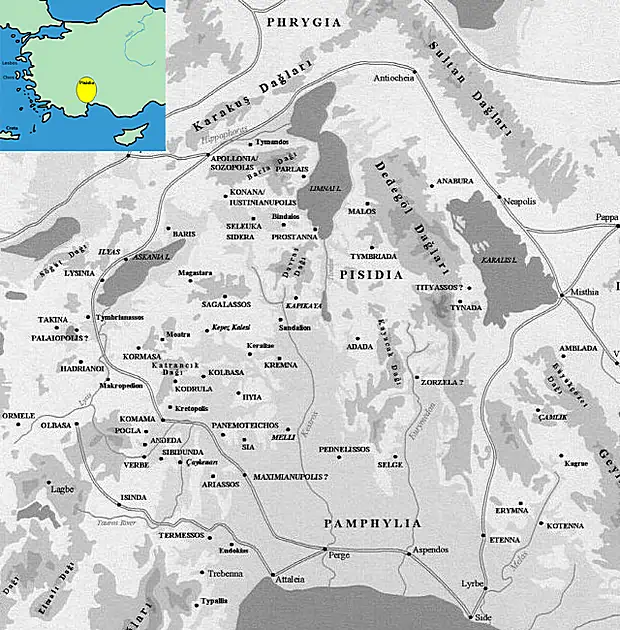
Where Was Pisidia?
Pisidia occupied a mountainous part of southern Asia Minor, in modern Turkey. It lay north of Lycia and Pamphylia, east of Caria, west of Lycaonia and Isauria, and south of Phrygia.
The Taurus Mountains dominated the region. However, Pisidia did not consist only of bare rock. Fertile plateaus and valleys also dotted the landscape. Mountain runoff watered these areas. As a result, some cities supported agriculture, viticulture, and local trade.
Still, the terrain shaped everything. It made travel difficult. It also made invasion dangerous.
A Fiercely Independent People
Pisidia’s history reaches back at least to the Hittite period, circa 1700–1178 BCE. Its people spoke their own language. They also kept a reputation for lawlessness and fierce independence in ancient sources.
That reputation mattered.
Unlike some neighboring peoples, the Pisidians did not focus on expanding into surrounding lands. Instead, they preferred to defend their own territory. When major powers entered the region, Pisidian communities often resisted them.
The Lydians and Persians struggled there. Alexander the Great captured Sagalassos, but he failed to take Termessos. Later, Pisidian cities resisted Alexander’s successors, the Attalids of Pergamon, and the Galatians.
Therefore, Pisidia became one of the last areas of Asia Minor to accept Greek culture fully. It also began striking coins later than many neighboring regions.
Rome finally brought Pisidia under firmer control by the time of Augustus.
This article covers Pisidian coinage up to its absorption into the Roman world. The main cities include Adada, Etenna, Isinda, Keraitai, Komama, Kremna, Sagalassos, Selge, and Termessos Major.
Selge: The Powerhouse of Pisidia
Etenna and Selge struck the earliest Pisidian coins. Selge began near the end of the fifth century BCE. Etenna followed in the fourth century.
Selge stood on the southern slope of the Taurus Mountains, near the point where the Eurymedon River exits the mountains and flows south. Ancient tradition linked the city to Sparta. The surrounding district had steep defenses, yet it also produced abundant oil and wine.
Selge grew into the most powerful and populous city of Pisidia. Ancient sources credit the city with the ability to field an army of 20,000 men.
That strength helped Selge preserve its freedom. The Selgians avoided lasting subjection to foreign powers for much of their history. In 216 BCE, the Seleucid general Achaeus besieged the city. However, the Selgians reached terms and agreed to pay a large indemnity.
Later, Selge also fought off a raiding force of Goths.
The city had a gymnasium, stoa, stadium, basilica, and two temples. However, its theater remains the best-preserved monument.
Selge’s Early Silver Coins
Selge began modestly in the second half of the fifth century BCE. Its early silver trihemiobols weigh about 1.05 grams. These coins show a facing Gorgon’s head on the obverse and Athena in a helmet on the reverse. The reverse design sits within a shallow incuse square.
By the beginning of the fourth century BCE, Selge struck larger and more artistic silver coins. Its staters became famous.
One striking example shows two wrestlers grappling on the obverse. The reverse shows a slinger in a throwing stance. A triskeles appears to the right. An astragalos, or ankle bone used as a die, appears between the slinger’s legs.
The legend reads [S]TLGEUE. This spelling gives the city’s name in Pisidian, though the spelling varies. Before the end of the century, the legend changed to SELGEWN.
Selge continued to strike coins through the third century BCE
The city also added a 3/4 obol of about 0.45 grams. That issue shows a lion’s head and an astragalos reverse.
In the early second century BCE, Selge added a drachm of about 4.6 grams. It shows the head of Herakles on the obverse and Artemis advancing with a torch on the reverse. A similar triobol weighs about 1.85 grams.
Later in the second century BCE, Selge struck a triobol of about 2.15 grams. This type shows Herakles facing three-quarters forward on the obverse and a club with a styrax plant on the reverse. The city also issued a diobol of about 1.42 grams with the head of Artemis on the obverse and the forepart of a stag on the reverse.
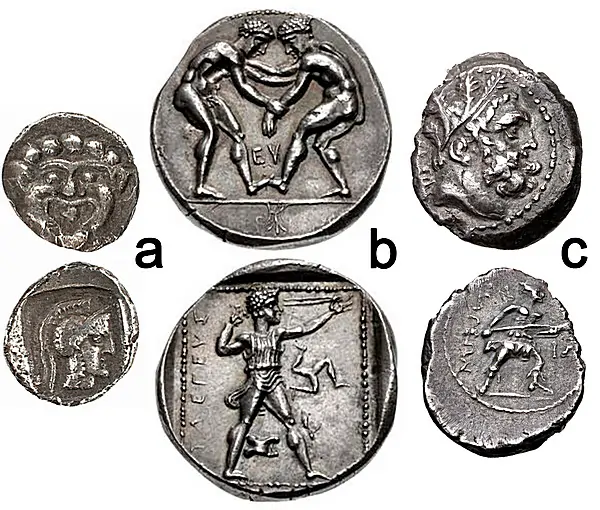
- A) c. 420 BCE, AR Trihemiobol, 0.93 g. Gorgon’s head facing with protruding tongue / Head of Athena right, wearing crested helmet, in shallow incuse square. Traité 1550; SNG.
- B) Circa 400–325 BCE. AR Stater, 22 mm, 10.80 g. Two wrestlers grappling; EY between, inverted palmette in exergue / Slinger in throwing stance right, [S]TLGEUE to left, triskeles to right, astragalos between legs; all within dotted square border in shallow incuse square. SNG BN 1923, same dies.
- C) 2nd–1st century BCE. AR Drachm, 16 mm, 4.53 g. Head of Herakles right, wearing wreath of styrax / Artemis holding torch and advancing right, SELGEWN to left, ID to right. SNG France 1960.
Selge’s Bronze Coinage
Selge also struck bronze coins beginning in the third century BCE. These bronzes usually range from about 12 to 18 mm.
Two examples show the city’s continued use of strong local symbols. One 18 mm bronze shows a PO monogram on a shield and a triskeles on the reverse. Another 12 mm bronze shows the head of Herakles and a reverse with a thunderbolt and bow.
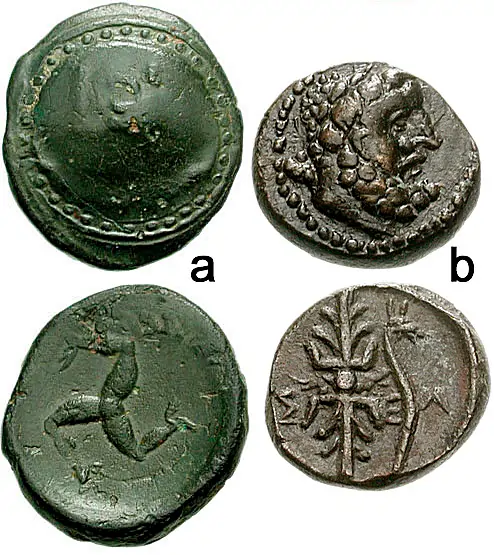
- A) 2nd–1st century BCE. Æ 18 mm, 5.68 g. PO monogram on shield / Triskeles. SNG France 2006.
- B) 2nd–1st century BCE. Æ 12 mm, 2.37 g. Head of Herakles right / Thunderbolt and bow. SNG France 1979.
Etenna: A City Known Through Its Coins
Scholars know far less about Etenna. Even its exact location remains uncertain. Many place it near Kotenna.
Because of that uncertainty, Etenna’s coins matter. They help confirm the city’s existence and identity.
Etenna began minting coins in the mid-fourth century BCE. It struck a stater and an obol.
The stater resembles the famous Selge type at first glance. The obverse shows two men wrestling. However, the reverse changes the message. Instead of a slinger, it shows a man preparing to throw a hooked, sickle-shaped knife, or harpa. A triskeles appears to the right. The legend ETENNEWN appears to the left.
That weapon likely served as Etenna’s civic badge.
The obol shows a facing gorgoneion on the obverse and a curved knife with a leaf on the reverse. The curved knife also appears on Etenna’s two bronze coin types, which measure about 18 and 13 mm.
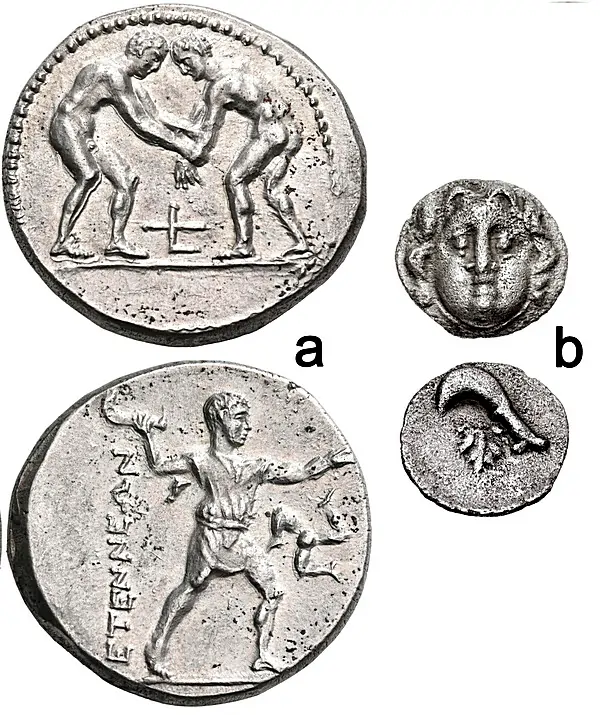
- A) Circa 320–280 BCE. AR Stater, 25 mm, 10.79 g. Two wrestlers grappling; linear symbol between them / ETENNEWN in field to right, male figure preparing to hurl a sickle-shaped knife, or harpa, held in his right hand; triskeles to left. Von Aulock, Pisidiens II 399–400 = Imhoof-Blumer.
- B) 3rd century BCE. AR Obol, 10 mm, 0.64 g. Facing gorgoneion / War sickle, leaf to left. Von Aulock, Pisidiens II 401–402 var., no leaf.
The Later Bronze Cities of Pisidia
Most other Pisidian cities did not begin minting coins until the first century BCE. Their coinage consists mostly of bronze.
Even so, these small bronzes preserve important civic identities. In some cases, they provide some of the best evidence for cities that left few surviving historical records.
Adada: The Bucranium and Triskeles
Adada lay northeast of Selge, on the upper waters of the Kestros River. The city’s history remains obscure.
Adada struck no silver coinage. Instead, it issued about three bronze types.
One example shows a garlanded bucranium, or bull’s head, on the obverse. A star appears above it. The reverse shows a triskeles with A-D-A between the legs. That legend identifies the city.
Isinda: A Strategic Pass Near Termessos
Isinda stood about 16 km west of Termessos. It occupied a strategic pass that led from Pamphylia, past Termessos, and into Pisidia.
In 186 BCE, Termessos besieged Isinda. The Romans stopped the siege.
Like Adada, Isinda struck no silver coins. However, it issued several small bronzes.
One bronze shows Zeus on the obverse. The reverse shows a horseman holding a spear. ISIN appears below the horseman and gives the city ethnic.
Keraitai: A Small City With a Joint Silver Issue
Keraitai probably stood southwest of Kremna. Its history remains poorly known.
The city struck several bronze coins but no regular civic silver coinage. One bronze shows a turreted head of Tyche on the obverse. The reverse shows a caduceus within a laurel wreath, with K-E on either side. That abbreviation gives the city ethnic.
Collectors should note one attribution issue. Some examples of this type appear misattributed to Keramos in Caria.
However, Keraitai did take part in one silver issue. Around 100 BCE, Keraitai struck a joint drachm with Kremna.
This coin celebrates homonoia, or civic harmony, between the two cities. The obverse shows the turreted head of Tyche. The reverse shows a double cornucopia. The names of both cities appear on the reverse: KRHMNEWN to the right and KERAEITWN to the left.
That joint issue gives collectors an unusual look at cooperation between two Pisidian communities.
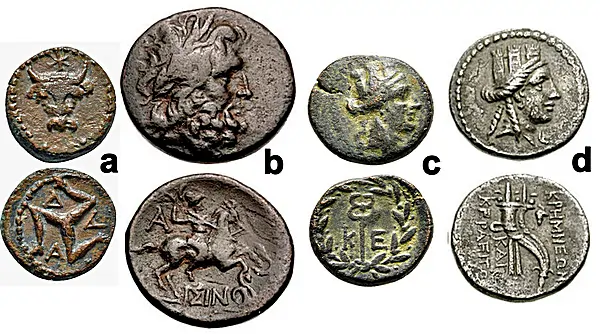
- A) Adada, AE 13, 1st century BCE, 2.00 g, 13 mm. Facing garlanded bucranium; star above / A-D-A. Triskeles.
- B) Isinda, 1st century BCE. Æ 21, 7.33 g. Laureate head of Zeus right / Warrior holding spear on horse leaping right; A, date, above; ISIN below with serpent. SNG BN 1570.
- C) Keraitai, Æ 14, 2.63 g. Turreted head of Tyche right / K-E, caduceus within laurel wreath.
- D) Keraitai and Kremna. Circa 100 BCE. AR Drachm, 3.69 g. Homonoia between Kremna and Keraitai. Turreted head of Tyche right / Cornucopiae. Von Aulock, Pisidiens 887.
Komama: A Rare Silver Hemidrachm
Komama’s history remains obscure. However, the city produced several interesting coins.
Its most important silver coin is a very rare hemidrachm. Earlier references described fewer than 15 known. More recent listings place the number at fewer than 20 known.
The hemidrachm shows Artemis on the obverse. A long torch appears on the reverse. The city name, KOMA-MEWN, also appears on the reverse. Not all sources list this issue.
Komama also struck a bronze coin with two bearded heads facing right in jugate style on the obverse. The reverse shows a lion bounding, with KO in the exergue.
Kremna: A Fortified City on the Kestros
Kremna stood in central Pisidia. It occupied a high plateau overlooking the Kestros River. Its position gave it strong natural defenses.
In 36 BCE, the Galatian general Amyntas conquered Kremna for Mark Antony. Amyntas then ruled as king of Pisidia until his death in 25 BCE.
As noted above, Kremna struck a joint silver drachm with Keraitai around 100 BCE. The city also issued several bronze types.
One small bronze shows Tyche on the obverse and the forepart of a horse on the reverse. The city ethnic, KRH, appears below the horse.
Sagalassos: A Wealthy Pisidian City
Sagalassos ranked among the major cities of Pisidia. It also became one of the region’s wealthiest communities.
The city stood northwest of Kremna, near the source of the Kestros River. In Roman times, Hadrian favored Sagalassos and elevated its status. Its extensive ruins include a nymphaeum, theater, agora, macellum, baths, and fountain house.
Sagalassos struck both silver and bronze coins in the second half of the first century BCE, especially during the reign of Amyntas.
The city issued a didrachm of about 8.18 grams and a drachm of about 3.72 grams. The didrachm shows the laureate head of Zeus on the obverse. Nike stands on the reverse and holds a wreath. The city name, SAGALAS-SEWN, appears to the left of Nike.
CNG also lists a hemidrachm of about 0.44 grams for Sagalassos. That coin shows the portrait of Herakles on the obverse and Nike holding a wreath on the reverse, with SA to the right. Many sources do not list this rare issue.
Sagalassos Bronze Coinage
Sagalassos struck at least two bronze types.
One type shows Athena wearing a Corinthian helmet on the obverse. Nike appears on the reverse holding a wreath and palm branch. The legend SAGA-LASS appears on either side.
Another type shows the head of Zeus on the obverse. Two goats contend on the reverse, with SA between them.
These bronzes connect the city to both Greek iconography and local civic identity.
Termessos Major: The City Alexander Could Not Take
Termessos ranked among the great cities of southeastern Pisidia. It controlled a large area of Pisidia and part of Lycia.
The city occupied a high site on Mount Solymos in the Taurus Mountains. Its position made it one of the best-defended cities in the region. Today, Termessos also ranks among the best-preserved ancient cities of this period. Theaters, temples, cemeteries, and other structures remain visible.
Alexander the Great reached Termessos in 333 BCE. He recognized the difficulty of the site and did not capture it. Instead, he moved on and later took Sagalassos.
Termessos later supported the Roman Republic. In 71 BCE, the Roman Senate granted the city independent status. That act protected its freedom and civic rights.
Termessos struck its civic coinage from this period until about 36 BCE.
Termessos Silver and Bronze Coinage
As a rule, Termessos did not strike local civic silver coins. However, one puzzle remains.
In 205 and 203 BCE, the city struck tetradrachms in the name and type of Alexander the Great. That issue raises questions. It means Termessos produced Alexander-type silver coins but did not later create a regular civic silver series. Perhaps a ruler or political authority requested the issue.
These tetradrachms carry either TE or a TE monogram on the reverse.
Termessos struck a wider range of bronze coins. The most common type shows Zeus on the obverse. The reverse shows either a full galloping horse or the forepart of a horse.
One example shows the laureate head of Zeus on the obverse. The reverse shows the forepart of a horse left, with a lightning bolt behind and the city ethnic, TER, below.
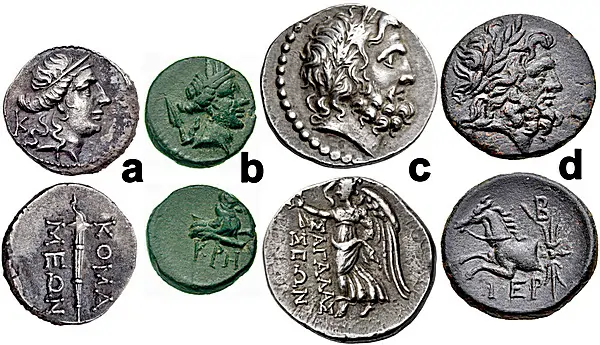
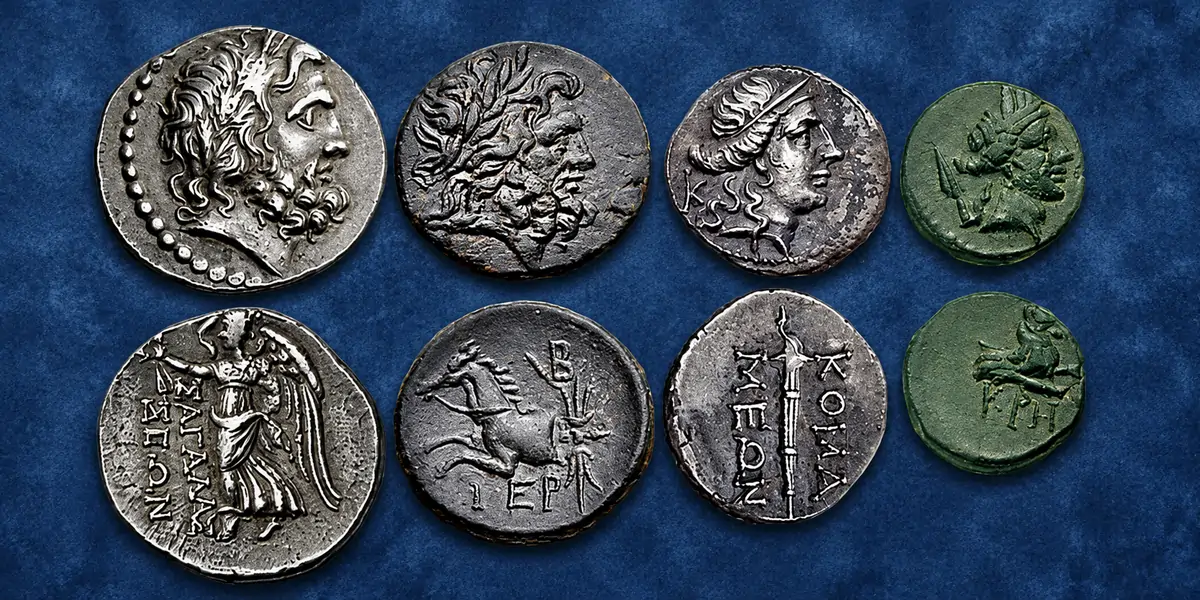
- A) Komama. 1st century BCE. AR Hemidrachm, 13 mm, 1.54 g. Diademed head of Artemis right; K behind / Long torch, KOMA-MEWN. Von Aulock, KM VI.
- B) Kremna. Circa 1st century BCE. Æ 11 mm, 1.69 g. Turreted head of Tyche right, spearhead behind / Forepart of horse right. SNG Copenhagen 137.
- C) Sagalassos. Circa 30 BCE. AR Didrachm, 8.18 g. Laureate head of Zeus right / ΣAΓAΛAΣ–ΣEΩN, Victory standing left and holding wreath. SNG France 1717, this obverse die.
- D) Termessos Major. 1st century BCE. Æ 20 mm, 5.58 g. Dated year 12, uncertain date. Laureate head of Zeus right / Forepart of horse left; IB, date, above; thunderbolt behind; TER below. SNG France 2131 var., no thunderbolt.
Why Pisidian Coins Matter
Pisidian coinage rewards close study.
Some of the region’s silver coins show exceptional artistry. Selge’s wrestler-and-slinger staters, Etenna’s wrestler-and-harpa staters, and Sagalassos’ Zeus-and-Nike didrachms stand out immediately. Their beauty, scarcity, and local character make them expensive when high-quality examples appear.
The joint Kremna-Keraitai drachm also deserves attention. It shows two neighboring cities cooperating on a silver issue. That message of homonoia gives the coin strong historical value beyond its rarity.
The bronze coins show less refinement than the silver. Yet they remain well worth collecting. They preserve the city badges, local legends, and civic identities of smaller Pisidian communities. In some cases, they help anchor cities that left limited written history.
Overall, Pisidian coins offer a remarkable combination of art, history, and regional character. They come from a mountain land that resisted kings, generals, and empires. As a result, the coins do more than identify cities. They preserve the voice of a people who valued independence above all.
References
- Acsearch.info: auction database.
- Classical Numismatic Group (CNG).
- Grant, Michael. A Guide to the Ancient World: A Dictionary of Classical Place Names. Barnes & Noble, 1986.
- Head, Barclay V. Historia Numorum: A Manual of Greek Numismatics. Oxford, 1887.
- Hoover, Oliver D. Handbook of Coins of Northern and Central Anatolia, Fifth to First Centuries BC. The Handbook of Greek Coinage Series, Volume 7. Classical Numismatic Group, Lancaster/London, 2012.
- Hornblower, Simon, and Antony Spawforth, eds. The Oxford Classical Dictionary, 3rd edition. Oxford, 1996.
- Sear, David R. Greek Coins and Their Values, Volume 2: Asia and Africa. Seaby, 1979.
- Von Aulock, Hans. Münzen und Städte Pisidiens. Istanbul, 1977–1979.
- Sylloge Nummorum Graecorum references as cited in figure captions.




Very thorough history of a little-known area and its coinage. Great pictures to illuminate the written descriptions.