


The 1977 Aluminum Penny That Should Not Exist
A 1977 Lincoln cent should be copper-colored. It should also weigh about 3.11 grams. Yet one extraordinary example breaks both rules.
This unique 1977 Lincoln cent was struck on an aluminum planchet. It weighs just 1.04 grams. NGC authenticated and certified the coin as Mint State 60. The piece also carries a remarkable provenance. Error coin expert Mike Byers, who owned the coin for over a decade and highlighted it in an issue of MintErrorNews Issue #56 in 2021, sold the coin via Heritage Auctions in 2025.
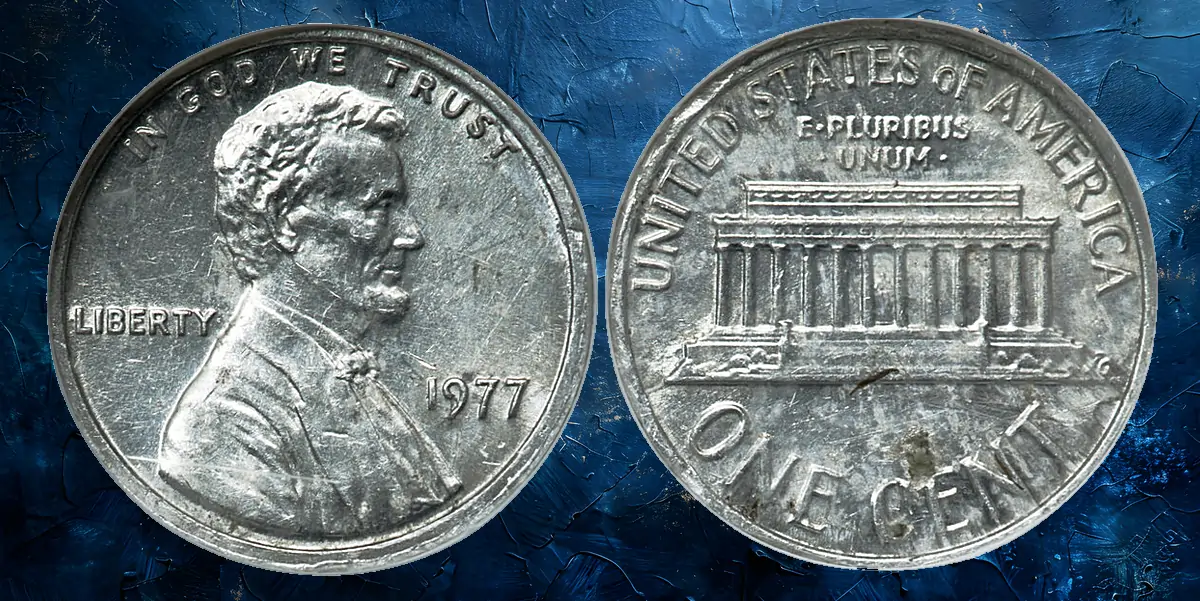
That alone makes the coin important. However, the real story runs deeper. This aluminum cent sits at the center of three possible explanations. Each one adds mystery. Each one connects the coin to one of the most famous experimental coinage programs in modern United States Mint history.
A 1977 Lincoln Cent With No Easy Explanation
Experts have proposed three explanations for the unique 1977 aluminum Lincoln cent.
It may be an intentionally made mint error. It may have been struck on a leftover aluminum planchet from the 1974-75 aluminum cent experiments. Or it may represent an unrecorded aluminum pattern struck with regular 1977 cent dies.
At this time, no public evidence proves one theory over the others.
What we can say with confidence is this: the coin exists, NGC certified it, and the known example weighs 1.04 grams. Heritage Auctions later described it as the sole known 1977 Lincoln cent struck in aluminum. The coin sold for $50,400 in the August 2025 Heritage ANA U.S. Coins Signature Auction.
That public sale gives the piece a confirmed market record. It also replaces older value speculation with a documented price.
Why Aluminum Matters
No regular-issue United States coin struck for circulation used aluminum. That matters here.
In 1977, the Lincoln cent used the traditional copper-based composition of 95% copper and 5% zinc. A normal 1977 cent weighs 3.11 grams. By contrast, this aluminum example weighs only 1.04 grams. That weight places it far outside normal production standards.
The Mint changed the cent’s composition in 1982. Since then, the Lincoln cent has used copper-plated zinc, with 97.5% zinc and 2.5% copper. However, the 1977 cent belongs to the earlier copper-alloy era. So an aluminum 1977 cent demands an explanation.
That is why this coin matters. It does not merely show a wrong color. It points to a wrong metal, a wrong planchet, and possibly an unauthorized or undocumented striking.
The Shadow of the 1974 Aluminum Cent
To understand the 1977 aluminum cent, collectors must first understand the 1974 aluminum cent.
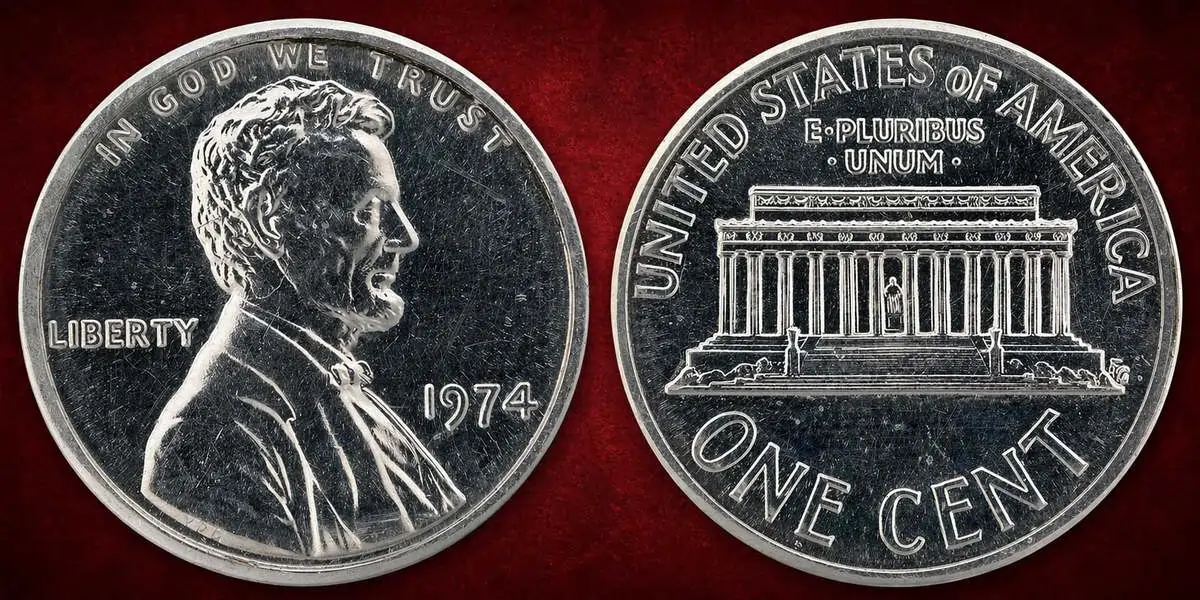
The U.S. Mint explored aluminum for the cent in the early 1970s because copper prices had risen sharply. In 1973 and 1974, the Philadelphia Mint struck large numbers of 1974-dated aluminum cents as part of that experiment. The Mint proposed the lighter metal as a replacement for the traditional copper-zinc cent.
However, the plan failed. The aluminum cent never entered circulation. The Mint distributed examples to members of Congress and other officials, but Director Mary Brooks later recalled them. Most examples were destroyed.
According to U.S. Mint records, the Philadelphia Mint struck 1,571,167 1974-dated aluminum cents in two production runs. The first run totaled 1,441,039 pieces between October 17, 1973, and March 29, 1974. The second run totaled 130,128 pieces between April 12 and May 30, 1974.
Audit records signed by William Humbert, who headed the Mint’s internal audit staff, stated that nearly all of those pieces were destroyed. Even so, a small number remained unaccounted for after the recall.
That uncertainty helped turn the 1974 aluminum cent into one of the most famous “coins that never were.”
The 1975 Aluminum Cent Connection
The Mint’s aluminum cent testing did not end with the 1974 date.
Pattern specialists list the 1974 aluminum cent as Judd-2151. They also list a 1975-dated aluminum cent as Judd-2155. These pieces came from regular dies, but they functioned as trial pieces or patterns.
That point matters. If a 1974 or 1975 aluminum blank remained inside the Mint system, it could have found its way into production later. This theory does not prove how the 1977 aluminum cent came into existence. Still, it gives the coin a plausible connection to the earlier experiment.
The 1977 piece may have come from a leftover planchet. It also may have resulted from intentional human action. Finally, it may represent an undocumented pattern. At present, the coin’s exact origin remains unresolved.
Not a Foreign Planchet Match
NGC could not match the 1977 aluminum Lincoln cent to a known foreign planchet. Mint Error News also could not match it to any planchet in its study of foreign coins struck by the United States Mint.
That is an important diagnostic point.
During the same general era, the U.S. Mint struck coinage for foreign countries. The San Francisco Mint also struck aluminum coinage for Nepal and the Philippines. Several famous aluminum Lincoln cent errors came from that foreign-planchet context.
However, the 1977 aluminum cent does not fit neatly into that category. Its weight and size did not match a specific known foreign planchet. As a result, the foreign-planchet explanation remains unsupported for this particular coin.
That distinction helps separate the 1977 Philadelphia aluminum cent from other aluminum Lincoln cent errors.
Other Aluminum Lincoln Cent Errors
Several other aluminum Lincoln cents deserve mention. However, they occupy a different category.
A 1971-S Lincoln cent struck on an unidentified foreign aluminum planchet earned an AU58 grade from NGC. Heritage sold that coin in its September 16, 2024 Error Coinage U.S. Coins Showcase Auction for $31,200.
A 1974-S Lincoln cent struck on a Philippine sentimo planchet also stands out. PCGS certified that piece as MS61. It shows a uniface strike, because only one die struck the aluminum planchet. Heritage sold it in January 2023 for $19,200.
Finally, a Proof 1974-S Lincoln cent struck on a Nepalese aluminum coin sold through GreatCollections for $199,687.50. PCGS certified it as Proof 68 Cameo. It came from Stewart Blay’s Red Copper Collection of Lincoln cents.
These coins prove that aluminum foreign-planchet Lincoln cent errors exist. Yet they do not explain the 1977 Philadelphia piece. The 1977 coin remains unique because experts have not matched it to a foreign planchet.
Could It Be an Intentional Mint Error?
The intentional-error theory cannot be dismissed. However, it also cannot be stated as fact.
During the 1970s, several spectacular mint errors left the San Francisco Mint under unusual circumstances. Authorities later discovered some of those coins in a bank safe deposit box. The U.S. Secret Service inspected the group and released it. The State of California then auctioned the coins.
That group included dramatic Proof and Mint State errors. Among them were double denominations, mated pairs, and other exotic pieces. One famous coin from that group is the 1970-S quarter struck on a Barber quarter, certified by NGC as Proof 65. Another is the 1970-S quarter struck on a 1941 Canadian quarter, a coin that later drew broad public attention.
The group also included unusual Mint State errors, including a Roosevelt dime struck with two reverse dies. PCGS later certified that piece.
Because those events occurred in the same decade, the idea of an intentionally created 1977 aluminum cent remains plausible. Still, no public record currently proves that this specific coin resulted from intentional action.
Could It Be a Leftover Planchet?
The leftover-planchet theory may offer the cleanest connection to the 1974-75 aluminum cent program.
The Philadelphia Mint struck aluminum cents in 1974 and 1975 as trial pieces. If one blank remained in the Mint environment, it could have entered a press later. In that scenario, regular 1977 Lincoln cent dies struck a planchet left over from an earlier experimental program.
This type of event has precedent in U.S. mint error collecting. PCGS and NGC have certified other U.S. coins struck on planchets from earlier production periods.
One example involves a 1989-D Lincoln cent struck on a 3.1-gram full copper planchet. That planchet matched the pre-1983 copper-alloy standard. PCGS certified the piece as MS64 Brown.
That example does not prove the 1977 aluminum cent’s origin. However, it shows that obsolete or leftover planchets can appear years after their normal production period.
Could It Be an Unrecorded Pattern?
The third possibility may be the most intriguing.
The 1977 aluminum cent could be an unrecorded pattern. If true, it would represent an undocumented trial striking made in aluminum with regular 1977 Lincoln cent dies.
This theory has obvious appeal. It would connect the coin directly to the Mint’s experimental cent program. However, the available public record does not yet support a firm conclusion.
For that reason, the word “pattern” should appear with caution. The coin may be a pattern. It may also be a mint error. At this point, the evidence allows both categories as possibilities.
A Small Coin With a Big Visual Clue
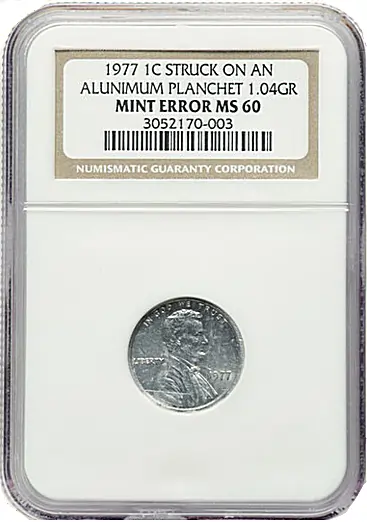
The coin’s appearance gives collectors an immediate clue. A normal 1977 Lincoln cent has a copper color. This piece has the light, pale look of aluminum.
Even the NGC insert adds a strange footnote. Heritage noted that the original NGC label misspelled the metal as “ALUNIMUM.” For a unique coin, that minor holder error has become part of the story.
Collectors should not confuse ordinary plated cents with this rarity. Many silver-colored Lincoln cents are standard copper cents coated with zinc, chrome, or another material. School chemistry experiments also created many plated cents.
Weight offers the quickest first test. A normal 1977 copper-alloy cent weighs about 3.11 grams. The unique aluminum example weighs 1.04 grams. A plated copper cent will usually remain close to the normal copper-alloy weight.
However, collectors should never alter, clean, file, or test a suspected rare error with destructive methods. If a 1977 cent looks silver and weighs near one gram, the next step should involve professional authentication by PCGS, NGC, or another recognized grading service.
The Legal Question Requires Caution
Collectors often ask whether aluminum cents are legal to own.
The 1974 aluminum cents occupy a difficult category because the Mint recalled them and never authorized them for circulation. A 1974-D aluminum cent surfaced in 2014, received a PCGS MS63 grade, and later returned to the federal government after litigation.
The 1977 aluminum cent has followed a different market path. It has appeared in private collections and sold publicly through Heritage Auctions. However, CoinWeek does NOT provide legal advice. The best editorial position is to describe the coin’s public certification, provenance, and auction history, while noting that official 1974 aluminum cents carry separate legal issues.
Why This Coin Belongs in the Modern Rarity Conversation
The unique 1977 aluminum Lincoln cent combines several powerful storylines.
It connects to the failed 1974 aluminum cent experiment. It carries the Fred Weinberg provenance. It resists a foreign-planchet explanation. It also sold publicly as the only known 1977 aluminum Lincoln cent.
That combination gives the coin rare crossover appeal. Lincoln cent specialists can appreciate it. Mint error collectors can appreciate it. Pattern specialists can study it. Even casual readers can understand the central hook: this is a 1977 penny made from the wrong metal, and no one can prove exactly why it exists.
That mystery gives the coin its staying power.
Final Thoughts
The unique 1977 aluminum Lincoln cent remains one of the most enigmatic modern U.S. mint errors.
NGC certified it as MS60. It weighs 1.04 grams. Heritage sold it for $50,400 in August 2025. Mint Error Expert Mike Byers has narrowed its origin to three possibilities: intentional mint error, leftover 1974-75 aluminum planchet, or unrecorded aluminum pattern.
None of those explanations has been proven beyond dispute. Yet each one places the coin near the center of the aluminum cent story.
For that reason, this small, silver-colored cent deserves serious attention. It is not just a Lincoln cent struck in the wrong metal. It is a modern numismatic mystery with direct ties to one of the most famous experimental coinage programs in U.S. Mint history.




I think I have a 1967 aluminum lincoln cent. Its yellowish color and very light. It’s in a mint state condition. I have put aside in a PROTECTIVE capsule. It’s super lightweight, nothing like the regular lincoln cent.
How do you find the value of a 1943 D wheat penny
If it’s copper it’s worth some money. Most 1943 pennies are made of steel. Called a war penny.
LRW
I have a 1996-D Lincoln penny on a aluminum planchet
I have a 1974, either steel or aluminum penny. How do I find out which it is and if it’s worth anything?
Steel is magnetic and aluminum is not. Put a magnet to it
Magnet sticks to steel not aluminum.Is it lite gold in color by chance?
Amber if it’s steel a magnet will stick to it. The best way to find a price of something is get with a trusted local coin dealer or just do some online research. There are some great YouTube video’s out there.
I have 1980 Liberty coin with mint marked D
i have a 1977 aluminum penny, very clean and uncirculated from my mom who past away recently.
what should i do to get it graded.
and which grading place should i trust.
I have a 1977 penny minted in Denver, it looks like aluminum but I could’nt determine the weight. I have some other unusual things, does anyone know who I should contact?
We have a 1977 D that weighs just over a gram. Our scale isn’t specific enough. Scratch test revealed it was solid aluminum. It is not magnetic. My fiance was given it when he was very young by his Grandma who was a county clerk, and she sorted coins for the meter maids during that Era. She would bring home anything collectable and replace the coins. She has since passed this year. I think it’s time to have it appraised!
Mike Byers I have a 1977 Lincoln double died penny. the second strike when you photograph the coin. the light reflected from the second strike. looks just like milk in color. so this penny is definitely a copper coated. the metal underneath the copper is a very shiny metal almost like pure nickel. so when you light that type of metal with my lights. That’s how you get the milky look. well it looks like i need to weight this coin. I just found a proof Lincoln penny that had been pressed 4 times. the mint mark has what i believe is 8 press lines on the S. back to the top penny is there a possibility. That this 1977 penny could be made out of Zinc copper plated. any thoughts greatly appreciated.
I have a gold 1977 penny. How much do u think it is worth? I never seen a penny like this one.
I have a 1977 no mint mark n it has an error of a off set stamp. It is in very good shape. I need to find out if it has value of more then it’s one cent. Can you help me with this. I am not a coin collector. I would like to send you a picture if possible. Your assistance is appreciated.
I have a 1977 Lincoln penny which has been recessed or pushed in on both sides, creating a wide band width. It has the diameter of a dime at 31.1mm. The width (Thickness) is 2.3mm. A regular penny is 1.4mm. Something has happened with this coin, and I am curious as to your thoughts. I do have pictures to send if you are interested. It looks like a crater on each side with the edges being a good 1/32 of an inch above the surface of the coin on each side.
Many thanks.
I have a 1976 d aluminum penny dos anyone have any idea of one looks in mint condition please reply thanks
I have a 1976 d looks aluminum but sticks to a magnetic anyone ever seen one or can tell me about it
Another unicorn coin for the hobby. I love unique coins like this, now where to get the $$$ to buy them?
Crazy that this exists. Lucky for whoever found it…
Ah…If I could only find one.
Nice coin.
I am 65 years old. I recall a story (probably in the Omaha World Hearld) from my young coin collecting days, about aluminum Penny’s being test minted and (as I recall) 13 of them being passed out to congress as samples of what an aluminum coin would look like. According to the story , those coins were never retured to the mint representative.
I want one.
Another great article!
Hi there; My name is Mathias Raposo, I have some one cent coin, bronze, 2014D, 2018D, 2022,2023,2024 no mark. Could I know if there is any value for? I am not a collector.
Thanks.
I have a 1986 penny silver in color and is slightly magnetic and still weighs the right amount can does anyone have any ideas on this one
I have a rare 1982 3.1 grams penny that is solid silver but can’t find anything on it and nobody will help me out. I would love to sell it and anybody who is interested in helping me out for money from the sale. Thank you
If it is genuine, and you want to sell it, you will need to have it authenticated and certified by either NGC or PCGS. Once that is done, show the coin to an error expert like Mike Byers. Then you promote the discovery and finally put it into a major auction in order to get the highest price. Good Luck!
Did anyone else notice that Aluminum is spelled wrong on the graded slabbed penny?